Author: Vigor Forty Editorial Team
Medically Reviewed By: Editorial Review Board
Disclaimer: This article is for informational and inspirational purposes. It is not a substitute for professional mental health or medical advice. Read our full Medical Disclaimer.
📌 Key Takeaways
- Joy Is the Most Underrated Performance Enhancer: The exercise you enjoy is the exercise you’ll actually do—consistently, for decades. After 40, adherence trumps intensity. A moderate workout you genuinely look forward to will always outperform a brutal protocol you dread and eventually abandon.
- Reframe Cardio from Punishment to Practice: The American fitness industry has sold exercise as penance—for the cookie you ate, the day you sat, the body you have. This guilt-driven model fails catastrophically after 40. The sustainable alternative is to view cardio as a practice: a daily ritual of self-care, like brushing your teeth or eating a good meal.
- Intrinsic Motivation Outlasts Extrinsic Goals: Training for a race, a weight-loss target, or a doctor’s warning can spark initial action, but these extrinsic motivators fade. Cultivating intrinsic motivation—the felt sense of energy, clarity, strength, and calm that comes from moving your body—creates a self-sustaining loop that lasts a lifetime.
- Play Is Not Just for Children: The midlife brain craves novelty, curiosity, and exploration. Injecting play into your cardio—a new trail, a silly dance-based workout, a ruck with a friend that ends at a brewery—re-engages the brain’s reward systems and prevents the staleness that kills consistency.
- Your Relationship With Exercise Mirrors Your Relationship With Yourself: If your cardio is driven by self-criticism, you’ll eventually rebel. If it’s driven by self-respect, you’ll return to it again and again, even through life’s chaotic seasons. The VigorForty system is an act of self-respect, not self-punishment.
Introduction: The Missing Ingredient in Every Training Plan
We’ve covered the science. Zone 2 mitochondria, VO2 max, heart rate zones, BDNF, metabolic flexibility, protein timing, periodization. You now possess a level of knowledge that would make most personal trainers envious. You have the blueprints, the protocols, the meal plans, and the equipment guides.
But there’s a question that no heart rate monitor can answer, and it’s the most important question of all: How do you keep doing this for the rest of your life?
Not for eight weeks. Not until the wedding or the beach vacation. But for the 30, 40, 50 years you have left on this planet. How do you sustain a cardio practice through the winter of a divorce, the chaos of a career change, the grief of losing a parent, the sleeplessness of a newborn grandchild, the simple, profound exhaustion of being human?
The answer is not discipline. Discipline is a finite resource that burns out under sufficient stress. The answer is not motivation. Motivation is a fleeting emotion, here this morning and gone by 4 p.m. The answer is something deeper, quieter, and profoundly more durable: it’s the cultivation of a genuine, felt sense of joy in movement itself.
This manifesto is not a typical guide. It contains no heart rate zones, no interval protocols, no meal plans. Instead, it offers a philosophical framework for transforming your relationship with cardio from one of obligation to one of genuine desire. It’s the missing chapter that makes all the other chapters work—not for eight weeks, but for a lifetime. If you read only one thing from the VigorForty library, make it this. Because without this foundation, all the knowledge in the world will eventually gather dust.
Section 1: The Great American Exercise Pathology
To rebuild something healthy, you must first name what’s broken. The standard American relationship with exercise is deeply, fundamentally dysfunctional. It’s built on a set of unexamined assumptions that poison the well from the start.
The Punishment Model
Exercise is penance. You ate the pizza, now you must run. You sat all week, now you must suffer. This model frames movement as a moral transaction—you’ve sinned, and sweat is your absolution. It’s a model that religious traditions perfected millennia ago, and the fitness industry has simply repackaged it. The problem is that punishment is not sustainable. The human psyche, even the most disciplined, will eventually rebel against a tyrant. If your inner voice about exercise is a drill sergeant, you will eventually go AWOL.
The Aesthetic Imperative
Exercise is for looking good. The promise is always the same: six-pack abs, a tight butt, arms that look great in a sleeveless shirt. After 40, this promise becomes a cruel lie. Your body changes. Skin loosens. Metabolism shifts. If your sole motivation is aesthetic, you’re building your house on sand. The mirror will, at some point, stop cooperating. And when it does, you’ll stop training—precisely when you need it most.
The “No Pain, No Gain” Lie
Intensity is the only currency that counts. If you’re not shattered on the floor, you didn’t work hard enough. This is a recipe for injury, burnout, and a deep, embodied dread of your workouts. After 40, your body needs a different kind of stimulus—mostly gentle, occasionally hard, rarely brutal. The “no pain, no gain” mantra is a young person’s game. The midlife mantra is “consistent, sustainable effort.”
The All-or-Nothing Trap
You’re either “on the wagon” (training five days a week, eating perfectly) or “off the wagon” (doing nothing, eating whatever, feeling guilty). There is no in-between. This black-and-white thinking is the enemy of lifelong movement. Life after 40 is messy, unpredictable, and full of seasons where the ideal routine simply isn’t possible. The all-or-nothing mindset guarantees that when you can’t do “all,” you’ll default to “nothing.” The sustainable alternative is “something, most of the time.”
Section 2: The Practice Model—A New Paradigm
What if exercise wasn’t punishment, or an aesthetic tool, or a test of grit? What if it was a practice—like meditation, like gardening, like playing a musical instrument?
What Is a Practice?
A practice is an activity you engage in regularly, not primarily for an external outcome, but for the intrinsic value of the activity itself. You don’t meditate to “win” at meditation. You don’t garden to achieve the perfect garden and then stop gardening. You don’t play the piano only to perform at Carnegie Hall. You do these things because the doing itself nourishes you. The outcome—a calmer mind, a beautiful garden, a lovely piece of music—is a byproduct of the practice, not its sole justification.
Cardio as a Practice
When you reframe your Zone 2 run, your morning ruck, or your Saturday trail hike as a practice, everything shifts. You’re not training for a future, thinner version of yourself who will finally be worthy of love. You’re engaging in an act of self-care right now, in this body, exactly as it is. The 45 minutes you spend on the bike isn’t “earning” your dinner; it’s a gift you’re giving your heart, your brain, and your nervous system. The movement is the point. The health benefits are the profound, life-extending side effect.
The Ritual of the Practice
A practice has a rhythm, a ritual. It’s the warm-up you do every time, the spot by the door where your shoes live, the post-workout coffee you sip in the quiet. These rituals anchor the practice in your daily life. They become something you look forward to, not because the workout is always easy, but because the entire experience—the solitude, the music, the fresh air, the feeling of your body working—has become a non-negotiable part of your well-being.
Section 3: Intrinsic Motivation—The Engine That Never Stalls
Psychologists distinguish between extrinsic motivation (doing something for an external reward or to avoid a punishment) and intrinsic motivation (doing something because the activity itself is satisfying). After 40, building your cardio practice on intrinsic motivation is not a luxury—it’s a survival strategy.
The Three Pillars of Intrinsic Motivation (Self-Determination Theory):
- Autonomy: You are the author of your own movement. You choose the modality, the pace, the duration, the playlist. When your cardio feels like a prescription forced upon you, motivation withers. When it feels like a choice you make for yourself, motivation flourishes.
- Competence: You experience a sense of mastery and progress. This is why tracking your Zone 2 pace improvement, or the weight you can ruck comfortably, is so powerful. It’s not about beating anyone else; it’s about the quiet satisfaction of becoming more skilled, more capable.
- Relatedness: You feel connected to others or to something larger than yourself. This could be the running group you join, the friend you ruck with on Saturdays, or simply the feeling of connection to nature on a solo trail run. Movement is profoundly social, even when you’re alone in the woods.
How to Cultivate Intrinsic Motivation:
- Notice the Afterglow: After your workout, pause for 60 seconds. Notice how your body feels. The warmth in your legs. The clarity in your mind. The calm in your chest. Don’t rush to the next task. Savor the feeling. This simple act of mindful attention wires your brain to associate exercise with pleasure.
- Chase the Feeling, Not the Number: Your Garmin says you burned 400 calories. Fine. But did you feel strong? Did your lungs feel open? Did the trail smell like pine after the rain? The data is useful; the felt experience is transformative.
- Give Yourself Radical Permission: You have permission to stop a workout if it feels terrible. You have permission to walk when you planned to run. You have permission to take a week off. This freedom, paradoxically, creates the psychological safety that makes you want to return.
Section 4: Play—The Forgotten Ingredient
When was the last time you moved your body just for fun? Not for a workout, not for steps, not for “training.” Just because it felt good? For most American adults, the answer is sometime in childhood. Somewhere along the line, we internalized the message that exercise is serious business, a grim duty to be discharged.
The Neurobiology of Play
Play activates the brain’s reward pathways—dopamine, endorphins—in a way that obligatory exercise does not. It engages creativity, curiosity, and a sense of exploration. A playful movement session doesn’t feel like a “workout”; it feels like recess. And because it’s intrinsically rewarding, you’ll seek it out again and again.
How to Reclaim Play After 40:
- Try Something New and Absurd: Take a dance class. Join a recreational kickball league. Try bouldering. Rent a kayak. Buy a hula hoop. The novelty is the point.
- Make Your Known Modalities Playful: Do your Zone 2 run on a new, unexplored trail and let yourself get a little lost. Ruck to a scenic overlook and have a picnic. Bike to a farmer’s market. Turn your HIIT session into a silly, competitive game with your partner or kids.
- Move Like an Animal: On all fours. Crawling. Climbing. Balancing on logs. These primal movements are deeply satisfying to the human nervous system and wake up muscles that chairs have put to sleep.
- Schedule Unstructured Movement: One session per week, don’t wear a watch. Don’t track anything. Just go outside and do whatever your body wants to do—walk, sprint, stretch, climb. Follow your impulses. This is movement re-wilded.
Section 5: Navigating the Inevitable Seasons of Life with a Practice Mindset
The all-or-nothing athlete is devastated by a week of missed workouts. The practice athlete understands that life has seasons, and the practice adapts.
The High-Stress Season (New Job, New Baby, Family Crisis)
Your practice shrinks, but it doesn’t disappear. A 15-minute walk. Five minutes of mobility. A few bodyweight squats while the coffee brews. The goal is not to maintain peak fitness; it’s to maintain the thread of connection to your body. The ritual is more important than the volume.
The Injury Season
An injury is not a failure; it’s a teacher. Your practice shifts to the parts of your body that are still healthy. Upper body strength when your knee is injured. Pool work when your foot is injured. Breathwork when everything is injured. The practice is not the specific modality; the practice is the commitment to caring for your body, no matter its state.
The Grief Season
Loss—of a loved one, a relationship, a career—can make movement feel impossible. This is when the practice holds you. A slow, solitary walk in a green space is not “exercise”; it’s emotional processing. Let the rhythm of your feet on the earth carry you through the days. Don’t push. Just show up and let the movement be gentle, slow, and full of whatever you’re feeling.
The Joyful Season
Life is good. You have time, energy, and a body that works. This is when your practice expands. Train for the race. Go on the long ruck. Push the intensity. But don’t attach your identity to this peak. It will pass, as all seasons do, and your practice will contract again. That’s not failure. That’s wisdom.
Section 6: The VigorForty Joyful Movement Weekly Practice
This is not a training plan. It’s a template for a week of movement that prioritizes joy, connection, and intrinsic reward. Use it as a guide, not a prescription.
| Day | Movement Practice | The Inner Experience |
|---|---|---|
| Monday | 20 min morning walk + 10 min mobility | Gratitude for a body that moves. Quiet before the day begins. |
| Tuesday | 40 min Zone 2 (bike, run, or ruck) + podcast or music you love | Steady rhythm, mental drift, the pleasure of easy effort. |
| Wednesday | Play day. Try something new, or do a silly, unstructured session. | Curiosity, laughter, the joy of moving without a plan. |
| Thursday | Strength (30 min) + 15 min Zone 2 cool-down walk | The satisfaction of feeling capable and strong. |
| Friday | HIIT or higher intensity, short and sweet (20 min) | The invigorating rush of pushing your limits, safely. |
| Saturday | Long outdoor adventure (ruck, hike, trail run, bike ride). With a friend or solo. | Connection to nature, to a friend, to your own endurance. |
| Sunday | Restorative movement: gentle yoga, a slow walk, foam rolling, or complete rest. | Deep rest, self-compassion, integration. |
The Only Rule: After every session, before you check your phone or rush to the next task, take 60 seconds. Close your eyes. Take three deep breaths. Notice how you feel. That’s it. That’s the practice.
The VigorForty Take
You now possess everything we have to offer. The entire VigorForty library—the Zone 2 protocols, the HIIT workouts, the running plans, the rucking guides, the heart rate zone science, the nutrition strategies, the equipment recommendations, the injury prevention blueprints, the mobility flows—all of it is available to you, a comprehensive system for building a strong, lean, and resilient body after 40.
But none of it matters if you don’t actually do it. And you won’t do it—not for the long, beautiful arc of your life—if it’s driven by guilt, shame, or a grim sense of obligation. The only fuel that lasts is joy.
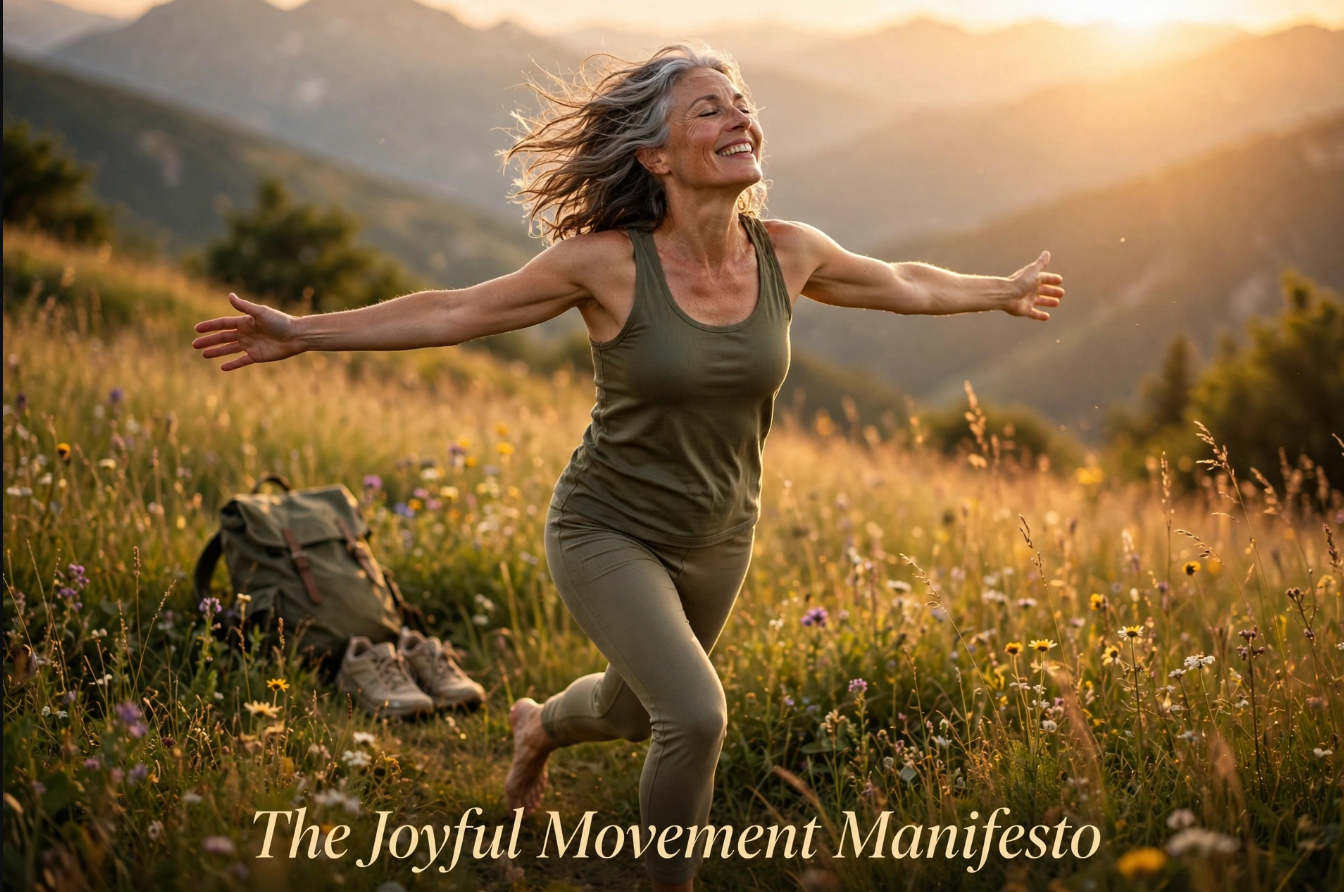
Rediscover the joy of moving your body. Not because you have to. Not because you should. Not because you’re trying to fix something that’s broken. But because you are a living, breathing, embodied human being, and movement is your birthright. It’s how you experience the world. It’s how you express your vitality. It’s how you connect with the people and the planet around you.
The run in the rain. The ruck up the mountain. The dance in the kitchen. The stretch on the floor. The deep, satisfied breath after a hard effort. This is not a chore. This is the stuff of a life fully lived.
So go. Lace up your shoes, step out your door, and move. Not because you’re chasing a smaller waistline or a faster time. But because it feels good to be alive, and movement is the most natural expression of that aliveness. The VigorForty system is here whenever you need it. But the practice is yours—today, tomorrow, and for all the decades to come.
Welcome to the joyful movement. It’s been waiting for you.
Read All Related Articles
- The Complete Guide to Zone 2 Training After 40: How Low-Intensity Cardio Boosts Fat Loss, Longevity, and Endurance
- The Complete Guide to HIIT After 40: Joint-Friendly Workouts That Torch Fat and Protect Your Heart
- The Complete Guide to Running After 40: How to Start, Stay Injury-Free, and Build Lifelong Endurance
- The Complete Guide to Metabolic Health After 40: Reverse Insulin Resistance, Burn Stubborn Fat, and Reclaim Your Energy with Cardio
- The Complete Guide to Cardio Recovery After 40: How to Rest, Rebuild, and Come Back Stronger
- The Complete Guide to Heart Rate Training Zones After 40: Unlock Every Beat for Maximum Fat Loss, Endurance, and Longevity
- The Complete Guide to VO2 Max After 40: The #1 Predictor of Longevity and How to Improve It
- The Complete Guide to Concurrent Training After 40: How to Combine Cardio and Strength for Maximum Fat Loss, Muscle Preservation, and Longevity
- The Complete Guide to Walking and Rucking After 40: The Most Underrated Cardio for Fat Loss, Joint Health, and Longevity
- The Complete Guide to Designing Your Own Cardio Plan After 40: A Personalized Blueprint for Fat Loss, Longevity, and Peak Performance
- The Complete Guide to Cardio Nutrition After 40: Fuel Your Workouts for Maximum Fat Loss, Endurance, and Recovery
- The Complete Guide to Cardio Equipment After 40: Choosing the Best Treadmill, Bike, Rower, or Elliptical for Your Home Gym
- The Complete Guide to Injury Prevention for Cardio After 40: Run, Ride, and Ruck Pain-Free for Life
- The Complete Guide to Cardio for Fat Loss After 40: Burn Stubborn Belly Fat Without Losing Muscle or Energy
- The Complete Guide to Seasonal Cardio Training After 40: How to Periodize Your Year for Year-Round Fitness, Fat Loss, and Injury Prevention
- The Complete Guide to Cardio and Brain Health After 40: How Exercise Protects Your Memory, Mood, and Mental Sharpness
- The Complete Guide to Building a Home Gym for Cardio After 40: Design a Space That Makes Consistency Inevitable
- The Joyful Movement Manifesto: How to Love Cardio After 40 and Make It a Lifelong Practice
- The Complete Guide to Sleep and Cardio After 40: How Deep Rest Unlocks Your Best Performance, Recovery, and Longevity
- The Complete Guide to Stress, Cortisol, and Cardio After 40: How to Manage Your Nervous System for Better Recovery and Performance
- The Complete Guide to Returning to Cardio After a Layoff After 40: Your Compassionate, Science-Backed Roadmap Back to Fitness
- The Complete Guide to Cardio Through Menopause: How to Adapt Your Training for Hormonal Changes, Protect Your Heart, and Feel Strong After 40
- The Complete Guide to Cycling After 40: Low-Impact Cardio for Joint Health, Endurance, and Lifelong Fitness
- The Complete Guide to Pool and Water-Based Cardio After 40: Low-Impact Workouts for Joint Pain, Recovery, and Total-Body Fitness
- The Complete Guide to Rowing After 40: Full-Body, Low-Impact Cardio for Strength, Endurance, and Longevity
- The Complete Guide to Tracking Cardio Progress After 40: The Key Metrics That Matter More Than the Scale
- The Complete Guide to Cardio for High Blood Pressure After 40: How Exercise Lowers Your Numbers and Protects Your Heart
- The Complete Guide to Cardio for Type 2 Diabetes and Prediabetes After 40: How Exercise Reverses Insulin Resistance and Protects Your Heart
- The Complete Guide to Cardio with Arthritis After 40: Pain-Free Workouts That Strengthen Joints and Keep You Moving
- The Complete Guide to Longevity and Cardio After 40: How Aerobic Fitness Adds Years to Your Life and Life to Your Years
- The Complete Guide to Building a Cardio Habit After 40: The Science of Making Exercise Stick for Life
- The Complete Guide to Cardio and Immune Health After 40: Strengthen Your Body’s Defense System for a Resilient, Vibrant Life
- The Complete Guide to Cardio While Traveling After 40: Stay Fit on the Road, in Hotels, and Away from Home
- The Complete Guide to Cardio for Posture and Back Pain After 40: Strengthen Your Posterior Chain and Reverse the Damage of Sitting
- The Complete Guide to the Social Side of Cardio After 40: How Community, Accountability, and Connection Make You Stronger
- The VigorForty Manifesto: A Final Word on the Lifelong Practice of Movement