Author: Vigor Forty Editorial Team
Medically Reviewed By: Editorial Review Board
Disclaimer: This article is for informational purposes only and is not a substitute for professional medical advice. If you have arthritis or chronic joint pain, consult your physician or a physical therapist before beginning a new exercise program. Read our full Medical Disclaimer.
📌 Key Takeaways
- Movement Is Medicine for Arthritic Joints—Resting Too Much Makes Them Worse: Cartilage, which cushions your joints, has no direct blood supply. It relies on the compression and decompression of movement to pump nutrient-rich synovial fluid in and out, nourishing the tissue and removing waste. A sedentary lifestyle starves cartilage and accelerates degeneration.
- The Right Type of Cardio Reduces Arthritis Pain, Not Increases It: Multiple large-scale studies show that regular, moderate-intensity, low-impact cardio significantly reduces pain, stiffness, and disability in people with knee and hip osteoarthritis. The key is choosing joint-respecting modalities and respecting the “pain window.”
- Strong Muscles Are Your Joints’ Best Shock Absorbers: For every pound of body weight, your knees absorb up to four pounds of force with each step. Strong quadriceps, glutes, and calf muscles act as biological shock absorbers, dissipating force before it hammers into the cartilage. Strength training is not optional—it’s the foundation of joint protection.
- Water-Based Cardio Is the Ultimate Starting Point: Pool walking, swimming, and deep-water running eliminate up to 90% of your body weight from your joints while providing natural resistance. For those with severe arthritis, obesity, or post-surgical recovery, the pool is a sanctuary where pain-free movement is possible.
- Excess Body Weight Is the Single Biggest Modifiable Risk Factor—and Cardio Is the Solution: Each pound of weight loss reduces the load on your knees by four pounds per step. A 10-pound weight loss can reduce knee pain by 50% in overweight individuals with osteoarthritis. The joint-friendly cardio in this guide, combined with the nutrition principles from our other articles, creates a virtuous cycle of pain reduction and increased activity.
Introduction: The False Choice Between Pain and Fitness
The creaking in your knees when you climb stairs. The deep, aching stiffness in your hips when you get out of bed. The sharp twinge in your ankle that makes you wince with the first few steps. If you’re over 40 and living with arthritis or chronic joint pain, these sensations are your daily companions. And the message they seem to scream is clear: Stop moving. Protect yourself. Rest.
That message is a liar.
It’s a deeply understandable liar, born from the very real fear that movement will grind your joints down further. But the overwhelming weight of modern medical evidence tells a different story. Appropriate, intelligent, and consistent movement is not the enemy of arthritic joints—it is their salvation. Cartilage, the smooth, shock-absorbing tissue that lines your joints, has no blood vessels. It’s nourished entirely by the ebb and flow of synovial fluid, which is pumped through the joint space by movement. When you stop moving, you starve your cartilage. When you move wisely, you feed it.
This guide is not about pushing through pain. It’s about finding the sweet spot of movement that nourishes your joints, strengthens the muscles that protect them, and allows you to reclaim the cardiovascular fitness and joy that arthritis has stolen from too many midlife Americans. You’ll learn exactly which types of cardio are safe and effective for arthritic joints, how to modify your favorite activities, a week-by-week protocol for building a pain-free cardio practice, and the crucial role of weight management and strength training. Your joints are not fragile relics to be preserved in a museum; they are living tissues that can adapt, strengthen, and heal with the right care. Let’s learn to care for them.
Section 1: Understanding Arthritis and Why Exercise Is Essential
“Arthritis” is an umbrella term for over 100 conditions affecting the joints, but two types account for the vast majority of cases in people over 40.
Osteoarthritis (OA)
The most common form, often called “wear and tear” arthritis, though that’s a misleading name. OA is a disease of the entire joint—cartilage breakdown, bone remodeling, synovial inflammation. It most commonly affects the knees, hips, hands, and spine. Risk factors include age, genetics, obesity, previous joint injury, and prolonged inactivity. Importantly, moderate loading is not a risk factor for OA; in fact, recreational runners have lower rates of knee OA than sedentary individuals.
Rheumatoid Arthritis (RA)
An autoimmune disease where the body’s immune system attacks the synovial lining of joints, causing painful swelling, stiffness, and eventually joint deformity. RA often affects joints symmetrically (both wrists, both knees). Exercise during periods of low disease activity is highly beneficial and recommended; during acute flares, rest and gentle range-of-motion are prioritized.
The Vicious Cycle of Arthritis and Inactivity:
Pain → Fear of movement → Inactivity → Muscle weakness → Joint instability → Increased joint stress → More pain. This cycle is the enemy. Exercise breaks the cycle at multiple points: it strengthens the muscles that stabilize the joint, reduces systemic inflammation, promotes weight loss, and releases endorphins that modulate pain perception.
Section 2: The Joint-Friendly Cardio Hierarchy—Best and Worst Modalities
Not all cardio is equal for the arthritic joint. Here’s the hierarchy from safest to most potentially aggravating.
Tier 1: The Zero-Impact Sanctuary (Safe for Almost Everyone)
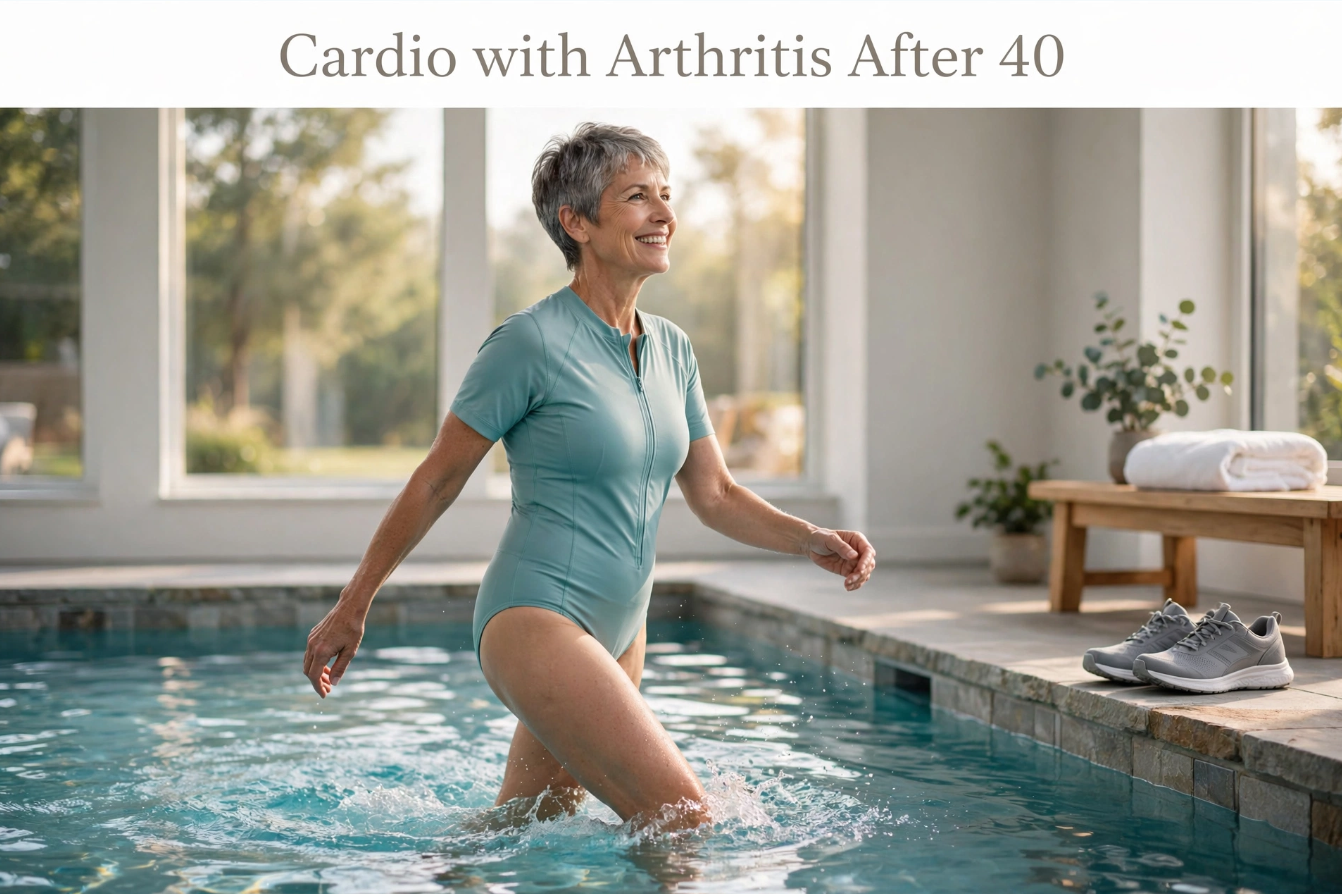
- Pool Walking / Swimming / Deep-Water Running: Buoyancy supports your body weight, making movement pain-free for even severely arthritic joints. The resistance of water builds strength. Warm water (83–88°F) is especially soothing for stiff, painful joints. Start here if any weight-bearing activity causes pain.
- Stationary Cycling (Upright or Recumbent): The smooth, circular pedal stroke is non-impact and keeps the knee and hip moving through a controlled, low-stress range of motion. Recumbent bikes are particularly good for those with low back pain or balance issues. Resistance should be low to moderate; avoid grinding at high resistance.
- Rowing (with Proper Form): As we detailed in our Rowing Guide, a properly executed rowing stroke is fluid and low-impact, strengthening the entire posterior chain that supports the spine and hips. The key is a light, controlled catch and a smooth drive.
Tier 2: Low-Impact, Weight-Bearing (Safe with Some Precautions)
- Walking: The most accessible and natural form of human movement. Walking loads the joints just enough to stimulate cartilage nutrition without the pounding of running. A brisk walk on a flat, forgiving surface (dirt trail, track, treadmill) is a cornerstone of arthritis management.
- Rucking (Light Weight): Adding a light pack (5–15 lbs) increases the cardiovascular demand and strengthens the back and core without significantly increasing knee loads, provided you maintain good posture and a short stride.
- Elliptical Trainer: Your feet never leave the pedals, eliminating impact. The elliptical provides a weight-bearing stimulus that’s beneficial for bone health without the jarring of running.
Tier 3: Higher-Impact (Use Caution, Modify, or Avoid)
- Running: Running is not inherently bad for all arthritic knees; many individuals with mild OA continue to run pain-free. However, for those with moderate-to-severe OA, running can be aggravating. If you want to run, start with a very gradual run-walk program on a soft surface (grass, trail, treadmill) and stop if pain increases beyond a mild, 3/10 level.
- HIIT with Jumping/Burpees: High-impact plyometrics are generally contraindicated for arthritic joints. The joint-friendly HIIT options we’ve detailed (bike, rower, pool) are far better choices.
Section 3: The “Pain Window” and How to Exercise Safely
How do you know if you’re helping or hurting your joints during exercise? The concept of the “pain window” is your guide.
The Traffic Light System:
- Green Light (Pain 0–3/10): A dull ache, stiffness that warms up and eases with movement. You may feel some general discomfort in the joint area, but it does not alter your gait or movement pattern. This is safe to train through. It’s the sound of your joints waking up and getting nourished.
- Yellow Light (Pain 4–6/10): A sharper, more localized pain that makes you conscious of the joint and might slightly alter your movement. This is a warning. Reduce the intensity, duration, or switch to a Tier 1 modality for the day. If the pain persists at this level for more than 2–3 sessions, take a few days off and reassess.
- Red Light (Pain 7+/10): Sharp, stabbing pain, swelling, or a sensation of the joint “giving way.” Stop immediately. Do not push through this pain. Ice the joint, rest, and consult your physician or physical therapist. This is injury pain, not “good” movement pain.
The 2-Hour Rule:
Monitor your pain after exercise. If your joint pain is significantly worse for more than 2 hours after your workout, or if you have increased pain the next day, you did too much. Reduce the duration or intensity of your next session.
Morning Stiffness and Warm-Up:
Arthritic joints are typically stiffest in the morning or after prolonged sitting. A longer, gentler warm-up is essential. 10–15 minutes of easy movement, dynamic mobility, and range-of-motion exercises before your cardio session prepares the joint, increases synovial fluid viscosity, and reduces pain during the workout.
Section 4: The Arthritis-Specific Strength Foundation
As our Injury Prevention Guide emphasized, strong muscles protect joints. For the arthritic individual, specific strengthening exercises are a medical treatment.
- Quadriceps Strengthening: Strong quads are the primary shock absorbers for the knee. Straight-leg raises, wall sits (hold to a shallow angle if needed), and seated knee extensions (low weight, high reps) build quad strength without compressing the kneecap.
- Glute Strengthening: Glute bridges, clamshells, and lateral band walks stabilize the pelvis and prevent the hip drop that torques the knee.
- Core Stability: Planks (on knees if needed), dead bugs, and gentle bird-dogs support the spine and reduce the load on the lower back and hips.
- Hip Abductors: Side-lying leg lifts and standing hip abductions strengthen the muscles that prevent the knee from collapsing inward.
These exercises should be performed 2–3 times per week. Start with bodyweight, then add light resistance bands or ankle weights as tolerated.
Section 5: The 4-Week Arthritis-Friendly Cardio Program
This program assumes you have some degree of chronic joint pain but are medically cleared for exercise. It starts conservatively and builds gently.
Week 1–2: Habituation and Pain-Free Movement
- Monday: 15 min gentle pool walking or stationary cycling (Zone 1–2). Follow with 10 min of lower-body stretches.
- Wednesday: 15 min walk on a soft, flat surface. 10 min glute and quad strengthening (glute bridges, straight-leg raises).
- Friday: 20 min pool walking or cycling, adding a few minutes of gentle deep-water running if comfortable.
- Saturday: 20 min gentle walk.
- Daily: Gentle morning mobility flow (see Mobility Guide) for 5–10 minutes. Post-meal 5–10 minute walks.
Week 3–4: Building Duration and Confidence
- Monday: 25 min stationary cycle or rower (Zone 2) + 15 min lower-body strength.
- Tuesday: 20 min brisk walk + 10 min core.
- Thursday: 30 min pool workout (mix of walking, light swimming, and deep-water running) + 15 min full-body strength.
- Saturday: 30–40 min walk on a scenic, soft trail or treadmill.
- Sunday: Active recovery: gentle pool session or 20 min easy cycling.
After Week 4, if your pain is stable or improving, you can gradually increase duration by 5–10 minutes per week and begin to layer in slightly more challenging terrain (gentle hills on a trail, slight incline on the treadmill). You can also introduce a single, joint-friendly HIIT session every other week (starting with 4 x 20-second gentle sprints on the bike).
Section 6: Weight Management—The Uncomfortable Truth and the Empowering Solution
It would be a disservice to discuss arthritis and not address the profound relationship between body weight and joint pain. This is not about body shaming; it’s about the cold, hard physics of the human body and the liberating possibility of reducing that load.
- The Multiplier Effect: Each pound of body weight adds approximately 3–4 pounds of compressive force across the knee joint during walking. A 20-pound excess weight load translates to 60–80 extra pounds of force on each knee with every step.
- The Inflammation Connection: Excess adipose tissue, particularly visceral fat, is not inert. It’s an active endocrine organ that secretes pro-inflammatory cytokines, which directly worsen arthritis inflammation throughout the body.
- The Solution Is the Cardio You’re Doing: The very activities outlined in this guide—swimming, cycling, walking, rowing—are your tools for creating a sustainable calorie deficit. Combined with the nutrition principles from our Cardio Nutrition and Fat Loss Guides, a loss of even 5–10% of body weight can dramatically reduce joint pain and improve function. The cardio protects your joints, and the resulting weight loss further unloads them. This is the most powerful positive feedback loop in arthritis management.
Section 7: FAQ—Your Arthritis and Cardio Questions
Q: I was told I have “bone on bone” arthritis. Is it safe to exercise?
A: The term “bone on bone” is frightening but often overstates the reality. There is almost always some cartilage remaining, and even in advanced OA, joint health can be improved with movement, strengthening, and weight loss. A physical therapist can guide you on safe ranges of motion and loading. Pool-based exercise is the most reliable starting point. Many individuals with severe OA on X-ray have minimal pain and good function because of strong surrounding muscles.
Q: Do I need a knee brace to exercise?
A: Braces can provide a sense of stability and proprioceptive feedback, but they are not a substitute for muscular strength. An unloader brace (which shifts weight away from the arthritic compartment of the knee) is sometimes prescribed for those with isolated medial knee OA. A simple compression sleeve can provide warmth and mild swelling control. Discuss with your orthopedist.
Q: Should I ice or heat my joints after exercise?
A: Both have roles. Heat (warm shower, heating pad, warm pool) is excellent before exercise to reduce stiffness and increase blood flow. Ice (ice pack wrapped in a towel, 15–20 minutes) is best after exercise if the joint feels acutely inflamed, swollen, or painful. Many find contrast therapy (alternating heat and cold) helpful.
Q: I have arthritis in my hands and shoulders. Can I still row?
A: Rowing can be beneficial for shoulder mobility and strength, but the grip and pull can aggravate hand arthritis. Use a looser grip on the handle or consider rowing-specific gloves with padding. For shoulder arthritis, focus on a smooth, controlled stroke that doesn’t force the shoulder into extreme ranges of motion. A wider grip can sometimes be more comfortable. If rowing consistently causes pain, switch to cycling or pool work.
The VigorForty Take
Arthritis is not the end of your active life; it’s a new chapter that demands a more sophisticated, compassionate, and intentional approach to movement. Your joints are not worn-out tires that need to be kept off the road. They are living, responsive tissues that thrive on the right kind of load—the gentle compression of a walk, the smooth glide of a bike pedal, the buoyant resistance of water.
The pain you feel is not a permanent sentence; it’s a signal that the previous volume, intensity, or modality was not right for your current state. It’s an invitation to experiment, to learn the language of your body, and to find the forms of movement that nourish you without damaging you.
Start in the pool. Get on the bike. Walk on the soft trail. Strengthen your quads and glutes religiously. Lose even a small amount of weight, and feel the difference in every step. This is not a life of limitation. This is a life of intelligent, adaptive, and deeply caring movement. Your joints have carried you through this life so far. It’s time to return the favor, one gentle, pain-free session at a time.
Read All Related Articles
- The Complete Guide to Zone 2 Training After 40: How Low-Intensity Cardio Boosts Fat Loss, Longevity, and Endurance
- The Complete Guide to HIIT After 40: Joint-Friendly Workouts That Torch Fat and Protect Your Heart
- The Complete Guide to Running After 40: How to Start, Stay Injury-Free, and Build Lifelong Endurance
- The Complete Guide to Metabolic Health After 40: Reverse Insulin Resistance, Burn Stubborn Fat, and Reclaim Your Energy with Cardio
- The Complete Guide to Cardio Recovery After 40: How to Rest, Rebuild, and Come Back Stronger
- The Complete Guide to Heart Rate Training Zones After 40: Unlock Every Beat for Maximum Fat Loss, Endurance, and Longevity
- The Complete Guide to VO2 Max After 40: The #1 Predictor of Longevity and How to Improve It
- The Complete Guide to Concurrent Training After 40: How to Combine Cardio and Strength for Maximum Fat Loss, Muscle Preservation, and Longevity
- The Complete Guide to Walking and Rucking After 40: The Most Underrated Cardio for Fat Loss, Joint Health, and Longevity
- The Complete Guide to Designing Your Own Cardio Plan After 40: A Personalized Blueprint for Fat Loss, Longevity, and Peak Performance
- The Complete Guide to Cardio Nutrition After 40: Fuel Your Workouts for Maximum Fat Loss, Endurance, and Recovery
- The Complete Guide to Cardio Equipment After 40: Choosing the Best Treadmill, Bike, Rower, or Elliptical for Your Home Gym
- The Complete Guide to Injury Prevention for Cardio After 40: Run, Ride, and Ruck Pain-Free for Life
- The Complete Guide to Cardio for Fat Loss After 40: Burn Stubborn Belly Fat Without Losing Muscle or Energy
- The Complete Guide to Seasonal Cardio Training After 40: How to Periodize Your Year for Year-Round Fitness, Fat Loss, and Injury Prevention
- The Complete Guide to Cardio and Brain Health After 40: How Exercise Protects Your Memory, Mood, and Mental Sharpness
- The Complete Guide to Building a Home Gym for Cardio After 40: Design a Space That Makes Consistency Inevitable
- The Joyful Movement Manifesto: How to Love Cardio After 40 and Make It a Lifelong Practice
- The Complete Guide to Sleep and Cardio After 40: How Deep Rest Unlocks Your Best Performance, Recovery, and Longevity
- The Complete Guide to Stress, Cortisol, and Cardio After 40: How to Manage Your Nervous System for Better Recovery and Performance
- The Complete Guide to Returning to Cardio After a Layoff After 40: Your Compassionate, Science-Backed Roadmap Back to Fitness
- The Complete Guide to Cardio Through Menopause: How to Adapt Your Training for Hormonal Changes, Protect Your Heart, and Feel Strong After 40
- The Complete Guide to Cycling After 40: Low-Impact Cardio for Joint Health, Endurance, and Lifelong Fitness
- The Complete Guide to Pool and Water-Based Cardio After 40: Low-Impact Workouts for Joint Pain, Recovery, and Total-Body Fitness
- The Complete Guide to Rowing After 40: Full-Body, Low-Impact Cardio for Strength, Endurance, and Longevity
- The Complete Guide to Tracking Cardio Progress After 40: The Key Metrics That Matter More Than the Scale
- The Complete Guide to Cardio for High Blood Pressure After 40: How Exercise Lowers Your Numbers and Protects Your Heart
- The Complete Guide to Cardio for Type 2 Diabetes and Prediabetes After 40: How Exercise Reverses Insulin Resistance and Protects Your Heart
- The Complete Guide to Cardio with Arthritis After 40: Pain-Free Workouts That Strengthen Joints and Keep You Moving
- The Complete Guide to Longevity and Cardio After 40: How Aerobic Fitness Adds Years to Your Life and Life to Your Years
- The Complete Guide to Building a Cardio Habit After 40: The Science of Making Exercise Stick for Life
- The Complete Guide to Cardio and Immune Health After 40: Strengthen Your Body’s Defense System for a Resilient, Vibrant Life
- The Complete Guide to Cardio While Traveling After 40: Stay Fit on the Road, in Hotels, and Away from Home
- The Complete Guide to Cardio for Posture and Back Pain After 40: Strengthen Your Posterior Chain and Reverse the Damage of Sitting
- The Complete Guide to the Social Side of Cardio After 40: How Community, Accountability, and Connection Make You Stronger
- The VigorForty Manifesto: A Final Word on the Lifelong Practice of Movement