
Author: Vigor Forty Editorial Team
Medically Reviewed By: Editorial Review Board
Disclaimer: This article is for informational purposes only and does not constitute professional design, structural, or electrical advice. Consult a qualified professional for any major home modifications. Some links may be affiliate links. Read our full Disclaimer.
📌 Key Takeaways
- The Best Home Gym Is the One You Walk Into Every Day: The psychology of environment design is as important as the equipment itself. A well-lit, organized, and inviting space reduces the friction between you and your workout, making consistency almost automatic. A cluttered, dark, or uninviting space creates a subtle but powerful resistance that erodes motivation over time.
- Start With the Essentials, Not the Aspirations: A $3,000 treadmill that becomes a clothes rack is a financial and psychological loss. Begin with a yoga mat, a set of adjustable dumbbells, and a rucksack. Add equipment only when you’ve proven to yourself that you will use what you have. The mind responds better to incremental upgrades than to overwhelming, guilt-inducing splurges.
- Safety and Joint Protection Should Guide Every Decision: For the 40+ athlete, proper flooring to absorb impact, adequate lighting to prevent trips, a quality fan to regulate body temperature, and accessible storage for equipment are not luxuries—they are the foundations that prevent injury and keep you training pain-free for decades.
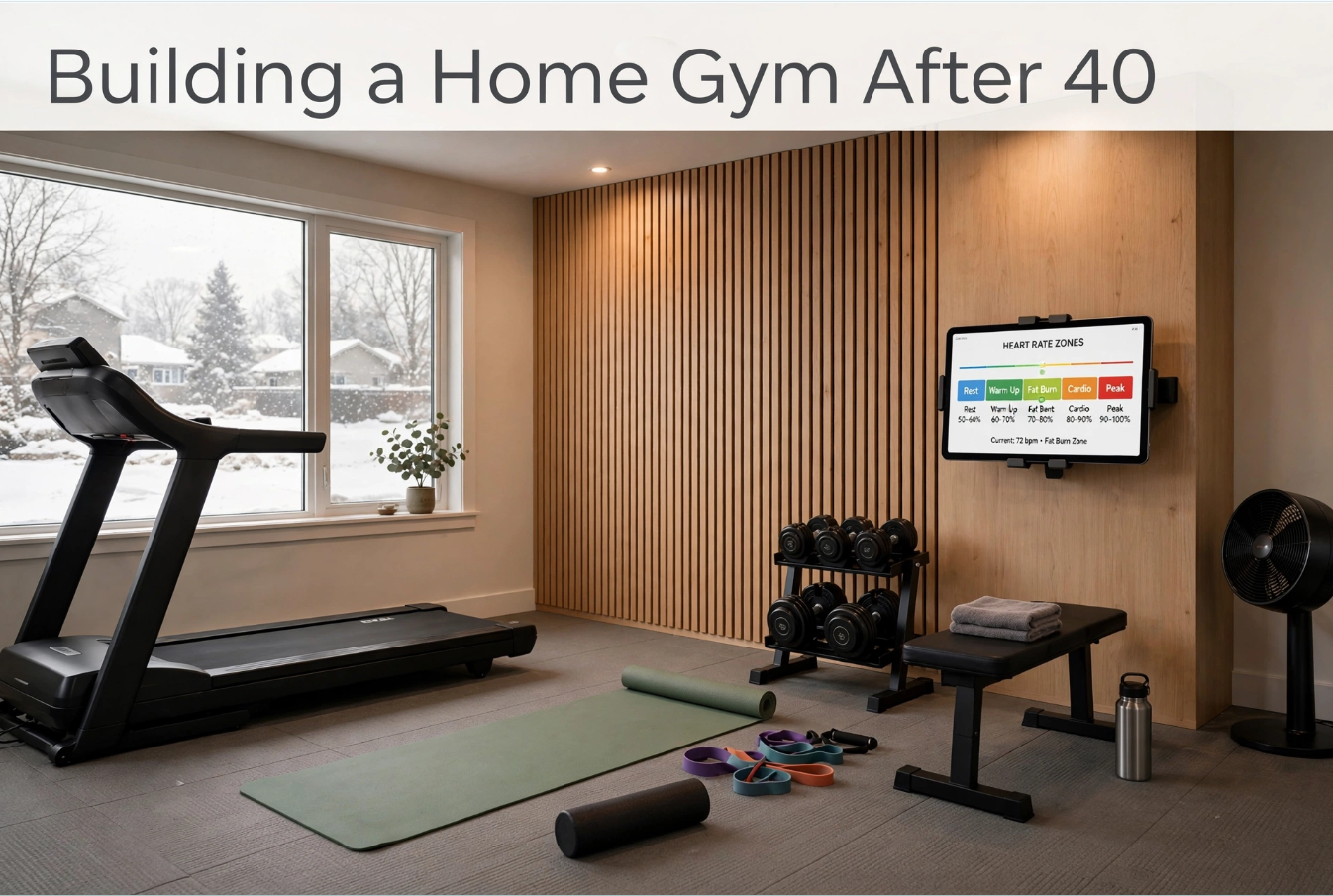
- Dedicated “Zones” Maximize Limited Space: Even a single-car garage corner or a spare bedroom can be transformed with distinct zones: a cardio zone (treadmill, bike, rower), a strength zone (dumbbells, bench, bands), and a mobility/recovery zone (mat, foam roller, open floor space). This mental partitioning creates a sense of purpose and flow.
- Technology Should Serve, Not Distract: A tablet mount, a heart rate monitor chest strap, and a good Bluetooth speaker can transform a boring indoor session into an engaging, data-rich experience. But the primary goal of the space is to connect you with your body, not to drown it in screens.
Introduction: The Space That Shapes Your Healthspan
We spend countless hours researching training protocols, optimizing nutrition, and tracking our heart rate zones. But there’s a silent factor that influences our fitness consistency more than any supplement or interval protocol: the physical space where we train. Walk into a cluttered, dusty basement with a single flickering bulb and a rickety old treadmill, and the thought of working out feels like a chore. Walk into a bright, clean, intentionally designed space where everything has its place, and the workout becomes a ritual you look forward to.
After 40, life is busy enough that any friction between you and your workout is a threat to your consistency. The 15-minute drive to the gym. The wait for the squat rack. The locker room that’s a little too cold and a little too public. These micro-frictions add up, and on a long, stressful day, they can tip the balance from “Let’s go” to “Not today.” A well-designed home gym eliminates every single one of those frictions. It’s there at 5 a.m. It’s there at 10 p.m. It’s configured exactly for your body, your goals, and your preferences.
But a home gym is more than a collection of equipment. It’s a psychological commitment device. It’s a visible, daily reminder of the person you’re becoming. It shifts your identity from someone who “tries to exercise” to someone who has a dedicated training space in their home—an athlete with a sanctuary. This guide walks you through every aspect of designing that sanctuary for the over-40 cardio athlete: the psychology of space, the budget-conscious approach, the optimal layout and flooring, the specific equipment that supports longevity, and the technology and ambiance that make indoor training a pleasure, not a punishment. By the end, you’ll have a complete blueprint for a home gym that makes your Zone 2 rides, HIIT sessions, and mobility work as inevitable as brushing your teeth.
Section 1: The Psychology of Place—Designing a Space You Crave
Before you buy a single piece of equipment, you need to understand the psychology of environment design. James Clear, author of Atomic Habits, emphasizes that environment is the invisible hand that shapes behavior. If you want to make a habit irresistible, design an environment that pulls you toward it.
The Friction Principle
Every obstacle between you and your workout—walking to the garage in the cold, moving a car, digging out equipment from a pile—is a point of friction. The best home gym minimizes these to zero. Your shoes are by the door. Your mat is already unrolled. Your bike is set up and ready. The temperature is comfortable. The lighting is welcoming. Walking into the space requires zero willpower because it’s effortless.
The Identity Anchor
A dedicated training space anchors a new identity. When you walk into your home gym, you’re not just a parent, a spouse, an employee. You’re an athlete. The space itself signals this shift. Hanging a single motivational poster, a whiteboard with your weekly plan, or your Garmin on a dedicated hook reinforces the identity every time you see it.
The Ritualization of Space
Separate the space from the rest of your home life. If it’s in a corner of a multipurpose room, use a room divider, a rug, or a change in lighting to demarcate the training zone. When you step onto the rubber mat, your brain shifts into training mode. When you step off, you leave it behind. This compartmentalization is especially important for the midlife brain, which juggles dozens of competing roles.
Section 2: The Budget-First Approach—Building in Phases
The single biggest mistake in home gym design is buying everything at once, often fueled by a surge of New Year’s motivation, only to see half of it gather dust. A phased approach respects both your psychology and your budget.
Phase 1: The Bare Minimum ($0–$200)
Start here, even if you have the budget for more. Prove your consistency first.
- Yoga Mat: For bodyweight work, mobility, and core. ($20–40)
- Resistance Bands Set: For strength, prehab, and travel workouts. ($30–50)
- Rucksack: You already own this. Add a few books or water bottles as weight. ($0)
- Jump Rope: A phenomenal, joint-friendly (when done on a mat) warm-up tool and light cardio option. ($15–30)
- Heart Rate Monitor: A chest strap connected to your phone app. Accurate data starts here. ($60–90)
- Foam Roller and Lacrosse Ball: For the recovery and mobility work detailed in our Mobility and Recovery Guides. ($20–40)
With this setup, you can execute every bodyweight HIIT workout, every rucking session, every mobility flow, and every prehab routine. You can build the habit, identify your preferences, and earn the right to invest in bigger equipment.
Phase 2: The Core Cardio Machine ($500–$1,500)
Once you’ve trained consistently in Phase 1 for 2–3 months, add the one cardio machine that aligns with your joint health and enjoyment. Refer to our Cardio Equipment Guide for detailed breakdowns.
- For Joint-Friendly, Total Body: A Concept2 RowErg (~$1,000) or a used Airdyne/Assault Bike ($300–700).
- For Runners/Walkers: A quality treadmill with a cushioned deck (~$1,000–1,500). Look for used commercial models.
- For Cyclists or Those With Back Pain: A magnetic resistance stationary bike or a bike trainer for your existing outdoor bike (~$300–500).
Phase 3: Strength Expansion ($200–$500)
- Adjustable Dumbbells: PowerBlocks or similar. They replace an entire rack of weights in a tiny footprint. ($300–400)
- A Simple, Sturdy Bench: Flat or adjustable. ($100–200)
- Doorway Pull-Up Bar: For the upper body pulling that counteracts desk posture. ($30)
Phase 4: The Refinement Layer (Ongoing)
- Better lighting, a large fan, a tablet mount, better flooring, a speaker system. These are the details that make the space a sanctuary.
Section 3: Space Planning and Flooring—The Safety Foundation
Your joints after 40 demand more from the surface you train on than a 25-year-old’s. A concrete garage floor is an injury waiting to happen. Hardwood can get scratched and is slippery with sweat.
Flooring Options:
- Rubber Gym Mats (Stall Mats): The gold standard. Horse stall mats from a farm supply store ($40–50 for a 4×6 foot, ¾-inch thick mat) are identical to gym mats at half the price. They absorb impact, protect the floor, and provide a non-slip surface. They are heavy and have an initial rubber smell that off-gasses in a few weeks.
- Interlocking Foam Tiles: Lighter, easier to install, and sufficient for bodyweight, yoga, and light equipment. Not ideal for heavy deadlifts or heavy equipment that can dent or tear them. A good budget starter.
- Carpet: Acceptable if clean and low-pile, but it absorbs sweat and odor. Not ideal.
Zoning a Small Space (8×10 feet, the size of a small home office or a corner of a garage):
- Cardio Zone (4×4 feet): The footprint of your treadmill, bike, or rower. Ensure clearance around the machine (at least 2 feet behind a treadmill, space to swing legs off a rower).
- Strength Zone (4×4 feet): Rubber matting. Space for a bench, dumbbells, and enough room to perform lunges, deadlifts, and presses safely.
- Mobility/Recovery Zone (4×4 feet in the center or in front of a wall): Open floor space for your yoga mat, foam roller, and dynamic warm-up. This is the space you walk into first. Keep it permanently clear.
Vertical Storage Is Your Friend:
- Wall-mounted hooks for bands, jump rope, and rucksack.
- A vertical barbell holder or a small dumbbell stand.
- A rower can be stored vertically against a wall.
- A folding treadmill or a walking pad can slide under a standing desk or a low shelf.
Section 4: The Ambiance Trifecta—Lighting, Ventilation, and Sound
These are not luxuries. They are the difference between a space you dread and a space you love.
Lighting:
Overhead fluorescent lights are harsh and reminiscent of a commercial gym or an office. Opt for warm, dimmable LED lighting. Natural light is ideal—if you have a window, position your cardio machine to face it. For early morning or late night sessions, a soft lamp or string lights create a calm, focused atmosphere. If you train in the dark, a motion-sensor light that gradually turns on can gently welcome you in.
Ventilation and Cooling:
Overheating impairs performance and can be dangerous after 40. A powerful fan—ideally a high-velocity floor fan or a wall-mounted oscillating fan—is non-negotiable. For garages in summer or heated rooms in winter, consider a portable air conditioner or a dehumidifier. Good airflow also prevents mold and mildew on equipment.
Sound:
A decent Bluetooth speaker transforms the experience. Curate a few playlists: high-energy for HIIT, deep focus or podcasts for Zone 2, and ambient or classical for mobility and cooldown. If the sound of a treadmill or rower fan disturbs the household, consider a pair of noise-canceling earbuds.
Section 5: Technology Integration Without Overwhelm
The right tech enhances the training experience. The wrong tech becomes a distraction.
Essential Tech for the Over-40 Athlete:
- Heart Rate Display: If your machine doesn’t have built-in HR connectivity, a simple tablet or phone mount allows you to run your HR monitor app (Garmin, Polar Beat, etc.) in clear view. This is your dashboard.
- Tablet/Screen Mount: For streaming classes, virtual routes (Zwift, iFit), or watching shows during long Zone 2 sessions. Position it at eye level to avoid neck strain.
- Training Log App or Whiteboard: A physical whiteboard on the wall with your week’s training plan, written every Sunday, is a powerful, simple tool. It holds you accountable and eliminates decision fatigue.
- Smart Watch or HR Strap Charging Station: A dedicated spot to charge your wearable ensures it’s always ready. This small organizational detail prevents missed data.
Tech to Avoid:
- Multiple, redundant screens that overstimulate.
- Scrolling social media between sets, which kills focus and prolongs workouts.
- Any tech that requires more than 60 seconds to set up before a workout.
Section 6: Sample Home Gym Setups at Different Budgets
The Apartment Corner ($300)
- 4×6 foot interlocking foam mat area.
- Yoga mat, resistance bands, adjustable dumbbells (one pair, light/medium).
- Jump rope.
- Tablet stand for following workouts.
- A small basket for storing everything neatly.
- Routine: Bodyweight HIIT, banded strength, jump rope intervals, mobility flows. Outdoor rucking and walking for Zone 2.
The Garage Athlete ($1,500–$2,500)
- Full rubber mat flooring in a 10×12 foot zone.
- Used Concept2 rower or a quality stationary bike.
- Adjustable dumbbells and a flat bench.
- Wall-mounted bands, foam roller, yoga mat.
- Large fan, bright LED shop lights (daylight spectrum), Bluetooth speaker.
- Wall-mounted whiteboard with weekly plan.
- Routine: Row or bike for Zone 2 and HIIT, full-body strength with dumbbells, mobility in the open space, rucking outdoors.
The Dedicated Room ($3,000–$5,000+)
- Premium rubber or rolled gym flooring, wall-to-wall.
- Treadmill with a cushioned deck and a large screen (or a tablet mount).
- Air bike or Concept2 rower (or both).
- Full dumbbell set or a compact home gym system (Tonal, etc. if budget allows).
- Adjustable bench, pull-up bar, squat stand.
- Dedicated wall-mounted TV or large tablet for interactive training.
- Professional lighting, climate control, full-length mirror for form checks.
- Routine: Every VigorForty protocol executed seamlessly, regardless of weather.
Section 7: Maintaining Your Sanctuary
A home gym that is clean, functional, and well-maintained is a space you respect. Sweat is corrosive. Dust clogs machines. A monthly maintenance routine protects your investment and your health.
- Weekly: Wipe down all equipment surfaces, mats, and electronics with a gentle cleaner. Vacuum or sweep the floor. Wash any towels used.
- Monthly: Check bolts and screws on all equipment; tighten as needed. Lubricate treadmill belts and rower chains per manufacturer instructions. Inspect resistance bands for cracks or tears.
- Seasonally: Deep clean the space. Rotate equipment if needed. Reevaluate the layout. Does it still flow? Is anything unused and in the way? Donate or sell unused equipment—it’s dead weight, both physically and psychologically.
The VigorForty Take
Your home gym is not a showroom. It’s not a monument to your aspirational self. It’s a workshop for the person you are becoming—a person who values their heart, their joints, their mental clarity, and their longevity enough to carve out a physical space dedicated to those things.
Start small. Start with a mat, a band, a rucksack, and a commitment to move in that space five days a week. Let the space evolve as your habits solidify. Invest in equipment that serves your joints and your goals, not trends. Prioritize lighting you want to be in, air you want to breathe, and a floor that cushions your 45-year-old knees.
The goal is not to replicate a commercial gym. The goal is to build a personal sanctuary that makes consistency—the quiet, unglamorous engine of all transformation—as frictionless as possible. When the alarm goes off at 5:30 a.m. on a dark February morning, and you don’t have to drive anywhere, wait for anything, or even put on real shoes, the only remaining barrier is you. And the space itself, intentionally designed, will pull you out of bed and onto that mat, one morning at a time, until the habit is so ingrained it’s simply who you are.
Now, clear a corner. Lay down a mat. Hang a band on the wall. And take the first step into your new sanctuary. Your future self will thank you for every bead of sweat that falls in that space, building a stronger, healthier, and more resilient version of you.
Read All Related Articles
Read All Related Articles
- The Complete Guide to Zone 2 Training After 40: How Low-Intensity Cardio Boosts Fat Loss, Longevity, and Endurance
- The Complete Guide to HIIT After 40: Joint-Friendly Workouts That Torch Fat and Protect Your Heart
- The Complete Guide to Running After 40: How to Start, Stay Injury-Free, and Build Lifelong Endurance
- The Complete Guide to Metabolic Health After 40: Reverse Insulin Resistance, Burn Stubborn Fat, and Reclaim Your Energy with Cardio
- The Complete Guide to Cardio Recovery After 40: How to Rest, Rebuild, and Come Back Stronger
- The Complete Guide to Heart Rate Training Zones After 40: Unlock Every Beat for Maximum Fat Loss, Endurance, and Longevity
- The Complete Guide to VO2 Max After 40: The #1 Predictor of Longevity and How to Improve It
- The Complete Guide to Concurrent Training After 40: How to Combine Cardio and Strength for Maximum Fat Loss, Muscle Preservation, and Longevity
- The Complete Guide to Walking and Rucking After 40: The Most Underrated Cardio for Fat Loss, Joint Health, and Longevity
- The Complete Guide to Designing Your Own Cardio Plan After 40: A Personalized Blueprint for Fat Loss, Longevity, and Peak Performance
- The Complete Guide to Cardio Nutrition After 40: Fuel Your Workouts for Maximum Fat Loss, Endurance, and Recovery
- The Complete Guide to Cardio Equipment After 40: Choosing the Best Treadmill, Bike, Rower, or Elliptical for Your Home Gym
- The Complete Guide to Injury Prevention for Cardio After 40: Run, Ride, and Ruck Pain-Free for Life
- The Complete Guide to Cardio for Fat Loss After 40: Burn Stubborn Belly Fat Without Losing Muscle or Energy
- The Complete Guide to Seasonal Cardio Training After 40: How to Periodize Your Year for Year-Round Fitness, Fat Loss, and Injury Prevention
- The Complete Guide to Cardio and Brain Health After 40: How Exercise Protects Your Memory, Mood, and Mental Sharpness
- The Complete Guide to Building a Home Gym for Cardio After 40: Design a Space That Makes Consistency Inevitable
- The Joyful Movement Manifesto: How to Love Cardio After 40 and Make It a Lifelong Practice
- The Complete Guide to Sleep and Cardio After 40: How Deep Rest Unlocks Your Best Performance, Recovery, and Longevity
- The Complete Guide to Stress, Cortisol, and Cardio After 40: How to Manage Your Nervous System for Better Recovery and Performance
- The Complete Guide to Returning to Cardio After a Layoff After 40: Your Compassionate, Science-Backed Roadmap Back to Fitness
- The Complete Guide to Cardio Through Menopause: How to Adapt Your Training for Hormonal Changes, Protect Your Heart, and Feel Strong After 40
- The Complete Guide to Cycling After 40: Low-Impact Cardio for Joint Health, Endurance, and Lifelong Fitness
- The Complete Guide to Pool and Water-Based Cardio After 40: Low-Impact Workouts for Joint Pain, Recovery, and Total-Body Fitness
- The Complete Guide to Rowing After 40: Full-Body, Low-Impact Cardio for Strength, Endurance, and Longevity
- The Complete Guide to Tracking Cardio Progress After 40: The Key Metrics That Matter More Than the Scale
- The Complete Guide to Cardio for High Blood Pressure After 40: How Exercise Lowers Your Numbers and Protects Your Heart
- The Complete Guide to Cardio for Type 2 Diabetes and Prediabetes After 40: How Exercise Reverses Insulin Resistance and Protects Your Heart
- The Complete Guide to Cardio with Arthritis After 40: Pain-Free Workouts That Strengthen Joints and Keep You Moving
- The Complete Guide to Longevity and Cardio After 40: How Aerobic Fitness Adds Years to Your Life and Life to Your Years
- The Complete Guide to Building a Cardio Habit After 40: The Science of Making Exercise Stick for Life
- The Complete Guide to Cardio and Immune Health After 40: Strengthen Your Body’s Defense System for a Resilient, Vibrant Life
- The Complete Guide to Cardio While Traveling After 40: Stay Fit on the Road, in Hotels, and Away from Home
- The Complete Guide to Cardio for Posture and Back Pain After 40: Strengthen Your Posterior Chain and Reverse the Damage of Sitting
- The Complete Guide to the Social Side of Cardio After 40: How Community, Accountability, and Connection Make You Stronger
- The VigorForty Manifesto: A Final Word on the Lifelong Practice of Movement