
Author: Vigor Forty Editorial Team
Medically Reviewed By: Editorial Review Board
Disclaimer: This article is for informational purposes only and does not constitute an endorsement of any specific product. Consult your physician before starting a new exercise program. Some links may be affiliate links, which support our work at no extra cost to you. Read our full Medical & Affiliate Disclaimer.
📌 Key Takeaways
- The Best Machine Is the One You’ll Actually Use: An expensive treadmill gathering dust is worthless. Your personal joint history, training goals, space constraints, and enjoyment level should dictate which cardio equipment earns a spot in your home—not marketing hype.
- Low-Impact Options Protect Aging Joints: For the 40+ athlete, the rower, stationary bike (especially recumbent or air bikes), and elliptical trainer provide world-class cardiovascular conditioning without the repetitive pounding that can aggravate knees, hips, and lower backs.
- Smart Features Can Keep You Consistent: Interactive programming (like Peloton, iFit, or Zwift) can transform a boring 45-minute Zone 2 session into an engaging, competitive, or meditative escape—dramatically increasing long-term adherence for those who need external motivation.
- Rucking, Walking, and Bodyweight Are the Only “Free” Essentials: If a large machine isn’t in your budget or living space, a $50 rucksack, a pair of walking shoes, and a jump rope can replicate nearly every metabolic benefit of expensive gym machines. Don’t let a lack of equipment be a barrier to fitness.
- Safety and Accessibility Features Matter More After 40: Heart rate monitor compatibility (chest strap or built-in grips), easy step-through designs, tablet mounts for entertainment, and quiet operation for early-morning sessions while the house sleeps are not luxuries—they are practical necessities.
Introduction: Building Your Personal Cardio Sanctuary
For many Americans over 40, the gym commute is the first thing to go when life gets busy. The 25-minute drive across town, the search for an open locker, the wait for a treadmill during peak hours—it adds up. A home cardio setup eliminates every excuse. It’s there at 5 a.m. when you wake up, at 9 p.m. after the kids are in bed, and at noon for a lunch-break sweat.
But walking into a sporting goods store or scrolling through online listings can be overwhelming. Treadmills with 15-inch screens. Bikes that require a monthly subscription. Rowers made of hand-finished walnut. Ellipticals with moving arms and incline settings that rival a mountain hike. The marketing wants you to believe you need a $3,000 machine to get a good workout. You don’t.
This guide cuts through the noise. It’s a practical, joint-focused breakdown of the four primary cardio machines—treadmill, stationary bike, rowing machine, and elliptical—plus the wildcard that often beats them all: the humble rucksack. You’ll learn the pros and cons of each for the 40+ body, what features actually matter, budget-conscious alternatives, and how to integrate your chosen equipment into the exact training protocols (Zone 2, HIIT, VO2 max) we’ve detailed across this entire series. By the end, you’ll know exactly what belongs in your corner of the garage, basement, or spare bedroom—and what’s just an expensive clothes rack waiting to happen.
Section 1: The Treadmill—The Classic Runner’s (and Walker’s) Best Friend
The treadmill is the most intuitive piece of cardio equipment: you already know how to walk and run. For the 40+ American, it offers a flat, predictable surface that’s far more forgiving than asphalt or concrete.
Pros:
- Weight-Bearing Exercise: Running and walking build bone density, which is crucial for preventing osteoporosis, especially in postmenopausal women.
- Incline Training Without Hills: You can crank the incline to 10–15% and get a grueling Zone 2 power walk or a glute-burning ruck simulation, even if you live in pancake-flat suburbia.
- HIIT-Friendly: Treadmill hill sprints (walking fast on a steep grade, not running) are a joint-safe way to hit Zone 4/5 without impact. Just step onto the side rails to rest.
Cons:
- High Impact for Running: Running on a treadmill is still repetitive impact. For those with knee or hip arthritis, a bike or rower may be a better primary machine.
- Space and Cost: High-quality treadmills are large, heavy, and expensive. Budget models under $500 often have weak motors and thin decks that wear out quickly under a heavy or frequent user.
- Noise: A treadmill motor and foot strikes can be loud enough to wake a sleeping household. If you train early, look for a model with a quiet brushless motor and a well-cushioned deck.
What to Look For If You’re Over 40:
- Cushioned Deck: Brands like NordicTrack, Sole, and Horizon prioritize deck cushioning systems that reduce joint stress. Test this in-store if possible.
- Easy-Access Speed and Incline Controls: Fumbling with a touchscreen at high intensity is dangerous. Look for quick-touch buttons on the handles or console.
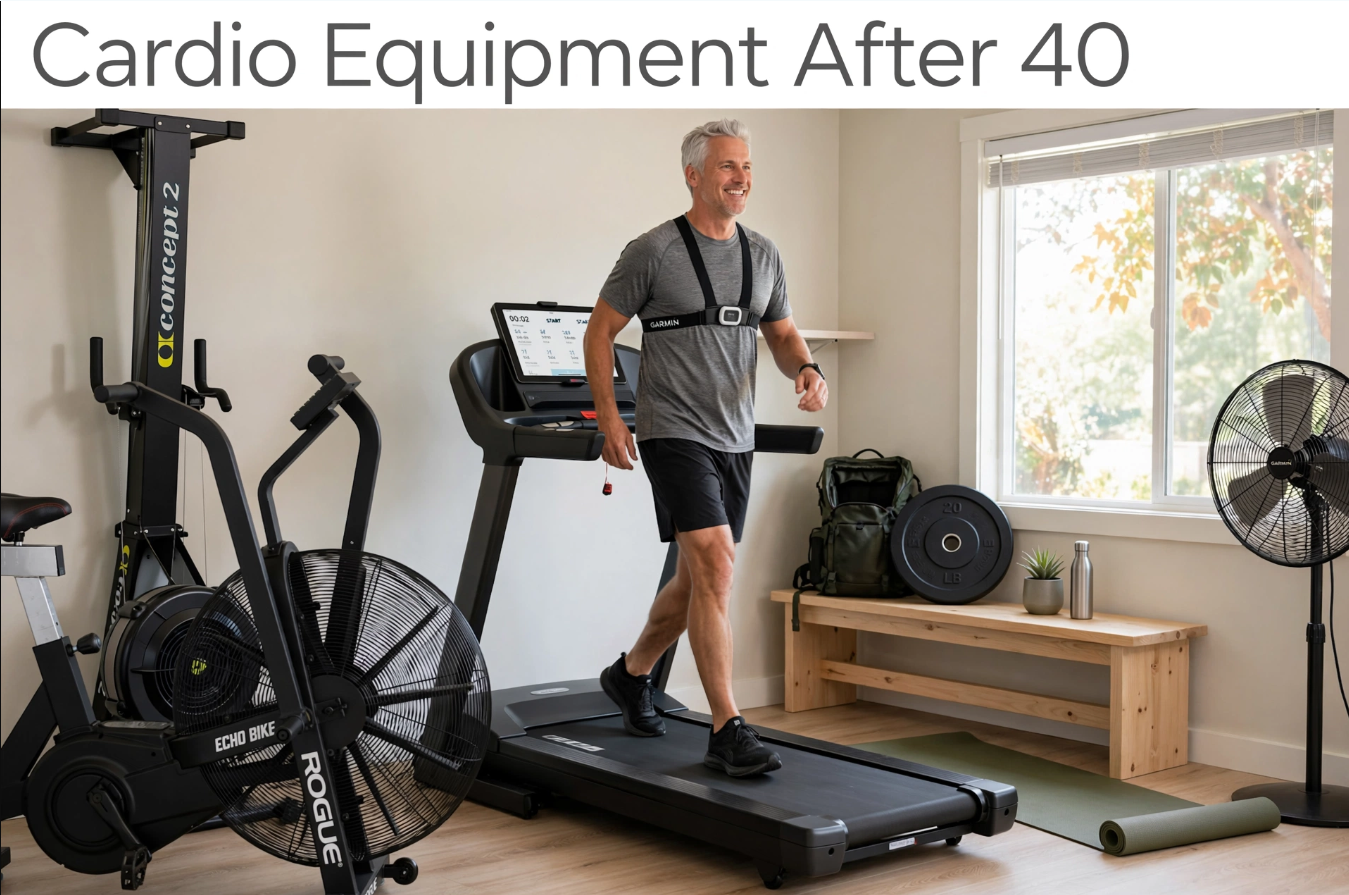
- Heart Rate Compatibility: Chest strap connectivity is more reliable than grip sensors. Ensure the machine pairs with your Garmin, Polar, or Apple Watch.
- Minimum 3.0 CHP Motor: Anything less will struggle under daily use and bog down during sprint intervals.
Budget-Friendly Alternative: A used commercial treadmill from a gym that’s upgrading equipment can be a steal. Check local classifieds for lightly used models. Alternatively, a walking pad (a compact, flat treadmill without a console) can slide under a standing desk for $300–400, perfect for daily Zone 1–2 movement while you work.
Section 2: The Stationary Bike—King of Low-Impact Cardio
For many midlife athletes, the bike becomes the backbone of their cardio program simply because it doesn’t hurt. There’s no impact, the seat supports your weight, and you can read, watch a show, or take a conference call while spinning.
The Three Types of Bikes:
- Upright Bike: Mimics a regular road bike. Can get uncomfortable in the saddle for some, and the forward-leaning posture may aggravate low backs.
- Recumbent Bike: A chair-like seat with pedals in front. The gold standard for those with low back pain, balance issues, or significant obesity. It’s the safest, most comfortable option but also the least engaging for high-intensity work.
- Air Bike (Fan Bike): Has moving arm handles and a large fan for resistance. Resistance increases as you pedal faster. The Assault Bike or Rogue Echo Bike are cult favorites for brutal, low-impact HIIT. This is the tool for the 20-second all-out intervals we programmed in our HIIT guide. It’s loud but devastatingly effective.
Pros:
- Truly zero-impact. Safest option for arthritic knees and hips.
- Excellent for long Zone 2 sessions while multitasking.
- Air bikes provide one of the most metabolically demanding workouts possible without loading the spine or joints.
Cons:
- Prolonged sitting can cause saddle soreness and tight hip flexors. A good pair of padded shorts helps.
- Recumbent bikes have a larger footprint.
- Pure upright or recumbent cycling is non-weight-bearing, so it doesn’t build bone density. You must supplement with strength training or rucking.
What to Look For:
- Magnetic Resistance: Far quieter and smoother than old-style friction pads.
- Adjustable Seat and Handlebars: Proper fit prevents knee and back strain. Your knee should have a slight bend at the bottom of the pedal stroke.
- Platform Pedals with Toe Cages or SPD Compatibility: Slipping on a flat pedal at high RPM is dangerous.
Budget Alternative: A sturdy indoor bike trainer stand ($60–100) that turns your existing outdoor bicycle into a stationary bike. Pair it with a $20 cadence sensor and the Zwift app on your phone, and you have a world-class interactive setup for a fraction of the price.
Section 3: The Rowing Machine—Full-Body, Meditative, and Joint-Friendly
The rower is the dark horse of home cardio. It recruits roughly 86% of your body’s muscle mass—legs, core, back, arms—in a single smooth, non-impact stroke. For the time-strapped 40-something who wants cardio and functional strength in one session, it’s unmatched.
Pros:
- Total-Body Engagement: Strengthens the posterior chain (glutes, hamstrings, back), counteracting the hunched-desk posture.
- Low-Impact and Scalable: You control the intensity with every stroke. It’s as gentle or as brutal as you want it to be.
- Space-Efficient: Most rowers can be stored vertically against a wall, taking up a footprint of only a couple of square feet.
Cons:
- Technique-Dependent: Poor form (slouching, pulling with the arms too early) can strain the lower back. A few sessions with a coach or detailed YouTube tutorials are a wise investment.
- Not Ideal for Multitasking: Rowing requires focus on rhythm and form. It’s harder to watch a movie or type emails than on a bike or treadmill.
What to Look For:
- Concept2 RowErg: The gold standard. Indestructible, holds its value, used by every collegiate and Olympic team. Air resistance, loud but iconic sound. Connects to apps via Bluetooth.
- Water Rowers: Beautiful wooden aesthetic, soothing water sound, smoother catch. Slightly less precise for interval work but a joy for steady-state Zone 2.
- Magnetic Rowers: Quieter and cheaper (Sunny, NordicTrack), but often lack the smooth, dynamic feel of air or water.
Budget Alternative: A set of resistance bands anchored to a door. You can mimic the rowing motion and get a great posterior-chain workout for under $30. It’s not a true cardiovascular substitute, but it builds the muscles that protect your back for when you do get on a real rower.
Section 4: The Elliptical—The Smooth Operator
The elliptical trainer was the darling of the 1990s fitness boom, and it remains a solid option for those who want a weight-bearing, low-impact workout without the pounding.
Pros:
- No Impact, Weight-Bearing: Your feet never leave the pedals, eliminating the impact spike of running while still loading your bones lightly.
- Upper and Lower Body: Models with moving arm handles provide a full-body workout that can elevate heart rate quickly.
- Quiet and Smooth: Magnetic resistance and the gliding motion are whisper-quiet, ideal for apartment dwellers or early risers.
Cons:
- Can Be Passive: It’s easy to lazily lean on the handles and let momentum carry you, dramatically reducing calorie burn and training effect. You must actively engage your glutes and core.
- Bulky Footprint: Ellipticals are often large, heavy, and difficult to move.
- Limited HIIT Capacity: Rapid changes in resistance and cadence aren’t as seamless as on a bike or rower, making true maximal intervals harder to achieve.
What to Look For:
- Adjustable Incline and Stride Length: A 20–22 inch stride length accommodates most heights comfortably. Incline ramps allow you to target different leg muscles.
- Articulating Pedals: Pedals that slightly adjust angle can reduce toe numbness on long sessions.
- Heavy Flywheel: A heavier flywheel provides a smoother, more natural feel.
Budget Alternative: A compact elliptical (often called an under-desk elliptical) sits on the floor and you pedal it while seated. It’s not a serious training tool, but it’s an excellent way to add low-grade movement and calorie burn throughout a workday.
Section 5: The Rucksack—The Equipment You Already Own
We dedicated an entire guide to walking and rucking, but it bears repeating here: a backpack with weight is the most underrated, accessible, and functional piece of cardio equipment in existence.
Why It Often Beats the Machines:
- Cost: Free (you already own a backpack) to $300 for a dedicated rucking pack and plate. No electricity, no maintenance.
- Outdoors and Vitamin D: Sunlight, fresh air, and exposure to nature amplify the mental health benefits of cardio. Treadmills and bikes can’t replicate a trail, birdsong, or a sunset.
- Functional, Real-World Strength: Carrying a load over distance translates directly to real life—lugging groceries, carrying a child, hauling luggage through an airport.
- Zone 2 Goldmine: With the right weight (20–40 lbs) and a brisk pace, rucking lands you squarely in Zone 2, building mitochondria and burning fat with every step.
How to Integrate With Your Home Gym: Even if you own a treadmill and a bike, rucking should be your go-to outdoor cardio session 1–2 times per week. It’s the perfect weekend long session that gets you out of the house and into your local parks or trails.
Section 6: Integrating Equipment Into Your VigorForty Training Week
Here’s a sample week for a home-based athlete with a treadmill, an air bike, and a rucksack.
| Day | Workout | Equipment |
|---|---|---|
| Monday | Full-body strength (bodyweight/dumbbells) + 20 min Zone 2 cool-down | Treadmill walk (8% incline) |
| Tuesday | HIIT: 20 min Air Bike Repeater (20 sec all-out / 100 sec easy × 6) | Air Bike |
| Wednesday | Zone 2: 60 min ruck with 25 lbs | Rucksack, local trail |
| Thursday | Full-body strength + 30 min Zone 2 | Treadmill incline walk or bike |
| Friday | VO2 Max intervals: 4×4 min rowing (if you have a rower) or treadmill hill intervals | Rower or Treadmill |
| Saturday | Long Zone 2: 90+ min ruck or hike | Rucksack, state park |
| Sunday | Active recovery: 45 min walk, no weight | Just your feet |
This schedule uses no more than two machines and the outdoors. It provides 3 strength sessions, 1 HIIT, 1 VO2 max, and plenty of Zone 2. It’s sustainable, varied, and leaves no room for boredom.
Section 7: The Tech Stack—Apps, Monitors, and Entertainment
The right tech can turn a dreaded indoor session into something you look forward to.
- For Treadmill and Bike: Zwift (cycling and running), Peloton app (no bike required—you can follow their classes on your own treadmill or bike), iFit (for NordicTrack or ProForm machines).
- For Rowing: EXRGame or Regatta, which gamify rowing with virtual courses and racing. Concept2’s free ErgData app logs every stroke.
- Universal: An iPad mount and a good pair of Bluetooth headphones. Netflix, audiobooks, and podcasts are the Zone 2 athlete’s best friends. A 45-minute easy spin flies by when you’re immersed in a great story.
Section 8: FAQ—Your Cardio Equipment Questions
Q: What’s the one best machine for a 55-year-old with bad knees?
A: A recumbent bike or a rower. The recumbent bike offers the most support and security with zero impact. The rower is a close second if your knees tolerate the full range of motion—it strengthens the quads and hamstrings that stabilize the knee joint. Test both before buying.
Q: Is a cheap Amazon treadmill worth it?
A: For walking only, a budget walking pad ($300–400) can be excellent for daily steps and light Zone 1–2 work. For running or heavy HIIT, a cheap treadmill will break down quickly, have a jarring deck, and become a safety hazard. Save and invest in a mid-range model ($1,000–1,500) if running is your primary modality.
Q: Can I get a good HIIT workout without any equipment?
A: Yes. Our HIIT guide includes a full bodyweight “Hotel Room” workout. Jump squats, mountain climbers, burpees on a soft mat, and high-knee marching can spike your heart rate effectively with zero equipment. Equipment simply expands your options and reduces joint stress.
Q: How do I maintain my equipment?
A: Vacuum under and around machines weekly. Wipe down sweat after every use—it corrodes metal and electronics. Lubricate treadmill belts and rower chains as specified in the manual. A well-maintained treadmill can last 10–15 years; a neglected one, two or three.
The VigorForty Take
Your home cardio setup doesn’t need to look like a commercial gym. One or two well-chosen machines, paired with the great outdoors and a rucksack, is more than enough to execute every training protocol in the VigorForty library—from Zone 2 base-building to HIIT to VO2 max intervals. The key is matching the equipment to your body, your space, and your psychology. If you hate cycling, don’t buy a Peloton just because it’s popular. If the sound of a rower’s flywheel soothes you, a Concept2 will be your best investment in years.
Start where you are. A good pair of walking shoes and a backpack you already own can carry you through months of transformative training without spending a dollar. Add a machine when you know your preferences and have built the habit. Make your cardio corner a place you want to be—good lighting, a screen, a fan, a mat underfoot. The goal is a space that invites you in, session after session, year after year.
The machines are tools. You are the engine. Keep the engine running, and it won’t matter whether you’re staring at a screen, a wall, or a mountain vista. You’ll be building a stronger heart, a leaner body, and a longer life. Now go set up your sanctuary, and put it to work.
Read All Related Articles
- The Complete Guide to Zone 2 Training After 40: How Low-Intensity Cardio Boosts Fat Loss, Longevity, and Endurance
- The Complete Guide to HIIT After 40: Joint-Friendly Workouts That Torch Fat and Protect Your Heart
- The Complete Guide to Running After 40: How to Start, Stay Injury-Free, and Build Lifelong Endurance
- The Complete Guide to Metabolic Health After 40: Reverse Insulin Resistance, Burn Stubborn Fat, and Reclaim Your Energy with Cardio
- The Complete Guide to Cardio Recovery After 40: How to Rest, Rebuild, and Come Back Stronger
- The Complete Guide to Heart Rate Training Zones After 40: Unlock Every Beat for Maximum Fat Loss, Endurance, and Longevity
- The Complete Guide to VO2 Max After 40: The #1 Predictor of Longevity and How to Improve It
- The Complete Guide to Concurrent Training After 40: How to Combine Cardio and Strength for Maximum Fat Loss, Muscle Preservation, and Longevity
- The Complete Guide to Walking and Rucking After 40: The Most Underrated Cardio for Fat Loss, Joint Health, and Longevity
- The Complete Guide to Designing Your Own Cardio Plan After 40: A Personalized Blueprint for Fat Loss, Longevity, and Peak Performance
- The Complete Guide to Cardio Nutrition After 40: Fuel Your Workouts for Maximum Fat Loss, Endurance, and Recovery
- The Complete Guide to Cardio Equipment After 40: Choosing the Best Treadmill, Bike, Rower, or Elliptical for Your Home Gym
- The Complete Guide to Injury Prevention for Cardio After 40: Run, Ride, and Ruck Pain-Free for Life
- The Complete Guide to Cardio for Fat Loss After 40: Burn Stubborn Belly Fat Without Losing Muscle or Energy
- The Complete Guide to Seasonal Cardio Training After 40: How to Periodize Your Year for Year-Round Fitness, Fat Loss, and Injury Prevention
- The Complete Guide to Cardio and Brain Health After 40: How Exercise Protects Your Memory, Mood, and Mental Sharpness
- The Complete Guide to Building a Home Gym for Cardio After 40: Design a Space That Makes Consistency Inevitable
- The Joyful Movement Manifesto: How to Love Cardio After 40 and Make It a Lifelong Practice
- The Complete Guide to Sleep and Cardio After 40: How Deep Rest Unlocks Your Best Performance, Recovery, and Longevity
- The Complete Guide to Stress, Cortisol, and Cardio After 40: How to Manage Your Nervous System for Better Recovery and Performance
- The Complete Guide to Returning to Cardio After a Layoff After 40: Your Compassionate, Science-Backed Roadmap Back to Fitness
- The Complete Guide to Cardio Through Menopause: How to Adapt Your Training for Hormonal Changes, Protect Your Heart, and Feel Strong After 40
- The Complete Guide to Cycling After 40: Low-Impact Cardio for Joint Health, Endurance, and Lifelong Fitness
- The Complete Guide to Pool and Water-Based Cardio After 40: Low-Impact Workouts for Joint Pain, Recovery, and Total-Body Fitness
- The Complete Guide to Rowing After 40: Full-Body, Low-Impact Cardio for Strength, Endurance, and Longevity
- The Complete Guide to Tracking Cardio Progress After 40: The Key Metrics That Matter More Than the Scale
- The Complete Guide to Cardio for High Blood Pressure After 40: How Exercise Lowers Your Numbers and Protects Your Heart
- The Complete Guide to Cardio for Type 2 Diabetes and Prediabetes After 40: How Exercise Reverses Insulin Resistance and Protects Your Heart
- The Complete Guide to Cardio with Arthritis After 40: Pain-Free Workouts That Strengthen Joints and Keep You Moving
- The Complete Guide to Longevity and Cardio After 40: How Aerobic Fitness Adds Years to Your Life and Life to Your Years
- The Complete Guide to Building a Cardio Habit After 40: The Science of Making Exercise Stick for Life
- The Complete Guide to Cardio and Immune Health After 40: Strengthen Your Body’s Defense System for a Resilient, Vibrant Life
- The Complete Guide to Cardio While Traveling After 40: Stay Fit on the Road, in Hotels, and Away from Home
- The Complete Guide to Cardio for Posture and Back Pain After 40: Strengthen Your Posterior Chain and Reverse the Damage of Sitting
- The Complete Guide to the Social Side of Cardio After 40: How Community, Accountability, and Connection Make You Stronger
- The VigorForty Manifesto: A Final Word on the Lifelong Practice of Movement