
Author: Vigor Forty Editorial Team
Medically Reviewed By: Editorial Review Board
Disclaimer: This article is for informational purposes only and is not a substitute for professional medical advice. Read our full Medical Disclaimer.
📌 Key Takeaways
- Setting clear, specific goals is the first step to success: Vague goals lead to vague results. Define exactly what you want to achieve—whether it’s a strength target, a body composition goal, or a performance milestone.
- Consistency trumps intensity: Training consistently over months and years produces far better results than sporadic bursts of intense training followed by long breaks.
- SMART goals provide a proven framework: Specific, Measurable, Achievable, Relevant, and Time-bound goals keep you focused and motivated.
- Track your progress to stay motivated: What gets measured gets managed. Regular tracking shows you’re making progress—even when it feels slow.
- Life happens—plan for it: Build flexibility into your plan. Expect setbacks and have strategies to get back on track.
- Long-term vision, short-term action: Think about where you want to be in 5 years, but focus on what you need to do today. The big picture keeps you going; daily actions get you there.
Introduction: The Journey Ahead
You’ve read the articles. You’ve learned the exercises. You understand the principles of strength training, nutrition, and recovery. You know what to do.
But knowing isn’t enough. You need a plan. You need a roadmap that takes you from where you are now to where you want to be.
The Challenge:
- Over 80% of New Year’s resolutions fail by February
- Most people quit their fitness programs within 6 months
- The average person starts and stops strength training multiple times
- Without a clear plan, motivation fades
The Solution:
A clear, actionable roadmap that turns your fitness goals into reality. A plan that accounts for life’s ups and downs. A strategy that keeps you consistent—not just for weeks or months, but for years.
The Roadmap Approach:
| Element | Why It Matters |
|---|---|
| Vision | Gives you a reason to keep going |
| Goals | Provides clear targets to aim for |
| Plan | Defines the path to get there |
| Tracking | Shows you’re making progress |
| Flexibility | Allows you to adapt when life happens |
| Support System | Keeps you accountable |
This guide will help you create your personal strength training roadmap for 2027 and beyond. You’ll learn how to set effective goals, build a sustainable training plan, stay consistent, track your progress, and adapt when life gets in the way.
Section 1: Setting Your Vision
The 5-Year Vision
Why It Matters: Your vision is your “why.” It’s the reason you’ll keep going when motivation fades. It’s the big picture that gives meaning to your daily efforts.
Questions to Ask Yourself:
| Question | Why It Matters |
|---|---|
| What do I want my life to look like in 5 years? | Helps you see the big picture |
| How do I want to feel physically? | Connects fitness to quality of life |
| What do I want to be able to do? | Makes fitness functional and meaningful |
| What kind of example do I want to set? | Connects fitness to family and legacy |
| What will I regret if I don’t start now? | Creates urgency and motivation |
Sample Vision Statements:
“In 5 years, I want to be strong enough to play with my grandchildren without getting tired. I want to feel capable, confident, and pain-free. I want to set an example of health and vitality for my family.”
“I want to be the strongest version of myself—able to lift heavy, move well, and keep up with life’s demands. I want to look in the mirror and feel proud of what I see.”
“I want to be independent and active well into my 80s. I don’t want to be limited by my body. I want to be strong for life.”
The 1-Year Vision
Why It Matters: Five years is a long time. A 1-year vision bridges the gap between your big-picture dream and your daily actions.
Questions to Ask Yourself:
| Question | Why It Matters |
|---|---|
| Where do I want to be one year from now? | Defines a shorter-term target |
| What specific results do I want? | Makes your vision measurable |
| What habits do I need to build? | Connects vision to daily actions |
| What obstacles might I face? | Prepares you for challenges |
Sample 1-Year Vision:
“One year from now, I want to have built a consistent strength training habit. I want to be squatting 225 lbs, deadlifting 315 lbs, and doing 10+ pull-ups. I want to have lost 15 lbs of fat and gained noticeable muscle definition. I want to feel stronger, more confident, and more capable in my daily life.”
Section 2: Setting SMART Goals
The SMART Framework
| Letter | Meaning | What It Means |
|---|---|---|
| S | Specific | Define exactly what you want to achieve |
| M | Measurable | Define how you’ll track progress |
| A | Achievable | Set goals that are challenging but realistic |
| R | Relevant | Goals that matter to you |
| T | Time-bound | Set a deadline for achievement |
Sample SMART Goals
Strength Goals:
| Goal | Type |
|---|---|
| “I will increase my squat 1RM from 185 lbs to 225 lbs by December 31, 2027.” | Strength |
| “I will deadlift 315 lbs for 3 reps by June 30, 2027.” | Strength |
| “I will bench press 225 lbs for 5 reps by October 31, 2027.” | Strength |
| “I will increase my overhead press from 95 lbs to 135 lbs by December 31, 2027.” | Strength |
Calisthenics Goals:
| Goal | Type |
|---|---|
| “I will do 20 consecutive push-ups with perfect form by March 31, 2027.” | Endurance |
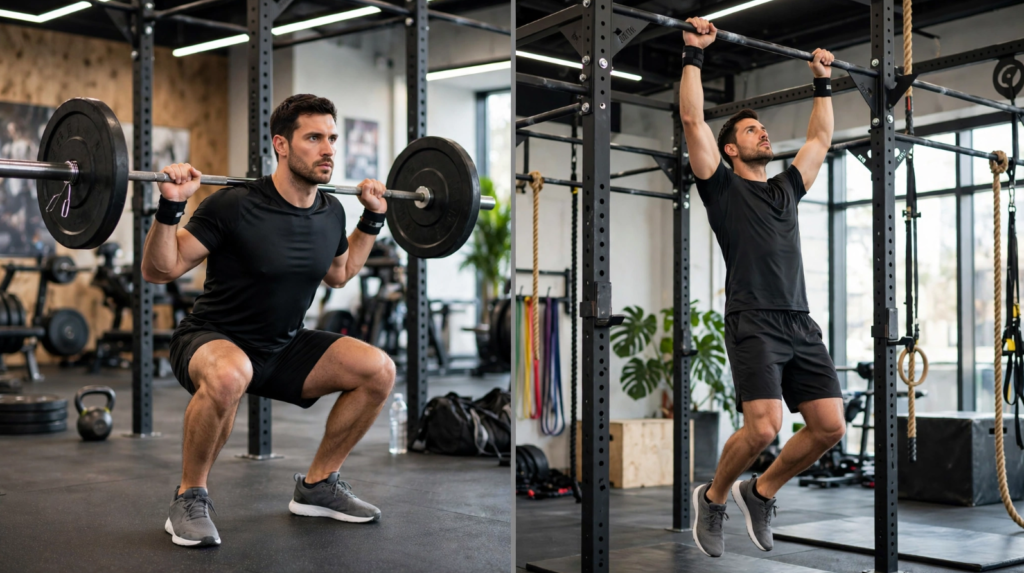
| “I will do 10 consecutive pull-ups by June 30, 2027.” | Strength |
| “I will hold a plank for 2 minutes by June 30, 2027.” | Endurance |
| “I will perform a pistol squat by December 31, 2027.” | Skill |
Body Composition Goals:
| Goal | Type |
|---|---|
| “I will lose 15 lbs of body fat while maintaining muscle mass by June 30, 2027.” | Fat Loss |
| “I will reduce my body fat percentage from 25% to 20% by December 31, 2027.” | Body Composition |
| “I will gain 5 lbs of muscle mass by December 31, 2027.” | Muscle Gain |
Performance Goals:
| Goal | Type |
|---|---|
| “I will complete a 5K run in under 30 minutes by August 31, 2027.” | Cardio |
| “I will complete 3 strength training sessions per week for 48 consecutive weeks in 2027.” | Consistency |
| “I will walk 10,000 steps per day for 30 consecutive days by March 31, 2027.” | Activity |
Goal Setting Worksheet
| My Goals | SMART Check | Deadline |
|---|---|---|
| Goal 1: | ☐ Specific ☐ Measurable ☐ Achievable ☐ Relevant ☐ Time-bound | — |
| Goal 2: | ☐ Specific ☐ Measurable ☐ Achievable ☐ Relevant ☐ Time-bound | — |
| Goal 3: | ☐ Specific ☐ Measurable ☐ Achievable ☐ Relevant ☐ Time-bound | — |
| Goal 4: | ☐ Specific ☐ Measurable ☐ Achievable ☐ Relevant ☐ Time-bound | — |
Section 3: Building Your Training Plan
The Annual Plan
Quarterly Breakdown:
| Quarter | Focus | Key Goals |
|---|---|---|
| Q1 (Jan–Mar) | Foundation Building | Establish consistency, perfect form, build base strength |
| Q2 (Apr–Jun) | Strength Development | Increase weights, progress variations, build muscle |
| Q3 (Jul–Sep) | Intensification | Push limits, increase intensity, break plateaus |
| Q4 (Oct–Dec) | Peak and Maintain | Achieve peak goals, maintain gains, plan for next year |
The Monthly Plan
Monthly Focus Areas:
| Month | Focus | Key Actions |
|---|---|---|
| January | Habit Building | Schedule workouts, track everything |
| February | Form Refinement | Master technique, address weaknesses |
| March | Consistency | 3+ sessions/week, no excuses |
| April | Strength Base | Build strength foundation |
| May | Volume Increase | Add sets and reps |
| June | Mid-Year Review | Assess progress, adjust goals |
| July | Intensification | Increase intensity |
| August | Challenge | Push limits, try new exercises |
| September | Plateaus | Break through stagnation |
| October | Peak | Work toward year-end goals |
| November | Testing | Test maxes, assess progress |
| December | Maintenance and Planning | Maintain gains, plan for next year |
The Weekly Plan
Sample Weekly Schedule (3-Day Full Body):
| Day | Focus | Exercises | Duration |
|---|---|---|---|
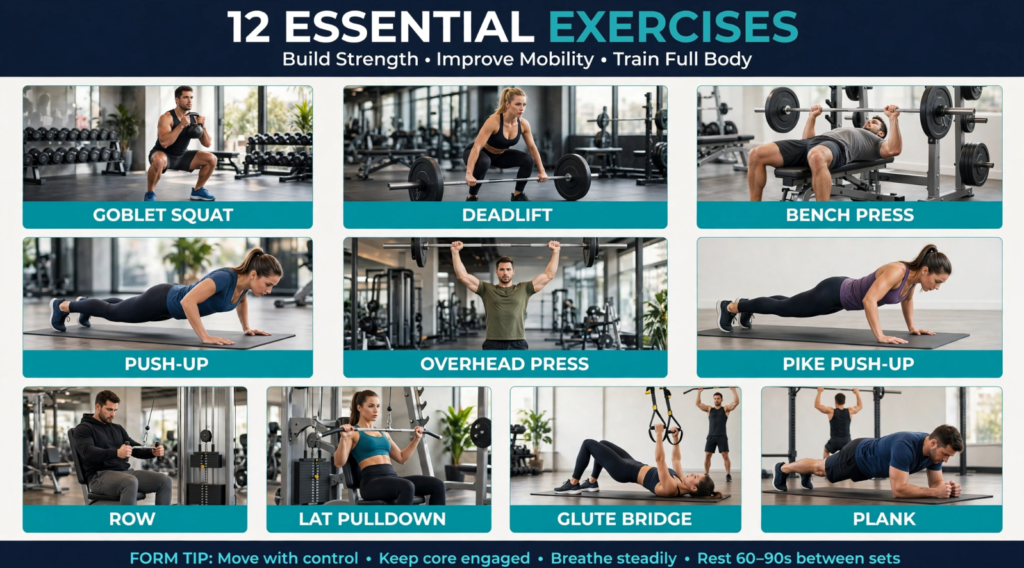
| Monday | Full Body A | Squats, Bench Press, Rows, Plank | 45–60 min |
| Wednesday | Full Body B | Deadlifts, Overhead Press, Pull-ups, Plank | 45–60 min |
| Friday | Full Body C | Lunges, Dumbbell Press, Rows, Core | 45–60 min |
| Saturday | Optional Active Recovery | Walking, Light Cardio, Mobility | 20–30 min |
| Sunday | Rest | Complete rest | — |
Section 4: Building Consistency
The Habit Loop
| Phase | Description | Example |
|---|---|---|
| Cue | The trigger that starts the habit | Putting on workout clothes |
| Routine | The habit itself | Doing your workout |
| Reward | The benefit you get | Feeling accomplished |
Strategies for Consistency
1. Schedule Your Workouts
| Strategy | How to Apply |
|---|---|
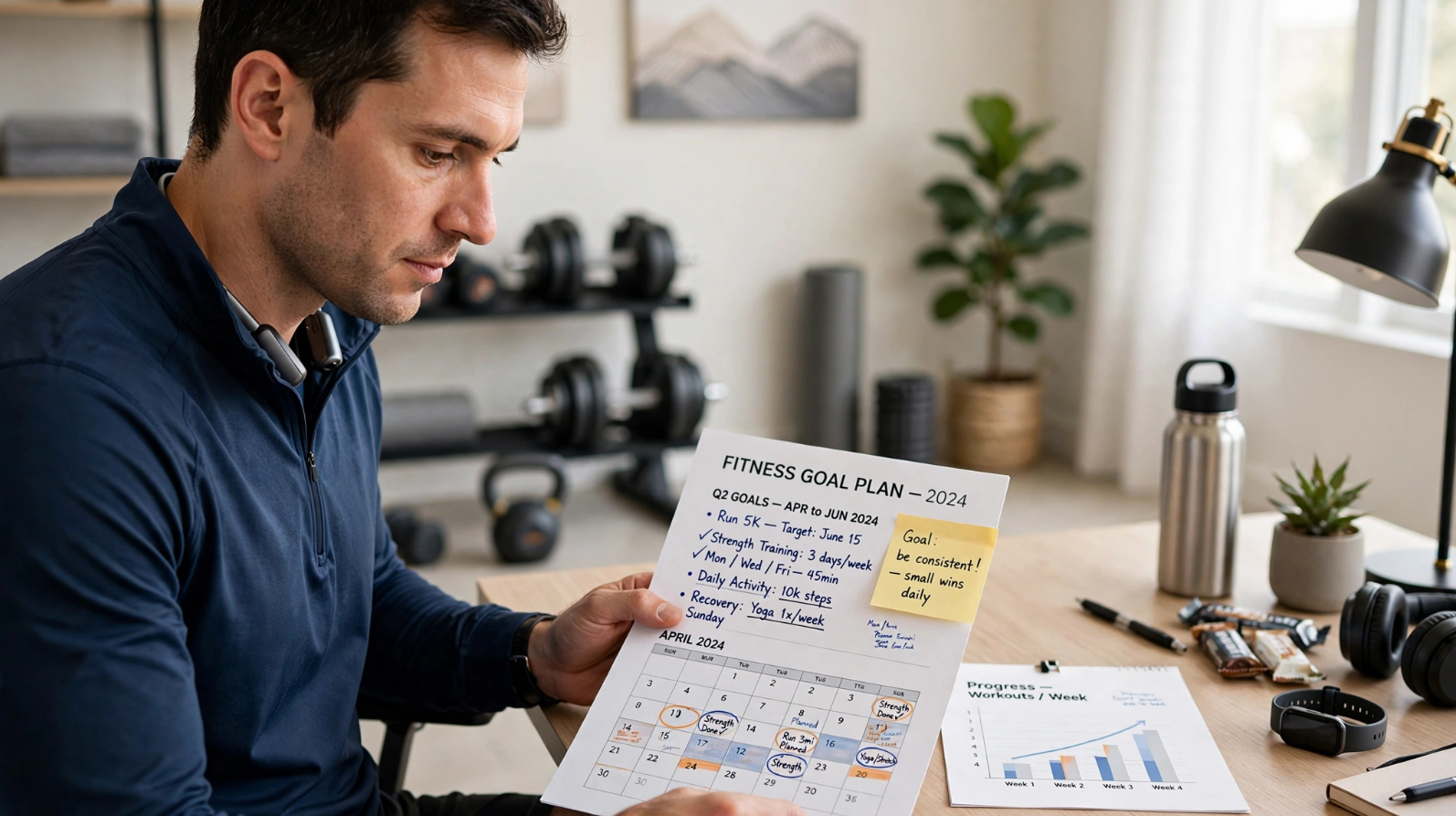
| Put it in your calendar | Treat workouts like any other appointment |
| Set reminders | Phone alerts, calendar notifications |
| Same time daily | Builds routine and reduces decision fatigue |
| Prepare the night before | Lay out clothes, pack bag |
2. Start Small
| Approach | Why It Works |
|---|---|
| 5-minute rule | Commit to 5 minutes—you’ll likely do more |
| Minimum viable workout | Even a short workout counts |
| Progress over perfection | Consistency matters more than intensity |
| Celebrate small wins | Every workout is a victory |
3. Build Momentum
| Strategy | How to Apply |
|---|---|
| Never miss twice | One missed workout is okay; don’t miss two |
| Streak tracking | Track consecutive days/weeks of training |
| Accountability partner | Workout with a friend or share progress |
| Visible reminders | Put your goals where you can see them |
The “Never Miss Twice” Rule
The Principle: You will miss workouts—life happens. The key is not missing twice in a row. One missed workout is a setback; two is a trend.
Example:
- Monday: You’re tired and skip your workout (Miss 1)
- Tuesday: You get back on track with a workout (Recovery)
- Wednesday: You’re consistent (Back on track)
VS.
- Monday: You skip your workout (Miss 1)
- Tuesday: You skip again (Miss 2)
- Wednesday: Momentum is lost (Trend)
The 5-Minute Rule
The Principle: If you don’t feel like working out, commit to doing just 5 minutes. More often than not, you’ll continue once you’ve started.
Why It Works:
- Overcomes the initial inertia
- Builds momentum
- Most people continue beyond 5 minutes
- Even if you stop at 5, you still did something
Section 5: Tracking Your Progress
What to Track
| Metric | Why It Matters | How to Track |
|---|---|---|
| Workout Consistency | Shows you’re showing up | Calendar, app |
| Weights Lifted | Shows strength progress | Log book, app |
| Reps and Sets | Shows volume progress | Log book, app |
| Body Weight | Shows body composition changes | Scale |
| Body Measurements | Shows muscle/fat changes | Tape measure |
| Photos | Visual progress | Phone photos |
| How You Feel | Energy, mood, confidence | Journal, notes |
| Sleep Quality | Recovery indicator | Sleep tracker, journal |
Sample Tracking Log
| Date | Workout | Exercise | Weight | Sets x Reps | RPE | Notes |
|---|---|---|---|---|---|---|
| 1/15 | Full Body A | Squats | 185 lbs | 3 x 8 | 7 | Good form |
| 1/15 | Full Body A | Bench Press | 135 lbs | 3 x 8 | 8 | Last set hard |
| 1/15 | Full Body A | Rows | 95 lbs | 3 x 10 | 7 | Good |
| 1/15 | Full Body A | Plank | BW | 3 x 45s | 7 | Strong |
The Power of Tracking
| Benefit | How It Works |
|---|---|
| Shows Progress | You see improvement over time |
| Motivates | Seeing progress keeps you going |
| Identifies Patterns | See what works (and what doesn’t) |
| Accountability | Track or not track—your choice |
| Guides Decisions | Data helps you make better choices |
| Celebrates Wins | You see how far you’ve come |
Section 6: Adapting to Life
Life Happens—Expect It
| Challenge | How to Handle It |
|---|---|
| Sickness | Rest completely, return gradually |
| Injury | Work around it, seek professional help |
| Travel | Do bodyweight workouts, use hotel gym |
| Busy Schedule | Shorten workouts, prioritize compounds |
| Low Motivation | 5-minute rule, focus on consistency |
| Plateau | Change variables, deload, assess |
The Four Types of Workout Days
| Type | Description | When to Use |
|---|---|---|
| Optimal | Full workout, full intensity | When energy is high, time is available |
| Good | Full workout, moderate intensity | Normal day |
| Minimal | Shortened workout (20 min) | Low energy, limited time |
| Survival | Just show up (5–10 min) | Very low energy, high stress |
The Adaptation Cycle
| Phase | What Happens | How to Respond |
|---|---|---|
| 1. Life Happens | Something disrupts your routine | Don’t panic |
| 2. Assess | How much time/energy do you have? | Be honest |
| 3. Adapt | Modify your workout | Do what you can |
| 4. Return | Get back to your normal plan | Don’t let disruption become permanent |
| 5. Learn | What worked? What didn’t? | Adjust for next time |
Sample Adaptation Scenarios
Scenario 1: Sick for 5 Days
| Day | Action |
|---|---|
| Day 1–3 | Complete rest |
| Day 4–5 | Light activity (walking) |
| Day 6 | Light workout (50%) |
| Day 7 | Moderate workout (75%) |
| Day 8 | Return to normal (100%) |
Scenario 2: Traveling (5 Days)
| Day | Action |
|---|---|
| Day 1 | Bodyweight workout (hotel room) |
| Day 2 | Bodyweight workout (hotel room) |
| Day 3 | Hotel gym (if available) |
| Day 4 | Bodyweight workout (hotel room) |
| Day 5 | Bodyweight workout (hotel room) |
Scenario 3: Extremely Busy Week
| Day | Action |
|---|---|
| Monday | Full workout (morning before work) |
| Tuesday | Minimal workout (20 min) |
| Wednesday | Full workout (lunch break) |
| Thursday | Survival workout (10 min) |
| Friday | Full workout (morning before work) |
Section 7: The Support System
Building Your Support Network
| Support Type | Who It Is | How They Help |
|---|---|---|
| Workout Partner | Friend, spouse, gym buddy | Accountability, motivation |
| Accountability Partner | Someone you check in with | Keeps you on track |
| Community | Online group, gym community | Support, advice, motivation |
| Trainer or Coach | Fitness professional | Guidance, form checks, programming |
| Family | Spouse, children, parents | Understanding, encouragement |
Community Resources
| Resource | How It Helps |
|---|---|
| Online Forums | Advice, community, motivation |
| Social Media | Follow fitness accounts for inspiration |
| Fitness Apps | Tracking, community, challenges |
| Gym Classes | Group motivation, structure |
| Running/Strength Clubs | Community, accountability |
When to Get Professional Help
| Situation | Professional |
|---|---|
| Learning form | Personal trainer, coach |
| Plateau | Coach, trainer |
| Injury | Physical therapist, sports medicine |
| Specific goal | Coach (strength, powerlifting, bodybuilding) |
| Medical condition | Doctor, physical therapist |
Section 8: Year-End Review and Planning
The Year-End Review (December)
| Question | Why Ask It |
|---|---|
| What goals did I achieve this year? | Celebrate wins |
| What goals didn’t I achieve? | Learn from setbacks |
| What worked well in my training? | Identify successful strategies |
| What didn’t work? | Identify what to change |
| What did I learn about myself? | Personal growth |
| What do I want to achieve next year? | Set new goals |
The Annual Review Template
| Category | This Year | Next Year |
|---|---|---|
| Strength Achievements | — | — |
| Consistency | — | — |
| Body Composition | — | — |
| Health Markers | — | — |
| Lessons Learned | — | — |
| Goals for Next Year | — | — |
Planning for 2028
| Step | What to Do |
|---|---|
| 1. Review | Look back at this year’s achievements and challenges |
| 2. Reflect | What worked, what didn’t, what you learned |
| 3. Set Goals | New goals for the coming year |
| 4. Plan | Outline your training for the next 12 months |
| 5. Act | Start implementing your plan on Day 1 |
Section 9: Motivation Maintenance
Understanding Motivation
| Phase | Description | What to Do |
|---|---|---|
| Initial Excitement | High motivation, easy to start | Take advantage, build habits |
| Dips | Motivation fades, life gets busy | Rely on habits, not motivation |
| Plateaus | Progress stalls, boredom sets in | Change variables, find new challenges |
| Long-Term Sustained | Sustainable motivation, consistent | Maintain habits, enjoy the process |
Motivation Strategies
1. Remember Your “Why”
| Strategy | How to Apply |
|---|---|
| Write down your reasons | Keep them visible |
| Visualize your goals | Imagine achieving them |
| Connect to values | Fitness supports what matters to you |
2. Make It Enjoyable
| Strategy | How to Apply |
|---|---|
| Choose exercises you like | Mix in favorite movements |
| Vary your workouts | Avoid boredom |
| Listen to music or podcasts | Make it fun |
| Train with friends | Social connection |
3. Track Your Progress
| Strategy | How to Apply |
|---|---|
| Keep a log | See how far you’ve come |
| Take photos | Visual proof of progress |
| Test your maxes | See strength gains |
| Celebrate milestones | Recognize achievements |
4. Focus on What You Can Control
| What You Can Control | What You Can’t |
|---|---|
| Showing up | How fast you progress |
| Your effort | Genetic limits |
| Your nutrition | What others think |
| Your recovery | Perfect circumstances |
Section 10: FAQ—Your Top Roadmap Questions
Q: What if I don’t reach my goals?
A: Not reaching a goal isn’t failure—it’s feedback. Use it to reassess and adjust. Did you set realistic goals? Were you consistent? Did life interfere? Learn from the experience and set new goals.
Q: How do I stay consistent when motivation fades?
A: Motivation is fleeting; habits are lasting. Build the habit of showing up. Use the 5-minute rule. Track your progress. Remember your “why.” And accept that some days you’ll just do the minimum—and that’s okay.
Q: What if I get injured?
A: It happens. Listen to your body, rest when needed, and work around the injury. Seek professional help if needed. Returning gradually is better than stopping completely.
Q: How often should I reassess my goals?
A: Assess quarterly (every 3 months) or monthly. Goals can change as you change. If a goal no longer matters, adjust it. If a goal is too easy or too hard, adjust it.
Q: Should I follow my plan rigidly or be flexible?
A: Be flexible within structure. Have a clear plan, but adapt when needed. Life happens—adjust your plan rather than abandoning it.
Q: What if I’m starting from zero?
A: Great! That means you have nowhere to go but up. Start with small, achievable goals. Build the habit first, then focus on intensity. Consistency beats intensity at the beginning.
Q: How do I avoid burnout?
A: Include deloads in your training. Take breaks when needed. Vary your training to avoid boredom. Listen to your body—when fatigue is high, reduce volume or intensity.
Q: What’s the single most important factor for success?
A: Consistency. Showing up—even when you don’t feel like it. Training for months and years, not weeks and months. Consistency beats talent, genetics, and perfect programming every time.
The VigorForty Take
Your strength training roadmap is your guide to success. It turns your fitness goals into reality by providing a clear path, measurable targets, and a system for staying on track.
The principles:
- Set a clear vision — know your “why”
- Set SMART goals — specific, measurable, achievable, relevant, time-bound
- Build a training plan — annual, monthly, weekly
- Build consistency — habits, routines, accountability
- Track your progress — data shows you’re improving
- Adapt to life — expect disruptions, have strategies to handle them
- Build support — community, accountability, professional guidance
- Review and adjust — assess progress, adjust goals, keep moving forward
The results:
- Consistent progress over years
- Achievement of fitness goals
- Improved health and function
- Greater confidence and capability
- Sustainable lifestyle changes
The best time to start was yesterday. The second best time is today.
Your roadmap is in your hands. Start planning. Start acting. Start becoming the strongest version of yourself.
This article was reviewed by the Vigor Forty Editorial Review Board on July 21, 2026.
🔗 Related Articles
- Beyond Crunches: The Best Exercises for True Core Stability
- Core Stability for Lifters: How a Strong Core Protects Your Lower Back
- The Connection Between Core Strength and Better Posture
- Top 5 Strength Training Myths Debunked
- “I’m Too Old to Start Lifting”: Why Strength Training is for Everyone
- “I Don’t Want to Get Bulky”: The Truth About Weightlifting and Muscle Growth
- Can You Build Muscle with Just Bodyweight Exercises?
- The Role of Nutrition in Strength Training: Fueling Your Gains
- The Importance of Rest and Recovery for Building Muscle
- Supplements 101: What Actually Works for Strength Athletes?
- Sleep and Strength: How Better Sleep Can Improve Your Lifts
- 5-Minute Daily Core Routine for Busy Americans
- The Science of Hypertrophy: How to Build Muscle Effectively
- Periodization: How to Plan Your Training for Long-Term Success
- Drop Sets, Supersets, and AMRAPs: Advanced Training Techniques Explained
- Strength Training for Fat Loss: A Comprehensive Guide
- How to Build Muscle and Strength with a Busy Schedule
- The Ultimate Guide to Kettlebell Training for Strength and Conditioning
- Resistance Band Workout: A Full-Body Strength Routine
- Dumbbell Only Workout: Build Muscle Anywhere
- Hybrid Training: Combining Calisthenics and Powerlifting
- The Importance of Mobility for Strength Athletes
- 5 Dynamic Warm-Up Exercises to Do Before Every Workout
- The Best of Both Worlds: Why You Should Combine Calisthenics and Weights
- Your 2027 Strength Training Roadmap: Setting Goals and Staying Consistent
- Strength Training for Life: Building a Sustainable Fitness Habit
- The 12 Best Strength Training Exercises for Americans
Affiliate Disclosure: Some links in this article may be affiliate links. If you make a purchase through these links, Vigor Forty may earn a small commission at no extra cost to you. We only recommend products we trust.