
Author: Vigor Forty Editorial Team
Medically Reviewed By: Editorial Review Board
Disclaimer: This article is for informational purposes only and is not a substitute for professional medical advice. Always consult your physician before starting a running program, especially if you have pre-existing joint pain or cardiovascular concerns. Read our full Medical Disclaimer.
📌 Key Takeaways
- Running After 40 Is Not Only Safe—It’s Protective: The myth that running ruins your knees has been debunked by large-scale studies. Recreational runners actually have lower rates of knee osteoarthritis than sedentary individuals and competitive runners. Smart, progressive running strengthens cartilage, improves bone density, and dramatically boosts cardiovascular health.
- Your Body Needs a Different Approach Now: The musculoskeletal system after 40 recovers more slowly, and connective tissue stiffness increases. A successful running program at this age prioritizes gradual volume build-up, longer warm-ups, strength training for the hips and core, and listening to pain before it becomes an injury.
- The Run-Walk Method Is the Smartest Way to Start (or Restart): Alternating short running intervals with walking breaks allows your bones, tendons, and aerobic system to adapt without overwhelming them. This method lowers injury risk and makes the process enjoyable—not a grind.
- Strength Training Is Non-Negotiable for the Mature Runner: Muscle mass declines 3–8% per decade after 30. Strong glutes, hamstrings, and core muscles protect the knees, hips, and lower back from the repetitive impact of running. Twice-weekly strength work is the best insurance policy a runner over 40 can buy.
- Running Complements—Not Competes With—Zone 2 and HIIT: Easy runs build your aerobic base (Zone 2), while a small dose of faster running (strides, tempo intervals) develops speed and running economy. A well-rounded week includes mostly easy running, one longer run, and one session of short, controlled speed work.
Introduction: Rediscovering the Freedom of the Road After 40
There’s a moment in every midlife runner’s journey when the memory of effortless miles in your 20s collides with the reality of a stiff lower back, a creaky knee, and lungs that burn after a single block. Maybe you’re looking to run your first 5K at 45. Maybe you’re a former high school athlete who wants to feel the wind on your face again. Or maybe you’ve simply heard that running is one of the most efficient ways to strengthen your heart and strip away stubborn belly fat—but you’re terrified of getting hurt.
The American running landscape is full of contradictory messages. One headline says running is the fountain of youth; the next says it’s a guaranteed knee replacement. The truth, backed by decades of sports medicine research, is this: when approached with patience, respect, and a midlife-specific strategy, running after 40 is one of the most liberating, health-extending activities you can do. It does not have to hurt. It does not have to be fast. And it absolutely does not have to break you down.
This guide gives you a start-to-finish roadmap for becoming a lifelong runner—starting exactly where you are today. You’ll learn why your body responds differently now, exactly how to build mileage without breaking, what strength exercises protect your joints, what to eat, what to wear, and how to structure a week that blends running with the Zone 2 and HIIT work you may already be doing. It’s time to lace up, shed the fear, and discover that the best miles of your life are still ahead.
Section 1: The Midlife Runner’s Body—What’s Different Now and Why It Matters
Running at 25 and running at 45 are fundamentally different physiological experiences. Understanding these changes allows you to work with your body instead of fighting it.
Connective Tissue Stiffness and Recovery
After 40, collagen cross-links in tendons and ligaments become stiffer and less elastic. Your Achilles tendon, plantar fascia, and iliotibial band absorb less shock and transfer force less efficiently. This is why sudden increases in mileage or intensity—things a 20-year-old might shrug off—can lead to nagging tendinopathies in a 45-year-old. The solution is not avoidance; it’s a longer, slower ramp-up and dedicated tissue-strengthening work.
Muscle Mass and Force Attenuation
The quadriceps, glutes, and calf muscles act as shock absorbers with every foot strike. As muscle mass naturally declines after 40, less of that ground reaction force is absorbed by muscles, and more is transmitted directly to the knee and hip joints. This is why strength training is no longer optional—it’s a prerequisite for pain-free running.
Hormonal Shifts and Bone Density
For women, declining estrogen after perimenopause accelerates bone loss, increasing stress fracture risk. For men, falling testosterone can slow muscle repair. Weight-bearing exercise like running is actually protective for bone density—it stimulates osteoblast activity—but the margin for error with volume and nutrition is narrower. Adequate calcium, vitamin D, and overall caloric intake become critical.
The Heart’s Adaptation Is Still Remarkable
The good news: your cardiac muscle doesn’t age the same way your joints do. A 50-year-old who starts running can still increase their VO2 max by 15–20% within six months, lower their resting heart rate, and significantly reduce their risk of a first heart attack. The cardiovascular return on investment from running after 40 is enormous.
Section 2: Debunking the “Running Ruins Your Knees” Myth
If you take one thing from this guide, let it be this: recreational running does not cause knee arthritis. In fact, it may protect against it.
A landmark 2017 study in the Journal of Orthopaedic & Sports Physical Therapy reviewed 25 studies and found that recreational runners had a knee osteoarthritis prevalence of just 3.5%, compared to 10.2% in sedentary non-runners and 13.3% in competitive, high-volume runners. Running appears to provide a chondroprotective effect—it stimulates the turnover of synovial fluid, delivers nutrients to cartilage, and strengthens the periarticular muscles that stabilize the joint.
The real culprit behind runner’s knee, IT band syndrome, and other common complaints is not running itself, but training errors: doing too much, too soon, too fast, without adequate hip and core strength. The body’s tissues adapt to load if you give them time. The problem is almost always the dosage, not the activity.
Section 3: How to Start Running at 40, 50, or Beyond—The 8-Week Run-Walk Plan
If you haven’t run in years—or ever—begin here. This plan assumes zero running experience but a baseline ability to walk comfortably for 20 minutes. All sessions are performed three times per week on non-consecutive days (e.g., Monday, Wednesday, Friday).
Week 1–2: Tissue Adaptation
- Session: 5 min brisk walk warm-up. Alternate 30 seconds of very light jogging with 2 minutes of walking. Repeat 6 times. 5 min walk cool-down. Total time: ~30 min.
- Goal: Introduce impact without strain. The jogging pace should feel embarrassingly slow—barely faster than your walk. This is intentional.
Week 3–4: Building Duration
- Session: 5 min walk warm-up. Alternate 1 min jog / 2 min walk x 8 rounds. 5 min walk cool-down. Total time: ~34 min.
- Strength add-in: Start twice-weekly bodyweight strength (see Section 5).
Week 5–6: Shifting the Ratio
- Session: 5 min walk warm-up. Alternate 2 min jog / 1 min walk x 8 rounds. 5 min cool-down. Total time: ~34 min.
- Midweek session variation: One session per week, try a continuous 15-min jog with no walking, at the same easy pace.
Week 7–8: Continuous Running
- Session A: 5 min walk warm-up, 20 min continuous easy run, 5 min walk cool-down.
- Session B: 5 min walk warm-up, 5 x (3 min jog / 1 min walk), 5 min cool-down—a slightly faster pace on the jogs to introduce gentle variety.
- Session C: 5 min walk warm-up, 25–30 min continuous easy run, 5 min cool-down.
At the end of 8 weeks, you will be running 20–30 minutes continuously, three times a week. This is your launchpad. From here, you can increase one run by 5–10 minutes each week to build toward a 5K distance (3.1 miles) or simply maintain a healthy, sustainable 3–4 runs per week.
Section 4: Running Form After 40—Efficiency Over Speed
Running form degrades when muscles are weak and when you overstride. The goal after 40 is not a “perfect” stride; it’s a low-impact, energy-efficient one.
Cadence: Aim for a cadence of 170–180 steps per minute, regardless of pace. A higher cadence reduces ground contact time and the impact shock that travels up your leg. Count your right foot strikes for 30 seconds; multiply by 4. If you’re below 160, consciously take shorter, quicker steps.
Foot Strike: Land with your foot underneath your hip, not way out in front. A midfoot strike (landing on the ball and middle of your foot, not the heel first) is gentler on the knees, but don’t obsess. If you’re a natural heel striker and you’ve never been injured, forcing a forefoot strike can cause new problems. Shorten your stride and let the foot fall naturally.
Posture: Run tall. Imagine a string pulling you up from the crown of your head. A slight forward lean from the ankles—not the waist—engages gravity to propel you forward. Keep your shoulders relaxed and down, arms swinging at your sides without crossing your midline.
Breathing: Breathe in through your nose and mouth together, deeply into your belly. Most of your running should be at conversational pace (Zone 2). If you can’t speak in sentences, you’re running too fast for an aerobic development day.
Section 5: The Strength-Training Foundation—5 Key Exercises
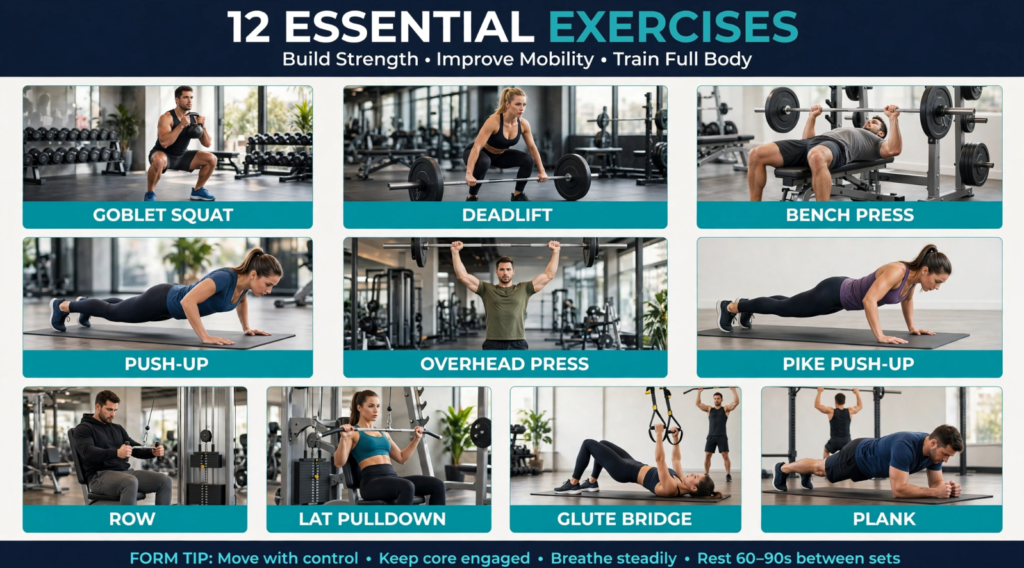
Perform these twice weekly on non-running days or after an easy run. They target the muscles that absorb impact and stabilize your joints. No gym required.
1. Glute Bridge (or Single-Leg Glute Bridge)
Lie on your back, knees bent, feet flat. Squeeze your glutes and lift your hips until your body forms a straight line from shoulders to knees. Hold for 2 seconds, lower slowly. 3 sets of 15. Progress to single-leg bridges when ready. Why: Strong glutes prevent the hip drop that causes IT band syndrome and patellofemoral pain.
2. Bulgarian Split Squat
Stand 2 feet in front of a chair or bench, place the top of your rear foot on it. Lower your front knee into a deep lunge, keeping your torso upright. Drive through your front heel to stand. 3 sets of 8–10 per leg. Why: Unilateral leg strength is the bedrock of running power and knee stability. This also stretches tight hip flexors.
3. Calf Raises (Straight-Knee and Bent-Knee)
Stand on a step edge, heels hanging off. Perform 15 straight-knee raises (gastrocnemius), then immediately 15 bent-knee raises (soleus). 3 rounds. Why: The calf-Achilles complex stores and releases elastic energy with every step. Strong, resilient calves fend off Achilles tendinopathy and plantar fasciitis.
4. Side-Lying Leg Raises or Banded Clamshells
Lie on your side, top leg straight. Raise it to 45 degrees, keeping the foot parallel to the floor. Lower slowly. 3 sets of 15 per side. Why: The gluteus medius stabilizes your pelvis. A weak glute medius is the root cause of runner’s knee and hip bursitis.
5. Plank and Dead Bug
Plank: hold a straight body line for 45–60 seconds. Dead bug: lie on your back, arms and legs extended toward the ceiling, and slowly lower opposite arm and leg while keeping your lower back pressed flat. 3 sets of 10 per side. Why: A stable core prevents energy leaks and excessive spinal motion that leads to low back pain on longer runs.
Section 6: Gearing Up—Shoes, Surfaces, and Tech
Shoes:
Go to a dedicated running store for a gait analysis. The right shoe for you depends on your foot shape, arch height, and strike pattern—not just cushion level. After 40, a slightly more cushioned, neutral daily trainer (e.g., Brooks Ghost, Hoka Clifton, New Balance 880) works well for most. Replace shoes every 300–400 miles. Worn-out shoes are a leading cause of new aches.
Surfaces:
Vary your terrain. Asphalt is harder than concrete but still high-impact. Dirt trails, grass fields, and crushed gravel paths reduce impact forces by 10–20%. The treadmill, while maligned by purists, offers a consistent, flat, low-impact surface that’s excellent for controlled easy runs and inclement weather.
Heart Rate Monitor:
A chest strap (Polar H10, Garmin HRM-Pro) is invaluable for keeping easy runs truly easy. It prevents you from drifting into the moderate-intensity black hole where recovery and aerobic development both suffer.
Apps:
Nike Run Club and Couch to 5K offer excellent free guided programs. Strava provides a motivating social community and tracks shoe mileage.
Section 7: Running and the VigorForty Cardio System
Running fits seamlessly into the broader aerobic and metabolic health framework.
Easy Runs = Zone 2
Three to four of your weekly runs should stay strictly in Zone 2, at conversational pace. These build mitochondria, fat-burning capacity, and capillary density without adding significant recovery debt. A 45–60 minute easy run is the backbone of your program.
One “Long” Run
Once you have a base, add a weekly long run that’s 20–25% of your total weekly volume, at an easy to steady pace. This builds endurance and time-on-feet resilience.
One Dose of Speed (Not HIIT—Running-Specific Speed)
After 4–6 months of consistent, injury-free running, add one short speed session per week, separate from your bike or rower HIIT day. Examples:
- Strides: 4–6 x 20 seconds at a fast, controlled pace (not a sprint) with full walking recovery. Do these after an easy run.
- Tempo Intervals: 3 x 5 minutes at a “comfortably hard” pace (you could speak a few words but not a full conversation) with 2 min jog recovery.
Sample Weekly Blend for the Fit Over-40 Runner:
- Monday: Strength (45 min) + 20 min Zone 2 bike
- Tuesday: 40 min easy run (Zone 2) + strides
- Wednesday: Rowing HIIT (Workout 2 from our HIIT guide) – 25 min
- Thursday: 35 min easy run (Zone 2)
- Friday: Strength (45 min)
- Saturday: 60–75 min long run (Zone 2, trails)
- Sunday: Rest or 60 min Zone 2 walk/ruck
Section 8: Nutrition and Hydration for the Mature Runner
Running increases calorie burn, but the goal is to fuel performance and recovery, not to outrun a poor diet.
- Pre-Run (Easy Runs Under 60 min): Water is sufficient. If you run first thing in the morning, a black coffee with a splash of milk can provide a gentle lift. Avoid heavy meals.
- Pre-Run (Long Runs or Speed Days): A small carbohydrate snack 30–60 minutes prior—half a banana, a rice cake with almond butter, or a piece of toast. This tops off glycogen and reduces the stress hormone response.
- During Runs Over 75 minutes: 30–60 grams of carbohydrate per hour from gels, chews, or real food (raisins, a mashed sweet potato pouch). Electrolytes (sodium, potassium) become essential in warm weather. A simple mix of water with a pinch of salt and a splash of juice works.
- Post-Run Recovery Window: Aim for 25–40 grams of protein within 60–90 minutes, paired with carbohydrates to replenish glycogen. Chocolate milk, a protein smoothie, or eggs on toast are all excellent. This window matters more after 40 as muscle protein synthesis is less efficient.
- Chronic Undereating Warning: Many midlife runners struggle with stubborn fat not because they’re eating too much, but because they’re under-eating relative to their training load, elevating cortisol and slowing metabolism. Fuel your runs adequately, and body composition will improve more reliably than if you run on fumes.
Section 9: FAQ—Your Top Running After 40 Questions
Q: I’m 55 and haven’t run since my 20s. Is it too late to start?
A: Absolutely not. The physiological adaptations—lower resting heart rate, increased mitochondrial density, improved bone mineral density—occur at any age. The 8-week run-walk plan in Section 3 is precisely designed for you. The key is patience; in three months, you can safely be running 20–30 minutes at a time.
Q: What if I have bad knees?
A: First, see a sports medicine physician or physical therapist to diagnose the specific issue. In many cases, running can be part of the solution, not the cause. Start with pool running to condition the cardiovascular system with zero impact. Then transition to a track or treadmill with a very slow walk-run protocol, while aggressively strengthening your hips and quads. Knee braces or sleeves can provide proprioceptive feedback, but they don’t fix underlying weakness.
Q: How do I know if a pain is “good” soreness or an injury?
A: Soreness is typically diffuse, appears 24–48 hours post-run, and improves with gentle movement. Injury pain is often sharp, localized (you can point to it with one finger), appears during or immediately after a run, and may swell or worsen with activity. If a pain changes your gait—you start limping—stop running. A physical therapist evaluation is warranted if pain persists for more than 3–5 days despite rest.
Q: I want to lose belly fat. Is running better than walking?
A: Running burns more calories per minute than walking, so total calorie expenditure is higher for a given duration. However, walking carries nearly zero injury risk and can be done daily. The best strategy is a combination: run 2–3 days per week for high caloric burn and cardiovascular benefit, and walk on the other days to promote active recovery and metabolic health without accumulating fatigue. Combine this with the strength and nutrition principles outlined above, and the visceral fat will start to disappear.
Q: Should I get a running coach?
A: For the vast majority of recreational runners over 40, a well-designed online program and a community running group are sufficient. If you’re training for a specific, ambitious goal (a marathon, a sub-2-hour half marathon) or have a history of running injuries, a qualified local running coach who can watch your form in person is a worthwhile investment.
The VigorForty Take
Running after 40 is not about proving anything to your younger self. It’s about building a durable, resilient body that can chase kids, hike mountains, and wake up without stiffness for decades to come. The road is always there, waiting for you—whether it’s the asphalt streets of your neighborhood, a crushed gravel path in your local park, or a treadmill in your basement with a fan and a good podcast.
Start with the run-walk plan. Prioritize hip and core strength. Keep most of your miles easy and conversational. Listen to your body’s whispers before they become screams. And remember: the goal is not to run a marathon next month. The goal is to still be running, pain-free and happy, at 65, 75, and beyond.
Your feet have carried you through life so far. Treat them with patience, respect, and a pair of good shoes, and they’ll take you places you never imagined. The first mile of your midlife running journey starts the moment you step out the door. See you on the road.
Read All Related Articles
- The Complete Guide to Zone 2 Training After 40: How Low-Intensity Cardio Boosts Fat Loss, Longevity, and Endurance
- The Complete Guide to HIIT After 40: Joint-Friendly Workouts That Torch Fat and Protect Your Heart
- The Complete Guide to Running After 40: How to Start, Stay Injury-Free, and Build Lifelong Endurance
- The Complete Guide to Metabolic Health After 40: Reverse Insulin Resistance, Burn Stubborn Fat, and Reclaim Your Energy with Cardio
- The Complete Guide to Cardio Recovery After 40: How to Rest, Rebuild, and Come Back Stronger
- The Complete Guide to Heart Rate Training Zones After 40: Unlock Every Beat for Maximum Fat Loss, Endurance, and Longevity
- The Complete Guide to VO2 Max After 40: The #1 Predictor of Longevity and How to Improve It
- The Complete Guide to Concurrent Training After 40: How to Combine Cardio and Strength for Maximum Fat Loss, Muscle Preservation, and Longevity
- The Complete Guide to Walking and Rucking After 40: The Most Underrated Cardio for Fat Loss, Joint Health, and Longevity
- The Complete Guide to Designing Your Own Cardio Plan After 40: A Personalized Blueprint for Fat Loss, Longevity, and Peak Performance
- The Complete Guide to Cardio Nutrition After 40: Fuel Your Workouts for Maximum Fat Loss, Endurance, and Recovery
- The Complete Guide to Cardio Equipment After 40: Choosing the Best Treadmill, Bike, Rower, or Elliptical for Your Home Gym
- The Complete Guide to Injury Prevention for Cardio After 40: Run, Ride, and Ruck Pain-Free for Life
- The Complete Guide to Cardio for Fat Loss After 40: Burn Stubborn Belly Fat Without Losing Muscle or Energy
- The Complete Guide to Seasonal Cardio Training After 40: How to Periodize Your Year for Year-Round Fitness, Fat Loss, and Injury Prevention
- The Complete Guide to Cardio and Brain Health After 40: How Exercise Protects Your Memory, Mood, and Mental Sharpness
- The Complete Guide to Building a Home Gym for Cardio After 40: Design a Space That Makes Consistency Inevitable
- The Joyful Movement Manifesto: How to Love Cardio After 40 and Make It a Lifelong Practice
- The Complete Guide to Sleep and Cardio After 40: How Deep Rest Unlocks Your Best Performance, Recovery, and Longevity
- The Complete Guide to Stress, Cortisol, and Cardio After 40: How to Manage Your Nervous System for Better Recovery and Performance
- The Complete Guide to Returning to Cardio After a Layoff After 40: Your Compassionate, Science-Backed Roadmap Back to Fitness
- The Complete Guide to Cardio Through Menopause: How to Adapt Your Training for Hormonal Changes, Protect Your Heart, and Feel Strong After 40
- The Complete Guide to Cycling After 40: Low-Impact Cardio for Joint Health, Endurance, and Lifelong Fitness
- The Complete Guide to Pool and Water-Based Cardio After 40: Low-Impact Workouts for Joint Pain, Recovery, and Total-Body Fitness
- The Complete Guide to Rowing After 40: Full-Body, Low-Impact Cardio for Strength, Endurance, and Longevity
- The Complete Guide to Tracking Cardio Progress After 40: The Key Metrics That Matter More Than the Scale
- The Complete Guide to Cardio for High Blood Pressure After 40: How Exercise Lowers Your Numbers and Protects Your Heart
- The Complete Guide to Cardio for Type 2 Diabetes and Prediabetes After 40: How Exercise Reverses Insulin Resistance and Protects Your Heart
- The Complete Guide to Cardio with Arthritis After 40: Pain-Free Workouts That Strengthen Joints and Keep You Moving
- The Complete Guide to Longevity and Cardio After 40: How Aerobic Fitness Adds Years to Your Life and Life to Your Years
- The Complete Guide to Building a Cardio Habit After 40: The Science of Making Exercise Stick for Life
- The Complete Guide to Cardio and Immune Health After 40: Strengthen Your Body’s Defense System for a Resilient, Vibrant Life
- The Complete Guide to Cardio While Traveling After 40: Stay Fit on the Road, in Hotels, and Away from Home
- The Complete Guide to Cardio for Posture and Back Pain After 40: Strengthen Your Posterior Chain and Reverse the Damage of Sitting
- The Complete Guide to the Social Side of Cardio After 40: How Community, Accountability, and Connection Make You Stronger
- The VigorForty Manifesto: A Final Word on the Lifelong Practice of Movement