Author: Vigor Forty Editorial Team
Medically Reviewed By: Editorial Review Board
Disclaimer: This article is for informational purposes only and is not a substitute for professional medical or mental health advice. Read our full Medical Disclaimer.
📌 Key Takeaways
- Loneliness Is as Dangerous as Smoking 15 Cigarettes a Day—Social Cardio Is the Antidote: The U.S. Surgeon General has declared an epidemic of loneliness and social isolation, which carries cardiovascular risks comparable to obesity and smoking. A running club, cycling group, or rucking partner provides not just accountability, but a direct, life-extending dose of social connection.
- The “Köhler Effect” Makes You Work Harder Together: Research in group dynamics shows that individuals exert significantly more effort in a group setting than they do alone, especially when they are the slightly weaker member of the partnership. A workout partner naturally pulls you to a higher level of performance without you even realizing it.
- Accountability Is the Glue of Consistency: On a dark, cold morning when your alarm goes off at 5:30 a.m., knowing that your friend is waiting for you in the park is a more powerful motivator than any internal pep talk. External accountability bridges the gap between intention and action when internal motivation inevitably fluctuates.
- Group Cardio Unlocks a Unique “Collective Joy”: The synchronized rhythm of a group run, the shared suffering of a tough interval session, and the post-workout coffee with friends activate the endocannabinoid system and release oxytocin, the “bonding hormone.” This creates a positive feedback loop where exercise becomes something you crave not just for the physical sensation, but for the emotional connection.
- It’s Never Too Late to Find Your Fit Tribe: Whether it’s a formal running club, a charity training team, a social media group that organizes meetups, or just one consistent rucking buddy, your people are out there. After 40, the barrier to entry is lower than you think—many clubs cater specifically to beginners and masters athletes.
Introduction: The Hidden Ingredient in Every Successful Fitness Story
If we strip away the heart rate monitors, the periodized training plans, the nutritional protocols, and the high-tech gear, we find a simple, ancient truth at the core of human movement: we are designed to move together. From the coordinated persistence hunts of our ancestors to the Olympic stadiums of today, physical exertion has always been a communal act. The lone wolf athlete, grinding in solitude, is a modern invention—and while solitude has its place, for many midlife Americans, it’s a recipe for stagnation and loneliness.
After 40, our social circles often shrink. Careers become more demanding, families require more attention, and the effortless social connections of our school years and early adulthood fade into memory. For many, the gym or the running trail becomes an isolated, solitary pursuit. We put in our headphones, zone out, and get the work done. And while that solo Zone 2 session can be a deeply meditative and restorative practice, if it’s all you ever do, you’re missing out on a powerful dimension of health: the social one.
The evidence is overwhelming. A meta-analysis of 148 studies found that the magnitude of the effect of social relationships on mortality risk is comparable to that of quitting smoking, and exceeds that of obesity and physical inactivity. In other words, a strong social network is a potent, life-extending medicine. When you combine that medicine with the known benefits of cardio, you create a synergistic health intervention of extraordinary power. This guide explores why training with others works, how to find your fit tribe, how to structure a social cardio session, and how to balance the quiet of solo work with the camaraderie of the pack. Your heart, your brain, and your social life will all be stronger for it.
Section 1: The Neuroscience of Shared Sweat—Why We Are Wired to Move Together
The phenomenon of group exercise isn’t just a cultural trend; it’s rooted in deep neurobiology.
The Endorphin and Endocannabinoid Rush Is Amplified
A landmark 2010 study from Oxford University found that rowers who trained together in a synchronized group had significantly higher endorphin release than those who trained alone at the same intensity. The coordinated, rhythmic movement of a group—running in step, cycling in a paceline, rowing in unison—triggers a flood of endorphins and endocannabinoids, the “runner’s high” compounds. This shared high creates a sense of euphoria and bonding that is deeply rewarding, making you want to return for more.
Oxytocin: The Trust and Bonding Molecule
Social interaction, physical touch (a high-five, a pat on the back), and shared challenging experiences release oxytocin, the “love hormone.” Oxytocin is a direct counterweight to cortisol. It lowers blood pressure, reduces anxiety, and promotes feelings of trust and connection. A workout with a friend is a cortisol-lowering, oxytocin-boosting cocktail that a solo workout cannot replicate.
The Köhler Effect: The Invisible Hand That Pushes You
A well-established finding in social psychology, the Köhler Effect demonstrates that a person working as part of a group will work harder than they would alone, particularly if they perceive themselves as the slightly less capable member of the dyad. You don’t want to let your partner down, so you push just a little harder. This effect is strong, unconscious, and completely absent when you’re training solo.
Section 2: The Spectrum of Social Cardio—Finding Your Fit
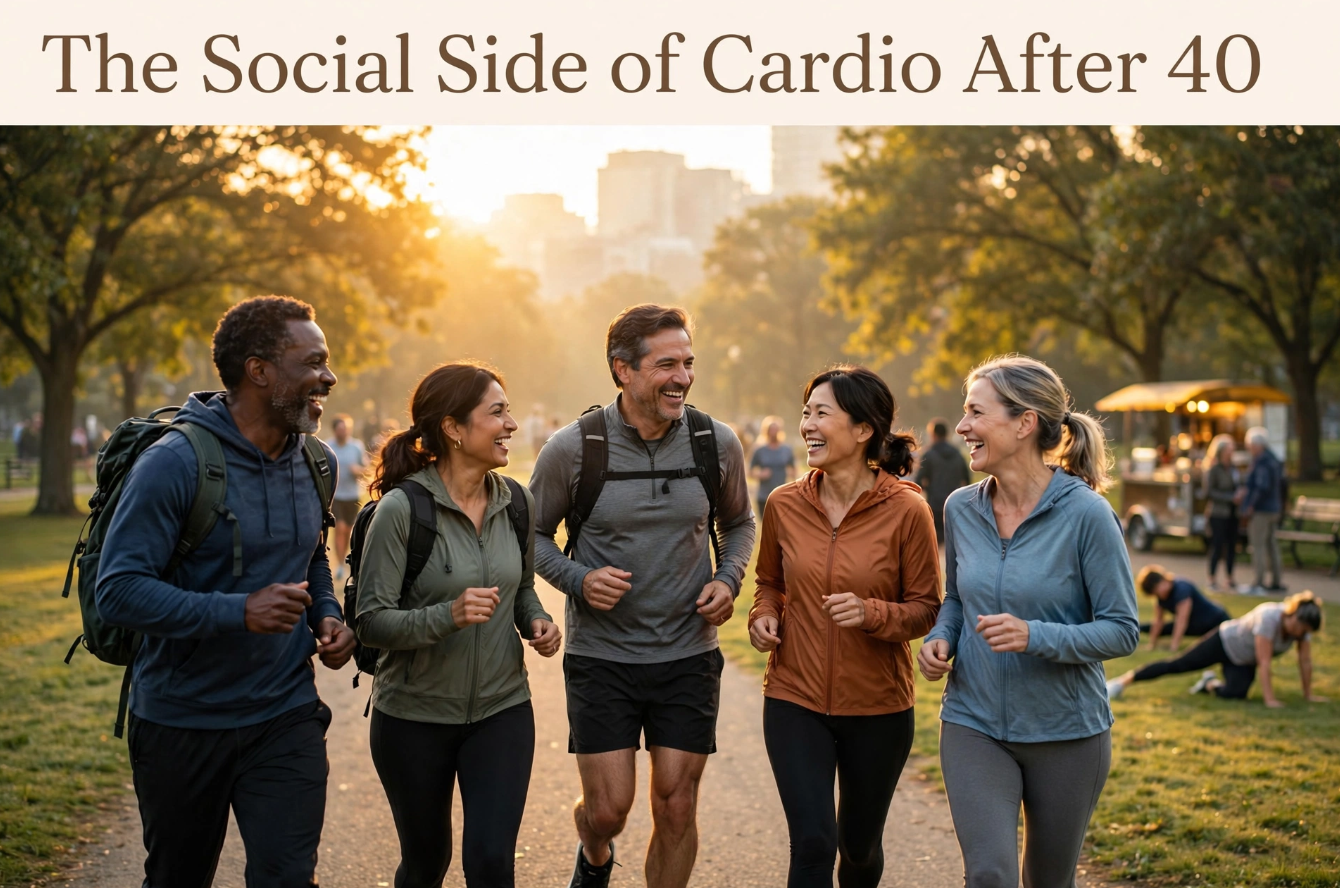
“Social cardio” doesn’t mean you have to join a 50-person peloton. There’s a spectrum, and finding the right level of engagement is key.
The Intimate Duo (The Accountability Partner)
One consistent partner. You meet every Tuesday and Thursday at 6 a.m. for a ruck. You know each other’s lives, families, and struggles. The workout is as much a therapy session as a physical one. This is the deepest level of social connection and the most powerful form of accountability. Choose wisely: someone with a similar schedule, fitness level, and a positive attitude.
The Small Crew (The Saturday Morning Group)
A group of 3–10 people who meet regularly. A local trail running group, a weekly gravel cycling ride, a small group that meets at the park for a HIIT circuit. The energy is higher, the conversation is livelier, and there’s always someone a little faster to chase and someone a little slower to encourage. This is a sweet spot for many, offering community without the intimidation of a huge club.
The Organized Club or Charity Team
A local running club, a Masters swim team, a cycling club, or a charity training team (e.g., Team in Training for leukemia, or a local heart association team). These provide structured workouts, coaching, a clear calendar, and a powerful sense of shared purpose. The charity angle adds an extra layer of meaning that transcends individual fitness goals.
The Digital Tribe (Social Apps and Virtual Challenges)
Strava, Zwift, Peloton communities, and online challenges like the Conqueror virtual races provide a form of social connection for those who prefer to train solo but still crave the accountability and camaraderie of a community. Seeing a friend’s completed run on Strava can be the nudge you need to lace up your own shoes. Virtual high-fives and leaderboards tap into the same competitive and social drives that in-person groups do. This can be a gateway or a supplement, but for most, it shouldn’t be the sole source of social cardio.
Section 3: How to Structure a Social Cardio Session
Mixing social cardio into your program requires some flexibility, but the trade-off is worth it.
The Social Zone 2 Session (The “Chatty Run”)
This is the staple. A 45–75 minute conversational-paced run, ruck, or ride. The primary goal is aerobic base-building and social connection. Keep the pace strictly in Zone 2—if you can’t speak in full paragraphs, you’re going too fast. These sessions should be a joy, not a test of willpower. They are the glue that holds a group together.
The Group Interval Session (Accountability in the Pain Cave)
A track workout, a hill repeat session, or a group HIIT class. The shared suffering of high-intensity intervals is profoundly bonding. You’re all in the same pain cave, encouraging each other through the last rep. A coach or a rotating “leader” can call the intervals, removing the mental burden of timing and pacing. This is where the Köhler Effect shines.
The Weekend Adventure (Long, Slow, Social)
A 2–3 hour hike, a long gravel ride to a scenic destination, or a ruck that ends at a favorite brewery or coffee shop. The goal is time on feet, exploration, and deep conversation. These are the workouts that become cherished memories and strengthen friendships for years.
The Post-Workout Ritual
Do not underestimate the power of the coffee, smoothie, or breakfast after the workout. This is where the real bonding happens. The workout is the shared effort; the coffee is the shared reward. It’s during these moments that life is discussed, problems are shared, and the fabric of the community is woven. Make the 15-minute post-workout hang a non-negotiable part of the session.
Section 4: Finding Your People After 40
If your current social circle doesn’t include active people, it can feel daunting to break in. Here’s your roadmap.
- Start with Your Existing Network: Mention on your social media or in casual conversation that you’re looking for a walking or running buddy. You might be surprised who’s also looking for the same thing.
- Visit Your Local Running or Outdoor Store: They are the hubs of the local community. They host free weekly group runs, walks, and rides, and they have bulletin boards with information on local clubs and events. The staff are passionate and welcoming.
- Use Meetup and Facebook Groups: Search for “[Your City] Running Club,” “[Your City] Hiking Group,” or “[Your City] Masters Cycling.” There are active, beginner-friendly groups in almost every American city and town.
- Sign Up for a Race or Event: Training for a specific event with a charity team is one of the easiest and most rewarding ways to find an instant, structured, and supportive community.
- Be the Initiator: If you can’t find the group you want, start one. Post in a local community group: “Any 40+ folks want to meet for a Saturday morning ruck and coffee? Beginners welcome.” You’ll be amazed at the response. The world is full of people waiting for someone else to make the first invitation.
Section 5: Balancing Solo and Social Cardio
The ideal training week often blends both. Use this framework to find your balance.
| Type of Session | Best Done | Why |
|---|---|---|
| Hard HIIT or VO2 Max Intervals | Often better with a group or partner | The Köhler Effect pushes you harder; shared accountability gets you out the door for a tough session. |
| Long Zone 2 Endurance | Perfect for a small group | The hours fly by in conversation; the social connection sustains the effort. |
| Recovery and Easy Zone 2 | Often better solo | You need to be able to truly listen to your body, dial the pace down, and not compete. Solo time is also a form of mental recovery. |
| Strength Training | Can be either, but often better solo or with one focused partner | Rest intervals are precise; conversation can distract from form and effort. But a good spotter and training partner is invaluable for safety. |
| Mobility and Breathwork | Best solo or in a quiet, restorative class | This is about internal listening and nervous system regulation, which is best done without social pressure. |
A sample balanced week: Solo Zone 2 on Monday (recovery), group HIIT on Wednesday (social intensity), solo strength on Thursday, and a long social ruck on Saturday morning, followed by coffee.
Section 6: FAQ—Your Social Cardio Questions Answered
Q: I’m an introvert, and group exercise sounds exhausting. Do I have to do this?
A: No. The VigorForty system is a buffet, not a prescription. If solo training is your sanctuary and you have a robust social life outside of exercise, honor that. However, if you find that your solo workouts are becoming a chore or your motivation is flagging, consider experimenting with just one intimate, low-pressure social session per week. An “introvert-friendly” social workout might be a quiet trail run with one other person, without the pressure of a large, chatty group.
Q: I’m slow and out of shape. I’m embarrassed to join a group.
A: This is the most common and most unnecessary fear. Every single member of that running club started somewhere. The vast majority of groups have multiple pace groups, including a walk/run group and a dedicated beginners’ group. The kindness and encouragement found in these communities is often staggering. Your presence is not a burden; it’s an inspiration. The only requirement is showing up. If you encounter a group that isn’t welcoming, find a different one; they are the exception, not the rule.
Q: My partner isn’t into fitness. Can I still have a social cardio life?
A: Absolutely. Your workout partner doesn’t have to be your life partner. Having a separate, dedicated training friend or group can be a healthy, independent part of your identity. Communicate with your partner about the importance of this time for your physical and mental health, and schedule it in a way that respects your shared responsibilities.
Q: I travel a lot for work. How can I maintain social accountability?
A: Use digital tools. Stay connected to your home group via Strava or a group chat. When you’re on the road, use the Meetup app or search for local drop-in run clubs. Many shops host evening runs that are perfect for visiting runners. A shared social cardio session is one of the best ways to experience a new city.
The VigorForty Take
You are not a solitary engine that simply needs fuel and maintenance. You are a social being, wired from the depths of your evolutionary past to move, sweat, laugh, and struggle alongside others. The isolation of modern midlife is a health risk as real as high blood pressure or a sedentary lifestyle, and the remedy is not a pill but a person—a friend, a partner, a group, a tribe.
The shared miles, the conversations that flow more freely when you’re side-by-side rather than face-to-face, the coffee that tastes better after a hard effort, the accountability that pulls you out of bed on a dark winter morning—these are not nice-to-have extras. They are essential components of a complete, resilient, and joyful cardio practice. You were never meant to do this alone. So call a friend, find a club, or be the one to start the group. Your heart, your brain, and your spirit will be fuller for it. And you might just find that the people you meet along the way become as vital to your health as the very miles you share.
Read All Related Articles
- The Complete Guide to Zone 2 Training After 40: How Low-Intensity Cardio Boosts Fat Loss, Longevity, and Endurance
- The Complete Guide to HIIT After 40: Joint-Friendly Workouts That Torch Fat and Protect Your Heart
- The Complete Guide to Running After 40: How to Start, Stay Injury-Free, and Build Lifelong Endurance
- The Complete Guide to Metabolic Health After 40: Reverse Insulin Resistance, Burn Stubborn Fat, and Reclaim Your Energy with Cardio
- The Complete Guide to Cardio Recovery After 40: How to Rest, Rebuild, and Come Back Stronger
- The Complete Guide to Heart Rate Training Zones After 40: Unlock Every Beat for Maximum Fat Loss, Endurance, and Longevity
- The Complete Guide to VO2 Max After 40: The #1 Predictor of Longevity and How to Improve It
- The Complete Guide to Concurrent Training After 40: How to Combine Cardio and Strength for Maximum Fat Loss, Muscle Preservation, and Longevity
- The Complete Guide to Walking and Rucking After 40: The Most Underrated Cardio for Fat Loss, Joint Health, and Longevity
- The Complete Guide to Designing Your Own Cardio Plan After 40: A Personalized Blueprint for Fat Loss, Longevity, and Peak Performance
- The Complete Guide to Cardio Nutrition After 40: Fuel Your Workouts for Maximum Fat Loss, Endurance, and Recovery
- The Complete Guide to Cardio Equipment After 40: Choosing the Best Treadmill, Bike, Rower, or Elliptical for Your Home Gym
- The Complete Guide to Injury Prevention for Cardio After 40: Run, Ride, and Ruck Pain-Free for Life
- The Complete Guide to Cardio for Fat Loss After 40: Burn Stubborn Belly Fat Without Losing Muscle or Energy
- The Complete Guide to Seasonal Cardio Training After 40: How to Periodize Your Year for Year-Round Fitness, Fat Loss, and Injury Prevention
- The Complete Guide to Cardio and Brain Health After 40: How Exercise Protects Your Memory, Mood, and Mental Sharpness
- The Complete Guide to Building a Home Gym for Cardio After 40: Design a Space That Makes Consistency Inevitable
- The Joyful Movement Manifesto: How to Love Cardio After 40 and Make It a Lifelong Practice
- The Complete Guide to Sleep and Cardio After 40: How Deep Rest Unlocks Your Best Performance, Recovery, and Longevity
- The Complete Guide to Stress, Cortisol, and Cardio After 40: How to Manage Your Nervous System for Better Recovery and Performance
- The Complete Guide to Returning to Cardio After a Layoff After 40: Your Compassionate, Science-Backed Roadmap Back to Fitness
- The Complete Guide to Cardio Through Menopause: How to Adapt Your Training for Hormonal Changes, Protect Your Heart, and Feel Strong After 40
- The Complete Guide to Cycling After 40: Low-Impact Cardio for Joint Health, Endurance, and Lifelong Fitness
- The Complete Guide to Pool and Water-Based Cardio After 40: Low-Impact Workouts for Joint Pain, Recovery, and Total-Body Fitness
- The Complete Guide to Rowing After 40: Full-Body, Low-Impact Cardio for Strength, Endurance, and Longevity
- The Complete Guide to Tracking Cardio Progress After 40: The Key Metrics That Matter More Than the Scale
- The Complete Guide to Cardio for High Blood Pressure After 40: How Exercise Lowers Your Numbers and Protects Your Heart
- The Complete Guide to Cardio for Type 2 Diabetes and Prediabetes After 40: How Exercise Reverses Insulin Resistance and Protects Your Heart
- The Complete Guide to Cardio with Arthritis After 40: Pain-Free Workouts That Strengthen Joints and Keep You Moving
- The Complete Guide to Longevity and Cardio After 40: How Aerobic Fitness Adds Years to Your Life and Life to Your Years
- The Complete Guide to Building a Cardio Habit After 40: The Science of Making Exercise Stick for Life
- The Complete Guide to Cardio and Immune Health After 40: Strengthen Your Body’s Defense System for a Resilient, Vibrant Life
- The Complete Guide to Cardio While Traveling After 40: Stay Fit on the Road, in Hotels, and Away from Home
- The Complete Guide to Cardio for Posture and Back Pain After 40: Strengthen Your Posterior Chain and Reverse the Damage of Sitting
- The Complete Guide to the Social Side of Cardio After 40: How Community, Accountability, and Connection Make You Stronger
- The VigorForty Manifesto: A Final Word on the Lifelong Practice of Movement