Author: Vigor Forty Editorial Team
Medically Reviewed By: Editorial Review Board
Disclaimer: This article is for informational purposes only and is not a substitute for professional medical advice. Always consult your physician before starting a new exercise program, and ensure your bike is properly fitted to your body. Read our full Medical Disclaimer.
📌 Key Takeaways
- Cycling Is the Quintessential Low-Impact, High-Reward Cardio for Midlife: The smooth, circular pedal stroke eliminates the pounding of running, making it one of the safest modalities for those with arthritic knees, hip issues, or lower back pain. It allows you to build a massive aerobic engine without accumulating joint microtrauma.
- It’s Both a Zone 2 Powerhouse and a HIIT Weapon: A long, steady outdoor ride or a structured indoor session on a smart trainer is one of the most effective ways to accumulate Zone 2 volume. Simultaneously, an air bike or a stationary bike allows for precise, joint-safe HIIT intervals that spike VO2 max and insulin sensitivity.
- Bike Fit Is Non-Negotiable After 40: The difference between a bike that feels like a magic carpet and one that causes knee pain, numb hands, and a sore neck is almost always fit. A professional bike fit is the best investment you can make in your cycling longevity, addressing the subtle postural and flexibility changes that come with age.
- Indoor Cycling Has Exploded and Offers Unmatched Convenience: Smart trainers, dedicated stationary bikes (Peloton, NordicTrack, Concept2 BikeErg), and apps like Zwift and TrainerRoad have transformed indoor cycling from a dull chore into an engaging, data-rich, community-driven experience. For the time-crunched midlife American, the ability to get a world-class workout in 45 minutes without leaving home is a game-changer.
- Safety on the Road Is a Paramount Concern After 40: Reaction times are slightly slower, and recovery from a crash is more prolonged. A focus on daytime riding, bright clothing, high-quality lights, a helmet with MIPS technology, and choosing routes with dedicated bike lanes or low traffic is essential to enjoy cycling safely for decades.
Introduction: The Freedom of Two Wheels, Rediscovered in Midlife
Remember the first time you rode a bike? The wobbly, heart-pounding moment the training wheels came off and you glided down the driveway, a new world of speed and freedom opening up. That same sense of liberation is waiting for you after 40. Cycling is unique among cardio modalities: it’s simultaneously a gentle, rehab-friendly movement for aching joints and a ferociously effective tool for building Tour de France-level cardiovascular fitness. It scales from a leisurely beach cruise with your partner to a lung-searing VO2 max interval session.
For the American over 40, cycling solves many of the problems that other forms of cardio present. Your knees don’t love running? The bike welcomes them. You’re carrying extra weight and feel self-conscious at the gym? The bike doesn’t care; it meets you where you are. You want to explore your local backroads, state parks, and rail-trails while getting a workout? The bike is your passport.
The modern cycling landscape is also richer than ever. You can ride a gravel bike through a national forest, join a social group ride on a Saturday morning, or clip into a smart trainer in your basement and race a friend in London via Zwift. The options are vast, which is both a blessing and a potential source of overwhelm. This guide cuts through the noise. It’s your complete manual for cycling after 40: the physiological benefits, the different types of cycling, the sacred art of bike fit, how to train using your VigorForty heart rate zones on the bike, nutrition for long rides, and a clear safety protocol for the open road. Whether you’re dusting off a 20-year-old hybrid in the garage or considering investing in a dedicated indoor setup, this guide will get you rolling with confidence, joy, and a deep sense of physical well-being.
Section 1: Why Cycling Is Ideal for the Over-40 Body
The physiological case for cycling as a primary or secondary cardio modality after 40 is compelling.
Truly Low-Impact, Joint-Nourishing Movement
Unlike running, where each foot strike sends a shockwave of two to three times your body weight through your knees, hips, and spine, cycling is a closed-chain, non-impact motion. Your feet never leave the pedals. This makes it an option for individuals with osteoarthritis, meniscus tears, hip labrum issues, and chronic lower back pain—conditions that would preclude running or high-impact HIIT. The repetitive, smooth motion also bathes the knee and hip cartilage in synovial fluid, delivering nutrients and removing waste, which can be therapeutic rather than destructive.
Customizable Intensity from Rehab to Race Pace
A stationary bike or a flat outdoor path allows you to precisely control your effort level. You can spin at 50 watts in Zone 1 for active recovery, settle into a fat-burning Zone 2 pace for two hours, or hammer out 30-second maximal sprints in Zone 5. No other modality offers such a seamless transition from clinical rehabilitation to elite performance. For the 40+ body that needs variety and the ability to downshift on high-stress days, this is invaluable.
Excellent for Building the Aerobic Base
Sustained Zone 2 cycling is one of the most effective ways to build mitochondrial density and capillary networks. The large muscle groups of the quadriceps, hamstrings, and glutes demand a significant amount of oxygen, providing a powerful stimulus for cardiovascular adaptation. Because cycling is so metabolically efficient, you can accumulate large volumes of Zone 2 work without the muscular damage and systemic fatigue that comes with equivalent running volume.
A Metabolic and Cognitive Boost
A 2017 study found that cycling to work was associated with a 41% lower risk of dying from all causes compared to driving or taking public transport. Regular cycling improves insulin sensitivity, lowers resting heart rate, and reduces visceral fat. Outdoors, the combination of rhythmic movement and changing scenery provides a meditative, stress-dissolving effect.
Section 2: Choosing Your Ride—The Main Types of Cycling for the Midlife Athlete
The bike you choose defines your experience. Each type has its own strengths.
Road Cycling
- What It Is: Lightweight bikes with drop handlebars and skinny tires, built for speed and efficiency on paved surfaces.
- Best For: Long Zone 2 rides, group rides, covering significant distance, climbing hills.
- Midlife Considerations: The forward-leaning, aerodynamic position can be tough on the lower back, neck, and wrists if mobility is limited (see our Mobility Guide). An “endurance” road bike geometry, which sits the rider slightly more upright, is more forgiving than an aggressive “race” geometry. Vibrations from rough pavement can fatigue the hands and shoulders.
Gravel and Adventure Bikes
- What It Is: Road bikes with wider, knobby tires, a more relaxed geometry, and often additional mounting points for bags. Designed for mixed surfaces—pavement, gravel, dirt.
- Best For: The midlife American who wants to explore backroads, rail-trails, and fire roads. The most versatile “do-it-all” bike.
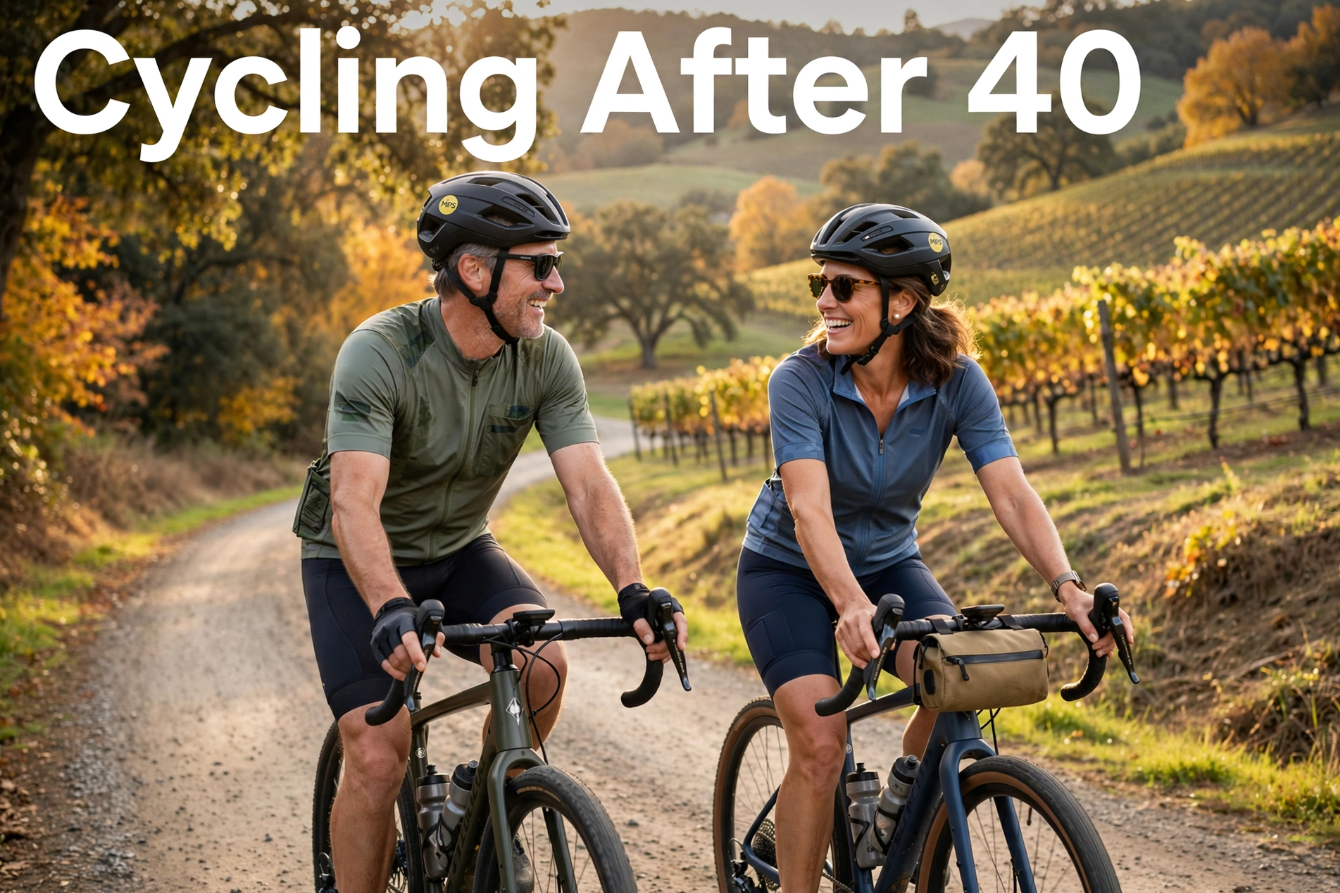
- Midlife Considerations: The more upright position, stable handling, and wider tires (which absorb vibration) make gravel bikes exceptionally comfortable for the 40+ rider. They open up routes free from car traffic, significantly enhancing safety.
Mountain Biking
- What It Is: Bikes with front or full suspension, flat handlebars, and aggressive knobby tires, designed for off-road trails.
- Best For: Technical trail riding, adrenaline, full-body engagement, connection to nature.
- Midlife Considerations: Highest risk of falls and injury. Demands good core strength, balance, and quick reaction time. Best pursued with a skills clinic and progressive trail difficulty. The full-body workout and mental engagement are unparalleled, but the risk profile must be respected.
Hybrid and Comfort Bikes
- What It Is: Flat-handlebar bikes with a very upright riding position, often with a plush, cushioned saddle and sometimes suspension in the seat post or fork.
- Best For: Leisurely neighborhood rides, bike paths, errands around town, and those with significant back or neck limitations who prioritize comfort above all else.
- Midlife Considerations: The most accessible entry point. Very low strain on the neck and back. However, the upright position is aerodynamically inefficient and can put more weight on the sit bones, making long rides uncomfortable.
Indoor Cycling (Stationary Bikes and Smart Trainers)
- What It Is: Dedicated stationary bikes (Peloton, NordicTrack S22i, Concept2 BikeErg) or a “smart trainer” that your outdoor bike mounts onto (Wahoo Kickr, Tacx Neo).
- Best For: Time-efficient, weather-proof, data-driven training. Perfect for Zone 2 while watching a show, structured HIIT workouts, and virtual riding/racing on Zwift.
- Midlife Considerations: The ultimate convenience and safety. No cars, no weather, no flat tires. The downside is the lack of the outdoor sensory experience and the absence of the subtle balance and steering skills that outdoor riding maintains.
Section 3: The Sacred Art of Bike Fit—Why It Matters More After 40
The single biggest predictor of whether you’ll love cycling or abandon it with a sore neck and numb hands is bike fit. The bike is an adjustable machine that must be adapted to your unique body. After 40, with accumulated postural habits, old injuries, and reduced flexibility, a professional fit is not a luxury—it’s a prerequisite.
The Three Key Contact Points:
- Saddle: The right width (sit bone measurement), height, fore/aft position, and tilt. Too high and your hips rock, causing lower back pain. Too low and your knees ache. The nose tilted up and you’ll go numb in sensitive areas. A good saddle supports your ischial tuberosities (sit bones) without putting pressure on soft tissues.
- Feet/Pedals: The cleat position on a cycling shoe is critical. A millimeter of misalignment can cause knee pain, hot spots, and numbness. Many 40+ riders benefit from a slightly wider stance and more float in their pedals to accommodate the natural outward angle of the feet.
- Hands/Handlebar: The reach to the bars and the height of the bars relative to the saddle determine how much weight is on your hands and the angle of your neck. Too much reach and you’ll get neck pain, hand numbness, and shoulder tension. A slightly more upright position—raising the stem, using a shorter stem—is a common and wise adaptation for the midlife rider.
Professional Bike Fit: A trained bike fitter uses motion capture, a fit bike, and a physical assessment of your flexibility and asymmetries to dial in your position. It costs $200–400 and takes 2–3 hours. It is worth every penny in comfort, power transfer, and injury prevention. If you plan to ride regularly, start here.
Section 4: Training with Heart Rate Zones on the Bike
Cycling is perfectly suited to the heart rate zone training model we detailed in our Heart Rate Zones Guide.
Applying the Zones to the Bike:
- Zone 1 (Active Recovery): Very light spinning, flat road, low resistance. You’re barely breathing. Use for warm-up, cool-down, and recovery days.
- Zone 2 (Endurance Base): The bread and butter of your cycling volume. A steady, conversational pace. You can ride here for hours. This builds mitochondrial density, improves fat oxidation, and strengthens your heart without accumulating fatigue.
- Zone 3 (Tempo): A “comfortably hard” pace. You’re breathing deeply but controlled. This improves your lactate threshold. In cycling, this is often called “sweet spot” training.
- Zone 4 (Threshold): Hard, sustained efforts. Think of a 20-minute climb. Very challenging but just below the point of going anaerobic. These intervals raise your VO2 max ceiling.
- Zone 5 (VO2 Max/Anaerobic): All-out sprints or 3–5 minute maximal intervals. The bike is one of the safest places to do true Zone 5 work because there’s no impact.
A Sample Weekly Cycling-Focused Cardio Plan:
- Monday: Rest or 30 min Zone 1 recovery spin.
- Tuesday: HIIT on the bike: 6 x 30-second all-out sprints with 4 min easy spin recovery (Zone 5).
- Wednesday: 60 min Zone 2 endurance ride.
- Thursday: Strength training (full body).
- Friday: Tempo ride: 15 min warm-up, 2 x 20 minutes at Zone 3 with 10 min easy between, 10 min cool-down.
- Saturday: Long Zone 2 ride: 2–3 hours outdoors or 90–120 min indoors, steady conversational pace.
- Sunday: Active recovery: 45 min gentle walk or yoga.
Section 5: Nutrition for the Cyclist Over 40
The nutritional principles from our Cardio Nutrition Guide apply directly.
Pre-Ride Fueling:
- Short Ride (<90 min Zone 2): Can be done fasted or with a light, low-carb snack. Hydrate with water.
- Long Ride (>90 min, or with intensity): Eat a balanced meal with 1–2 g/kg of carbs 2–3 hours before. Oatmeal, a turkey sandwich, or a smoothie.
On-the-Bike Fueling (For Rides >90 Minutes):
- Consume 30–60 grams of carbohydrates per hour. This can be from sports drinks, gels, bananas, fig bars, or a peanut butter and honey sandwich. A mix of glucose and fructose sources (like a gel plus a banana) maximizes absorption and minimizes GI distress. Don’t forget electrolytes: 300–600 mg of sodium per hour, especially on hot days.
Post-Ride Recovery:
- The 60–90 minute window: 25–40 grams of protein and 0.5–1.0 g/kg of carbs. A recovery shake with whey protein and a banana is ideal and quick. Follow with a balanced meal within 2 hours.
Hydration: Sip consistently. For every pound lost during a ride, replenish with 16–20 oz of water.
Section 6: Safety on the Road—A Protocol for the Midlife Rider
The open road is where cycling’s joy is fullest, but it demands respect. After 40, we’re less visible than we think and slower to heal.
The Non-Negotiables:
- Helmet with MIPS: MIPS (Multi-directional Impact Protection System) reduces rotational forces on the brain during a crash. Replace your helmet every 3–5 years, or immediately after any impact.
- Daytime Running Lights: A bright, flashing red tail light and a solid white front light, even in broad daylight, dramatically increase your visibility to drivers.
- Bright, Contrasting Clothing: Neon yellow, orange, or green jerseys or vests. Avoid dark colors that blend into the road.
- A Mirror: A small mirror mounted on your helmet or handlebars allows you to see approaching cars without turning your head constantly.
- Route Selection: Prioritize roads with wide shoulders, dedicated bike lanes, and low traffic volume. Apps like Strava and Ride with GPS have heatmaps showing popular, safe cycling routes. Gravel and rail-trails eliminate the car danger entirely.
- Ride Predictably: Signal your turns. Hold a straight line. Don’t weave. Make eye contact with drivers at intersections. Assume they don’t see you.
- Group Riding: Joining a local cycling club or a group ride provides safety in numbers, social connection, and a structured learning environment for road etiquette.
Section 7: FAQ—Your Cycling Questions Answered
Q: My lower back hurts on the bike. What’s wrong?
A: The most common causes are a saddle that’s too high (causing your hips to rock), handlebars that are too low and far away (overstretching your back), or tight hamstrings and hip flexors that pull your pelvis out of alignment. A professional bike fit is the first step. Additionally, the core strengthening exercises in our Mobility and Injury Prevention Guides will provide the stability your lower back needs.
Q: Is indoor cycling as effective as outdoor cycling?
A: From a pure cardiovascular and metabolic standpoint, yes. A structured workout on a smart trainer is often more effective because there are no traffic lights, downhills, or tailwinds to interrupt the effort. What you lose is the variability of outdoor terrain, the balance and handling skills, the fresh air, and the psychological benefits of being in nature. A blend of both is ideal.
Q: I’m 55 and haven’t been on a bike in 30 years. Can I start?
A: Absolutely. Start with a comfort or hybrid bike. Find a flat, paved bike path free of cars. Aim for just 15–20 minutes of easy pedaling, three times a week. Let your sit bones adapt to the saddle over a few weeks (some initial soreness is normal; persistent numbness or pain is a fit issue). As your confidence and fitness grow, you can gradually increase duration and explore new terrain. The freedom and joy of cycling are waiting for you, exactly where you left them.
Q: How do I prevent numbness in my hands and groin area?
A: Hand numbness is often caused by too much weight on the hands due to a reach that’s too long or bars that are too low. Padded cycling gloves and a professional fit adjustment can resolve it. Groin numbness is a fit and saddle issue—a saddle that’s too narrow, too wide, or tilted incorrectly will put pressure on nerves and blood vessels. Do not ignore numbness; it can lead to long-term nerve damage. A proper saddle and fit will eliminate it.
The VigorForty Take
Cycling is a lifelong companion. It’s the sport you can do with your kids, your grandkids, and your friends. It’s the machine that takes you through vineyards, up mountain passes, along coastal highways, and through the quiet countryside of your own thoughts. It’s gentle on your joints and ferocious on your heart. It’s a community waiting at the local bike shop and a global one riding beside you on a screen in your basement.
After 40, the bike offers something profound: the ability to feel like a kid again, balanced on two wheels, wind on your face, moving through the world under your own power. It’s a form of freedom that doesn’t demand youth or a perfectly functioning body, just the willingness to pedal.
Invest in a bike that fits you. Get a professional fit. Start on quiet roads and bike paths. Layer in the VigorForty training principles—mostly Zone 2, a dash of HIIT, plenty of strength work off the bike—and you’ll have a recipe for a lifetime of cardiovascular health, mental clarity, and pure, simple joy. The road is waiting. All you have to do is push down on the pedal.
Read All Related Articles
- The Complete Guide to Zone 2 Training After 40: How Low-Intensity Cardio Boosts Fat Loss, Longevity, and Endurance
- The Complete Guide to HIIT After 40: Joint-Friendly Workouts That Torch Fat and Protect Your Heart
- The Complete Guide to Running After 40: How to Start, Stay Injury-Free, and Build Lifelong Endurance
- The Complete Guide to Metabolic Health After 40: Reverse Insulin Resistance, Burn Stubborn Fat, and Reclaim Your Energy with Cardio
- The Complete Guide to Cardio Recovery After 40: How to Rest, Rebuild, and Come Back Stronger
- The Complete Guide to Heart Rate Training Zones After 40: Unlock Every Beat for Maximum Fat Loss, Endurance, and Longevity
- The Complete Guide to VO2 Max After 40: The #1 Predictor of Longevity and How to Improve It
- The Complete Guide to Concurrent Training After 40: How to Combine Cardio and Strength for Maximum Fat Loss, Muscle Preservation, and Longevity
- The Complete Guide to Walking and Rucking After 40: The Most Underrated Cardio for Fat Loss, Joint Health, and Longevity
- The Complete Guide to Designing Your Own Cardio Plan After 40: A Personalized Blueprint for Fat Loss, Longevity, and Peak Performance
- The Complete Guide to Cardio Nutrition After 40: Fuel Your Workouts for Maximum Fat Loss, Endurance, and Recovery
- The Complete Guide to Cardio Equipment After 40: Choosing the Best Treadmill, Bike, Rower, or Elliptical for Your Home Gym
- The Complete Guide to Injury Prevention for Cardio After 40: Run, Ride, and Ruck Pain-Free for Life
- The Complete Guide to Cardio for Fat Loss After 40: Burn Stubborn Belly Fat Without Losing Muscle or Energy
- The Complete Guide to Seasonal Cardio Training After 40: How to Periodize Your Year for Year-Round Fitness, Fat Loss, and Injury Prevention
- The Complete Guide to Cardio and Brain Health After 40: How Exercise Protects Your Memory, Mood, and Mental Sharpness
- The Complete Guide to Building a Home Gym for Cardio After 40: Design a Space That Makes Consistency Inevitable
- The Joyful Movement Manifesto: How to Love Cardio After 40 and Make It a Lifelong Practice
- The Complete Guide to Sleep and Cardio After 40: How Deep Rest Unlocks Your Best Performance, Recovery, and Longevity
- The Complete Guide to Stress, Cortisol, and Cardio After 40: How to Manage Your Nervous System for Better Recovery and Performance
- The Complete Guide to Returning to Cardio After a Layoff After 40: Your Compassionate, Science-Backed Roadmap Back to Fitness
- The Complete Guide to Cardio Through Menopause: How to Adapt Your Training for Hormonal Changes, Protect Your Heart, and Feel Strong After 40
- The Complete Guide to Cycling After 40: Low-Impact Cardio for Joint Health, Endurance, and Lifelong Fitness
- The Complete Guide to Pool and Water-Based Cardio After 40: Low-Impact Workouts for Joint Pain, Recovery, and Total-Body Fitness
- The Complete Guide to Rowing After 40: Full-Body, Low-Impact Cardio for Strength, Endurance, and Longevity
- The Complete Guide to Tracking Cardio Progress After 40: The Key Metrics That Matter More Than the Scale
- The Complete Guide to Cardio for High Blood Pressure After 40: How Exercise Lowers Your Numbers and Protects Your Heart
- The Complete Guide to Cardio for Type 2 Diabetes and Prediabetes After 40: How Exercise Reverses Insulin Resistance and Protects Your Heart
- The Complete Guide to Cardio with Arthritis After 40: Pain-Free Workouts That Strengthen Joints and Keep You Moving
- The Complete Guide to Longevity and Cardio After 40: How Aerobic Fitness Adds Years to Your Life and Life to Your Years
- The Complete Guide to Building a Cardio Habit After 40: The Science of Making Exercise Stick for Life
- The Complete Guide to Cardio and Immune Health After 40: Strengthen Your Body’s Defense System for a Resilient, Vibrant Life
- The Complete Guide to Cardio While Traveling After 40: Stay Fit on the Road, in Hotels, and Away from Home
- The Complete Guide to Cardio for Posture and Back Pain After 40: Strengthen Your Posterior Chain and Reverse the Damage of Sitting
- The Complete Guide to the Social Side of Cardio After 40: How Community, Accountability, and Connection Make You Stronger
- The VigorForty Manifesto: A Final Word on the Lifelong Practice of Movement