Author: Vigor Forty Editorial Team
Medically Reviewed By: Editorial Review Board
Disclaimer: This article is for informational purposes only and is not a substitute for professional medical advice. Read our full Medical Disclaimer.
📌 Key Takeaways
- You don’t need dozens of exercises to build a strong, functional body: These 12 exercises—properly performed and progressively overloaded—can provide a complete strength training program for life.
- Compound exercises are the foundation: Most of these exercises work multiple muscle groups simultaneously, giving you the most “bang for your buck” in terms of time and results.
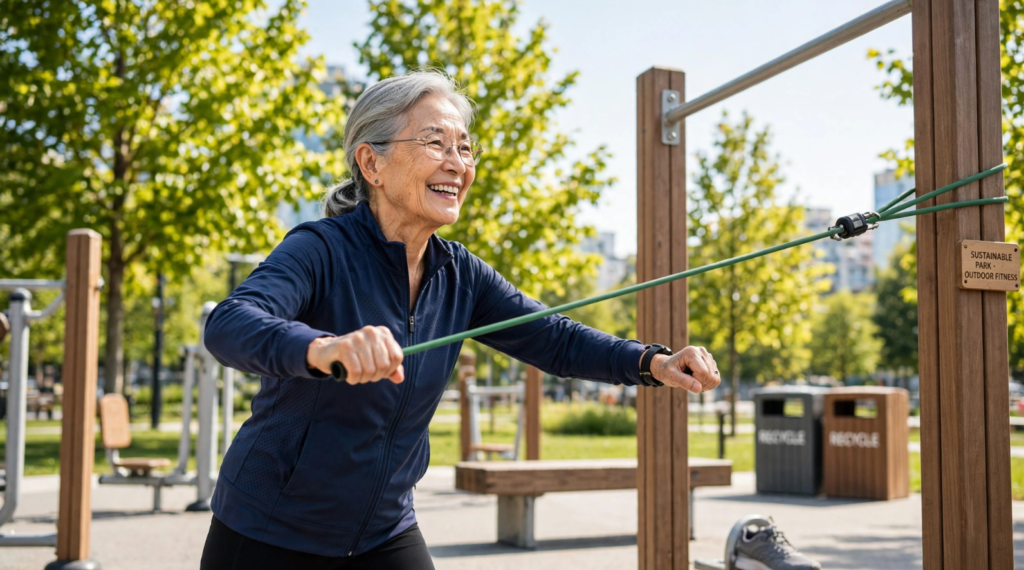
- These exercises are suitable for all ages and fitness levels: Each exercise can be scaled to match your current strength and mobility. Start with easier variations and progress as you get stronger.
- This list balances all movement patterns: Push, pull, squat, hinge, and core stabilization—all essential movement patterns are covered.
- Master these 12 exercises and you’ll never need another workout program: Variation is fine, but these 12 movements provide everything you need for lifelong strength, health, and functionality.
Introduction: The Essential Dozen
Walk into any gym and you’ll see dozens of machines, racks of dumbbells, and endless exercise options. It’s overwhelming. And it’s unnecessary.
You don’t need 50 exercises to build strength. You don’t need the latest machines or fancy equipment. You need a handful of fundamental movements—exercises that work your body in the ways it was designed to move.
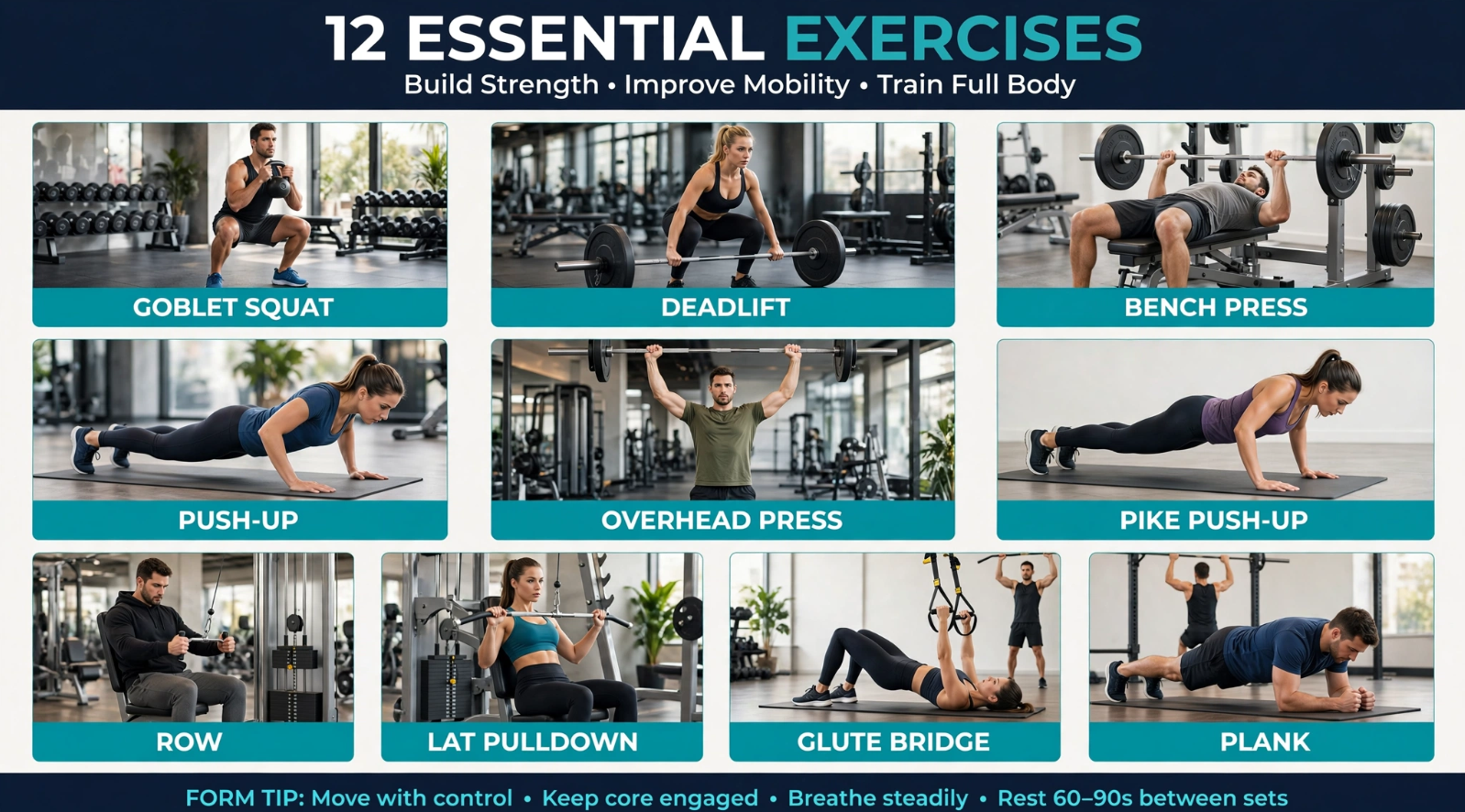
The Essential Dozen:
These 12 exercises are the foundation of effective strength training. They work multiple muscle groups, build functional strength, and can be scaled to any fitness level. Master these, and you’ll have everything you need for a lifetime of strength, health, and capability.
The Movement Patterns:
| Pattern | Exercises |
|---|---|
| Squat | Goblet Squat, Bulgarian Split Squat |
| Hinge | Deadlift, Glute Bridge |
| Push (Horizontal) | Push-up, Dumbbell Bench Press |
| Push (Vertical) | Overhead Press, Pike Push-up |
| Pull (Horizontal) | Dumbbell Row, Bodyweight Row |
| Pull (Vertical) | Pull-up, Lat Pulldown |
| Core | Plank |
The Selection Criteria:
| Criterion | Why It Matters |
|---|---|
| Compound Movement | Works multiple muscle groups |
| Functional | Translates to daily activities |
| Scalable | Can be adapted for any fitness level |
| Accessible | Requires minimal equipment |
| Proven | Evidence-based effectiveness |
| Safe | Low injury risk with proper form |
The 12 Exercises
Exercise 1: The Goblet Squat
Movement Pattern: Squat
Primary Muscles: Quads, Glutes, Core
Equipment: Dumbbell or Kettlebell
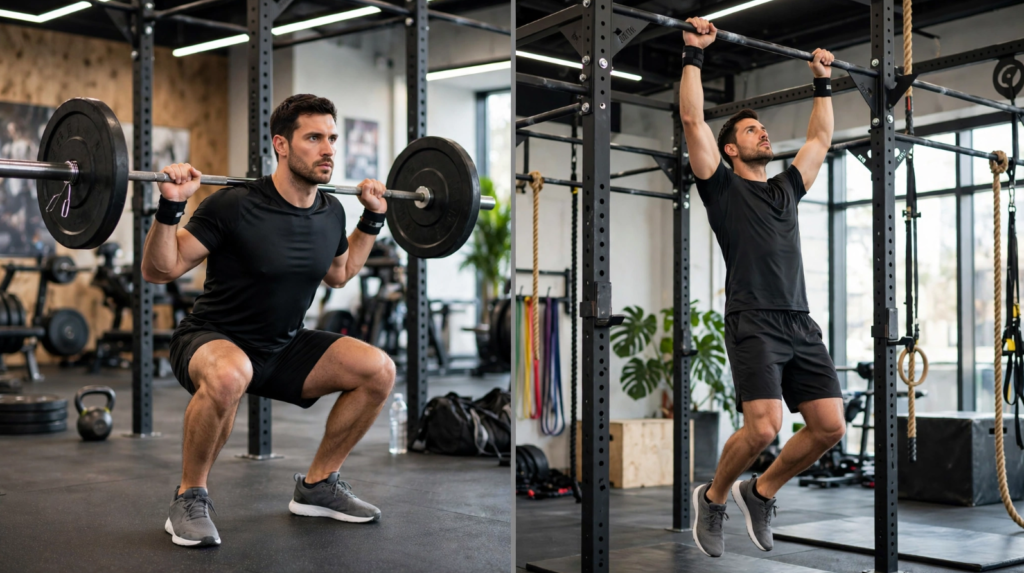
Why It’s Essential: The goblet squat is the best way to learn proper squat form. Holding the weight in front of you forces an upright torso, preventing the common mistake of leaning too far forward. It’s accessible for beginners yet challenging for advanced lifters.
How to Perform:
- Hold a dumbbell or kettlebell vertically against your chest
- Stand with feet shoulder-width apart, toes slightly turned out
- Squat down as if sitting in a chair, keeping your chest up
- Go as low as your mobility allows (aim for at least parallel)
- Drive through your heels to return to standing
- Keep your core braced throughout
Key Points:
- Keep your chest up—don’t let it collapse forward
- Push your knees out (track over your toes)
- Drive through your heels
- Control the movement (no bouncing)
Scaling:
| Level | Variation |
|---|---|
| Beginner | Bodyweight Squats (to a chair) |
| Intermediate | Goblet Squat (light weight) |
| Advanced | Heavy Goblet Squat (heavy dumbbell or kettlebell) |
Sets & Reps: 3–4 sets of 8–12 reps
Exercise 2: The Dumbbell Romanian Deadlift (RDL)
Movement Pattern: Hinge
Primary Muscles: Hamstrings, Glutes, Lower Back, Core
Equipment: Dumbbells
Why It’s Essential: The RDL teaches the hip hinge—a fundamental movement pattern for lifting safely and efficiently. It strengthens the posterior chain (hamstrings, glutes, lower back) and is one of the best exercises for preventing lower back pain.
How to Perform:
- Stand with feet hip-width apart, dumbbells at your sides
- Keep a slight bend in your knees
- Hinge at your hips, pushing your hips back
- Keep your back straight—don’t round it
- Lower the dumbbells along your shins
- Drive your hips forward to return to standing
- Squeeze your glutes at the top
Key Points:
- Keep your back straight throughout
- Push your hips back, don’t just bend at the waist
- The movement comes from your hips, not your lower back
- Squeeze your glutes at the top
Scaling:
| Level | Variation |
|---|---|
| Beginner | Bodyweight Good Mornings |
| Intermediate | Dumbbell RDL (light weight) |
| Advanced | Heavy Dumbbell RDL |
Sets & Reps: 3–4 sets of 8–12 reps
Exercise 3: The Dumbbell Bench Press
Movement Pattern: Horizontal Push
Primary Muscles: Chest, Triceps, Front Shoulders
Equipment: Dumbbells, Bench (or floor)
Why It’s Essential: The bench press is the classic upper body strength builder. Dumbbells offer a greater range of motion than barbells and help correct muscle imbalances. It’s a foundational exercise for upper body strength.
How to Perform:
- Lie on a flat bench (or floor), dumbbells at chest level
- Keep your feet planted on the floor
- Press the dumbbells up, keeping them over your chest
- Squeeze your chest at the top
- Lower the dumbbells with control to the starting position
Key Points:
- Keep your elbows at about 45 degrees (not flared)
- Squeeze your chest at the top
- Control the descent (2–3 seconds)
- Keep your shoulder blades retracted
Scaling:
| Level | Variation |
|---|---|
| Beginner | Floor Press (dumbbells on floor) |
| Intermediate | Dumbbell Bench Press (light weight) |
| Advanced | Heavy Dumbbell Bench Press |
Sets & Reps: 3–4 sets of 8–12 reps
Exercise 4: The Push-up
Movement Pattern: Horizontal Push
Primary Muscles: Chest, Triceps, Shoulders, Core
Equipment: None (bodyweight)
Why It’s Essential: The push-up is one of the most effective upper body exercises—and it requires no equipment. It builds pushing strength, core stability, and shoulder stability. It’s scalable for any fitness level.
How to Perform:
- Start in a high plank position, hands under shoulders
- Your body forms a straight line from head to heels
- Lower your chest toward the floor, keeping your elbows at 45 degrees
- Push back up to the starting position
- Keep your core engaged throughout
Key Points:
- Keep your body straight—no sagging or piking
- Lower your chest close to the floor
- Keep elbows at 45 degrees
- Control the movement (no bouncing)
Scaling:
| Level | Variation |
|---|---|
| Beginner | Incline Push-ups (hands on bench or wall) |
| Intermediate | Full Push-ups |
| Advanced | Weighted Push-ups, Diamond Push-ups |
Sets & Reps: 3–4 sets of 8–15 reps
Exercise 5: The Dumbbell Overhead Press
Movement Pattern: Vertical Push
Primary Muscles: Shoulders, Triceps, Upper Chest, Core
Equipment: Dumbbells
Why It’s Essential: The overhead press builds strong, healthy shoulders. It’s a fundamental movement pattern that improves posture, strengthens the upper body, and prepares you for real-world activities (lifting things overhead).
How to Perform:
- Sit or stand with dumbbells at shoulder height
- Palms facing forward (or slightly inward)
- Press the dumbbells overhead until arms are fully extended
- Keep the dumbbells slightly in front of your ears
- Lower with control to the starting position
- Keep your core braced throughout
Key Points:
- Don’t arch your lower back—keep your core tight
- Keep the dumbbells in a straight line
- Don’t lock your elbows at the top
- Control the descent
Scaling:
| Level | Variation |
|---|---|
| Beginner | Light Dumbbell Overhead Press |
| Intermediate | Moderate Overhead Press |
| Advanced | Heavy Overhead Press |
Sets & Reps: 3–4 sets of 8–12 reps
Exercise 6: The Pike Push-up
Movement Pattern: Vertical Push
Primary Muscles: Shoulders, Triceps, Upper Chest, Core
Equipment: None (bodyweight)
Why It’s Essential: The pike push-up is the bodyweight equivalent of the overhead press. It builds shoulder strength and stability, improves overhead pressing mechanics, and is the first step toward handstand push-ups.
How to Perform:
- Start in a high plank position
- Walk your feet forward, raising your hips toward the ceiling
- Your body forms an inverted V (like a downward dog)
- Lower your head toward the floor (between your hands)
- Push back up to the starting position
Key Points:
- Keep your hips high throughout
- Lower your head toward the floor (not the floor to your head)
- Keep your elbows tracking backward (not flaring)
- Control the movement
Scaling:
| Level | Variation |
|---|---|
| Beginner | Incline Pike Push-up (feet elevated) |
| Intermediate | Pike Push-up |
| Advanced | Elevated Pike Push-up (feet on bench) |
Sets & Reps: 3–4 sets of 8–12 reps
Exercise 7: The Dumbbell Row
Movement Pattern: Horizontal Pull
Primary Muscles: Lats, Rhomboids, Biceps, Rear Delts
Equipment: Dumbbells, Bench (or support)
Why It’s Essential: The row is the foundation of pulling strength. It builds a strong, defined back, improves posture, and counteracts the effects of sitting and forward shoulders. It’s essential for balanced upper body development.
How to Perform:
- Place one knee and one hand on a bench (or support)
- Other foot on the floor, back straight
- Hold the dumbbell with the opposite hand
- Pull the dumbbell up toward your hip
- Squeeze your shoulder blade at the top
- Lower with control to the starting position
Key Points:
- Keep your back straight—don’t round it
- Squeeze your shoulder blade at the top
- Control the descent
- Don’t use momentum to swing the weight up
Scaling:
| Level | Variation |
|---|---|
| Beginner | Light Dumbbell Row |
| Intermediate | Moderate Dumbbell Row |
| Advanced | Heavy Dumbbell Row |
Sets & Reps: 3–4 sets of 8–12 reps per side
Exercise 8: The Bodyweight Row (Inverted Row)
Movement Pattern: Horizontal Pull
Primary Muscles: Lats, Rhomboids, Biceps, Core
Equipment: Bar, Table, or Sturdy Object
Why It’s Essential: The bodyweight row is the pull-up’s cousin—it builds pulling strength and back development without requiring the strength to do a full pull-up. It’s accessible for beginners and still challenging for advanced lifters.
How to Perform:
- Lie under a bar (or sturdy table) at waist height
- Grip the bar with hands shoulder-width apart
- Pull your chest toward the bar
- Squeeze your shoulder blades at the top
- Lower with control to the starting position
- Keep your body straight throughout
Key Points:
- Keep your body straight—no sagging
- Squeeze your shoulder blades at the top
- Control the descent
- Keep your core engaged
Scaling:
| Level | Variation |
|---|---|
| Beginner | Higher Bar (easier angle) |
| Intermediate | Lower Bar (harder angle) |
| Advanced | Feet Elevated (harder) |
Sets & Reps: 3–4 sets of 8–12 reps
Exercise 9: The Pull-up
Movement Pattern: Vertical Pull
Primary Muscles: Lats, Biceps, Upper Back, Core
Equipment: Pull-up Bar
Why It’s Essential: The pull-up is one of the best upper body exercises. It builds a wide, strong back, improves grip strength, and develops pulling power. It’s a true test of relative strength and a benchmark of fitness.
How to Perform:
- Grip the bar slightly wider than shoulder-width (overhand)
- Hang with arms fully extended
- Pull your body up until your chin clears the bar
- Squeeze your shoulder blades at the top
- Lower with control to the starting position
- Keep your core engaged throughout
Key Points:
- Don’t use momentum (no kipping)
- Control the descent (2–3 seconds)
- Squeeze your shoulder blades at the top
- Keep your core engaged
Scaling:
| Level | Variation |
|---|---|
| Beginner | Negative Pull-ups, Scapular Pull-ups |
| Intermediate | Full Pull-ups |
| Advanced | Weighted Pull-ups, Archer Pull-ups |
Sets & Reps: 3–4 sets of 5–10 reps
Exercise 10: The Lat Pulldown
Movement Pattern: Vertical Pull
Primary Muscles: Lats, Biceps, Upper Back
Equipment: Lat Pulldown Machine, Resistance Bands
Why It’s Essential: The lat pulldown is a great alternative to pull-ups—especially for beginners who can’t yet do a full pull-up. It builds back strength and prepares you for pull-ups. It’s also excellent for adding volume to your back training.
How to Perform:
- Sit at a lat pulldown machine with your knees locked under the pad
- Grip the bar with hands wider than shoulder-width
- Pull the bar down to your upper chest
- Squeeze your shoulder blades at the bottom
- Return with control to the starting position
Key Points:
- Don’t lean back excessively
- Squeeze your shoulder blades at the bottom
- Control the ascent
- Keep your core engaged
Scaling:
| Level | Variation |
|---|---|
| Beginner | Light Weight Lat Pulldown |
| Intermediate | Moderate Weight Lat Pulldown |
| Advanced | Heavy Lat Pulldown |
Sets & Reps: 3–4 sets of 8–12 reps
Exercise 11: The Glute Bridge
Movement Pattern: Hinge
Primary Muscles: Glutes, Hamstrings, Core
Equipment: None (bodyweight) or Weighted (dumbbell/barbell)
Why It’s Essential: The glute bridge strengthens the glutes—one of the most important muscle groups for lower back health, hip stability, and overall strength. Weak glutes are a common cause of lower back pain and hip issues.
How to Perform:
- Lie on your back with knees bent, feet flat on the floor
- Feet hip-width apart, arms at your sides
- Press through your heels to lift your hips toward the ceiling
- Squeeze your glutes at the top
- Lower with control to the starting position
Key Points:
- Squeeze your glutes at the top
- Don’t overextend your lower back
- Press through your heels
- Control the descent
Scaling:
| Level | Variation |
|---|---|
| Beginner | Bodyweight Glute Bridge |
| Intermediate | Single-Leg Glute Bridge |
| Advanced | Weighted Glute Bridge (barbell or dumbbell) |
Sets & Reps: 3–4 sets of 12–20 reps
Exercise 12: The Plank
Movement Pattern: Core Stabilization
Primary Muscles: Core (Abs, Obliques, Lower Back), Shoulders, Glutes
Equipment: None (bodyweight)
Why It’s Essential: The plank is the foundational core stability exercise. It builds the type of core strength that protects your lower back, supports your lifts, and improves posture. It’s not about how long you hold it—it’s about how well you maintain form.
How to Perform:
- Forearms on the floor, elbows directly under shoulders
- Body forms a straight line from head to heels
- Squeeze your glutes and engage your core
- Hold, breathing steadily
- Don’t let your hips sag or pike up
Key Points:
- Keep your body in a straight line
- Squeeze your glutes
- Don’t hold your breath
- If your form breaks, stop the set
Scaling:
| Level | Variation |
|---|---|
| Beginner | Knee Plank |
| Intermediate | Full Plank |
| Advanced | Weighted Plank, Side Plank |
Sets & Duration: 3 sets of 30–60 seconds
Section 1: The Complete Workout Programs
Program A: The Essentials (3 Days/Week)
Goal: Build foundational strength with the 12 essential exercises
| Day | Exercises | Sets x Reps | Rest |
|---|---|---|---|
| Monday | Goblet Squat, Dumbbell Bench Press, Dumbbell Row, Plank | 3 x 8–12 | 60 sec |
| Wednesday | Deadlift (RDL), Overhead Press, Push-up, Glute Bridge | 3 x 8–12 | 60 sec |
| Friday | Pull-up, Lat Pulldown, Pike Push-up, Bodyweight Row | 3 x 8–12 | 60 sec |
Program B: Upper/Lower Split (4 Days/Week)
Monday: Upper Body A
| Exercise | Sets x Reps | Rest |
|---|---|---|
| Dumbbell Bench Press | 4 x 8–10 | 60 sec |
| Dumbbell Row | 4 x 8–10 | 60 sec |
| Overhead Press | 3 x 8–10 | 60 sec |
| Pull-up | 3 x 5–8 | 60 sec |
| Plank | 3 x 45–60 sec | 45 sec |
Tuesday: Lower Body A
| Exercise | Sets x Reps | Rest |
|---|---|---|
| Goblet Squat | 4 x 8–10 | 60 sec |
| Deadlift (RDL) | 4 x 8–10 | 60 sec |
| Glute Bridge | 3 x 12–15 | 60 sec |
| Bulgarian Split Squat | 3 x 8–10 per leg | 60 sec |
Thursday: Upper Body B
| Exercise | Sets x Reps | Rest |
|---|---|---|
| Push-up | 4 x 8–12 | 60 sec |
| Bodyweight Row | 4 x 8–12 | 60 sec |
| Pike Push-up | 3 x 8–10 | 60 sec |
| Lat Pulldown | 3 x 8–10 | 60 sec |
Friday: Lower Body B
| Exercise | Sets x Reps | Rest |
|---|---|---|
| Dumbbell Squat | 4 x 8–10 | 60 sec |
| Deadlift (RDL) | 4 x 8–10 | 60 sec |
| Glute Bridge | 3 x 12–15 | 60 sec |
| Plank | 3 x 45–60 sec | 45 sec |
Program C: The Minimalist (2 Days/Week)
Goal: Maintain strength with minimal time commitment
| Day | Exercises | Sets x Reps | Rest |
|---|---|---|---|
| Tuesday | Goblet Squat, Dumbbell Bench Press, Dumbbell Row, Plank | 3 x 8–12 | 60 sec |
| Friday | Deadlift (RDL), Overhead Press, Pull-up, Glute Bridge | 3 x 8–12 | 60 sec |
Section 2: Scaling for All Levels
Beginner Modifications
| Exercise | Beginner Version |
|---|---|
| Squat | Bodyweight Squat (to chair) |
| Bench Press | Floor Press (light weights) |
| Push-up | Incline Push-up (hands on bench/wall) |
| Overhead Press | Seated Press (light weights) |
| Row | Light Dumbbell Row |
| Bodyweight Row | Higher Bar (easier angle) |
| Pull-up | Negative Pull-ups, Band Assisted |
| Lat Pulldown | Light Weight |
| Glute Bridge | Bodyweight |
| Plank | Knee Plank |
Advanced Modifications
| Exercise | Advanced Version |
|---|---|
| Squat | Heavy Goblet Squat, Barbell Squat |
| Bench Press | Heavy Dumbbell Bench Press |
| Push-up | Weighted Push-up, Diamond Push-up |
| Overhead Press | Heavy Overhead Press |
| Row | Heavy Dumbbell Row |
| Bodyweight Row | Feet Elevated |
| Pull-up | Weighted Pull-up, Archer Pull-up |
| Lat Pulldown | Heavy Lat Pulldown |
| Glute Bridge | Weighted Glute Bridge |
| Plank | Weighted Plank, Side Plank |
Section 3: Why These 12 Exercises?
The Science Behind the Selection
| Criterion | How These Exercises Meet It |
|---|---|
| Compound Movements | All 12 exercises work multiple muscle groups |
| Functional Patterns | Squat, hinge, push, pull, core—all essential patterns |
| Scalability | Each exercise can be modified for any level |
| Accessibility | Minimal equipment required |
| Proven Effectiveness | Evidence-based exercises |
| Balanced Development | All major muscle groups covered |
The Muscle Groups Covered
| Muscle Group | Exercises |
|---|---|
| Chest | Bench Press, Push-up |
| Back | Row, Bodyweight Row, Pull-up, Lat Pulldown |
| Shoulders | Overhead Press, Pike Push-up |
| Biceps | Row, Bodyweight Row, Pull-up, Lat Pulldown |
| Triceps | Bench Press, Push-up, Overhead Press |
| Quads | Squat, Goblet Squat |
| Hamstrings | Deadlift (RDL), Glute Bridge |
| Glutes | Squat, Deadlift (RDL), Glute Bridge |
| Core | Plank, Squat, Deadlift, Push-up, Overhead Press |
| Calves | Squat, Deadlift (secondary) |
Section 4: Progression Strategies
The 2-Rep Rule
When you can complete 2 more reps than your target with good form, increase the challenge.
Example:
- Target: 3 sets of 10 reps
- If you can do 3 sets of 12 reps → Progress
Options for Progression:
| Method | How to Apply |
|---|---|
| Increase Weight | Add 2.5–5 lbs to the exercise |
| Increase Reps | Add 1–2 reps per set |
| Increase Sets | Add 1 set per exercise |
| Increase Difficulty | Move to harder variation |
| Decrease Rest | Shorten rest periods |
The 12-Week Progression Plan
| Phase | Weeks | Focus | Progression |
|---|---|---|---|
| Phase 1 | 1–4 | Master Form | Light weights, focus on technique |
| Phase 2 | 5–8 | Build Strength | Increase weights, moderate reps |
| Phase 3 | 9–12 | Peak | Heavy weights, low reps |
| Deload | 13 | Recovery | Reduce volume and intensity |
Section 5: The Equipment Guide
Minimal Equipment Needed
| Equipment | Purpose | Cost |
|---|---|---|
| Adjustable Dumbbells | Bench Press, Rows, Overhead Press, Squats | $100–400 |
| Pull-up Bar | Pull-ups, Hanging Leg Raises | $25–60 |
| Resistance Bands | Pull-up assistance, warm-ups | $20–40 |
| Exercise Mat | Core work, floor exercises | $15–30 |
Optional Equipment
| Equipment | Purpose | Cost |
|---|---|---|
| Adjustable Bench | Presses, rows, step-ups | $100–300 |
| Barbell and Plates | Heavy squats, deadlifts | $200–600 |
| Squat Rack | Heavy squats, bench press | $300–800 |
Section 6: Frequently Asked Questions
Q: Do I really only need 12 exercises?
A: Yes. These 12 exercises cover all major movement patterns and muscle groups. Master these, and you’ll have a complete strength training program. Variation is fine, but these are the essential movements you need.
Q: Can I do these exercises at home?
A: Yes. Dumbbells, a pull-up bar, and some floor space are all you need. Most of these exercises can be done with minimal equipment.
Q: What if I can’t do a pull-up?
A: Use the scaling options: negative pull-ups, band-assisted pull-ups, or bodyweight rows. Lat pulldowns (if you have access to a machine) are also a great alternative.
Q: What if I don’t have access to weights?
A: Bodyweight versions of these exercises (push-ups, bodyweight squats, pike push-ups, etc.) are effective. You can also use resistance bands as an alternative to dumbbells.
Q: How often should I do these exercises?
A: 2–4 days per week, depending on your goals and schedule. Three days per week (full body) is ideal for most people. Two days per week is sufficient for maintenance.
Q: Can I add other exercises?
A: Yes. These 12 are the foundation—not the entire program. Add exercises that address your specific goals or preferences. Just make sure your core program includes these fundamental movements.
Q: Which exercise is the most important?
A: The squat and the deadlift (RDL) are arguably the most important because they build full-body strength and functional power. But don’t neglect the others—all 12 are important for balanced development.
Q: How long will it take to see results?
A: With consistent training (3 days/week) and proper nutrition, most people notice improved strength and energy in 2–4 weeks. Visible muscle changes typically appear in 6–12 weeks.
The VigorForty Take
These 12 exercises are the foundation of a lifetime of strength. Master them, and you’ll build a body that is strong, functional, and resilient.
The principles:
- Master the basics — these 12 exercises are all you need
- Progress consistently — apply progressive overload
- Train regularly — 2–4 days per week
- Focus on form — quality over quantity
- Be patient — strength takes time
The benefits:
- Complete strength development
- Functional, real-world strength
- Injury prevention
- Balanced muscle development
- Lifelong capability
The best time to start was 20 years ago. The second best time is today.
Master these 12 exercises. Build a strong body. Train for life.
This article was reviewed by the Vigor Forty Editorial Review Board on July 21, 2026.
🔗 Related Articles
- Beyond Crunches: The Best Exercises for True Core Stability
- Core Stability for Lifters: How a Strong Core Protects Your Lower Back
- The Connection Between Core Strength and Better Posture
- Top 5 Strength Training Myths Debunked
- “I’m Too Old to Start Lifting”: Why Strength Training is for Everyone
- “I Don’t Want to Get Bulky”: The Truth About Weightlifting and Muscle Growth
- Can You Build Muscle with Just Bodyweight Exercises?
- The Role of Nutrition in Strength Training: Fueling Your Gains
- The Importance of Rest and Recovery for Building Muscle
- Supplements 101: What Actually Works for Strength Athletes?
- Sleep and Strength: How Better Sleep Can Improve Your Lifts
- 5-Minute Daily Core Routine for Busy Americans
- The Science of Hypertrophy: How to Build Muscle Effectively
- Periodization: How to Plan Your Training for Long-Term Success
- Drop Sets, Supersets, and AMRAPs: Advanced Training Techniques Explained
- Strength Training for Fat Loss: A Comprehensive Guide
- How to Build Muscle and Strength with a Busy Schedule
- The Ultimate Guide to Kettlebell Training for Strength and Conditioning
- Resistance Band Workout: A Full-Body Strength Routine
- Dumbbell Only Workout: Build Muscle Anywhere
- Hybrid Training: Combining Calisthenics and Powerlifting
- The Importance of Mobility for Strength Athletes
- 5 Dynamic Warm-Up Exercises to Do Before Every Workout
- The Best of Both Worlds: Why You Should Combine Calisthenics and Weights
- Your 2027 Strength Training Roadmap: Setting Goals and Staying Consistent
- Strength Training for Life: Building a Sustainable Fitness Habit
- The 12 Best Strength Training Exercises for Americans
Affiliate Disclosure: Some links in this article may be affiliate links. If you make a purchase through these links, Vigor Forty may earn a small commission at no extra cost to you. We only recommend products we trust.