Author: Vigor Forty Editorial Team
Medically Reviewed By: Editorial Review Board
Disclaimer: This article is for informational purposes only and is not a substitute for professional medical advice. Always consult your physician before starting a new exercise program, and never swim alone in unsupervised water. Read our full Medical Disclaimer.
📌 Key Takeaways
- Water Is the Ultimate Joint-Friendly Medium: Buoyancy supports up to 90% of your body weight, virtually eliminating impact on the knees, hips, and spine. For the over-40 athlete with osteoarthritis, back pain, or a history of injury, water provides a safe environment to train hard without the consequences of land-based pounding.
- Hydrostatic Pressure Boosts Circulation and Recovery: The pressure of water on your body naturally assists venous return, reducing swelling in the lower legs and improving cardiovascular efficiency. A pool session can serve as both an effective Zone 2 workout and an active recovery tool that leaves you feeling refreshed, not wrecked.
- You Can Replicate Any Land-Based Workout in the Water: With the right technique, pool running, water-based HIIT, and lap swimming can match the intensity and cardiovascular demands of running, cycling, or rowing—often with a higher caloric burn due to water’s 12x greater resistance than air.
- It’s Not Just for the Injured or Elderly: Elite athletes use pool training for cross-training and rehabilitation. The resistance and cooling properties of water allow for high-volume, high-intensity training that’s impossible to sustain on land without injury risk.
- Swimming Is a Skill, but You Don’t Need to Be a Swimmer to Benefit: Pool running, water walking, and aqua aerobics are accessible to non-swimmers and can provide all the cardiovascular and metabolic benefits of lap swimming. Flotation belts and pool-friendly gear unlock the pool for everyone.
Introduction: The Cool, Quiet Power of the Pool
The American fitness landscape often overlooks the pool. It’s seen as a place for kids’ swim lessons, senior water aerobics, or the occasional lazy float on a summer afternoon. But for the over-40 athlete, the pool is a secret weapon hiding in plain sight. It’s a laboratory for cardiovascular adaptation, a sanctuary for aching joints, and a medium that allows you to push your heart and lungs to their limits without your knees ever feeling a thing.
After 40, the cumulative toll of decades of running, jumping, and lifting can catch up. Arthritis sets in. Old injuries ache. The lower back stiffens. And yet, the need for vigorous cardiovascular exercise doesn’t diminish—if anything, it increases. The pool resolves this paradox elegantly. It’s the place where you can do a brutal HIIT session, a meditative Zone 2 endurance workout, or a gentle active recovery session, all without the impact forces that aggravate chronic joint conditions.
Moreover, water-based exercise offers unique physiological benefits that land-based cardio cannot. The hydrostatic pressure of water improves venous return and acts like a full-body compression garment, reducing inflammation and enhancing recovery. The thermal conductivity of water cools your body efficiently, preventing the overheating that can cut summer workouts short or make menopausal hot flashes unbearable. And the rhythmic sound of your own breath and the water moving around you creates a sensory environment that is deeply meditative, reducing cortisol and quieting the anxious, overstimulated midlife brain.
This guide opens the door to the pool. You’ll learn the different types of water-based cardio—from lap swimming to pool running to deep-water HIIT—and exactly how to structure workouts that align with your VigorForty heart rate zones. You’ll get specific protocols, form tips, gear recommendations, and a plan for integrating water training into your existing weekly routine. Whether you’re a lifelong swimmer looking to refine your program or someone who hasn’t been in a pool since childhood, this guide will show you that the water is waiting, and it’s ready to make you stronger.
Section 1: The Unique Physiology of Water-Based Exercise
Water isn’t just a different environment; it fundamentally changes how your body responds to exercise.
Buoyancy and the End of Impact
When you’re submerged to your chest, your body bears only 25–35% of its land-based weight. This unloading decompresses the spine, cushions the knees and hips, and allows for movement patterns—like running—that would be painful or impossible on land. This makes the pool an ideal environment for those with knee osteoarthritis, lumbar disc issues, hip pain, or plantar fasciitis to continue training without exacerbating their condition.
Hydrostatic Pressure and the Cardiac Boost
The pressure exerted by water on your body from all directions is more significant than most realize. It compresses the veins in your legs and abdomen, pushing blood back toward your heart. This increases stroke volume (the amount of blood pumped per beat) and can lower your heart rate by 10–15 beats per minute compared to the same relative effort on land. This means your heart is working more efficiently in the water, and the training effect on cardiac muscle is profound.
Resistance in All Directions
Water is approximately 800 times denser than air. Every movement you make against it requires muscular effort. This constant, multi-directional resistance engages stabilizing muscles—the rotator cuff, the core, the hip abductors—in a way that land-based forward-motion cardio (like running or cycling) does not. The result is a more balanced, functional muscular development that can correct imbalances and prevent injury.
Thermal Regulation and Caloric Burn
Water conducts heat away from the body 25 times faster than air. This prevents the core temperature spikes that limit performance in summer heat. It also means your body burns extra calories simply maintaining its core temperature in cooler pool water (typically 78–82°F for lap swimming). A 30-minute pool session can burn 300–500 calories, depending on intensity and stroke, without the sweat-drenched discomfort.
Section 2: The Main Types of Water-Based Cardio
You don’t need to be a swimmer to use the pool for cardio. Here are the primary modalities, each with its own strengths.
Lap Swimming
- What It Is: Continuous swimming using one or more strokes (freestyle, backstroke, breaststroke, butterfly).
- Best For: Full-body conditioning, rhythmic breathing practice, and those who find a meditative flow state in the repetition of laps.
- Midlife Considerations: Freestyle (front crawl) requires the most technique but is the most efficient for cardiovascular training. Breaststroke is gentler but can strain the knees if done with a wide, whip-kick. Backstroke is excellent for posture and those with neck issues. Butterfly is highly demanding and not recommended for novices. Consider a few lessons with a swim coach to refine your technique; efficiency in the water is everything.
Pool Running (Deep Water Running)
- What It Is: Wearing a flotation belt in deep water (feet don’t touch the bottom), you mimic your land-based running motion. You remain vertical, pumping your legs and arms as if running.
- Best For: Runners who are injured and need to maintain running-specific fitness, anyone who wants the cardiovascular demands of running with zero impact.
- Midlife Considerations: The form matters. Don’t lean forward; stay tall and drive from the hips. Short, quick strides are more effective than long, lunging ones. It can be performed in Zone 2 for recovery or in high-intensity intervals for a brutal VO2 max session.
Water Walking and Jogging (Shallow Water)
- What It Is: Walking or jogging in chest-deep water, feet touching the bottom.
- Best For: Those new to water exercise, those recovering from surgery, or as a warm-up/cool-down. The resistance of the water turns a simple walk into a significant muscular and cardiovascular effort.
- Midlife Considerations: Use an exaggerated arm swing and a high knee drive to increase the workload. Walking backward and sideways adds variety and targets different muscle groups. Aqua shoes with grippy soles prevent slipping.
Water Aerobics and Fitness Classes
- What It Is: Structured group classes led by an instructor, often using pool noodles, dumbbells (foam), and kickboards.
- Best For: Social connection, variety, and a structured full-body workout without the need for self-programming.
- Midlife Considerations: Not just for seniors. High-intensity water fitness classes exist and can be very challenging. The social component is excellent for mental health and accountability.
Section 3: Applying Heart Rate Zones to the Pool
The standard heart rate formulas shift slightly in the water due to the effects of hydrostatic pressure and the supine/prone body position.
The Adjustment: Your maximum heart rate in the water is typically 10–15 bpm lower than on land. A chest strap monitor (like the Polar H10 or Garmin HRM-Swim) that stores data and syncs after the workout is essential; wrist-based optical sensors are unreliable in the water.
Zone Prescriptions for the Pool:
- Zone 1 (Active Recovery): Gentle water walking, easy pool running with a belt, or slow swimming with a pull buoy. You can sing.
- Zone 2 (Endurance Base): Continuous lap swimming at a steady pace, or sustained deep-water running at a conversational effort. This is your fat-burning, mitochondrial-building zone. Aim for 30–60 minutes.
- Zone 3 (Tempo): A “comfortably hard” swim. You can speak a few words between breaths. Sets like 6 x 5-minute swims with 1-minute rests.
- Zone 4–5 (HIIT/VO2 Max): Maximal effort intervals. For swimming: 10 x 50-yard sprints with 30 seconds rest. For pool running: 30 seconds all-out sprint, 60 seconds easy treading water. This is where water’s resistance and cooling power allow you to go truly maximal with minimal injury risk.
Section 4: The VigorForty Pool Workout Library
Here are three structured sessions you can take to the pool.
Workout 1: The Zone 2 Endurance Swim (or Pool Run)
- Goal: Build aerobic base, burn fat, meditative movement.
- Warm-up: 5 minutes easy swimming or water walking.
- Main Set: 40–50 minutes continuous steady-state. If swimming, use a pull buoy and focus on a smooth, bilateral breathing rhythm. If pool running, maintain a steady, conversational pace with good form. Monitor your perceived exertion—you should feel you could continue for another 20 minutes.
- Cool-down: 5 minutes very easy swimming or floating.
Workout 2: The Deep-Water HIIT Session
- Goal: Spike VO2 max, growth hormone, and EPOC with zero impact.
- Warm-up: 5 minutes easy pool running.
- Main Set: 10 rounds of: 30 seconds all-out sprint (imagine you’re running from something, maximal arm and leg drive), followed by 60 seconds of easy treading water or slow pool running. Focus on keeping your effort truly maximal during the sprints.
- Cool-down: 5 minutes easy water walking or gentle swimming.
Workout 3: The Total-Body Swim Intervals
- Goal: Improve swimming efficiency, build full-body strength and cardiovascular power.
- Warm-up: 200 yards easy swimming (mix strokes).
- Drill Set (10 min): 4 x 50 yards with 30 seconds rest, focusing on one form cue (e.g., high elbow catch, bilateral breathing).
- Main Set: 8 x 100 yards at a hard, sustainable pace (Zone 3–4), with 45 seconds rest between each.
- Cool-down: 200 yards very easy swimming, focusing on long, gliding strokes.
Section 5: Gear You’ll Need
Minimal gear opens up the pool’s full potential.
- Swimsuit: For lap swimming, a form-fitting, chlorine-resistant suit is essential. Baggy swim trunks create significant drag.
- Goggles: A well-fitting pair that doesn’t leak is non-negotiable. Look for UV protection if swimming outdoors.
- Swim Cap: Protects hair from chlorine and reduces drag.
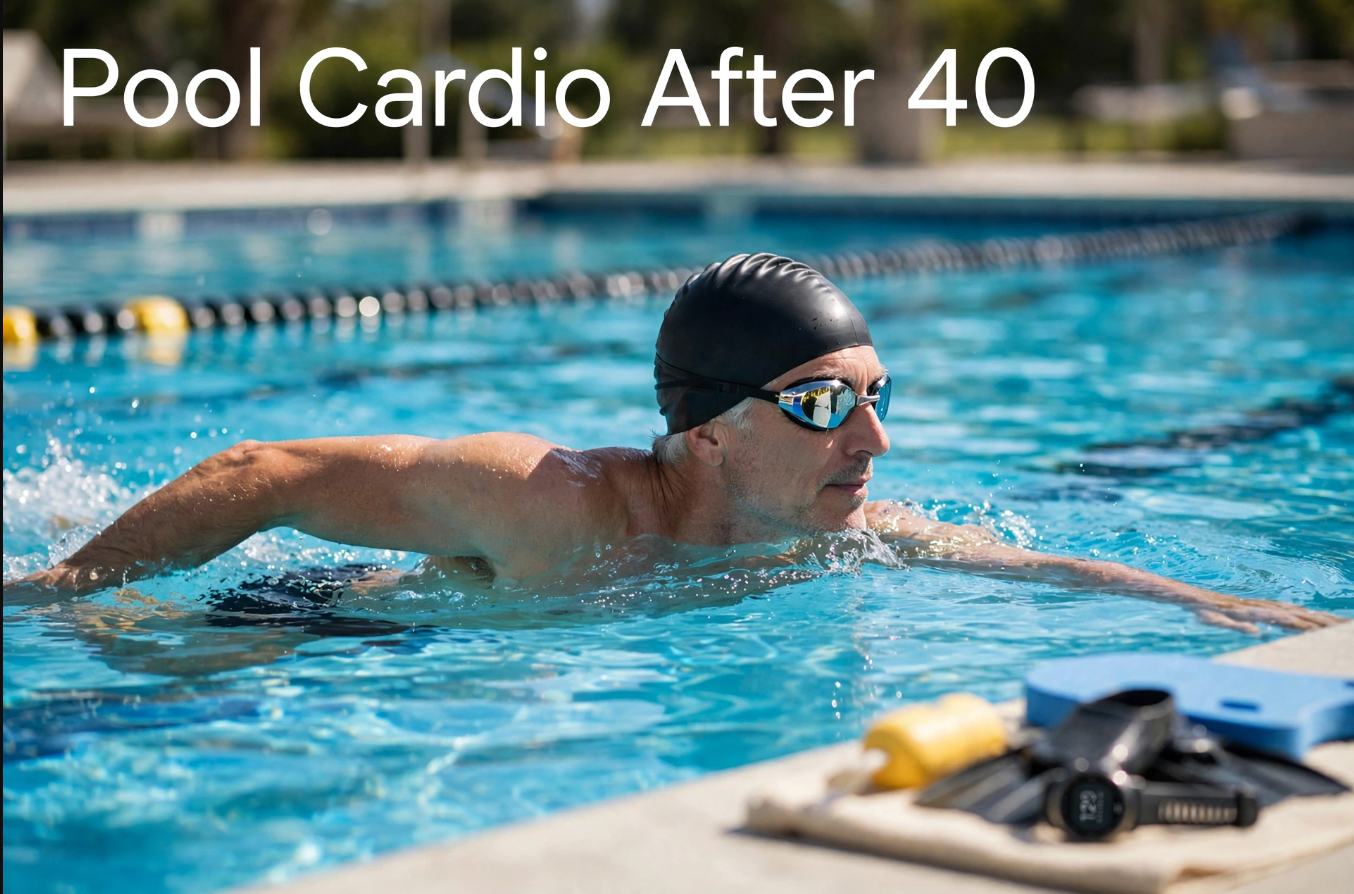
- Pull Buoy: A figure-eight-shaped foam float held between your thighs. It immobilizes your legs, forcing you to focus on your upper body pull and body position. Excellent for Zone 2 work.
- Kickboard: Allows you to isolate leg work. Good for warm-ups and technique drills.
- Fins: Short training fins add resistance for leg strengthening and improve ankle flexibility.
- Flotation Belt: Essential for deep-water running. Brands like AquaJogger are the standard.
- Waterproof Heart Rate Monitor: A chest strap designed for swimming (Garmin HRM-Swim, Polar Verity Sense) will store your workout data and sync it later.
- Aqua Shoes: Provide traction and foot protection for shallow-water walking and jogging.
Section 6: Integrating Pool Workouts into Your VigorForty Week
The pool can serve multiple roles.
As a Primary Cardio Modality: If joint pain prevents you from running or rucking, replace 2–3 of your weekly Zone 2 sessions and your HIIT session with the pool workouts above. Follow the same 80/20 polarized model.
As Active Recovery: A 30-minute Zone 1 water walking or gentle swimming session on a rest day enhances blood flow, reduces muscle soreness, and accelerates recovery without any training stress.
As Cross-Training: For the runner or rucker, one pool session per week can add cardiovascular volume without additional orthopedic load. Use the deep-water HIIT session as your second high-intensity day, or the endurance swim as a bonus Zone 2 session.
Sample Hybrid Week (Runner with Pool Access):
- Monday: Strength training + 20 min Zone 2 run
- Tuesday: 45 min Zone 2 swim
- Wednesday: 20 min deep-water HIIT
- Thursday: Strength training
- Friday: 40 min Zone 2 run
- Saturday: 90 min long run
- Sunday: 30 min active recovery pool session (water walking and gentle swimming)
Section 7: FAQ—Your Pool Cardio Questions Answered
Q: I don’t know how to swim. Can I still benefit?
A: Absolutely. Deep-water running with a flotation belt and shallow-water walking/jogging require zero swimming skill. They provide the same cardiovascular and muscular benefits as lap swimming. Many pools also offer aqua fitness classes that take place in shallow water.
Q: Is pool exercise effective for weight loss?
A: Yes, very much so. Water’s resistance and cooling effects allow for high calorie burns (often exceeding land-based cardio at similar intensities because of the added muscular resistance and thermoregulatory cost). The key, as with all exercise, is consistency and pairing it with sound nutrition (see our Cardio Nutrition and Fat Loss Guides).
Q: I find swimming incredibly tiring after just one lap. Am I that out of shape?
A: You’re likely just experiencing the effects of poor technique. Swimming is highly technical; inefficient movement wastes enormous energy. A few sessions with a qualified swim coach to work on your breathing and body position can dramatically improve your efficiency. What feels like a fitness problem is often a skill problem. Be patient with yourself.
Q: Is chlorine bad for me?
A: For most people, the benefits of swimming far outweigh the risks of chlorine exposure. To minimize irritation, shower before entering the pool (reducing the formation of chloramines), wear a swim cap and goggles, and rinse off thoroughly after your session. If you are sensitive, look for saltwater or ozone-purified pools in your area.
The VigorForty Take
The pool is a refuge. It’s a place where the aches and pains of midlife dissolve into buoyancy, where your heart can hammer against your ribs without your knees ever feeling the shock, and where the rhythmic sound of your own breath in the water becomes a form of moving meditation. For the American over 40, it is not an admission of fragility to step into the pool; it is a sophisticated, strategic choice to protect your joints while building a cardiovascular engine that rivals any runner’s.
Whether you’re diving into the black line for a meditative hour of lap swimming, strapping on a flotation belt and running furiously in the deep end, or simply walking the lanes with your friends, the water is your ally. It resists you just enough to make you strong, supports you just enough to keep you safe, and cools you just enough to let you push harder.
Add the pool to your VigorForty toolkit. Let it be your active recovery, your cross-training, or your primary modality. The water has been waiting for you since you were a child. It’s time to come home to it, to move in it, and to let it carry you toward a fitter, more resilient, and pain-free future. The deep end is calling—jump in.
Read All Related Articles
- The Complete Guide to Zone 2 Training After 40: How Low-Intensity Cardio Boosts Fat Loss, Longevity, and Endurance
- The Complete Guide to HIIT After 40: Joint-Friendly Workouts That Torch Fat and Protect Your Heart
- The Complete Guide to Running After 40: How to Start, Stay Injury-Free, and Build Lifelong Endurance
- The Complete Guide to Metabolic Health After 40: Reverse Insulin Resistance, Burn Stubborn Fat, and Reclaim Your Energy with Cardio
- The Complete Guide to Cardio Recovery After 40: How to Rest, Rebuild, and Come Back Stronger
- The Complete Guide to Heart Rate Training Zones After 40: Unlock Every Beat for Maximum Fat Loss, Endurance, and Longevity
- The Complete Guide to VO2 Max After 40: The #1 Predictor of Longevity and How to Improve It
- The Complete Guide to Concurrent Training After 40: How to Combine Cardio and Strength for Maximum Fat Loss, Muscle Preservation, and Longevity
- The Complete Guide to Walking and Rucking After 40: The Most Underrated Cardio for Fat Loss, Joint Health, and Longevity
- The Complete Guide to Designing Your Own Cardio Plan After 40: A Personalized Blueprint for Fat Loss, Longevity, and Peak Performance
- The Complete Guide to Cardio Nutrition After 40: Fuel Your Workouts for Maximum Fat Loss, Endurance, and Recovery
- The Complete Guide to Cardio Equipment After 40: Choosing the Best Treadmill, Bike, Rower, or Elliptical for Your Home Gym
- The Complete Guide to Injury Prevention for Cardio After 40: Run, Ride, and Ruck Pain-Free for Life
- The Complete Guide to Cardio for Fat Loss After 40: Burn Stubborn Belly Fat Without Losing Muscle or Energy
- The Complete Guide to Seasonal Cardio Training After 40: How to Periodize Your Year for Year-Round Fitness, Fat Loss, and Injury Prevention
- The Complete Guide to Cardio and Brain Health After 40: How Exercise Protects Your Memory, Mood, and Mental Sharpness
- The Complete Guide to Building a Home Gym for Cardio After 40: Design a Space That Makes Consistency Inevitable
- The Joyful Movement Manifesto: How to Love Cardio After 40 and Make It a Lifelong Practice
- The Complete Guide to Sleep and Cardio After 40: How Deep Rest Unlocks Your Best Performance, Recovery, and Longevity
- The Complete Guide to Stress, Cortisol, and Cardio After 40: How to Manage Your Nervous System for Better Recovery and Performance
- The Complete Guide to Returning to Cardio After a Layoff After 40: Your Compassionate, Science-Backed Roadmap Back to Fitness
- The Complete Guide to Cardio Through Menopause: How to Adapt Your Training for Hormonal Changes, Protect Your Heart, and Feel Strong After 40
- The Complete Guide to Cycling After 40: Low-Impact Cardio for Joint Health, Endurance, and Lifelong Fitness
- The Complete Guide to Pool and Water-Based Cardio After 40: Low-Impact Workouts for Joint Pain, Recovery, and Total-Body Fitness
- The Complete Guide to Rowing After 40: Full-Body, Low-Impact Cardio for Strength, Endurance, and Longevity
- The Complete Guide to Tracking Cardio Progress After 40: The Key Metrics That Matter More Than the Scale
- The Complete Guide to Cardio for High Blood Pressure After 40: How Exercise Lowers Your Numbers and Protects Your Heart
- The Complete Guide to Cardio for Type 2 Diabetes and Prediabetes After 40: How Exercise Reverses Insulin Resistance and Protects Your Heart
- The Complete Guide to Cardio with Arthritis After 40: Pain-Free Workouts That Strengthen Joints and Keep You Moving
- The Complete Guide to Longevity and Cardio After 40: How Aerobic Fitness Adds Years to Your Life and Life to Your Years
- The Complete Guide to Building a Cardio Habit After 40: The Science of Making Exercise Stick for Life
- The Complete Guide to Cardio and Immune Health After 40: Strengthen Your Body’s Defense System for a Resilient, Vibrant Life
- The Complete Guide to Cardio While Traveling After 40: Stay Fit on the Road, in Hotels, and Away from Home
- The Complete Guide to Cardio for Posture and Back Pain After 40: Strengthen Your Posterior Chain and Reverse the Damage of Sitting
- The Complete Guide to the Social Side of Cardio After 40: How Community, Accountability, and Connection Make You Stronger
- The VigorForty Manifesto: A Final Word on the Lifelong Practice of Movement