
Author: Vigor Forty Editorial Team
Medically Reviewed By: Editorial Review Board
Disclaimer: This article is for informational purposes only and is not a substitute for professional medical or psychological advice. Consult your physician before beginning a new exercise program. Read our full Medical Disclaimer.
📌 Key Takeaways
- Motivation Is Overrated—Systems Are Everything: After 40, relying on willpower and fleeting motivation to exercise is a losing strategy. The midlife brain is overloaded with decisions and stress; willpower is a finite resource. The only sustainable path is building automated systems and habits that make cardio feel as inevitable as your morning coffee.
- “Frictionless” Environments Are the Secret Weapon: The most successful exercisers don’t have more discipline; they have less friction. A home gym setup, workout clothes laid out the night before, and a pre-planned weekly schedule eliminate the micro-decisions that derail consistency. Reduce the steps between you and your workout, and you radically increase the odds of doing it.
- The 2-Day Rule Prevents the Downward Spiral: Life will disrupt your routine. The “2-Day Rule”—never miss two consecutive days—is a simple, forgiving standard that prevents a single missed workout from becoming a week, a month, or a permanent layoff. Consistency over the long arc is built on this kind of flexible resilience.
- Identity-Based Habits Outlast Outcome-Based Goals: “I am a person who moves daily” is a more powerful and durable driver than “I want to lose 15 pounds.” The latter is an external goal that, once achieved (or if stalled), removes the motivation. The former is an internal identity that becomes self-reinforcing. Your self-talk shapes your actions.
- Habit Stacking and Temptation Bundling Make Cardio Effortless: Linking your cardio to an existing, ingrained habit (e.g., “After I drop the kids at school, I go for a walk”) or bundling it with a pleasure (e.g., “I only listen to my favorite podcast when I’m on the bike”) leverages powerful psychological wiring to automate the behavior.
Introduction: The Missing Ingredient That Trumps Every Protocol
You now possess a library of knowledge that could fill a graduate course in exercise physiology. You understand the intricacies of Zone 2 mitochondrial adaptation, the hormonal cascade of HIIT, the biomechanics of the perfect rowing stroke, and the precise nutritional window for post-workout recovery. You have more evidence-based training information at your fingertips than any Olympic athlete did a generation ago.
And yet, a haunting question remains: Will you actually do it? Not for a week. Not for a month while the New Year’s glow persists. But for the rest of your life, through the winter of a demanding job, the chaos of family life, the flat periods where motivation vanishes, and the seasons where the couch exerts a gravitational pull stronger than any treadmill ever could.
The answer to that question has nothing to do with your VO2 max, your lactate threshold, or your protein-to-carb ratio. It has everything to do with the invisible architecture of your daily habits. After 40, life is a complex, demanding tapestry of responsibilities. The midlife brain is constantly making decisions, managing stress, and conserving energy. Expecting yourself to rely on raw willpower to consistently choose a workout over the siren call of comfort is naive. Willpower is a muscle that fatigues. Habits are neural pathways that automate.
This guide is not about what to do—you’ve already learned that in exquisite detail. It’s about how to make yourself do it, automatically, for a lifetime. We’ll delve into the behavioral psychology of habit formation, the environmental design principles that make exercise the path of least resistance, the identity-based mindset shift that changes everything, and the practical, tactical tools—like habit stacking, the 2-Day Rule, and temptation bundling—that weave cardio into the fabric of your daily existence. By the end, you’ll have a blueprint not just for a training plan, but for a new way of being.
Section 1: Why Willpower Fails After 40 (and What to Do Instead)
To build lasting habits, you must first understand why the “just push through it” model collapses in midlife.
Decision Fatigue
The average American adult makes approximately 35,000 decisions per day. By the time you’ve navigated work emails, family logistics, and the endless micro-choices of modern life, your prefrontal cortex—the brain’s decision-making and impulse-control center—is depleted. When 6 p.m. arrives and you face the choice between a workout and the couch, you’re asking a tired brain to make a hard decision. The couch almost always wins. The solution is to remove the decision entirely. The workout is already scheduled, the clothes are already laid out, and the only choice is to follow the script.
The Dopamine Mismatch
Modern life is a dopamine flood: social media notifications, streaming entertainment, processed food. Exercise, for the untrained brain, offers a delayed and often subtle reward. The immediate pleasure of a screen is a far more potent dopamine hit than the promise of future health. The trick is not to fight dopamine but to hijack it. By linking exercise with immediate, intrinsic rewards—a favorite podcast, a beautiful outdoor route, the satisfying data on your tracker—you train your brain to anticipate pleasure from the workout itself.
The All-or-Nothing Mindset
As we discussed in our Joyful Movement Manifesto, the belief that a workout must be an hour of intense suffering to “count” is the enemy of consistency. When life inevitably disrupts the perfect plan, the all-or-nothing thinker abandons the whole endeavor. The habit-builder embraces the “something is better than nothing” philosophy. A 10-minute walk still reinforces the identity and the neural pathway. It keeps the streak alive.
Section 2: The Four Laws of Behavior Change (Applied to Cardio)
James Clear’s “Four Laws of Behavior Change” from Atomic Habits provide an elegant, actionable framework for building a cardio habit.
1. Make It Obvious (The Cue)
Habits are triggered by cues. You need a clear, unmistakable signal that it’s time to move.
- Implementation Intention: “I will [exercise] at [time] in [location].” Vague plans fail. “I will walk for 30 minutes at 7 a.m. in my neighborhood” is a concrete, executable script.
- Habit Stacking: Anchor your new cardio habit to an existing, deeply ingrained behavior. “After I brew my morning coffee, I will put on my walking shoes and step outside for 10 minutes.” “After I close my laptop for the day, I will immediately put on my gym clothes.” The existing habit becomes the automatic trigger for the new one.
- Environmental Design: Place your workout shoes, yoga mat, or rucksack in a highly visible, unavoidable location. The mere sight of them acts as a cue.
2. Make It Attractive (The Craving)
You need to want to do the habit.
- Temptation Bundling: Pair an action you need to do with an action you want to do. “I will only watch my favorite Netflix series while I’m on the stationary bike.” “I will only listen to my gripping audiobook when I’m walking or rucking.” You begin to crave the workout because it’s the gateway to a pleasure you’ve strategically restricted.
- Social Magnetism: Join a walking group, a cycling club, or find a rucking partner. The social connection and accountability make the activity attractive. You show up for the people, and the cardio happens as a side effect.
3. Make It Easy (The Response)
The behavior itself must be as frictionless as possible.
- The 2-Minute Rule: “The beginning of any habit should take less than two minutes to do.” Your goal on a low-motivation day is not to complete a full workout; it’s to put on your workout clothes and step outside. Once you’re outside, you almost always do more. The hardest part is the start.
- Reduce Friction: Sleep in your workout clothes. Have a dedicated home gym space where nothing needs to be set up. Pre-pack your gym bag the night before. Choose a gym on your commute route. Eliminate every obstacle between you and your first step.
- Increase Friction for Unwanted Behaviors: Put the TV remote in a drawer. Delete social media apps from your phone’s home screen. Make the couch slightly less inviting.
4. Make It Satisfying (The Reward)
You need an immediate sense of success to reinforce the behavior.
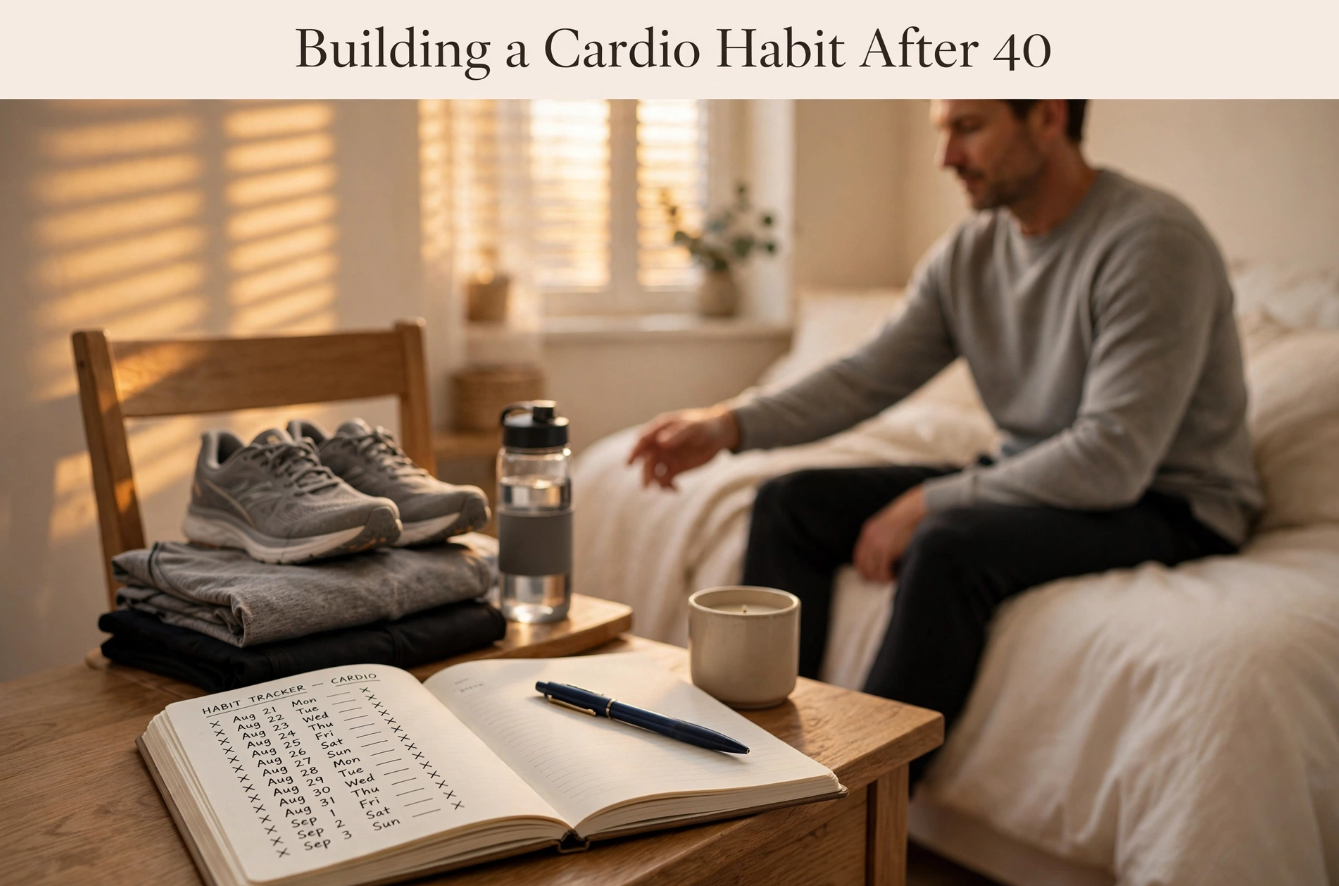
- Track Your Streak: A visual calendar where you mark an “X” for each day you moved is profoundly satisfying. The “don’t break the chain” mentality leverages the brain’s desire for completion and consistency.
- Celebrate Small Wins: Acknowledge the 15-minute walk as a victory. It is a victory. It’s a deposit in the habit bank. That positive self-acknowledgment reinforces the behavior.
- Savor the Afterglow: As we emphasized in the Joyful Movement Manifesto, take 60 seconds after your workout to notice how your body feels. The warmth, the clarity, the calm. This immediate, intrinsic reward is the most sustainable form of satisfaction.
Section 3: The 2-Day Rule and the Art of the Graceful Comeback
Life after 40 is predictably unpredictable. Illness, injury, travel, family crises, and crushing work deadlines will disrupt your perfect routine. The mark of a lifelong athlete is not a flawless streak; it’s the speed and grace with which they recover from a break.
The Rule: Never Miss Two in a Row
A single missed day is a blip. Two missed days start to form a new neural pathway of inactivity. Three missed days is the beginning of a new habit—the habit of not exercising. The “2-Day Rule” is a simple, non-punitive standard: you can miss one day for any reason, but you must do something on the second day. A 10-minute walk counts. Five minutes of mobility counts. It’s not about the physical training effect; it’s about maintaining the identity and the streak. It signals to your brain, “I am still the person who moves.”
The Graceful Comeback After a Longer Layoff:
If life knocks you out for a week, a month, or more (which it will), do not attempt to “make up for lost time.” That’s the express lane to injury and burnout. Refer to our dedicated guide, Returning to Cardio After a Layoff, and follow the gentle, compassionate protocol. The key is to resist the shame and guilt that lead to the all-or-nothing crash. Acknowledge the layoff without self-judgment, and step back into the practice with kindness.
Section 4: Identity—The Ultimate Long-Term Driver
Goals are about what you want to achieve. Identity is about who you believe you are. A person whose goal is to run a 5K will stop running once the race is over. A person who believes “I am a runner” will run for the rest of their life.
The Shift from “I Should” to “I Am”
- Old Narrative: “I should exercise to lose weight.” (External, punitive, temporary)
- New Narrative: “I am the kind of person who values my body and moves it daily.” (Internal, affirming, permanent)
Every time you complete a workout, you cast a vote for this new identity. Every time you choose a walk over the couch, you reinforce the belief. The evidence accumulates, and over time, the identity becomes self-sustaining. You don’t exercise because you’re trying to become someone else; you exercise because it’s simply what the person you now are does.
The VigorForty Identity Statement:
“I am a midlife athlete. I train my heart, my lungs, and my muscles not out of fear or self-loathing, but out of deep respect for the body that carries me through life. I move with consistency, intelligence, and joy. Movement is my birthright, my practice, and my lifelong companion.”
Section 5: Practical Tools for Habit Architecture
- The Sunday Strategy Session: Spend 10 minutes every Sunday reviewing your upcoming week and scheduling your workouts like non-negotiable appointments. Put them in your calendar.
- Lay Out Your Gear: Every night, lay out your workout clothes, shoes, heart rate monitor, and water bottle. In the morning, you’ll wake up to a visual cue that’s impossible to ignore.
- The “No-Phone” Warm-Up: Commit to a 2-minute, no-phone warm-up (marching in place, arm circles). The simple act of starting physically often bypasses the mental resistance.
- Accountability Partner: Find a friend with similar goals. A simple text check-in (“Did you get your workout in today?”) can dramatically increase adherence.
- Reward Milestones: After 30 consecutive days of hitting your movement goal, treat yourself to something that reinforces the identity—a new pair of shoes, a quality rucksack, a professional bike fit.
Section 6: FAQ—Your Habit Building Questions
Q: I’ve failed so many times before. How is this time different?
A: Past failures were likely built on motivation, willpower, and unrealistic expectations. This time, you’re building a system. You’re engineering your environment, reducing friction, and starting with ridiculously small, achievable actions. The 2-Minute Rule and the 2-Day Rule are your safety nets. Forgive your past self; they were doing the best they could without this knowledge. Your present self is equipped with a behavioral science toolkit.
Q: What if I genuinely hate exercise?
A: Then you haven’t found your modality or your context yet. “Exercise” is not a monolithic activity. If you hate running, don’t run. Dance. Swim. Ruck with a friend. Bike to a scenic overlook. Walk in a beautiful forest. The world is full of joyful movement; you simply haven’t discovered yours. Approach it with curiosity, not obligation. You’re not looking for a workout; you’re looking for a form of movement that makes you feel alive.
Q: I’m too tired after work. How do I overcome that?
A: First, acknowledge that fatigue is real. Second, experiment with morning exercise, before the day’s demands drain your willpower. If evenings are your only window, use the 2-Minute Rule: commit only to putting on your clothes and stepping outside. The fresh air and initial movement often generate energy. Also, audit your sleep and nutrition—chronic fatigue is often a signal of insufficient recovery, not a lack of motivation.
Q: How long does it take to form a habit?
A: The popular “21 days” is a myth. Research suggests it takes anywhere from 18 to 254 days for a behavior to become automatic, with an average of around 66 days. The key variable is the complexity of the behavior and the consistency of the context. Focus on the process, not the timeline. One day, you’ll notice that lacing up your shoes no longer feels like a decision; it just feels like what you do.
The VigorForty Take
The entire VigorForty library—every protocol, every guide, every scientific deep-dive—is a gift you give to your future self. But habits are the bridge that carries those gifts across the river of time. Without the bridge, the knowledge remains on the far shore, a beautiful but inaccessible treasure.
Building a cardio habit after 40 is not an act of punishment or a test of character. It’s an act of profound self-care, executed with the quiet, intelligent precision of a behavioral engineer. You are designing an environment where the default choice is the healthy choice. You are forging an identity that acts as an internal compass. You are giving yourself permission to be imperfect, to miss a day, to adapt to the seasons of life, and to always, always return to the practice.
Start today. Not Monday. Not January 1st. Today. Put on your shoes. Walk for two minutes. Mark an “X” on your calendar. Look in the mirror and say, “I am a person who moves.” You have just laid the first brick in the foundation of a lifelong, life-giving habit. The rest is just repetition. You’ve got this.
Read All Related Articles
- The Complete Guide to Zone 2 Training After 40: How Low-Intensity Cardio Boosts Fat Loss, Longevity, and Endurance
- The Complete Guide to HIIT After 40: Joint-Friendly Workouts That Torch Fat and Protect Your Heart
- The Complete Guide to Running After 40: How to Start, Stay Injury-Free, and Build Lifelong Endurance
- The Complete Guide to Metabolic Health After 40: Reverse Insulin Resistance, Burn Stubborn Fat, and Reclaim Your Energy with Cardio
- The Complete Guide to Cardio Recovery After 40: How to Rest, Rebuild, and Come Back Stronger
- The Complete Guide to Heart Rate Training Zones After 40: Unlock Every Beat for Maximum Fat Loss, Endurance, and Longevity
- The Complete Guide to VO2 Max After 40: The #1 Predictor of Longevity and How to Improve It
- The Complete Guide to Concurrent Training After 40: How to Combine Cardio and Strength for Maximum Fat Loss, Muscle Preservation, and Longevity
- The Complete Guide to Walking and Rucking After 40: The Most Underrated Cardio for Fat Loss, Joint Health, and Longevity
- The Complete Guide to Designing Your Own Cardio Plan After 40: A Personalized Blueprint for Fat Loss, Longevity, and Peak Performance
- The Complete Guide to Cardio Nutrition After 40: Fuel Your Workouts for Maximum Fat Loss, Endurance, and Recovery
- The Complete Guide to Cardio Equipment After 40: Choosing the Best Treadmill, Bike, Rower, or Elliptical for Your Home Gym
- The Complete Guide to Injury Prevention for Cardio After 40: Run, Ride, and Ruck Pain-Free for Life
- The Complete Guide to Cardio for Fat Loss After 40: Burn Stubborn Belly Fat Without Losing Muscle or Energy
- The Complete Guide to Seasonal Cardio Training After 40: How to Periodize Your Year for Year-Round Fitness, Fat Loss, and Injury Prevention
- The Complete Guide to Cardio and Brain Health After 40: How Exercise Protects Your Memory, Mood, and Mental Sharpness
- The Complete Guide to Building a Home Gym for Cardio After 40: Design a Space That Makes Consistency Inevitable
- The Joyful Movement Manifesto: How to Love Cardio After 40 and Make It a Lifelong Practice
- The Complete Guide to Sleep and Cardio After 40: How Deep Rest Unlocks Your Best Performance, Recovery, and Longevity
- The Complete Guide to Stress, Cortisol, and Cardio After 40: How to Manage Your Nervous System for Better Recovery and Performance
- The Complete Guide to Returning to Cardio After a Layoff After 40: Your Compassionate, Science-Backed Roadmap Back to Fitness
- The Complete Guide to Cardio Through Menopause: How to Adapt Your Training for Hormonal Changes, Protect Your Heart, and Feel Strong After 40
- The Complete Guide to Cycling After 40: Low-Impact Cardio for Joint Health, Endurance, and Lifelong Fitness
- The Complete Guide to Pool and Water-Based Cardio After 40: Low-Impact Workouts for Joint Pain, Recovery, and Total-Body Fitness
- The Complete Guide to Rowing After 40: Full-Body, Low-Impact Cardio for Strength, Endurance, and Longevity
- The Complete Guide to Tracking Cardio Progress After 40: The Key Metrics That Matter More Than the Scale
- The Complete Guide to Cardio for High Blood Pressure After 40: How Exercise Lowers Your Numbers and Protects Your Heart
- The Complete Guide to Cardio for Type 2 Diabetes and Prediabetes After 40: How Exercise Reverses Insulin Resistance and Protects Your Heart
- The Complete Guide to Cardio with Arthritis After 40: Pain-Free Workouts That Strengthen Joints and Keep You Moving
- The Complete Guide to Longevity and Cardio After 40: How Aerobic Fitness Adds Years to Your Life and Life to Your Years
- The Complete Guide to Building a Cardio Habit After 40: The Science of Making Exercise Stick for Life
- The Complete Guide to Cardio and Immune Health After 40: Strengthen Your Body’s Defense System for a Resilient, Vibrant Life
- The Complete Guide to Cardio While Traveling After 40: Stay Fit on the Road, in Hotels, and Away from Home
- The Complete Guide to Cardio for Posture and Back Pain After 40: Strengthen Your Posterior Chain and Reverse the Damage of Sitting
- The Complete Guide to the Social Side of Cardio After 40: How Community, Accountability, and Connection Make You Stronger
- The VigorForty Manifesto: A Final Word on the Lifelong Practice of Movement