Author: Vigor Forty Editorial Team
Medically Reviewed By: Editorial Review Board
Disclaimer: This article is for informational purposes only and is not a substitute for professional medical advice. Consult your physician before beginning a new exercise program. Proper rowing technique is essential to avoid injury; consider a session with a qualified rowing coach. Read our full Medical Disclaimer.
📌 Key Takeaways
- Rowing Engages 86% of Your Muscles in One Movement: Unlike cycling or running, which are lower-body dominant, rowing recruits the legs, core, back, and arms in a coordinated, full-body sequence. Every stroke is a miniature strength and cardio session combined, making it the most time-efficient modality for the midlife athlete.
- It’s Zero-Impact and Joint-Friendly: Your feet never leave the footplate, and there’s no pounding, twisting, or jarring. For those with knee arthritis, hip issues, or a history of running injuries, the rower provides a safe, smooth alternative that strengthens the very muscles that protect those joints.
- The Posterior Chain Gets a Vital Workout: The leg drive and hip hinge of the rowing stroke powerfully target the glutes, hamstrings, and back—the muscles that atrophy from decades of sitting. Rowing counteracts the hunched, desk-bound posture that plagues millions of American professionals over 40.
- Technique Is Everything: A poorly executed rowing stroke (slouching, pulling with the arms too early, overreaching at the catch) can strain the lower back. A well-executed stroke is a thing of beauty and safety. Invest time in learning proper form; it’s the difference between a lifetime of rowing and a two-week experiment that ends in soreness.
- The Concept2 RowErg Is the Gold Standard, but Not the Only Option: While the Concept2 is ubiquitous in gyms and the competitive indoor rowing world, magnetic and water rowers offer quieter, aesthetically pleasing alternatives for home use. The key is a machine that allows you to dial in your intensity and connect to a heart rate monitor.
Introduction: The Machine You’ve Been Walking Past for Years
It sits in the corner of every commercial gym, often collecting dust while the treadmills and ellipticals are packed. It looks intimidating—a sliding seat, a chain, a fan cage, a small monitor with numbers that seem to belong on a spaceship dashboard. You might have pulled it a few times, felt your lungs burn within 90 seconds, and walked away thinking, “That’s not for me.”
But the rowing machine—or “erg” (short for ergometer)—is perhaps the single most complete, joint-respecting, and metabolically powerful piece of cardio equipment available to the American over 40. It doesn’t just train your heart and lungs; it builds functional strength in the exact muscles that keep you standing tall, pain-free, and capable of lifting heavy things off the ground for the rest of your life. It’s a cardio machine that secretly doubles as a resistance training tool.
Rowing has a storied history, from the elite university boathouses of New England to the Olympic Games. But you don’t need a river, a crew, or a unisuit to access its benefits. All you need is an ergometer, a willingness to learn a new skill, and the humility to accept that your first few sessions will be lessons in technique, not fitness. This guide is your complete manual for indoor rowing after 40. You’ll learn the precise biomechanics of a safe, powerful stroke, how to use the machine’s data to guide your training zones, a library of workouts from Zone 2 endurance pieces to lung-searing HIIT intervals, and how to integrate the rower into your wider VigorForty training plan. By the end, that dusty machine in the corner will look like the golden ticket to a stronger, fitter, and more resilient midlife body.
Section 1: The Biomechanics of the Perfect Stroke—Why Form Is Your Foundation
Rowing is not pulling a handle. It’s a coordinated, full-body sequence that, when done correctly, feels fluid, powerful, and almost effortless. When done incorrectly, it feels clunky, exhausting, and strains the lower back. The stroke has four distinct phases. Mastering them is your first and most important task.
The Four Phases of the Rowing Stroke:
- The Catch: You are compressed at the front of the machine. Shins are vertical or near-vertical. Your torso is hinged slightly forward from the hips, back straight, shoulders relaxed, arms reaching forward. The chain is taut. This is the “loaded” position. Think of a coiled spring.
- The Drive: This is where the power happens. The sequence is critical: Legs, then Body, then Arms. You push explosively with your legs while your arms remain straight and your torso remains in the forward hinge. When your legs are nearly straight, you begin to swing your torso back from the hips to about the 11 o’clock position (a slight backward lean). Only then do you pull the handle into your lower sternum/upper abdomen. The drive is a powerful, accelerating push, not a constant-speed pull.
- The Finish: Your legs are extended, your torso is slightly reclined, and the handle is pulled lightly to your body. Your core is braced, and your shoulders are down and back. This is the “release” point.
- The Recovery: The sequence is reversed and performed slowly and deliberately: Arms away, then Body over, then Legs bend. You extend your arms, then hinge forward from the hips, and finally allow your knees to bend, sliding the seat forward back to the catch position. The recovery should take about twice as long as the drive. This is your active rest between strokes.
The Three Most Common Midlife Rowing Errors (and How to Fix Them):
- The Sloucher: Rounded back at the catch. Fix: Hinge from the hips, not the waist. Imagine a rod running from your tailbone to the back of your head. Keep your chest lifted.
- The Early Arm Puller: Bending the arms before the legs are fully extended. Fix: Drill the sequence separately. Do “legs only” rowing, then “legs and body,” then the full stroke. Your arms are passive ropes until the very end of the drive.
- The Rushing Recovery: Rushing up the slide back to the catch, which kills the rhythm and doesn’t allow for recovery. Fix: Count in your head—”one” for the drive, “two, three” for the recovery. Relax on the way forward.
Section 2: The Data Screen—Understanding Your Power and Pace
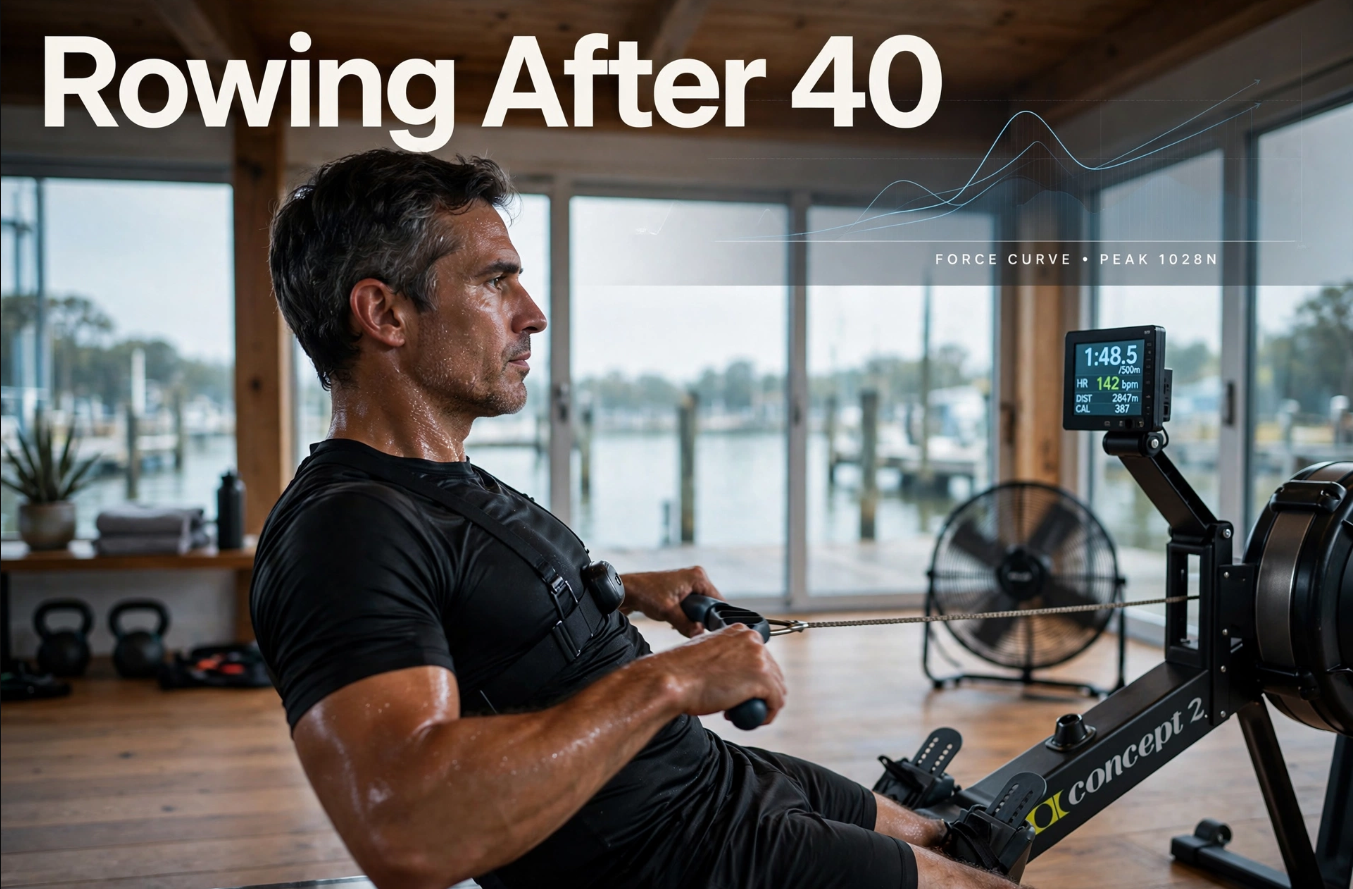
The Concept2 performance monitor is your dashboard. The most important metric for the over-40 rower is split time (the time it takes to row 500 meters at your current pace) and stroke rate (strokes per minute, or s/m).
- Split Time / 500m Pace: This is your speed. It directly reflects how hard you’re working. A 2:00 split means it would take you 2 minutes to row 500 meters.
- Stroke Rate (s/m): This is your cadence. For most training, you should be between 18–24 strokes per minute. This feels slow to beginners, who often crank the rate up to 30+. A low rate with high power (a fast split) means you’re being efficient, driving hard with your legs and then recovering fully. A high rate with a slow split means you’re spinning your wheels.
- Watts: A measure of power output. Useful for very precise interval training.
Connecting to Your Heart Rate Zones:
The rower is perfect for heart rate zone training. Connect your chest strap (Polar H10 works seamlessly with Concept2 PM5 monitors). Use the same zones we’ve defined in our Heart Rate Zones Guide.
- Zone 2: A steady, conversational pace. Aim for a split that keeps you at 60–70% of max HR. Stroke rate 18–20 s/m. This is your “all day” pace.
- Zone 4–5 (HIIT): All-out efforts for short durations. Stroke rate will climb to 28–34 s/m, and your split will drop dramatically. The monitor’s force curve can show you if you’re maintaining a smooth, powerful drive even at high speed.
Section 3: The VigorForty Rowing Workout Library
Here are three cornerstone sessions, from base-building to maximal intensity.
Workout 1: The Zone 2 Endurance Row (The Bread and Butter)
- Goal: Build mitochondrial density, improve fat oxidation, strengthen the posterior chain, and create a meditative rhythm.
- Warm-up: 5 minutes very easy rowing, focusing on form. Include some legs-only and arms-only drill strokes.
- Main Set: 40–60 minutes of continuous, steady-state rowing at 18–20 strokes per minute. Your breathing is rhythmic and conversational. Focus on a smooth drive and a slow, relaxed recovery. Your 500m split time should be one you could hold a conversation at without gasping.
- Cool-down: 5 minutes of very easy rowing, letting the split time rise.
- Why it works: This session builds the deep aerobic engine, strengthens the postural muscles of the back and core, and is gentle enough to do several times a week.
Workout 2: The Power Pyramid (Building Strength and Threshold)
- Goal: Improve rowing-specific strength and power at low stroke rates, while building lactate threshold.
- Warm-up: 5–10 minutes easy rowing with form drills.
- Main Set: Pyramid of 4-minute intervals with 3 minutes of light rowing rest between each. The stroke rate is strictly capped at 22 s/m, forcing you to generate power with each drive rather than relying on speed. The split times should get faster as the interval duration shortens, then slower as it lengthens.
- 4 min @ 22 s/m
- 3 min @ 22 s/m
- 2 min @ 22 s/m
- 1 min @ 22 s/m (a hard, powerful minute)
- Then back up: 2 min, 3 min, 4 min.
- Cool-down: 5–10 minutes easy rowing.
- Why it works: Low-rate, high-power rowing teaches perfect force application and builds the glutes, hamstrings, and back like few other cardio modalities.
Workout 3: The 30/30 HIIT Blast (VO2 Max and Afterburn)
- Goal: Spike VO2 max, growth hormone, and EPOC in minimal time.
- Warm-up: 10 minutes of gradual building, including a few 10-stroke power bursts at race pace.
- Main Set: 10 rounds of: 30 seconds ALL-OUT sprint, followed by 30 seconds of very light, easy paddling. The goal on the sprints is maximal power—your split time should be dramatically faster than your Zone 2 pace. Expect to be gasping by round 6. Hold on.
- Cool-down: 10 minutes of very easy rowing, letting your heart rate come down.
- Why it works: This is metabolically devastating in the best way. It torches calories, sharply improves insulin sensitivity, and improves your ability to produce power under fatigue. The rower is the ideal tool for this because the impact-free motion protects your joints even at maximal effort.
Section 4: Integrating the Rower into Your VigorForty Week
The rower can serve multiple roles in your training plan.
As Your Primary HIIT Tool: The 30/30 workout is your go-to, joint-friendly HIIT session. Substitute it for your air bike or running intervals once a week. The full-body nature of the rower makes this incredibly demanding.
As an Active Recovery Tool: A 20–30 minute session at an ultra-easy pace (Zone 1, very low resistance, focusing purely on the smooth, relaxing rhythm of the stroke) is a superb active recovery workout. The sliding motion gently moves the knees and hips through a full range of motion, flushing out soreness.
As a Cross-Training Day: For the runner or cyclist, a weekly rowing session adds cardiovascular volume without the orthopedic load of additional running miles. The upper-body and posterior-chain engagement also corrects the muscular imbalances that running and cycling can create.
Sample Week (Runner with Rowing Cross-Training):
- Monday: Strength training (full body)
- Tuesday: 45 min Zone 2 run
- Wednesday: Rowing Workout 2 (Power Pyramid) – 40 min
- Thursday: 60 min Zone 2 run
- Friday: Strength training
- Saturday: 90 min long run
- Sunday: Rowing Workout 1 (Zone 2 Endurance Row, 45 min) or active recovery walk
Section 5: Setting Up Your Home Rower and Maintaining It
If you decide to invest in a rower for your home gym (as discussed in our Equipment Guide), a few setup tips ensure comfort and longevity.
- Floor Protection: A rubber mat under the rower protects your floor from sweat and vibration.
- Ventilation: Rowing generates significant body heat. Position a fan to blow directly on you.
- Entertainment: An iPad mount on the Concept2 is a popular add-on. Zone 2 rows are perfect for watching documentaries or shows. HIIT rows demand focus and a good playlist.
- Maintenance: Wipe the rail and seat rollers clean after every session. Oil the chain every 50 hours of use with Concept2’s chain oil. Keep the flywheel housing dust-free.
Section 6: FAQ—Your Rowing Questions Answered
Q: I keep hearing rowing is bad for your back. Is it?
A: Rowing with poor form can strain the lower back, but rowing with good form is one of the best things you can do for your back. The key is maintaining a neutral spine (not slouching) and generating power from the hips and legs, not by yanking with your lower back. If you have a history of disc issues, consult a physical therapist and start with very light, slow, form-focused sessions.
Q: My butt gets sore on the seat. What can I do?
A: This is common for new rowers. A gel seat pad or a folded towel can provide immediate relief. Over time, your body adapts. Also, check your posture—sitting too much on your tailbone instead of your sit bones (ischial tuberosities) will cause discomfort. Tilting your pelvis slightly forward can help you find the right position.
Q: I’m short. Will rowing work for me?
A: Absolutely. While elite rowers are tall due to the leverage advantage on the water, indoor rowing is for everyone. Shorter rowers may have a slightly shorter stroke length, but they can generate just as much cardiovascular intensity and benefit. The key is fitting the machine to your body—adjusting the foot stretchers and ensuring you can reach the catch comfortably without overcompressing your knees.
Q: How do I know if I’m getting a good workout? My legs aren’t burning like they do on a run.
A: Rowing fatigue is different. It’s often a full-body, systemic tiredness rather than localized muscle burn. If your heart rate is in the target zone and you’re breathing hard, you’re getting an excellent cardiovascular workout, even if your legs don’t feel the same acute burn as running hills. The proof is in your improved split times and lower resting heart rate over time.
The VigorForty Take
The rowing machine is not a piece of medieval torture equipment. It is a sophisticated, time-efficient, and remarkably gentle-on-the-joints tool for building the strong, resilient, and capable body you want to inhabit for the rest of your life. It asks for your attention and your technique, but it repays that investment with a cascade of benefits: a powerful posterior chain that reverses the damage of your desk job, a cardiovascular engine that rivals any cyclist’s or runner’s, and a meditative rhythm that quiets the noise of midlife.
Don’t let the dust gather on the erg in the corner of your gym, or let it become a clothes rack in your spare bedroom. Learn the stroke. Dial in your form. Start with the Zone 2 endurance row, let your body find its rhythm, and experience the quiet satisfaction of seeing your split times drop and your stroke power rise. The river is calling, even if it’s just a virtual one on your monitor. Take a seat, strap in, and pull. Your heart, your back, and your future self will thank you for every single stroke.
Read All Related Articles
- The Complete Guide to Zone 2 Training After 40: How Low-Intensity Cardio Boosts Fat Loss, Longevity, and Endurance
- The Complete Guide to HIIT After 40: Joint-Friendly Workouts That Torch Fat and Protect Your Heart
- The Complete Guide to Running After 40: How to Start, Stay Injury-Free, and Build Lifelong Endurance
- The Complete Guide to Metabolic Health After 40: Reverse Insulin Resistance, Burn Stubborn Fat, and Reclaim Your Energy with Cardio
- The Complete Guide to Cardio Recovery After 40: How to Rest, Rebuild, and Come Back Stronger
- The Complete Guide to Heart Rate Training Zones After 40: Unlock Every Beat for Maximum Fat Loss, Endurance, and Longevity
- The Complete Guide to VO2 Max After 40: The #1 Predictor of Longevity and How to Improve It
- The Complete Guide to Concurrent Training After 40: How to Combine Cardio and Strength for Maximum Fat Loss, Muscle Preservation, and Longevity
- The Complete Guide to Walking and Rucking After 40: The Most Underrated Cardio for Fat Loss, Joint Health, and Longevity
- The Complete Guide to Designing Your Own Cardio Plan After 40: A Personalized Blueprint for Fat Loss, Longevity, and Peak Performance
- The Complete Guide to Cardio Nutrition After 40: Fuel Your Workouts for Maximum Fat Loss, Endurance, and Recovery
- The Complete Guide to Cardio Equipment After 40: Choosing the Best Treadmill, Bike, Rower, or Elliptical for Your Home Gym
- The Complete Guide to Injury Prevention for Cardio After 40: Run, Ride, and Ruck Pain-Free for Life
- The Complete Guide to Cardio for Fat Loss After 40: Burn Stubborn Belly Fat Without Losing Muscle or Energy
- The Complete Guide to Seasonal Cardio Training After 40: How to Periodize Your Year for Year-Round Fitness, Fat Loss, and Injury Prevention
- The Complete Guide to Cardio and Brain Health After 40: How Exercise Protects Your Memory, Mood, and Mental Sharpness
- The Complete Guide to Building a Home Gym for Cardio After 40: Design a Space That Makes Consistency Inevitable
- The Joyful Movement Manifesto: How to Love Cardio After 40 and Make It a Lifelong Practice
- The Complete Guide to Sleep and Cardio After 40: How Deep Rest Unlocks Your Best Performance, Recovery, and Longevity
- The Complete Guide to Stress, Cortisol, and Cardio After 40: How to Manage Your Nervous System for Better Recovery and Performance
- The Complete Guide to Returning to Cardio After a Layoff After 40: Your Compassionate, Science-Backed Roadmap Back to Fitness
- The Complete Guide to Cardio Through Menopause: How to Adapt Your Training for Hormonal Changes, Protect Your Heart, and Feel Strong After 40
- The Complete Guide to Cycling After 40: Low-Impact Cardio for Joint Health, Endurance, and Lifelong Fitness
- The Complete Guide to Pool and Water-Based Cardio After 40: Low-Impact Workouts for Joint Pain, Recovery, and Total-Body Fitness
- The Complete Guide to Rowing After 40: Full-Body, Low-Impact Cardio for Strength, Endurance, and Longevity
- The Complete Guide to Tracking Cardio Progress After 40: The Key Metrics That Matter More Than the Scale
- The Complete Guide to Cardio for High Blood Pressure After 40: How Exercise Lowers Your Numbers and Protects Your Heart
- The Complete Guide to Cardio for Type 2 Diabetes and Prediabetes After 40: How Exercise Reverses Insulin Resistance and Protects Your Heart
- The Complete Guide to Cardio with Arthritis After 40: Pain-Free Workouts That Strengthen Joints and Keep You Moving
- The Complete Guide to Longevity and Cardio After 40: How Aerobic Fitness Adds Years to Your Life and Life to Your Years
- The Complete Guide to Building a Cardio Habit After 40: The Science of Making Exercise Stick for Life
- The Complete Guide to Cardio and Immune Health After 40: Strengthen Your Body’s Defense System for a Resilient, Vibrant Life
- The Complete Guide to Cardio While Traveling After 40: Stay Fit on the Road, in Hotels, and Away from Home
- The Complete Guide to Cardio for Posture and Back Pain After 40: Strengthen Your Posterior Chain and Reverse the Damage of Sitting
- The Complete Guide to the Social Side of Cardio After 40: How Community, Accountability, and Connection Make You Stronger
- The VigorForty Manifesto: A Final Word on the Lifelong Practice of Movement