Author: Vigor Forty Editorial Team
Medically Reviewed By: Editorial Review Board
Disclaimer: This article is for informational purposes only and is not a substitute for professional medical advice. Consult your physician before starting any new exercise program. Read our full Medical Disclaimer.
📌 Key Takeaways
- One Size Fits None After 40: Generic online workout plans ignore your unique injury history, stress levels, sleep quality, and metabolic health. A personalized plan—built on the principles you’ve learned across our guides—delivers better results and prevents burnout.
- Start With Your “Big Why” and Choose a Primary Goal: Whether it’s losing visceral fat, reversing prediabetes, training for a 5K, or simply having enough energy to play with your kids at 60, your goal determines the mix and dose of Zone 2, HIIT, running, rucking, and strength.
- The 80/20 Rule Is Your Compass, Not a Cage: 80% low-intensity (Zone 1–2) and 20% high-intensity (Zone 4–5) is the proven polarized formula. But your individual ratio can flex based on your recovery capacity, age, and goals. Some weeks it might be 90/10; others, 70/30. Learn to listen to your body’s signals.
- Progressive Overload Applies to Cardio, Too: You can’t do the same three runs and two bike sessions forever and expect continuous improvement. Gradually increasing weekly volume (no more than 5–10% per week), adding a few minutes to intervals, or increasing ruck weight provides the stimulus for ongoing adaptation.
- Your Plan Must Fit Your Real Life, Not a Fantasy Schedule: The best plan in the world is useless if you can’t stick to it. A sustainable 3-day plan executed for years beats an ambitious 6-day plan abandoned in three weeks. We’ll give you templates for 3, 4, and 5-day weeks that fit around a demanding American career and family life.
Introduction: You Have All the Pieces—Now Build the Puzzle
By now, you’ve immersed yourself in the VigorForty cardio library. You understand that Zone 2 builds your mitochondrial engine, HIIT spikes insulin sensitivity and growth hormone, running builds bone density and VO2 max, walking is a daily metabolic tonic, and rucking uniquely combines strength and endurance. You know your heart rate zones, you respect recovery, and you’re aware that lifting weights is non-negotiable.
But knowledge without a plan is like a garage full of high-end tools and no blueprint for what to build. Many well-intentioned midlife Americans read article after article, buy a heart rate monitor, maybe even a rucksack, and then freeze. How many days a week should I do Zone 2? Can I do HIIT and legs on the same day? What if I only have three days to train? Am I doing too much? Too little? The paralysis is real.
This guide is your blueprint. It translates every principle from our previous articles into a step-by-step system for designing your own personalized cardio plan. You’ll identify your primary goal, honestly assess your recovery capacity and schedule, pick from proven weekly templates, learn how to progress safely, and—most importantly—learn how to adjust on the fly based on your body’s real-time feedback. No more guessing. No more generic programs built for 22-year-olds. Just a clear, flexible, scientifically grounded roadmap to the fittest, healthiest version of your midlife self.
Section 1: Step One—Define Your Primary Goal and “Big Why”
Every effective plan starts with clarity of purpose. Your goal determines which training elements take priority and how much volume you allocate to each. After 40, you can absolutely improve multiple fitness qualities simultaneously (concurrent training), but one goal must be primary.
Common Midlife Goals and Their Training Priorities
| Primary Goal | Priority #1 | Priority #2 | Priority #3 |
|---|---|---|---|
| Fat Loss & Metabolic Reset | Zone 2 (60–70% of total volume) + Daily walking | Strength (2x/week) | 1 HIIT session/week |
| Longevity & Healthspan | Zone 2 + Walking (build base) | Strength (2x/week) | 1 HIIT or VO2 max session/week |
| 5K/10K Race Performance | Running: easy runs + 1 tempo + 1 long run | Strength (2x/week) | Optional HIIT (bike/row) for cross-training |
| Build Muscle While Staying Lean | Strength (3x/week) | Zone 2 (2–3x/week) | Minimal HIIT (1x/week or less) |
| Joint Pain / Rehab Focus | Walking, pool, cycling (Zone 1–2) | Gentle strength & mobility | Very gradual rucking or elliptical intervals |
Be brutally honest about what you actually want. If your deepest desire is to lose 20 pounds of belly fat and get your blood sugar under control, your plan looks very different than if you’re a former runner who wants to race a half-marathon at 50. Write your primary goal down. This becomes your North Star.
Section 2: Step Two—Assess Your Recovery Capacity and Real-Life Schedule
Your plan must fit within the container of your actual life. Overestimating your available time and recovery capacity is the single biggest reason plans fail.
The Recovery Inventory
Ask yourself honestly:
- How many hours of quality sleep do I consistently get? (Under 7 hours means you need lower volume and more recovery days.)
- How stressful is my job and home life right now? (High life stress = lower tolerance for high-intensity training. Favor Zone 2.)
- Do I have any nagging injuries or chronic pain? (Adjust modalities accordingly—bike instead of run, ruck instead of HIIT.)
- How do I feel after a hard workout the next day? (If you’re wrecked for 48 hours, your intensity dose is too high.)
The Schedule Reality Check
Look at your typical week. Block out non-negotiable commitments: work, commute, family obligations, sleep. Identify the realistic windows for exercise. Be specific:
- Can I consistently train 3, 4, or 5 days per week?
- How long are those windows? (30 min? 60 min? 90 min on weekends?)
- Can I double up on any day with a morning and evening session?
It’s far better to commit to three sessions you’ll actually do than five sessions you’ll bail on. A 3-day plan executed with consistency for 12 weeks will transform your health. A 6-day fantasy plan abandoned after week 2 changes nothing.
Section 3: Step Three—Choose Your Weekly Template
Based on your goal, recovery capacity, and available days, select one of the following templates. Each template integrates the modalities we’ve covered across all our guides. Think of them as starting blueprints you’ll customize.
The 3-Day Essential Template (Minimalist, High Impact)
Best for: Busy professionals, parents, those new to structured training.
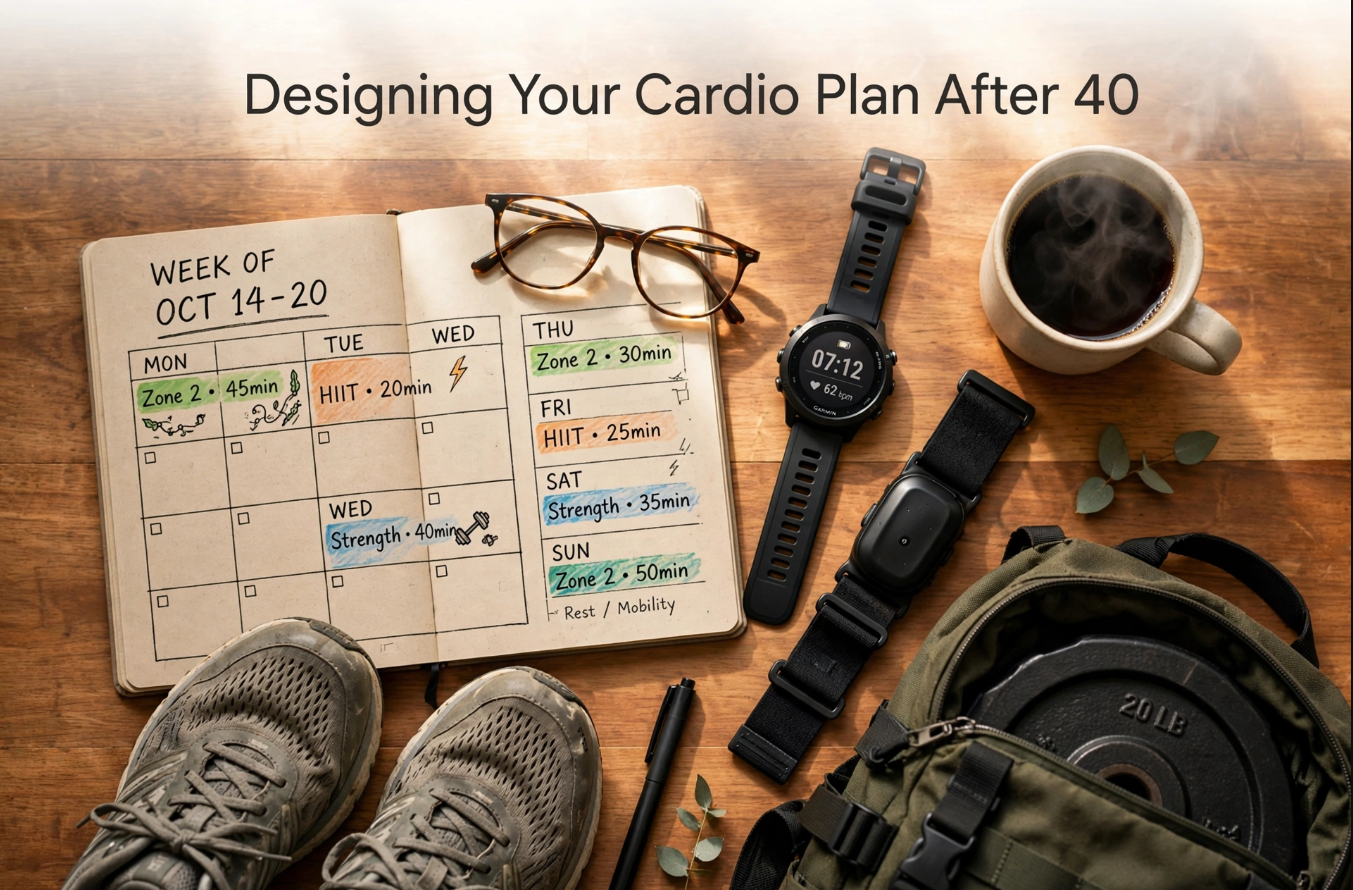
- Day 1 (Strength + Short Cardio): Full-body strength (45 min) + 20 min Zone 2 cool-down (walk, bike).
- Day 2 (HIIT or VO2 Max): 20–25 min interval session (bike, rower, pool) + 10 min core.
- Day 3 (Long Zone 2 Endurance): 75–90 min Zone 2 (ruck, run/walk, bike, or hike).
- Daily: Aim for 7,000–8,000 steps, including a 15-min post-meal walk.
- Pro tip: If your goal is fat loss, make Day 2 another Zone 2 session instead of HIIT and rely on your strength day for metabolic intensity.
The 4-Day Balanced Template (The VigorForty Sweet Spot)
Best for: Most midlife adults who want comprehensive fitness without overtraining.
- Day 1 (Upper Body Strength + Zone 2): Upper body lift (40 min) + 30 min Zone 2 bike or row.
- Day 2 (HIIT or Tempo Run): 20–25 min interval session (HIIT guide Workouts 1–7) or 20-min tempo run.
- Day 3 (Lower Body Strength + Active Recovery): Lower body lift (40 min) + 20 min Zone 1 walk.
- Day 4 (Long Endurance): 90–120 min Zone 2 ruck, run, or long hike.
- Daily: 8,000–10,000 steps, post-meal walks.
The 5-Day Performance Template (For the Serious, Well-Recovered Athlete)
Best for: Those with training experience, good sleep, and a specific performance goal (race, significant VO2 max improvement).
- Day 1 (Lower Body Strength): Heavy compound leg day (45–50 min).
- Day 2 (Zone 2 + Strides): 60 min Zone 2 run or ruck + 6×20 sec strides at the end.
- Day 3 (Upper Body Strength + HIIT): Upper body lift (35 min) + 15-min HIIT finisher (bike).
- Day 4 (Zone 2 Recovery): 40–50 min very easy Zone 2 (conversational, no drift).
- Day 5 (Long Endurance or VO2 Max Intervals): Alternate weeks: Week A: 90–120 min long Zone 2. Week B: 4×4 min VO2 max intervals + warm-up/cool-down.
- Day 6: Active recovery walk or rest.
- Day 7: Rest.
- Daily: 10,000+ steps.
Section 4: Step Four—Plug In Your Specific Modalities
Now tailor the templates with the activities you enjoy and that your body tolerates well. Use this decision matrix:
For Zone 2 Sessions:
- Joints feel great, want outdoors: Running (trail or road) or rucking.
- Joints achy, need low impact: Cycling (stationary or outdoor), rowing, elliptical.
- Zero impact, rehab focus: Pool running or swimming.
- Want functional strength boost: Rucking with 20–30 lbs.
For HIIT Sessions:
- Knees good: Treadmill hill power walks (Workout 5), bodyweight circuit on grass.
- Knees sensitive: Assault bike (Workout 1), rowing pyramid (Workout 2), battle ropes (Workout 4).
- Back issues: Pool sprints (Workout 3), recumbent bike intervals.
For Strength Sessions:
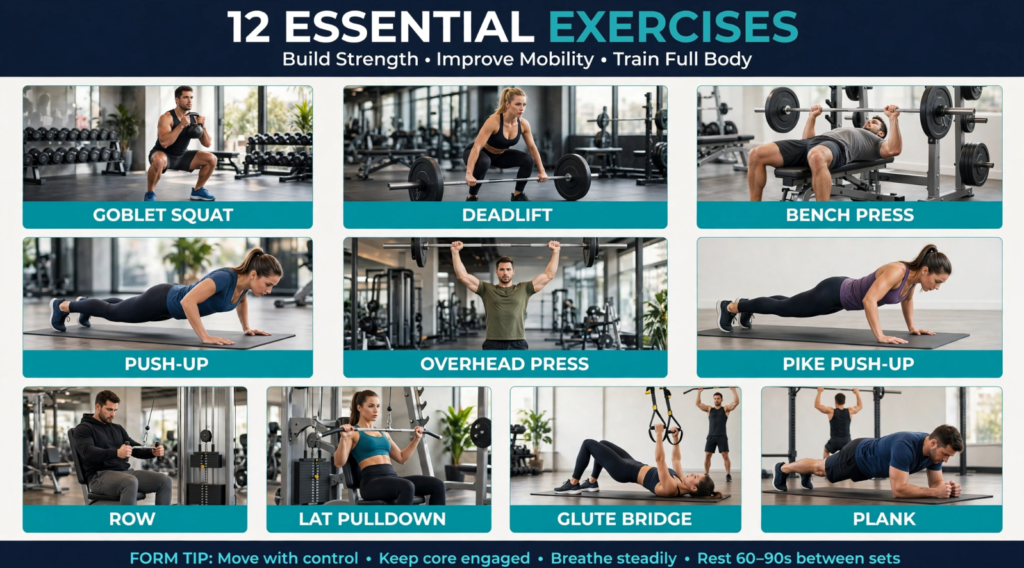
- Always include: Squat or leg press, hip hinge (deadlift or kettlebell swing), push, pull, and core.
- If time-crunched: Full-body compound circuits (kettlebell, dumbbell).
- If joint-limited: Machines and bodyweight can be highly effective. Don’t avoid strength just because barbells aren’t for you.
Rotate Modalities Seasonally
Your body adapts to repetitive stimuli. Every 8–12 weeks, consider swapping one modality for another. If you’ve been running for Zone 2 all summer, try rucking in the fall. If you’ve been cycling for HIIT, switch to the rower. This keeps your mind engaged and challenges your body in new ways without abandoning the underlying zone distribution.
Section 5: Step Five—Progress Safely and Avoid the Plateau
Progressive overload in cardio isn’t just about going faster. It’s about systematically increasing the training stimulus so your body keeps adapting.
Ways to Progress Cardio (Pick ONE at a Time)
- Increase Duration: Add 5–10 minutes to one Zone 2 session per week. A 45-min session becomes 50, then 55. Cap Zone 2 sessions at 90–120 minutes.
- Increase Frequency: Move from 3 sessions to 4, but only after 4–6 weeks of consistency at the lower frequency.
- Add an Interval Round: Go from 4×4 min VO2 max intervals to 5×4 min. Go from 6 rounds of HIIT to 8 rounds. Only when the current prescription feels manageable.
- Increase Ruck Weight: Add 5 lbs only when you can complete your target distance comfortably. Never increase weight and distance together.
- Slightly Increase Zone 2 Pace: As aerobic fitness improves, your pace at the same heart rate will naturally increase. Let this happen organically; don’t force it.
The 3:1 Cycle
For every 3 weeks of progressive overload, schedule 1 deload week. Reduce total volume by 30–40%, cut HIIT, and keep all work in Zone 1 or low Zone 2. This is when your body actually gets stronger, faster, and more resilient. Skipping deloads is a direct path to overtraining and injury after 40.
Section 6: Step Six—Listen, Tweak, and Never Be a Prisoner to the Plan
Your plan is a living document, not a contract. The single most important skill a midlife athlete can develop is the ability to read their body’s signals and adjust.
Daily Decision Tree
When you wake up on a training day, ask:
- How did I sleep? (Poor sleep + elevated resting HR = easy Zone 2 or active recovery, even if the plan says HIIT.)
- How do my joints and muscles feel? (Sharp pain = don’t train that area. Diffuse soreness = proceed with warm-up, adjust intensity down if needed.)
- What’s my mental state? (Dreading the workout = do something easier but still move. Low motivation is often a sign of accumulated fatigue, not laziness.)
- What’s my resting heart rate relative to baseline? (Elevated by 5+ bpm = easy day. Normal or low = green light for intensity.)
Tweak, Don’t Quit
If you miss a planned session, don’t try to “make it up” by cramming two hard days together. Simply pick up the plan where you left off. Consistency over weeks and months is the engine of transformation. A single missed workout is a drop in the ocean; a pattern of guilt-driven overcompensation is a tidal wave that can wash out weeks of progress.
Section 7: Sample Cardio Plans for Common Goals
Plan A: Bob, 48—Wants to Lose 25 lbs and Fix Prediabetes
- Schedule: 4 days/week. High-stress job. Sleep ~6.5 hrs (working on it).
- Monday: Full-body strength (45 min) + 20 min Zone 2 walk.
- Wednesday: 45 min Zone 2 ruck (20 lbs).
- Friday: Full-body strength (45 min).
- Saturday: 90 min Zone 2 hike with family.
- Daily: 10-min post-meal walks after lunch and dinner. Target 8,000 steps.
- Rationale: Emphasis on Zone 2 and daily walking to improve insulin sensitivity and burn fat. Two strength days preserve muscle. HIIT omitted initially due to low sleep and high stress; added later once recovery improves.
Plan B: Lisa, 52—Training for Her First 5K
- Schedule: 4 days/week. Good sleep. No major injuries.
- Tuesday: Easy run, 30–40 min Zone 2 + 4×20 sec strides.
- Thursday: Full-body strength (40 min).
- Friday: Tempo intervals: 10 min warm-up, 2×10 min at “comfortably hard” pace, 10 min cool-down.
- Sunday: Long run, 50–65 min Zone 2.
- Daily: Walk 20–30 min on non-running days.
- Rationale: Running-specific plan with one speed day, one long run, and strength to prevent injury. Total volume increases gradually toward race day.
Plan C: Mark, 45—Wants to Maintain Muscle, Improve VO2 Max, and Stay Lean
- Schedule: 5 days/week. Good recovery. Former athlete.
- Monday: Lower body strength (heavy).
- Tuesday: VO2 max intervals (4×4 min rower) + 20 min Zone 2 cool-down.
- Wednesday: Upper body strength.
- Thursday: 60 min Zone 2 ruck (30 lbs).
- Friday: Full-body strength (moderate) + 15 min HIIT bike finisher.
- Saturday: 90–120 min Zone 2 trail run or long ruck.
- Sunday: Rest.
- Rationale: Equal priority to strength and high-end cardio. One dedicated VO2 max day, one long Zone 2 day, one blended HIIT day, and three strength days with careful separation of heavy leg work and hard intervals.
Section 8: FAQ—Your Program Design Questions Answered
Q: I only have 30 minutes a day, three times a week. Can I still make progress?
A: Absolutely. In 30 minutes, you can do a full-body strength circuit (20 min) followed by 10 minutes of hard intervals on a bike. Or you can do a 30-minute Zone 2 walk or jog. The key is making those 30 minutes count—no scrolling, no long transitions. Three focused 30-minute sessions per week, combined with a daily walk and smart nutrition, can produce significant changes in body composition and cardiovascular health.
Q: How do I know when to advance from the 3-day to the 4-day template?
A: When you’ve been consistent for 8–12 weeks on the 3-day plan, feel energized rather than drained after workouts, and find yourself wishing you could do a little more. Add one day, keep intensity moderate for the first two weeks, and reassess.
Q: Should I do the same plan year-round?
A: Not necessarily. Seasonality is smart. Many over-40 athletes use fall and winter for more strength-focused work and base-building Zone 2, then shift to more running or HIIT in spring and summer when weather and daylight improve. This undulating approach prevents stagnation and overuse injuries.
Q: My goal is longevity, not performance. Do I still need HIIT?
A: Yes, but a very small dose. One 15–20 minute HIIT session per week—or even one 4×4 minute VO2 max session every other week—provides the cardiac power, insulin sensitivity, and growth hormone benefits that pure Zone 2 doesn’t. The longevity sweet spot appears to be mostly easy with a sprinkle of hard. Don’t skip it entirely.
The VigorForty Take
You now have everything you need. Not just a generic workout, but a framework for building your own personalized, evidence-backed cardio plan—one that honors your body, your goals, your schedule, and your life after 40.
This series has taken you from the mitochondrial depths of Zone 2 to the peak intensity of HIIT, from the pavement-pounding rhythm of running to the quiet, loaded power of rucking. You’ve learned how to measure your VO2 max, how to listen to your heart rate, how to recover like a pro, and how to weave strength and cardio into a seamless, life-extending fabric. This final guide hands you the needle and thread.
Start simple. Pick the template that matches your life right now. Execute it with consistency, not perfection. Listen to your body’s whispers and adjust. Progress slowly and celebrate the small wins—a lower resting heart rate, a faster mile at the same effort, a belt that fits looser, an afternoon without an energy crash.
Your fitness after 40 is not a race. It’s a long, beautiful, and deeply personal journey. You’ve got the map. Now walk it, ruck it, run it, ride it—one intentional session at a time. Your future self, at 60, 70, and beyond, will look back and thank you for the foundation you’re laying today. See you on the road, on the trail, in the gym, and everywhere in between.
Read All Related Articles
- The Complete Guide to Zone 2 Training After 40: How Low-Intensity Cardio Boosts Fat Loss, Longevity, and Endurance
- The Complete Guide to HIIT After 40: Joint-Friendly Workouts That Torch Fat and Protect Your Heart
- The Complete Guide to Running After 40: How to Start, Stay Injury-Free, and Build Lifelong Endurance
- The Complete Guide to Metabolic Health After 40: Reverse Insulin Resistance, Burn Stubborn Fat, and Reclaim Your Energy with Cardio
- The Complete Guide to Cardio Recovery After 40: How to Rest, Rebuild, and Come Back Stronger
- The Complete Guide to Heart Rate Training Zones After 40: Unlock Every Beat for Maximum Fat Loss, Endurance, and Longevity
- The Complete Guide to VO2 Max After 40: The #1 Predictor of Longevity and How to Improve It
- The Complete Guide to Concurrent Training After 40: How to Combine Cardio and Strength for Maximum Fat Loss, Muscle Preservation, and Longevity
- The Complete Guide to Walking and Rucking After 40: The Most Underrated Cardio for Fat Loss, Joint Health, and Longevity
- The Complete Guide to Designing Your Own Cardio Plan After 40: A Personalized Blueprint for Fat Loss, Longevity, and Peak Performance
- The Complete Guide to Cardio Nutrition After 40: Fuel Your Workouts for Maximum Fat Loss, Endurance, and Recovery
- The Complete Guide to Cardio Equipment After 40: Choosing the Best Treadmill, Bike, Rower, or Elliptical for Your Home Gym
- The Complete Guide to Injury Prevention for Cardio After 40: Run, Ride, and Ruck Pain-Free for Life
- The Complete Guide to Cardio for Fat Loss After 40: Burn Stubborn Belly Fat Without Losing Muscle or Energy
- The Complete Guide to Seasonal Cardio Training After 40: How to Periodize Your Year for Year-Round Fitness, Fat Loss, and Injury Prevention
- The Complete Guide to Cardio and Brain Health After 40: How Exercise Protects Your Memory, Mood, and Mental Sharpness
- The Complete Guide to Building a Home Gym for Cardio After 40: Design a Space That Makes Consistency Inevitable
- The Joyful Movement Manifesto: How to Love Cardio After 40 and Make It a Lifelong Practice
- The Complete Guide to Sleep and Cardio After 40: How Deep Rest Unlocks Your Best Performance, Recovery, and Longevity
- The Complete Guide to Stress, Cortisol, and Cardio After 40: How to Manage Your Nervous System for Better Recovery and Performance
- The Complete Guide to Returning to Cardio After a Layoff After 40: Your Compassionate, Science-Backed Roadmap Back to Fitness
- The Complete Guide to Cardio Through Menopause: How to Adapt Your Training for Hormonal Changes, Protect Your Heart, and Feel Strong After 40
- The Complete Guide to Cycling After 40: Low-Impact Cardio for Joint Health, Endurance, and Lifelong Fitness
- The Complete Guide to Pool and Water-Based Cardio After 40: Low-Impact Workouts for Joint Pain, Recovery, and Total-Body Fitness
- The Complete Guide to Rowing After 40: Full-Body, Low-Impact Cardio for Strength, Endurance, and Longevity
- The Complete Guide to Tracking Cardio Progress After 40: The Key Metrics That Matter More Than the Scale
- The Complete Guide to Cardio for High Blood Pressure After 40: How Exercise Lowers Your Numbers and Protects Your Heart
- The Complete Guide to Cardio for Type 2 Diabetes and Prediabetes After 40: How Exercise Reverses Insulin Resistance and Protects Your Heart
- The Complete Guide to Cardio with Arthritis After 40: Pain-Free Workouts That Strengthen Joints and Keep You Moving
- The Complete Guide to Longevity and Cardio After 40: How Aerobic Fitness Adds Years to Your Life and Life to Your Years
- The Complete Guide to Building a Cardio Habit After 40: The Science of Making Exercise Stick for Life
- The Complete Guide to Cardio and Immune Health After 40: Strengthen Your Body’s Defense System for a Resilient, Vibrant Life
- The Complete Guide to Cardio While Traveling After 40: Stay Fit on the Road, in Hotels, and Away from Home
- The Complete Guide to Cardio for Posture and Back Pain After 40: Strengthen Your Posterior Chain and Reverse the Damage of Sitting
- The Complete Guide to the Social Side of Cardio After 40: How Community, Accountability, and Connection Make You Stronger
- The VigorForty Manifesto: A Final Word on the Lifelong Practice of Movement