
Author: Vigor Forty Editorial Team
Medically Reviewed By: Editorial Review Board
Disclaimer: This article is for informational purposes only and is not a substitute for professional medical advice. Consult your physician before beginning a new exercise program, especially when traveling to new environments or altitudes. Read our full Medical Disclaimer.
📌 Key Takeaways
- Travel Is a Maintenance Phase, Not a Setback: A week or two of reduced but consistent training will not erase your fitness gains. Significant detraining begins after 2–3 weeks of complete inactivity. View travel as an active recovery or deload period that keeps the habit alive while allowing your body to rest and adapt.
- Bodyweight Circuits and Walking Are Your Portable Powerhouses: A 15–20 minute hotel room circuit—squats, lunges, push-ups, mountain climbers—requires zero equipment and delivers a potent cardiovascular and muscular stimulus. Exploring a new city on foot provides excellent Zone 2 cardio while immersing you in the local culture.
- A Single Resistance Band Creates a Complete Travel Gym: Weighing less than 4 ounces, a looped resistance band fits in any bag and allows for banded squats, rows, presses, and pull-aparts. Combined with bodyweight cardio intervals, it provides a full-body, joint-friendly workout anywhere.
- The “2-Day Rule” and “Something Is Better Than Nothing” Are Your Guiding Principles: Never let two consecutive days pass without some form of purposeful movement. A 10-minute session is a victory—it maintains the neural pathway of the habit and reinforces your identity as a person who moves.
- Nutrition, Hydration, and Sleep Are Even More Critical on the Road: Air travel is profoundly dehydrating. Restaurant meals are often calorie-dense and sodium-heavy. Prioritize protein and vegetables, drink water relentlessly, and recreate your home sleep environment with a sleep mask, earplugs, and a cool room.
Introduction: The Frequent Flyer’s Dilemma—and Solution
You’ve built a consistent, effective cardio routine at home. Your Zone 2 route is mapped, your rower is dialed in, your rucksack waits by the door. Then the calendar flips: a business trip to Chicago, a family reunion in Florida, a long-awaited vacation to Italy. The disruption looms large, and with it, the quiet fear that your hard-won progress will evaporate in a week of conference rooms, restaurant meals, and airport lounges.
For the over-40 American, travel is a double-edged sword. It offers enrichment, adventure, and necessary escape, but it also presents a minefield of sedentary hours, unfamiliar food, disrupted sleep, and the complete dismantling of daily routines. The all-or-nothing mindset whispers, “You can’t do your full workout, so why bother?” And many people, even dedicated athletes, abandon their practice entirely, returning home feeling sluggish, stiff, and guilty.
This guide is the antidote to travel-induced fitness derailment. It rejects the all-or-nothing trap and provides a flexible, creative, and highly effective toolkit for staying active anywhere on the planet. You don’t need a well-equipped hotel gym. You don’t need to pack a suitcase full of gear. All you need is your body, a sliver of floor space, maybe a resistance band, and the willingness to see a new city as your expanded gym. Whether you have 10 minutes between meetings or a full morning to explore, you’ll find a protocol here that fits your travel reality. The goal isn’t to set personal records on the road; it’s to maintain your fitness, manage travel stress, and return home with your habit and healthspan fully intact.
Section 1: The Travel Cardio Mindset—Maintenance, Adaptation, and Freedom
The first and most important shift is mental. Your home routine is designed for progressive overload and specific physiological adaptations. Travel is a maintenance phase—and that’s not a compromise, it’s a strategic adjustment.
Physiological Reality Check:
Significant detraining—measurable drops in VO2 max, mitochondrial enzyme activity, and plasma volume—begins after approximately 2–3 weeks of complete inactivity. A week of reduced but consistent movement will not set you back. In fact, a travel week can serve as an unintentional deload, allowing your body to recover more deeply from accumulated training stress. You may return home feeling fresher, not stale.
The 2-Day Rule, Applied to Travel:
Never let two consecutive days pass without some form of purposeful movement. A 15-minute hotel room circuit, a brisk 20-minute walk to a coffee shop across town, a few flights of stairs climbed intentionally—this is a deposit in the habit bank. It signals to your brain, “I am still a person who moves, even when I’m not at home.”
Embrace “Something Is Better Than Nothing”:
A 10-minute workout on a grueling travel day is a success. It maintains the neural pathway of the habit, burns some calories, elevates your mood, and prevents the “I’ve fallen off the wagon” psychology that can spiral into weeks of inactivity. Own those 10 minutes as a victory.
Section 2: The Ultimate Portable Cardio Toolkit
Pack light, but pack smart. These items turn any space into a functional workout zone.
- Your Body: The original, ultimate piece of equipment. Bodyweight exercises can be scaled—easier or harder—by adjusting leverage, tempo, and range of motion. No excuses, ever.
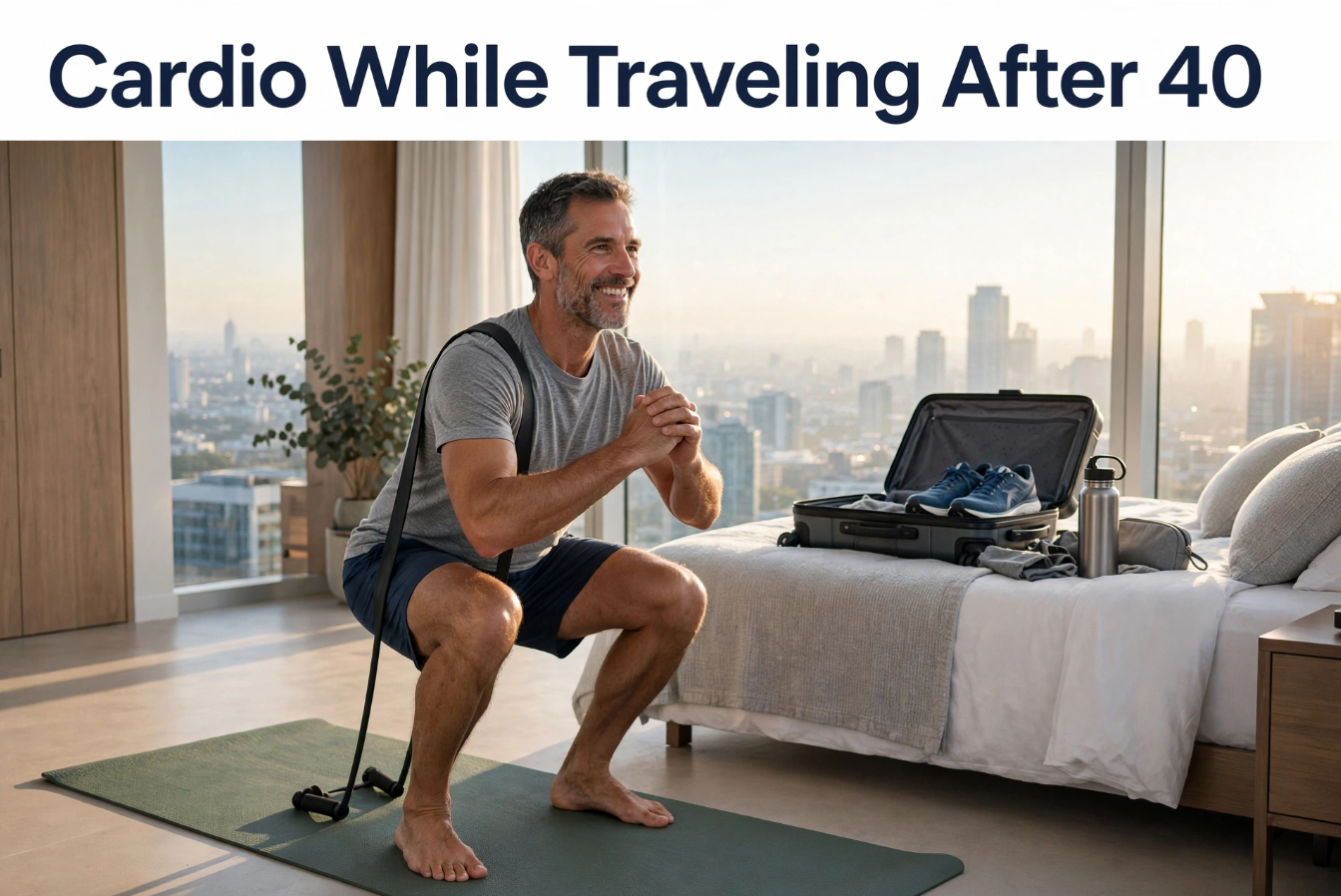
- Resistance Band (Medium/Heavy Loop): A 4-ounce, 4-foot looped band fits in a shoe. Use it for banded squats, rows, presses, pull-aparts, and good mornings. Anchor it to a door hinge or a sturdy piece of furniture.
- Jump Rope (Optional): A speed rope provides phenomenal high-intensity cardio in a tiny package. A jump rope mat or a towel on a hard floor is essential for your joints. Use only if your joints are pain-free.
- Walking or Running Shoes: You’ll be wearing these anyway. They are your ticket to Zone 2 exploration in any city, on any terrain.
- Your Daypack or Laptop Bag: It doubles as a rucking weight. Add your water bottle, a few books, or a bag of local apples for a 10–20 lb load, and your walk becomes a ruck.
Section 3: The VigorForty Travel Workout Library
These sessions require minimal space and no more than the basics above. They can be done in a hotel room, a park, or a quiet corner of an airport terminal.
Workout 1: The 15-Minute “No Excuses” Hotel Room Circuit
- Format: Perform each exercise for 45 seconds, followed by 15 seconds of rest. Cycle through the circuit 3 times (15 minutes total).
- Exercises:
- Bodyweight Squats
- Incline Push-Ups (hands on bed, desk, or wall) or Knee Push-Ups
- Reverse Lunges (alternating legs)
- Glute Bridges (single-leg if possible)
- Mountain Climbers (slow, controlled, on a towel)
- Plank Hold
- Why It Works: This full-body circuit elevates heart rate into Zone 3–4, builds muscular endurance, and requires zero equipment. It’s the perfect antidote to a day spent in conference rooms or on planes.
Workout 2: The “Explore the City” Zone 2 Walk or Ruck
- Format: 45–75 minutes of brisk walking or light rucking. Set a general direction on your map, then put the phone in your pocket. Get intentionally, safely lost. Let your curiosity guide you.
- Why It Works: Walking is the ultimate Zone 2 cardio. Exploring a new city on foot turns a workout into an immersive cultural experience. You’ll discover cafes, parks, and street art you’d never see from a taxi.
Workout 3: The 20-Minute Band and Bodyweight Blast
- Format: AMRAP (As Many Rounds As Possible) in 20 minutes.
- Circuit:
- 15 Banded Squats (band under feet, over shoulders)
- 10 Banded Rows (band anchored around a sturdy bedpost or door handle, or looped around your feet while seated)
- 10 Push-Ups (on floor or knees)
- 10 Banded Pull-Aparts (hold band at chest level, pull apart, squeeze shoulder blades)
- 20 Walking Lunges (10 per leg)
- 30-Second Plank Hold
- Why It Works: The band adds resistance, elevating heart rate and providing a strength stimulus. It’s a full-body, sweat-inducing session in a compact time frame.
Workout 4: The Airport or Roadside Reset (5–10 Minutes)
- Format: A series of gentle movements to counteract the stiffness of prolonged sitting.
- Movements:
- Standing Hip Circles (10 each leg)
- Deep Squat Hold (hold onto a pillar or chair) for 60 seconds
- Standing Calf Raises and Toe Raises (20 each)
- Arm Circles and Shoulder Rolls (10 each direction)
- Walking Lunges in a quiet corner
- Why It Works: This isn’t a cardio workout; it’s a recovery and mobility session. It prevents the aches, stiffness, and circulatory issues that come with long-haul travel.
Workout 5: The Stairwell HIIT Session
- Format: Find a quiet stairwell in your hotel. Walk up 5–10 floors at a brisk pace, then take the elevator down for recovery. Repeat 4–6 times. For higher intensity, take the stairs two at a time or increase your climbing speed.
- Why It Works: Stair climbing is a powerful, low-impact (if walked, not run) cardio workout that heavily recruits the glutes and legs. It’s private, climate-controlled, and often empty.
Section 4: Making the Most of Hotel Gyms (If Available)
If your hotel has a gym, use it strategically. Hotel gyms are often sparse—a couple of treadmills, a multi-purpose cable machine, and some light dumbbells. Have a plan before you walk in.
The 30-Minute Hotel Gym Protocol:
- 10-Minute Warm-Up on Treadmill or Bike: Start easy, gradually build to low Zone 2.
- 15-Minute Interval Circuit:
- 1 min hard on the bike/elliptical/treadmill (Zone 4–5, breathing heavily)
- Followed immediately by a strength exercise:
- Round 1: Dumbbell Squats x 12
- Round 2: Dumbbell Rows x 12 (per arm)
- Round 3: Dumbbell Overhead Press x 12
- Round 4: Dumbbell Romanian Deadlifts x 12
- Round 5: Dumbbell Chest Press x 12
- Minimal rest between rounds.
- 5-Minute Cool-Down: Easy pedaling or walking, followed by stretching.
Section 5: Nutrition, Hydration, and Recovery on the Road
Travel disrupts more than your workout schedule; it disrupts your entire physiological equilibrium. A few conscious strategies mitigate the damage.
Hydrate Relentlessly:
Air travel is profoundly dehydrating. Cabin air has extremely low humidity. Drink 8 oz of water for every hour of the flight. Avoid excessive alcohol and caffeine, which compound dehydration. Carry a reusable water bottle and refill it constantly.
The Restaurant Strategy:
You don’t need to eat perfectly, but a few simple rules preserve your metabolic health. Make protein the centerpiece of every meal: grilled chicken, fish, lean steak, eggs, or legumes. Add a large serving of vegetables. Request dressings and sauces on the side. Share desserts or skip them. Limit alcohol to one drink, consumed with food and water.
The Sleep Sanctuary Away from Home:
Hotel sleep can be terrible. Recreate your home environment as faithfully as possible. Pack a sleep mask and earplugs. Set the thermostat to 65–68°F. Use a white noise app on your phone. Avoid screens for 30–60 minutes before bed. If you’re crossing time zones, get morning light exposure immediately upon waking to reset your circadian clock.
Move After Meals:
A 10-minute walk after a business lunch or dinner is one of the easiest and most effective travel habits. It blunts the blood sugar spike from a large meal, aids digestion, and adds to your daily step count.
Section 6: FAQ—Your Travel Cardio Questions Answered
Q: I’m on vacation. Shouldn’t I just relax and not worry about exercise?
A: Rest and recovery are essential, and a vacation is a perfect time for a planned deload. However, complete inactivity for a week often leads to stiffness, low energy, and a sluggish feeling that can detract from the vacation experience. The solution is not to skip movement, but to choose vacation-friendly movement: a morning walk on the beach, a hike to a scenic viewpoint, a playful swim in the ocean. These aren’t “workouts”; they’re joyful, restorative activities that happen to be cardiovascular exercise.
Q: What if my hotel room is tiny and I’m worried about disturbing guests?
A: Modify exercises to be low-impact and silent. Swap jumping jacks for step-outs. Do stationary lunges instead of walking lunges. Perform push-ups and core work on a towel. A 20-minute silent, low-impact bodyweight circuit can still be an excellent workout. Focus on slow, controlled movements that maximize time under tension.
Q: I’m traveling to a high-altitude destination. Should I still do cardio?
A: Yes, but adjust your expectations. Altitude (above 5,000 feet) reduces the partial pressure of oxygen, meaning your heart rate will be significantly higher for a given effort. For the first 2–3 days, stick to Zone 1–2 walking and light activity to acclimatize. Hydrate even more aggressively. Do not attempt high-intensity intervals until you feel fully acclimatized. Listen to your body; it will tell you when it’s ready.
Q: How do I stay motivated when traveling for a sad or stressful reason?
A: During times of grief or high stress, movement is not about fitness—it’s about self-care. A gentle walk provides a quiet space to process emotions. It lowers cortisol and provides a sense of grounding. Do not impose a “workout” on yourself. Simply give yourself permission to step outside, breathe fresh air, and move gently. The goal is emotional regulation and physical comfort, not calorie burn or performance.
The VigorForty Take
Travel is not the enemy of your fitness; it’s a test of your adaptability and the depth of your habit. The person who can maintain their movement practice in a cramped hotel room in Des Moines, a beach resort in Cancún, or a relative’s guest bedroom in Phoenix is a person who has truly integrated movement into their identity. It’s no longer dependent on a specific gym, a perfect schedule, or an ideal set of circumstances. It’s a portable, flexible, and resilient practice that travels with you wherever you go.
Pack your resistance band. Pack your curiosity. Let the new city’s sidewalks be your treadmill, its parks be your gym, its staircases be your StairMaster. Use the 15-minute hotel room circuit to shake off the stiffness of a long flight. Walk after every meal. Drink water endlessly. Protect your sleep fiercely.
Return home not feeling guilty and sluggish, but feeling proud, energized, and ready to jump back into your full VigorForty routine. The road is not a barrier. It’s just a different path—and it’s waiting for your footsteps. Now go explore.
Read All Related Articles
- The Complete Guide to Zone 2 Training After 40: How Low-Intensity Cardio Boosts Fat Loss, Longevity, and Endurance
- The Complete Guide to HIIT After 40: Joint-Friendly Workouts That Torch Fat and Protect Your Heart
- The Complete Guide to Running After 40: How to Start, Stay Injury-Free, and Build Lifelong Endurance
- The Complete Guide to Metabolic Health After 40: Reverse Insulin Resistance, Burn Stubborn Fat, and Reclaim Your Energy with Cardio
- The Complete Guide to Cardio Recovery After 40: How to Rest, Rebuild, and Come Back Stronger
- The Complete Guide to Heart Rate Training Zones After 40: Unlock Every Beat for Maximum Fat Loss, Endurance, and Longevity
- The Complete Guide to VO2 Max After 40: The #1 Predictor of Longevity and How to Improve It
- The Complete Guide to Concurrent Training After 40: How to Combine Cardio and Strength for Maximum Fat Loss, Muscle Preservation, and Longevity
- The Complete Guide to Walking and Rucking After 40: The Most Underrated Cardio for Fat Loss, Joint Health, and Longevity
- The Complete Guide to Designing Your Own Cardio Plan After 40: A Personalized Blueprint for Fat Loss, Longevity, and Peak Performance
- The Complete Guide to Cardio Nutrition After 40: Fuel Your Workouts for Maximum Fat Loss, Endurance, and Recovery
- The Complete Guide to Cardio Equipment After 40: Choosing the Best Treadmill, Bike, Rower, or Elliptical for Your Home Gym
- The Complete Guide to Injury Prevention for Cardio After 40: Run, Ride, and Ruck Pain-Free for Life
- The Complete Guide to Cardio for Fat Loss After 40: Burn Stubborn Belly Fat Without Losing Muscle or Energy
- The Complete Guide to Seasonal Cardio Training After 40: How to Periodize Your Year for Year-Round Fitness, Fat Loss, and Injury Prevention
- The Complete Guide to Cardio and Brain Health After 40: How Exercise Protects Your Memory, Mood, and Mental Sharpness
- The Complete Guide to Building a Home Gym for Cardio After 40: Design a Space That Makes Consistency Inevitable
- The Joyful Movement Manifesto: How to Love Cardio After 40 and Make It a Lifelong Practice
- The Complete Guide to Sleep and Cardio After 40: How Deep Rest Unlocks Your Best Performance, Recovery, and Longevity
- The Complete Guide to Stress, Cortisol, and Cardio After 40: How to Manage Your Nervous System for Better Recovery and Performance
- The Complete Guide to Returning to Cardio After a Layoff After 40: Your Compassionate, Science-Backed Roadmap Back to Fitness
- The Complete Guide to Cardio Through Menopause: How to Adapt Your Training for Hormonal Changes, Protect Your Heart, and Feel Strong After 40
- The Complete Guide to Cycling After 40: Low-Impact Cardio for Joint Health, Endurance, and Lifelong Fitness
- The Complete Guide to Pool and Water-Based Cardio After 40: Low-Impact Workouts for Joint Pain, Recovery, and Total-Body Fitness
- The Complete Guide to Rowing After 40: Full-Body, Low-Impact Cardio for Strength, Endurance, and Longevity
- The Complete Guide to Tracking Cardio Progress After 40: The Key Metrics That Matter More Than the Scale
- The Complete Guide to Cardio for High Blood Pressure After 40: How Exercise Lowers Your Numbers and Protects Your Heart
- The Complete Guide to Cardio for Type 2 Diabetes and Prediabetes After 40: How Exercise Reverses Insulin Resistance and Protects Your Heart
- The Complete Guide to Cardio with Arthritis After 40: Pain-Free Workouts That Strengthen Joints and Keep You Moving
- The Complete Guide to Longevity and Cardio After 40: How Aerobic Fitness Adds Years to Your Life and Life to Your Years
- The Complete Guide to Building a Cardio Habit After 40: The Science of Making Exercise Stick for Life
- The Complete Guide to Cardio and Immune Health After 40: Strengthen Your Body’s Defense System for a Resilient, Vibrant Life
- The Complete Guide to Cardio While Traveling After 40: Stay Fit on the Road, in Hotels, and Away from Home
- The Complete Guide to Cardio for Posture and Back Pain After 40: Strengthen Your Posterior Chain and Reverse the Damage of Sitting
- The Complete Guide to the Social Side of Cardio After 40: How Community, Accountability, and Connection Make You Stronger
- The VigorForty Manifesto: A Final Word on the Lifelong Practice of Movement