Author: Vigor Forty Editorial Team
Medically Reviewed By: Editorial Review Board
Disclaimer: This article is for informational purposes only and is not a substitute for professional medical advice. Always consult your physician before starting a high-intensity exercise program. Read our full Medical Disclaimer.
📌 Key Takeaways
- HIIT Is a Metabolic Power Tool After 40: Short bursts of intense effort followed by rest dramatically improve insulin sensitivity, spike human growth hormone, and increase post-exercise fat burning (EPOC) in a fraction of the time of steady-state cardio.
- Joint Protection Is Non-Negotiable: The wrong HIIT format (pounding box jumps, hard sprints on asphalt) can aggravate knees, hips, and lower backs that have accumulated decades of wear. Low-impact modalities—bike, rower, swimming, sled pushes—deliver all the cardiovascular and metabolic punch with none of the orthopedic risk.
- The Magic Is in the Rest Intervals: Most 40+ HIITers work too hard during work periods and not hard enough, or they don’t rest fully between intervals. True HIIT requires all-out efforts of 20–60 seconds followed by recovery that restores 80%+ of your heart rate, allowing each burst to be truly maximal.
- Less Is More: Two, maybe three, HIIT sessions per week are the maximum most midlife bodies can absorb before cortisol rises, recovery stalls, and injury risk climbs. One HIIT workout plus 2–3 Zone 2 sessions is the gold-standard polarized combo.
- Adaptation Beats Ego Every Time: Scaling movements to your current fitness—using a stationary bike instead of sprinting, swapping burpees for slam balls—keeps you consistent and un-injured. Consistency over years, not intensity in a single session, builds a bulletproof heart.
Introduction: The Smart American’s Guide to High-Intensity Training
Walk into any big-box gym or scroll through fitness Instagram, and HIIT is sold as a war: people flinging themselves off plyo boxes, gasping through endless burpees, collapsing into a pool of sweat. For a 45-year-old with a demanding job, a mortgage, and a twinge-y lower back, that image is as discouraging as it is dangerous.
The truth, backed by a mountain of human physiology research, is that high-intensity interval training after 40 is not only safe—it’s one of the most potent anti-aging levers you can pull. You just need the right tools, the right dosage, and a joint-respecting framework.
This guide rewrites the HIIT rulebook for the midlife American. You’ll learn the exact metabolic benefits, why low-impact intervals are equally (if not more) effective, how to structure a week that accelerates fat loss without crushing your recovery, and seven fully programmed, joint-friendly HIIT workouts you can start today. Whether you’re a former athlete trying to recapture your edge or a complete beginner wondering if intense exercise still has a place in your life after 45, this is your evidence-backed, safe, and sustainable plan.
Section 1: What HIIT Does for the Over-40 Body That Steady-State Cardio Doesn’t
High-Intensity Interval Training alternates short bouts of near-maximal effort with periods of rest or low activity. The physiological demands are fundamentally different from Zone 2 training, and the adaptations are complementary.
Insulin Sensitivity and Glucose Disposal
After 40, peripheral insulin resistance rises, especially in skeletal muscle. HIIT intensely stimulates GLUT4 transporters—the proteins that pull glucose out of the bloodstream—in a way that moderate steady-state cardio does not. A single HIIT session can improve insulin sensitivity for up to 48 hours. This makes it a frontline tool for preventing metabolic syndrome and managing type 2 diabetes, which affects over 37 million Americans, disproportionately in middle age.
EPOC: The Afterburn That Chisels Away Fat
Excess Post-Exercise Oxygen Consumption (EPOC) refers to the elevated metabolic rate that persists after a workout as your body repairs, refuels, and rebalances hormones. With HIIT, EPOC can remain elevated for 12–24 hours, burning an extra 100–200 calories beyond the session itself. This is in contrast to Zone 2, where calorie burn largely stops when you stop moving. Over time, this contributes to a significant reduction in visceral abdominal fat—the most metabolically dangerous kind.
Growth Hormone and Lean Mass Preservation
After 40, growth hormone (GH) secretion naturally declines, contributing to muscle loss and increased body fat. High-intensity work that generates significant lactate—think 30-second sprints—can acutely spike GH levels by 400–500%. This anti-catabolic environment preserves lean muscle mass, which in turn keeps your resting metabolic rate higher.
Cardiac Power and VO2 Max
While Zone 2 builds the heart’s stroke volume and aerobic base, HIIT builds cardiac power—the ability to pump blood under high demand—and significantly raises VO2 max. In a 2020 study, middle-aged adults performing 4×4-minute intervals at 90–95% max HR twice weekly for 12 weeks increased their VO2 max by 11%, a gain typically seen in people a decade younger. VO2 max is one of the most potent predictors of all-cause mortality.
Section 2: Why Joint-Friendly HIIT Matters More After 40
The American orthopedic landscape is unforgiving. By age 45, more than one in three adults has some degree of knee osteoarthritis, and lumbar disc degeneration is nearly universal on MRI—even in pain-free individuals. High-impact HIIT (plyometric box jumps, hard sprints on concrete, burpees) compresses these structures under high force.
Low-impact modalities—the bike, the rower, the pool, the battle ropes, the sled—remove the eccentric pounding while preserving the cardiovascular demand. You can push your heart rate to 90% of its max on a stationary bike without ever loading your knees with twice your body weight. Research shows that low-impact HIIT improves VO2 max and insulin sensitivity to the same degree as running-based HIIT, with a fraction of the injury rate.
The goal after 40 is not to replicate your college football two-a-days. It’s to create enough metabolic stress to force an adaptation while arriving at the next workout fresh and pain-free.
Section 3: How to Structure a HIIT Workout (The 4 Variables)
Every effective HIIT session manipulates these four levers.
1. Work Interval Duration
- Short (10–30 seconds): Maximal sprints, pure ATP-PC system. Best for preserving fast-twitch fibers.
- Moderate (30–60 seconds): High but not all-out, relying heavily on glycolysis. Potent GH and lactate response.
- Long (60–120 seconds): Near-threshold pace, heavily aerobic. Blurs into VO2 max intervals.
2. Rest Interval Duration and Type
- Passive rest (standing still, light stretching) allows heart rate to drop faster, enabling higher-quality subsequent efforts.
- Active rest (light pedaling, walking) keeps blood flowing and can reduce muscle soreness.
- A rest:work ratio of 1:1 to 2:1 is typical. For true maximal efforts, rest may be 3:1 or 4:1. If you’re crushing yourself on a 30-second sprint and resting only 30 seconds, you’re not doing HIIT—you’re doing a painful tempo run.
3. Intensity
True HIIT requires hitting 85–95% of your maximum heart rate (or an RPE of 9 out of 10) during the work interval. If you could hold a conversation, it’s not HIIT.
4. Total Session Volume
15–25 minutes of total interval work (excluding warm-up and cool-down) is the sweet spot. More than 30 minutes of high-intensity work rarely provides additional benefit and dramatically increases recovery debt.
Section 4: 7 Joint-Friendly HIIT Workouts (Full Programs)
Workout 1: The Assault Bike Repeater (Knee-Saver)
- Warm-up: 5 min easy pedaling.
- Protocol: 20 seconds ALL-OUT sprint, 100 seconds slow pedaling. Repeat 6–8 rounds.
- Cool-down: 5 min easy pedaling + hip flexor stretch.
- Why: The fan bike is zero-impact, full-body, and the 1:5 work:rest ratio ensures every sprint is truly maximal. Total HIIT time: 8 min.
Workout 2: Rowing Pyramid of Power
- Warm-up: 5 min easy rowing, mix in 3x 10-stroke pick-ups.
- Pyramid: 30 sec hard / 30 sec easy, 40/40, 50/50, 60/60, then back down: 50/50, 40/40, 30/30. Hard strokes at 90% effort, easy at paddle pressure.
- Cool-down: 5 min easy rowing.
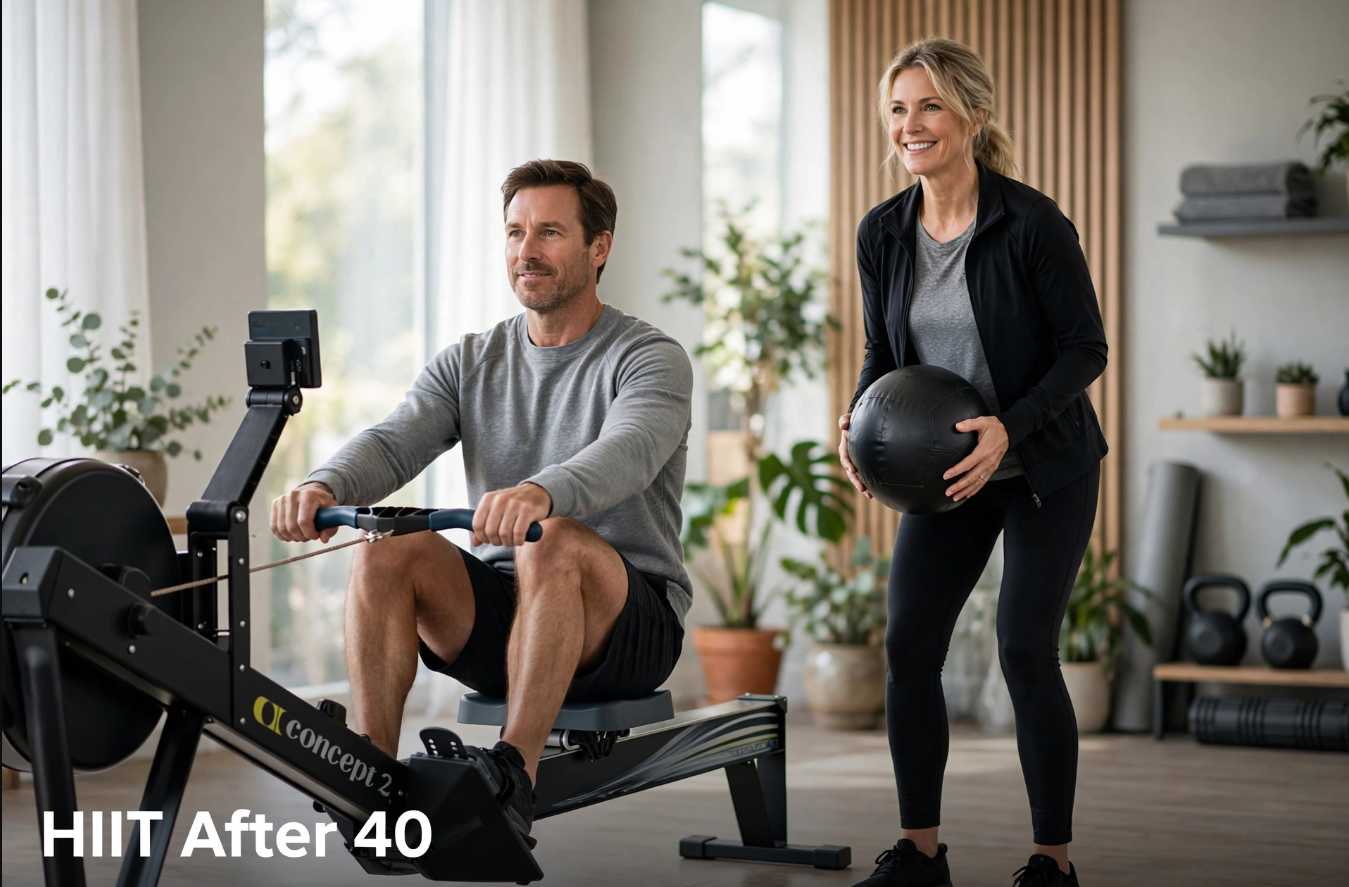
- Why: Rowing uses hips, back, and legs in a smooth, non-jarring motion. The pyramid gradually builds intensity and brings you down safely.
Workout 3: Pool Running Sprints (Ultra Low-Impact)
- Warm-up: 5 min water jogging in deep water with a flotation belt.
- Protocol: 30 sec maximal effort “sprint” in deep water (legs and arms churning), 60 sec recovery jog. Repeat 8–10 times.
- Cool-down: 5 min easy water walking + stretch.
- Why: Zero joint stress. The water’s resistance forces you to work incredibly hard without any impact. Excellent for anyone with arthritis or back pain.
Workout 4: Battle Rope and Slam Ball Circuit (Metabolic Mayhem, No Running)
- Warm-up: 5 min dynamic mobility (arm circles, torso twists, bodyweight squats).
- Circuit: 4 rounds of:
- 30 sec battle rope waves (as fast as possible)
- 30 sec rest
- 30 sec slam ball overhead throws (20–30 lb ball)
- 30 sec rest
- 30 sec Kettlebell Swings (moderate weight, hip hinge focus)
- 60 sec rest after full round.
- Cool-down: 5 min walking + deep breathing.
- Why: All upper-body dominant with hip hinge, no jumping, minimal spinal compression. Massive calorie burn.
Workout 5: Treadmill Hill Power Walks (Not Running)
- Warm-up: 5 min walking at 3 mph, 0% incline.
- Protocol: Set treadmill at 12–15% incline, 3.2–3.8 mph (a fast walk, not a run). Walk HARD for 60 seconds, then step onto side rails and rest 75 seconds. Repeat 8 rounds.
- Cool-down: 5 min flat walking.
- Why: The grade spikes heart rate into the 85–90% zone without the impact of running. Glutes and hamstrings get a tremendous strengthening stimulus.
Workout 6: The 10-20-30 Protocol (Simple, Research-Backed)
Originally developed by Danish researchers for runners, adapted to the stationary bike.
- Warm-up: 5 min easy cycle.
- Repeat 5 times: 30 seconds easy, 20 seconds moderate, 10 seconds ALL-OUT sprint. That’s 1 minute. After 5 consecutive minutes, take a 2-minute break. Do 3 blocks total (15 min interval time).
- Cool-down: 5 min easy spin.
- Why: The 10-second bursts are short enough to go truly max without breaking down, and the varied pace keeps it mentally engaging.
Workout 7: Bodyweight 20-Minute AMRAP (As Many Rounds As Possible) – The “No-Equipment Hotel Room”
- Warm-up: 5 min jog in place, arm circles, lunges.
- 20-Minute AMRAP, using only low-impact exercises:
- 10 Step-Ups (use a sturdy chair or low box, alternate legs)
- 10 Push-Ups (knee or incline if needed)
- 10 Bodyweight Squats (slow and controlled, no jump)
- 10 Mountain Climbers (slow, on a soft surface)
- 10 Glute Bridges
- Perform the circuit continuously at a steady, challenging pace. Count rounds.
- Cool-down: 5 min walking + stretch.
- Why: Portable, zero equipment, joint-respectful movements that elevate heart rate and build work capacity.
Section 5: The VigorForty 40+ HIIT Weekly Integration
The biggest mistake midlife exercisers make is stacking HIIT on HIIT on HIIT. The 80/20 rule (80% low intensity, 20% high intensity) should guide your week. Here is how to layer these joint-friendly HIIT sessions into a comprehensive plan.
The Balanced 4-Day Week
- Monday: Strength Training (Full Body) + 20 min Zone 2 cool-down
- Tuesday: HIIT (choose any Workout 1–7) – 25 min total
- Wednesday: Zone 2 – 60 min bike or ruck
- Thursday: Strength Training (Upper/Lower split)
- Friday: Zone 2 – 45 min treadmill incline walk
- Saturday: Long Zone 2 outdoors (90+ min)
- Sunday: Rest or gentle yoga
The Time-Strapped 3-Day Week
- Monday: Combined session – 20 min HIIT (Workout 5 – Treadmill Hills) + 20 min Zone 2 cool-down
- Wednesday: Zone 2 – 50 min brisk walk/bike
- Friday: Full-body Strength + short HIIT finisher (Workout 1 – 5 rounds of Bike Repeater)
Never schedule two HIIT workouts on consecutive days. Your autonomic nervous system and joints need at least 48 hours to recover from truly high-intensity work. If you wake up with an elevated resting heart rate (5+ bpm above your baseline) or feel achy, replace the HIIT with a Zone 2 session. Your body adapts during rest, not during the seventh interval.
Section 6: HIIT, Nutrition, and Metabolic Recovery After 40
Fueling HIIT properly prevents muscle loss and adrenal burnout.
- Pre-Workout (45–60 min prior): A small serving of protein (15–20g) plus a moderate-carb source (banana, rice cake) if your session is longer than 20 minutes of hard intervals. This preserves muscle glycogen and minimizes the cortisol spike. Fasted HIIT is not recommended for most over-40 individuals because the higher cortisol can promote muscle catabolism.
- Post-Workout: Within 60–90 minutes, consume 30–40g of protein with some carbohydrates to replenish glycogen and stimulate muscle repair. A classic chocolate milk, a smoothie with protein powder and berries, or a turkey sandwich works perfectly.
- Hydration: HIIT sweats. Replace fluid losses with water and electrolytes—sodium, potassium, and magnesium. A zero-sugar electrolyte powder can prevent cramping and afternoon fatigue.
- Anti-Inflammatory Support: Omega-3s (2–3g daily) and adequate sleep are your strongest recovery tools. Turmeric/curcumin supplements may help mitigate exercise-induced inflammation in joints, especially in those with pre-existing arthritis.
Section 7: FAQ—Your Top HIIT After 40 Questions Answered
Q: Can HIIT be dangerous for an unconditioned heart after 40?
A: The risk of a cardiac event during sudden, unaccustomed maximal exercise in a previously sedentary individual with underlying plaque is real but rare. The American College of Sports Medicine recommends that men over 45 and women over 55 with one or more cardiovascular risk factors get medical clearance before beginning vigorous exercise. Start moderately—use the talk test, build up to true max efforts over 4–6 weeks—and the risk drops to near zero. The long-term risk of not exercising is astronomically higher.
Q: I have arthritis in my knees. Which workout should I pick?
A: Workout 3 (Pool Running) and Workout 1 (Assault Bike) are ideal. Pool running is completely non-weight-bearing, and the bike forces a smooth, circular pedal stroke that won’t compress the joint capsule. Avoid any lateral cutting or jumping movements.
Q: How do I know if I’m pushing hard enough?
A: At the end of a true HIIT work interval, you should be unable to speak in full sentences and feel a strong urge to stop. If you could have continued for another 10 seconds, you weren’t going hard enough. Heart rate monitors help—look for 85–95% of your estimated max HR during the peak of the interval.
Q: Will HIIT make me bulky or cause me to lose too much weight?
A: HIIT alone does not build large amounts of muscle mass—that requires heavy resistance training and a caloric surplus. It will preferentially strip visceral fat and preserve lean mass when combined with adequate protein, leading to a leaner, more defined physique.
Q: Can I do HIIT and Zone 2 on the same day?
A: Yes, but do Zone 2 first if the session is primarily aerobic, or HIIT first if metabolic conditioning is the goal, followed by a low-intensity cool-down. A popular split is HIIT in the AM for fat-burning and metabolic boost, and an easy 30–40 minute Zone 2 walk in the evening to aid recovery and clear stress. Listen to your body.
The VigorForty Take
HIIT after 40 is not about demolishing yourself. It’s about delivering a precise, powerful, and brief metabolic shock that forces your heart, lungs, and muscles to adapt and grow stronger. When you strip away the ego, pick joint-respecting movements, and dose the intensity correctly—twice a week, 15 to 25 minutes, full rest between bursts—HIIT becomes a sustainable, lifelong tool that builds a robust cardiovascular engine and a lean, resilient body.
The seven workouts in this guide remove the guesswork and the impact. Print them out, post them on your gym wall or save them in your phone, and start with the one that feels least intimidating. In 12 weeks, your VO2 max, your waistline, and your energy will tell the story of a heart and metabolism that are getting younger, not older. Pair these sessions with the Zone 2 foundation you’ve already laid, and you’ll have the most intelligent, effective, and joint-respecting cardio program you’ve ever followed.
Now pick a workout, warm up thoroughly, and work hard—then rest even harder. Your future self will thank you for the smart intensity you delivered today.
Read All Related Articles
- The Complete Guide to Zone 2 Training After 40: How Low-Intensity Cardio Boosts Fat Loss, Longevity, and Endurance
- The Complete Guide to HIIT After 40: Joint-Friendly Workouts That Torch Fat and Protect Your Heart
- The Complete Guide to Running After 40: How to Start, Stay Injury-Free, and Build Lifelong Endurance
- The Complete Guide to Metabolic Health After 40: Reverse Insulin Resistance, Burn Stubborn Fat, and Reclaim Your Energy with Cardio
- The Complete Guide to Cardio Recovery After 40: How to Rest, Rebuild, and Come Back Stronger
- The Complete Guide to Heart Rate Training Zones After 40: Unlock Every Beat for Maximum Fat Loss, Endurance, and Longevity
- The Complete Guide to VO2 Max After 40: The #1 Predictor of Longevity and How to Improve It
- The Complete Guide to Concurrent Training After 40: How to Combine Cardio and Strength for Maximum Fat Loss, Muscle Preservation, and Longevity
- The Complete Guide to Walking and Rucking After 40: The Most Underrated Cardio for Fat Loss, Joint Health, and Longevity
- The Complete Guide to Designing Your Own Cardio Plan After 40: A Personalized Blueprint for Fat Loss, Longevity, and Peak Performance
- The Complete Guide to Cardio Nutrition After 40: Fuel Your Workouts for Maximum Fat Loss, Endurance, and Recovery
- The Complete Guide to Cardio Equipment After 40: Choosing the Best Treadmill, Bike, Rower, or Elliptical for Your Home Gym
- The Complete Guide to Injury Prevention for Cardio After 40: Run, Ride, and Ruck Pain-Free for Life
- The Complete Guide to Cardio for Fat Loss After 40: Burn Stubborn Belly Fat Without Losing Muscle or Energy
- The Complete Guide to Seasonal Cardio Training After 40: How to Periodize Your Year for Year-Round Fitness, Fat Loss, and Injury Prevention
- The Complete Guide to Cardio and Brain Health After 40: How Exercise Protects Your Memory, Mood, and Mental Sharpness
- The Complete Guide to Building a Home Gym for Cardio After 40: Design a Space That Makes Consistency Inevitable
- The Joyful Movement Manifesto: How to Love Cardio After 40 and Make It a Lifelong Practice
- The Complete Guide to Sleep and Cardio After 40: How Deep Rest Unlocks Your Best Performance, Recovery, and Longevity
- The Complete Guide to Stress, Cortisol, and Cardio After 40: How to Manage Your Nervous System for Better Recovery and Performance
- The Complete Guide to Returning to Cardio After a Layoff After 40: Your Compassionate, Science-Backed Roadmap Back to Fitness
- The Complete Guide to Cardio Through Menopause: How to Adapt Your Training for Hormonal Changes, Protect Your Heart, and Feel Strong After 40
- The Complete Guide to Cycling After 40: Low-Impact Cardio for Joint Health, Endurance, and Lifelong Fitness
- The Complete Guide to Pool and Water-Based Cardio After 40: Low-Impact Workouts for Joint Pain, Recovery, and Total-Body Fitness
- The Complete Guide to Rowing After 40: Full-Body, Low-Impact Cardio for Strength, Endurance, and Longevity
- The Complete Guide to Tracking Cardio Progress After 40: The Key Metrics That Matter More Than the Scale
- The Complete Guide to Cardio for High Blood Pressure After 40: How Exercise Lowers Your Numbers and Protects Your Heart
- The Complete Guide to Cardio for Type 2 Diabetes and Prediabetes After 40: How Exercise Reverses Insulin Resistance and Protects Your Heart
- The Complete Guide to Cardio with Arthritis After 40: Pain-Free Workouts That Strengthen Joints and Keep You Moving
- The Complete Guide to Longevity and Cardio After 40: How Aerobic Fitness Adds Years to Your Life and Life to Your Years
- The Complete Guide to Building a Cardio Habit After 40: The Science of Making Exercise Stick for Life
- The Complete Guide to Cardio and Immune Health After 40: Strengthen Your Body’s Defense System for a Resilient, Vibrant Life
- The Complete Guide to Cardio While Traveling After 40: Stay Fit on the Road, in Hotels, and Away from Home
- The Complete Guide to Cardio for Posture and Back Pain After 40: Strengthen Your Posterior Chain and Reverse the Damage of Sitting
- The Complete Guide to the Social Side of Cardio After 40: How Community, Accountability, and Connection Make You Stronger
- The VigorForty Manifesto: A Final Word on the Lifelong Practice of Movement