Author: Vigor Forty Editorial Team
Medically Reviewed By: Editorial Review Board
Disclaimer: This article is for informational purposes only and is not a substitute for professional medical advice. If you have chronic, severe, or radiating back pain, or a diagnosed spinal condition, consult your physician or a physical therapist before beginning a new exercise program. Read our full Medical Disclaimer.
📌 Key Takeaways
- The “Sitting Disease” Epidemic Can Be Reversed: The average American over 40 spends 8–10 hours a day seated, leading to a predictable pattern of dysfunction: short, tight hip flexors; weak, lengthened glutes; a rounded thoracic spine; and a forward head posture. This postural collapse is the root cause of most non-specific chronic back pain, and a strategic cardio and strength program can correct it.
- Rowing, Rucking, and Swimming Are Your Posture-Saving Superstars: These modalities inherently strengthen the posterior chain—the muscles along the back of your body that are weakened by sitting. They open the chest, engage the upper back, and teach your body to maintain a tall, stable spine under load.
- Running and Cycling Must Be Paired with Compensatory Work: Without a prehab routine, the forward-leaning posture of cycling and the repetitive forward motion of running can exacerbate existing imbalances. The antidote is a dedicated routine of hip flexor stretching, glute activation, and thoracic spine mobility, performed consistently.
- Your “Core” Is a 360-Degree Stability System, Not Just Abs: True core stability involves the diaphragm, pelvic floor, deep spinal stabilizers, and the obliques, working together to maintain a neutral spine. Cardio modalities like rowing and swimming teach this coordinated engagement, while breath work deepens the connection.
- Posture Is a Dynamic Movement Habit, Not a Static Position: “Sitting up straight” is a temporary fix. The real solution is to build a body that naturally gravitates toward an upright, balanced posture because the muscles are strong, the joints are mobile, and the movement patterns are ingrained. Cardio trains this dynamic posture under load and over time.
Introduction: The High Cost of Our Modern Convenience
If you’re over 40 and reading this, there’s a high probability you’re doing so while sitting down. And if you’re sitting down, even as you read this sentence, your body is likely settling into a familiar, destructive shape: your pelvis is tilted posteriorly, your low back is flattened or over-arched, your shoulders are rounding forward, and your chin is jutting toward the screen. This is the posture of modern life, and it is silently, relentlessly rewiring your musculoskeletal system.
You feel the consequences in the dull ache between your shoulder blades at the end of a long workday. In the stiffness in your lower back when you stand up from the couch. In the nagging hip pain that makes your morning run feel like a battle. Chronic back pain is the leading cause of disability worldwide, and the vast majority of it is non-specific—meaning it’s driven not by a catastrophic injury or a herniated disc, but by the slow, cumulative toll of dysfunctional posture and weak supporting muscles.
The good news is that the very cardio you’re doing for your heart and metabolism can be a powerful corrective tool. But it must be applied intelligently. The same rowing machine that builds a bulletproof back with perfect form can strain it with a slouched stroke. The same cycling session that strengthens your heart can shorten your hip flexors and round your spine if not balanced with compensatory work. This guide is your complete manual for turning your cardio practice into a posture-rehabilitating, back-strengthening, and pain-relieving practice. You’ll learn the biomechanics of sitting disease, the best and worst cardio modalities for your spine, the essential prehab and core exercises, and a weekly protocol to stand taller, move better, and finally leave that chronic ache behind.
Section 1: The Anatomy of Sitting Disease—What You’re Up Against
To fix the problem, you must understand the specific muscular and skeletal shifts that occur after years of sitting.
The “Desk Posture” Cascade:
- Tight Hip Flexors: The iliopsoas and rectus femoris muscles shorten and become chronically tight from being in a seated, flexed position for hours each day. When you stand, these tight muscles pull the front of your pelvis down, tilting it anteriorly (forward). This increases the arch in your lower back (lordosis), compressing the lumbar facet joints and straining the spinal ligaments.
- Inhibited and Weak Glutes: Your gluteal muscles—the primary hip extensors—are in a stretched, inactive position while you sit. Over time, they become weak and fail to fire properly. This is called “gluteal amnesia.” When your glutes don’t activate to extend your hip during walking, running, or lifting, your lower back and hamstrings compensate, taking on a workload they weren’t designed for.
- Rounded Thoracic Spine and Forward Head Posture: Your head weighs approximately 10–12 pounds. For every inch your head moves forward from its neutral position over your shoulders, the effective weight on your neck and upper back increases by an additional 10 pounds. A forward head posture of just 2–3 inches (common with screen use) places 30–40 pounds of strain on your cervical and thoracic spine. The upper back rounds to accommodate, the chest muscles tighten, and the muscles between your shoulder blades (rhomboids, middle trapezius) become weak and overstretched.
- Deconditioned Deep Core Stabilizers: Your transverse abdominis, multifidus, and pelvic floor muscles—the deep core team that stabilizes your spine segment by segment—become weak from disuse. Without this internal scaffolding, your spine is less stable, more vulnerable to shear forces, and more reliant on the already-fatigued superficial back muscles.
Section 2: The Posture-Saving Cardio Hierarchy
Not all cardio is created equal when it comes to your spine. Here’s how the main modalities rank for postural health.
Tier 1: The Corrective Superstars (Do These Often)
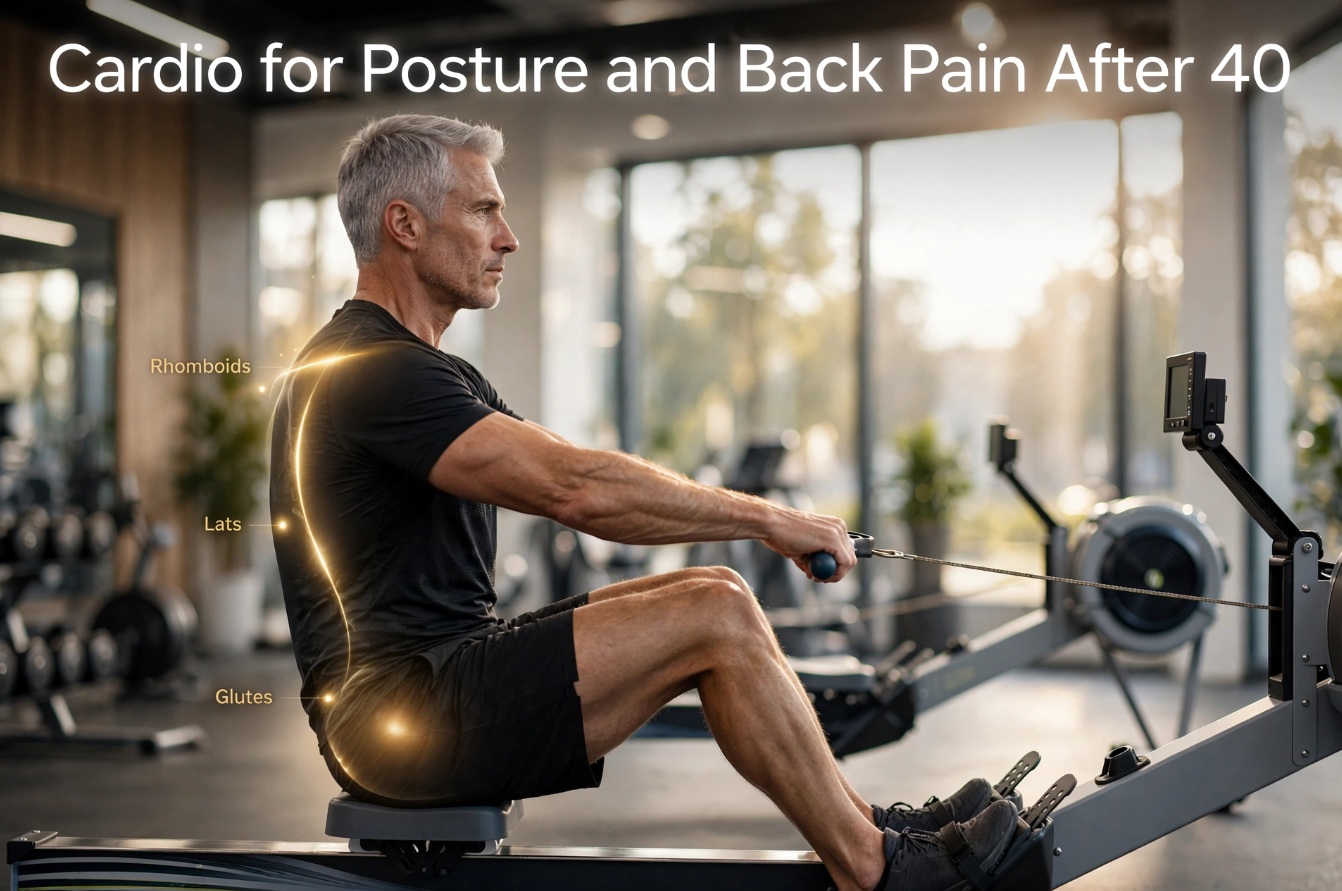
- Rowing (with Perfect Form): The rowing stroke is a continuous cycle of hip hinge, leg drive, and controlled back extension, followed by a relaxed recovery. It is the single best cardio modality for teaching the coordination of the posterior chain, strengthening the entire back, and reinforcing a tall, neutral spine. The catch position (shins vertical, torso hinged forward) provides a gentle, dynamic hip flexor stretch. The finish position (slight backward lean, handle at sternum) engages the upper back and opens the chest. Rowing is a posture masterclass.
- Rucking: Walking with a weighted backpack places a direct demand on your upper back and core to stabilize the load. It actively pulls your shoulders back, counteracting the forward slouch, and builds endurance in the postural muscles that hold you upright against gravity. The key is a properly fitted pack with the weight high and close to your spine, and a conscious tall posture.
- Swimming (Backstroke and Freestyle): The horizontal, weightless position of swimming decompresses the spine. The repetitive overhead reach of the freestyle stroke mobilizes the thoracic spine and stretches the lats. Backstroke is particularly beneficial, opening the chest, engaging the posterior shoulder, and promoting spinal extension in a safe, supported position.
Tier 2: The Double-Edged Swords (Do With Caution and Compensatory Work)
- Running: Running requires and builds excellent core stability. It can be a fantastic posture strengthener. However, the natural forward lean of running can exacerbate a rounded upper back, and tight hip flexors from sitting can limit hip extension during the stride, causing the lower back to hyperextend to compensate. Postural running demands a dedicated prehab routine.
- Cycling: The forward-flexed cycling position, held for hours, shortens the hip flexors and pectorals, rounds the thoracic spine, and weakens the posterior chain. Without a robust off-bike strength and mobility routine, a dedicated cyclist can develop a pronounced “cyclist’s hunch.” The air bike is slightly better, as the upright position and upper body push-pull engagement are more back-friendly.
Tier 3: The Low-Impact Neutrals (Safe, but Not Specifically Corrective)
- Walking (Without Weight): Walking is the most natural human movement and is generally excellent for spinal health. It encourages gentle, reciprocal hip and spinal motion. However, a casual walk does not specifically strengthen the posterior chain or open the chest the way rucking or rowing do. It’s benign, but not a targeted corrective.
- Elliptical and Stair Climber: These are weight-bearing and low-impact, which is good for spinal discs. The upright posture is a plus. However, they don’t inherently build back strength.
Section 3: The Essential Prehab Routine—The Daily Antidote to Sitting
This 10-minute routine should be performed daily, ideally as a warm-up before your cardio session or as a stand-alone mid-day break. It targets the exact imbalances caused by sitting.
- Couch Stretch (Hip Flexor Release): Kneel in front of a wall or couch, place one foot up the wall behind you, and bring your hips square and forward until you feel a deep stretch in the front of your thigh and hip. Squeeze the glute on the stretched side. Hold for 60–90 seconds per side.
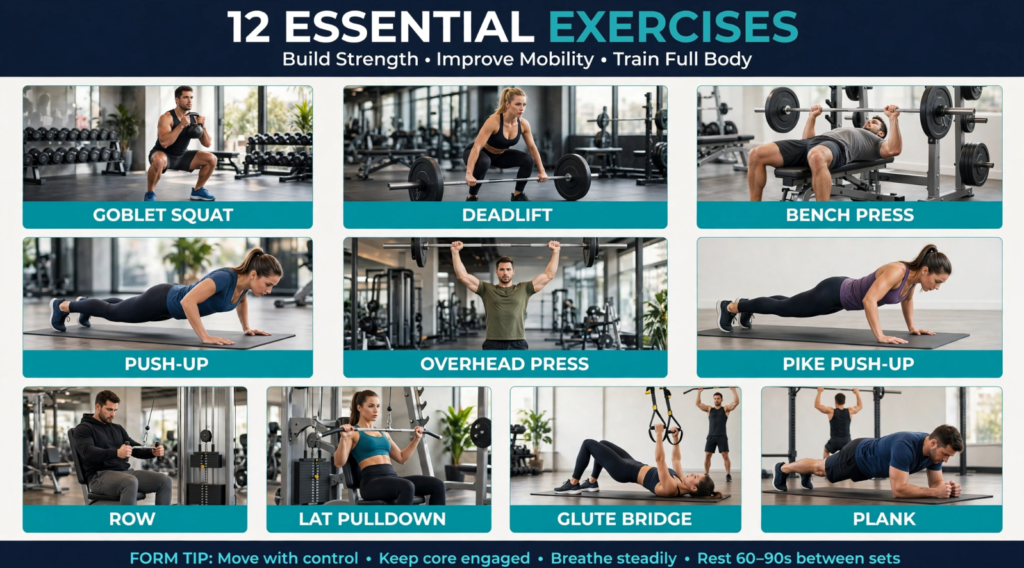
- Glute Bridge with 2-Second Hold: Lie on your back, knees bent, feet flat. Squeeze your glutes, drive through your heels, and lift your hips until your body forms a straight line from shoulders to knees. Hold at the top for 2 full seconds, focusing on glute engagement. Perform 2 sets of 15.
- Thoracic Spine Rotation (Open Book Drill): Lie on your side with knees bent at 90 degrees and arms extended straight out in front. Keeping your knees pinned together, slowly rotate your top arm open like a book, trying to touch the floor behind you. Let your head follow your arm. Perform 10 slow, deep-breath cycles per side.
- Chin Tucks (Forward Head Correction): Stand with your back against a wall. Tuck your chin straight back, as if making a double chin, keeping the back of your head against the wall. Hold for 5 seconds. Perform 15 repetitions.
- Dead Bug (Deep Core Activation): Lie on your back with arms extended to the ceiling and legs in a tabletop position (knees at 90 degrees). Flatten your lower back into the floor. Slowly extend your right arm and left leg toward the floor, keeping your back flat and core engaged. Return to center and repeat on the opposite side. Perform 2 sets of 10 total alternating reps.
Section 4: The VigorForty Posture-Building Cardio Week
This sample week strategically combines corrective cardio modalities with the essential prehab and strength work.
| Day | Workout | Posture Focus |
|---|---|---|
| Monday | 10 min Prehab Routine + 30 min Rowing (Zone 2) + 5 min cool-down | Posterior chain strength, hip hinge patterning, upper back engagement |
| Tuesday | Full-Body Strength (focus: deadlifts, rows, face pulls) + 20 min Zone 2 walk | Glute and back strength, pulling exercises to counteract desk posture |
| Wednesday | 10 min Prehab Routine + 45 min Rucking (20–30 lbs, Zone 2) | Loaded posture endurance, shoulder retraction, core stability |
| Thursday | 10 min Prehab Routine + 20 min HIIT on Air Bike + 10 min Core (dead bugs, planks, bird dogs) | Short, intense cardio in an upright posture, followed by deep core work |
| Friday | 10 min Prehab Routine + 30 min Swimming (alternating freestyle and backstroke) | Spinal decompression, chest opening, thoracic mobility, full-body lengthening |
| Saturday | 90 min Zone 2 outdoor hike or long ruck | Sustained, low-intensity postural endurance in a natural environment |
| Sunday | Active Recovery: 30 min gentle walk + 20 min yoga or mobility flow | Full-body relaxation, hip opening, spinal elongation |
This schedule is a template. The core principles are to prioritize the prehab routine daily, make rowing, rucking, or swimming the backbone of your cardio, and always pair cycling or running with the compensatory strength and mobility work.
Section 5: Core Stability—The Missing Link in Cardio Training
Your core is more than your abs. It’s a 360-degree cylinder of muscle that stabilizes your spine from your pelvis to your ribcage. When you run, your core resists the rotational force of your arm and leg swing. When you row, your core transfers power from your legs to the handle. A weak core forces your spine into excessive, uncontrolled movement, leading to pain.
The Core Engagement “Brace”:
Learn to engage your core as if you’re about to be punched gently in the stomach. It’s a 20% contraction of the deep abdominal wall, not a sucked-in belly or a full-crunch crunch. This brace should be present during every cardio exertion.
Incorporate These Core Exercises 2–3 Times Per Week:
- Dead Bug: Teaches anti-extension and limb movement with a stable spine.
- Pallof Press (with Band): Teaches anti-rotation—holding your spine still against a twisting force.
- Farmer’s Carry: A weighted walk holding a dumbbell or kettlebell in one hand, forcing your core to resist side-bending. This is functional, dynamic core training.
Section 6: FAQ—Your Posture and Back Pain Questions
Q: My back hurts after rowing. Am I doing it wrong?
A: Probably. The most common rowing mistake is slouching at the catch, which flexes the lumbar spine under load. This is dangerous. The second is pulling with the arms and back too early, before the legs are fully extended, which jerks the lower back. Ensure your back is straight, you’re hinging from the hips, and you’re following the precise sequence: legs, then body, then arms. A session with a rowing coach or a detailed video review of your own form is invaluable.
Q: I stand all day for work instead of sitting. Is that better?
A: Standing all day without moving is also problematic. It can lead to its own set of issues: low back fatigue, varicose veins, and foot pain. The solution is not a static posture, whether sitting or standing. It’s frequent movement. Alternate between sitting and standing, shift your weight, and take frequent walking breaks. A standing desk is a tool, not a solution in itself.
Q: How long will it take to fix my posture and back pain?
A: You will likely feel some relief within a week or two of consistent prehab work and posture-focused cardio. The pain often subsides as the tight muscles are released and the weak muscles begin to engage. However, truly remodeling the postural habits and tissue takes months of consistent practice. Think in terms of 12 weeks for significant, lasting change. Be patient, persistent, and consistent.
Q: Can I still run if I have a desk job and mild back pain?
A: Yes, if you commit to the prehab routine. The running itself is not the problem; it’s the muscular imbalances you bring to the run. By releasing your hip flexors, activating your glutes, and stabilizing your core before your run, you can create the conditions for a pain-free, posture-enhancing run. If pain increases during or after running, consult a physical therapist.
The VigorForty Take
Your spine is the structural centerline of your entire body. It houses the nervous system that controls every thought and movement. Treating it with respect is not optional. The hours you’ve spent sitting are a debt that’s been accumulating, but you now have the payment plan. Every rowing stroke, every rucking mile, every deliberate glute bridge, and every chin tuck is a deposit into your spinal health account.
This is not about achieving a military-perfect posture for a photograph. It’s about building a resilient, mobile, and strong body that can sit when it needs to, stand when it wants to, and move through the world without the constant, grinding, distracting hum of back pain. You don’t have to live with that pain. It’s a signal, a messenger, and the message is clear: your body needs more of the right kind of movement. You now know exactly what that movement is.
Stand tall. Pull your shoulders back. Tuck your chin. And go row, ruck, or swim your way to a stronger, pain-free, and more upright future. Your spine will thank you for the rest of your life.
Read All Related Articles
- The Complete Guide to Zone 2 Training After 40: How Low-Intensity Cardio Boosts Fat Loss, Longevity, and Endurance
- The Complete Guide to HIIT After 40: Joint-Friendly Workouts That Torch Fat and Protect Your Heart
- The Complete Guide to Running After 40: How to Start, Stay Injury-Free, and Build Lifelong Endurance
- The Complete Guide to Metabolic Health After 40: Reverse Insulin Resistance, Burn Stubborn Fat, and Reclaim Your Energy with Cardio
- The Complete Guide to Cardio Recovery After 40: How to Rest, Rebuild, and Come Back Stronger
- The Complete Guide to Heart Rate Training Zones After 40: Unlock Every Beat for Maximum Fat Loss, Endurance, and Longevity
- The Complete Guide to VO2 Max After 40: The #1 Predictor of Longevity and How to Improve It
- The Complete Guide to Concurrent Training After 40: How to Combine Cardio and Strength for Maximum Fat Loss, Muscle Preservation, and Longevity
- The Complete Guide to Walking and Rucking After 40: The Most Underrated Cardio for Fat Loss, Joint Health, and Longevity
- The Complete Guide to Designing Your Own Cardio Plan After 40: A Personalized Blueprint for Fat Loss, Longevity, and Peak Performance
- The Complete Guide to Cardio Nutrition After 40: Fuel Your Workouts for Maximum Fat Loss, Endurance, and Recovery
- The Complete Guide to Cardio Equipment After 40: Choosing the Best Treadmill, Bike, Rower, or Elliptical for Your Home Gym
- The Complete Guide to Injury Prevention for Cardio After 40: Run, Ride, and Ruck Pain-Free for Life
- The Complete Guide to Cardio for Fat Loss After 40: Burn Stubborn Belly Fat Without Losing Muscle or Energy
- The Complete Guide to Seasonal Cardio Training After 40: How to Periodize Your Year for Year-Round Fitness, Fat Loss, and Injury Prevention
- The Complete Guide to Cardio and Brain Health After 40: How Exercise Protects Your Memory, Mood, and Mental Sharpness
- The Complete Guide to Building a Home Gym for Cardio After 40: Design a Space That Makes Consistency Inevitable
- The Joyful Movement Manifesto: How to Love Cardio After 40 and Make It a Lifelong Practice
- The Complete Guide to Sleep and Cardio After 40: How Deep Rest Unlocks Your Best Performance, Recovery, and Longevity
- The Complete Guide to Stress, Cortisol, and Cardio After 40: How to Manage Your Nervous System for Better Recovery and Performance
- The Complete Guide to Returning to Cardio After a Layoff After 40: Your Compassionate, Science-Backed Roadmap Back to Fitness
- The Complete Guide to Cardio Through Menopause: How to Adapt Your Training for Hormonal Changes, Protect Your Heart, and Feel Strong After 40
- The Complete Guide to Cycling After 40: Low-Impact Cardio for Joint Health, Endurance, and Lifelong Fitness
- The Complete Guide to Pool and Water-Based Cardio After 40: Low-Impact Workouts for Joint Pain, Recovery, and Total-Body Fitness
- The Complete Guide to Rowing After 40: Full-Body, Low-Impact Cardio for Strength, Endurance, and Longevity
- The Complete Guide to Tracking Cardio Progress After 40: The Key Metrics That Matter More Than the Scale
- The Complete Guide to Cardio for High Blood Pressure After 40: How Exercise Lowers Your Numbers and Protects Your Heart
- The Complete Guide to Cardio for Type 2 Diabetes and Prediabetes After 40: How Exercise Reverses Insulin Resistance and Protects Your Heart
- The Complete Guide to Cardio with Arthritis After 40: Pain-Free Workouts That Strengthen Joints and Keep You Moving
- The Complete Guide to Longevity and Cardio After 40: How Aerobic Fitness Adds Years to Your Life and Life to Your Years
- The Complete Guide to Building a Cardio Habit After 40: The Science of Making Exercise Stick for Life
- The Complete Guide to Cardio and Immune Health After 40: Strengthen Your Body’s Defense System for a Resilient, Vibrant Life
- The Complete Guide to Cardio While Traveling After 40: Stay Fit on the Road, in Hotels, and Away from Home
- The Complete Guide to Cardio for Posture and Back Pain After 40: Strengthen Your Posterior Chain and Reverse the Damage of Sitting
- The Complete Guide to the Social Side of Cardio After 40: How Community, Accountability, and Connection Make You Stronger
- The VigorForty Manifesto: A Final Word on the Lifelong Practice of Movement