
Author: Vigor Forty Editorial Team
Medically Reviewed By: Editorial Review Board
Disclaimer: This article is for informational purposes only and is not a substitute for professional medical advice. Read our full Medical Disclaimer.
📌 Key Takeaways
- Periodization is the strategic planning of your training over time: It involves systematically varying volume, intensity, and exercise selection to maximize progress and prevent plateaus.
- Without periodization, progress eventually stalls: Doing the same workout week after week leads to adaptation and stagnation. Periodization keeps your body guessing and continuously adapting.
- There are several types of periodization: Linear, undulating, block, and conjugate periodization each have unique benefits. The best approach depends on your goals and experience level.
- Periodization prevents overtraining: By incorporating planned recovery weeks (deloads), periodization allows you to train hard without burning out.
- Even beginners benefit from simple periodization: You don’t need a complex plan to start—simple linear progression or weekly undulation can significantly improve your results.
Introduction: The Long Game
Most beginners approach training with enthusiasm. They show up, work hard, and see results quickly. Those first few weeks and months are exciting—the weights go up, the muscles grow, and motivation is high.
But then something happens. Progress slows. The weights stop going up. The excitement fades. You’re doing the same workout, but you’re not getting the same results.
This is the adaptation plateau.
Your body has adapted to your training. What was once a stimulus for growth is now just maintenance. To continue making progress, you need a plan—a strategy for systematically increasing the challenge and preventing plateaus.
This is periodization.
| Without Periodization | With Periodization |
|---|---|
| Same workout week after week | Varying volume and intensity |
| Progress stalls after 6–12 weeks | Continuous progress over months and years |
| Boredom and burnout | Engagement and motivation |
| Inconsistent results | Consistent, predictable progress |
Periodization is the long game. It’s the difference between training for a few months and training for a lifetime. It’s the strategy that separates those who make consistent progress from those who spin their wheels.
This guide will teach you everything you need to know about periodization. You’ll learn the different types, how to apply them, and how to create a long-term training plan that keeps you progressing for years.
Section 1: What Is Periodization?
The Definition
Periodization is the systematic planning of your training to optimize performance, maximize progress, and prevent plateaus. It involves varying training variables—volume, intensity, frequency, and exercise selection—over time.
The Principles
| Principle | What It Means |
|---|---|
| General Adaptation Syndrome (GAS) | Your body goes through alarm, resistance, and exhaustion phases. Periodization manages this cycle. |
| Progressive Overload | You must gradually increase the challenge to continue adapting. Periodization plans this progression. |
| Specificity | Your training should be specific to your goals. Periodization ensures you’re working toward your goals at the right time. |
| Variation | Changing variables prevents adaptation and keeps training effective. Periodization builds in planned variation. |
| Recovery | Planned recovery (deloads) prevents overtraining and promotes adaptation. Periodization includes recovery phases. |
The History
Periodization was first developed in the 1960s by Eastern European sports scientists. They noticed that athletes who systematically varied their training made better progress than those who trained the same way year-round.
The concept was popularized in the West by coaches like Tudor Bompa, who wrote extensively on periodization for strength and conditioning. Today, periodization is a cornerstone of modern strength training.
Section 2: The Types of Periodization
Type 1: Linear Periodization (Classic)
What It Is: Gradual progression from high volume/low intensity to low volume/high intensity over time.
The Classic Model:
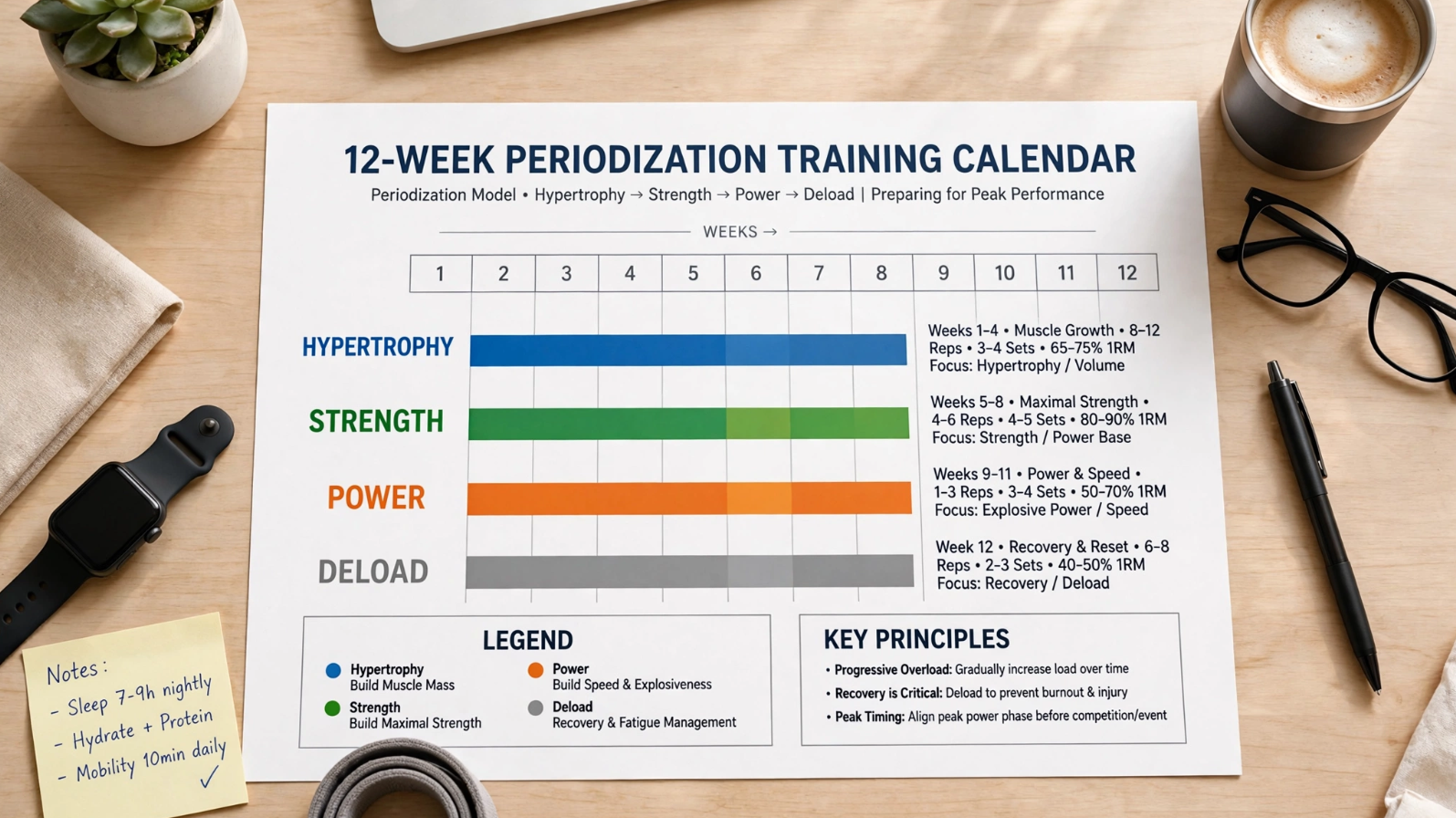
| Phase | Duration | Volume | Intensity | Focus |
|---|---|---|---|---|
| Hypertrophy | 4–6 weeks | High (3–4 x 10–15) | Low-Moderate (60–70%) | Muscle growth |
| Strength | 4–6 weeks | Moderate (3–4 x 6–8) | Moderate-High (75–85%) | Strength development |
| Power | 4–6 weeks | Low (3–5 x 3–5) | High (85–95%) | Power and speed |
| Peak | 1–2 weeks | Very Low | Very High (90%+) | Competition peak |
Sample Linear Periodization Plan (Squat):
| Week | Sets x Reps | Intensity (% of 1RM) | RPE |
|---|---|---|---|
| 1–2 | 4 x 12 | 60–65% | 6–7 |
| 3–4 | 4 x 10 | 65–70% | 7 |
| 5–6 | 4 x 8 | 70–75% | 7–8 |
| 7–8 | 3 x 6 | 75–80% | 8 |
| 9–10 | 5 x 5 | 80–85% | 8–9 |
| 11–12 | 3 x 3 | 85–90% | 9 |
Best For: Beginners, intermediates, powerlifters, athletes with specific peak dates
Pros:
- Clear progression
- Easy to follow
- Proven effectiveness
- Builds a strong foundation
Cons:
- Can become monotonous
- May not suit all goals
- Requires patience (progress is gradual)
Type 2: Undulating Periodization (Daily or Weekly)
What It Is: Varying volume and intensity within the same week (daily undulating) or from week to week (weekly undulating).
Weekly Undulating Example:
| Day | Focus | Sets x Reps | Intensity |
|---|---|---|---|
| Monday | Strength | 4 x 6 | 80% |
| Wednesday | Hypertrophy | 3 x 10 | 70% |
| Friday | Power | 5 x 3 | 85% |
Daily Undulating Example (Same Day):
| Exercise | Set 1–2 | Set 3–4 | Set 5–6 |
|---|---|---|---|
| Bench Press | 4 x 12 (Hypertrophy) | 4 x 8 (Strength) | 5 x 3 (Power) |
Best For: Intermediates, advanced lifters, those who prefer variety, athletes in-season
Pros:
- More variety
- Less monotony
- Addresses multiple qualities simultaneously
- May produce better results in some studies
Cons:
- More complex to plan
- Harder to track progress
- May not build a foundation as effectively
Type 3: Block Periodization
What It Is: Focusing on one training quality at a time in blocks (4–8 weeks), then moving to the next quality.
The Block Model:
| Block | Duration | Focus | Volume | Intensity |
|---|---|---|---|---|
| Accumulation | 4–6 weeks | Hypertrophy/Work Capacity | High | Low-Moderate |
| Intensification | 4–6 weeks | Strength | Moderate | Moderate-High |
| Realization | 2–4 weeks | Power/Performance | Low | High |
Sample 16-Week Block Plan:
| Weeks | Focus | Sets x Reps | Intensity |
|---|---|---|---|
| 1–4 | Accumulation | 4 x 10–12 | 60–70% |
| 5–8 | Intensification | 4 x 6–8 | 70–80% |
| 9–12 | Realization | 5 x 3–5 | 80–90% |
| 13–16 | Deload/Testing | — | — |
Best For: Advanced lifters, powerlifters, Olympic weightlifters, athletes with long competition preparation
Pros:
- Deep focus on one quality at a time
- Prevents interference between qualities
- Effective for advanced lifters
- Leads to significant peaks
Cons:
- Requires longer planning horizon
- May not be suitable for general fitness
- Complex to implement
Type 4: Conjugate Periodization
What It Is: Training multiple qualities simultaneously, often on different days of the week.
The Conjugate Model (Westside Barbell):
| Day | Focus | Exercises |
|---|---|---|
| Monday | Max Effort (Strength) | Heavy compound (1–3 reps) |
| Tuesday | Dynamic Effort (Speed) | Speed lifts with bands/chains |
| Thursday | Max Effort (Strength) | Heavy compound variation |
| Friday | Dynamic Effort (Speed) | Speed lifts with bands/chains |
Best For: Advanced powerlifters, strength athletes, those who need to develop multiple qualities
Pros:
- Develops multiple qualities simultaneously
- Keeps training interesting
- Effective for advanced lifters
- Addresses weaknesses directly
Cons:
- Very complex
- Requires significant recovery capacity
- Not suitable for beginners
- Requires specialized equipment
Section 3: Deloading—The Recovery Phase
What Is a Deload?
A deload is a planned reduction in training volume and/or intensity to allow for full recovery and supercompensation. It’s an essential part of any periodization plan.
Why Deloads Are Essential:
| Reason | What It Prevents |
|---|---|
| Recovery | Overtraining, burnout |
| Supercompensation | Stagnation, plateaus |
| Injury Prevention | Overuse injuries, joint pain |
| Mental Refresh | Boredom, loss of motivation |
When to Deload
| Timing | When to Deload |
|---|---|
| Every 4–8 Weeks | After a training block |
| After a Peak | After competition or testing |
| When Progress Stalls | When you’ve been stuck for 2+ weeks |
| When Fatigue is High | If you’re constantly tired or sore |
| Every 12 Weeks | At minimum, take a deload every 12 weeks |
How to Deload
Option 1: Reduce Volume (Keep Intensity)
| Factor | Normal | Deload |
|---|---|---|
| Volume | 100% | 40–60% |
| Intensity | 100% | 80–90% |
Example:
- Normal: 4 x 8 at 80% 1RM
- Deload: 3 x 5 at 70% 1RM
Option 2: Reduce Intensity (Keep Volume)
| Factor | Normal | Deload |
|---|---|---|
| Volume | 100% | 100% |
| Intensity | 100% | 60–70% |
Example:
- Normal: 4 x 8 at 80% 1RM
- Deload: 4 x 8 at 60% 1RM
Option 3: Reduce Both
| Factor | Normal | Deload |
|---|---|---|
| Volume | 100% | 50–70% |
| Intensity | 100% | 60–70% |
Example:
- Normal: 4 x 8 at 80% 1RM
- Deload: 3 x 8 at 60% 1RM
Option 4: Active Recovery
| Activity | Duration | Intensity |
|---|---|---|
| Walking | 20–30 minutes | Light |
| Light Biking | 20–30 minutes | Light |
| Swimming | 20–30 minutes | Light |
| Yoga | 15–20 minutes | Light |
Section 4: Sample Periodization Programs
Program A: Beginner Linear Progression (12 Weeks)
Goal: Build strength and muscle foundation
| Phase | Weeks | Focus | Sets x Reps | Progression |
|---|---|---|---|---|
| Phase 1 | 1–4 | Hypertrophy | 3 x 10–12 | Add reps weekly (10 → 12) |
| Phase 2 | 5–8 | Strength | 4 x 6–8 | Add weight weekly |
| Phase 3 | 9–12 | Peak | 5 x 3–5 | Add weight weekly |
| Deload | 13 | Recovery | 3 x 6–8 at 60% | — |
Weekly Progression Example (Squat):
| Week | Sets x Reps | Weight | Notes |
|---|---|---|---|
| 1 | 3 x 10 | 135 lbs | Start light |
| 2 | 3 x 11 | 135 lbs | Add reps |
| 3 | 3 x 12 | 135 lbs | Max reps |
| 4 | 3 x 10 | 140 lbs | Add weight |
| 5 | 4 x 8 | 145 lbs | Strength phase |
| 6 | 4 x 8 | 150 lbs | Add weight |
| 7 | 4 x 6 | 155 lbs | Add weight |
| 8 | 4 x 6 | 160 lbs | Add weight |
| 9 | 5 x 5 | 165 lbs | Peak phase |
| 10 | 5 x 5 | 170 lbs | Add weight |
| 11 | 5 x 3 | 175 lbs | Add weight |
| 12 | 5 x 3 | 180 lbs | Peak |
| 13 | 3 x 8 | 135 lbs | Deload |
Program B: Intermediate Undulating Periodization (12 Weeks)
Goal: Build strength and muscle with variety
| Week | Monday (Strength) | Wednesday (Hypertrophy) | Friday (Power) |
|---|---|---|---|
| 1–4 | 4 x 6 (80%) | 3 x 10 (70%) | 5 x 3 (85%) |
| 5–8 | 4 x 5 (82%) | 3 x 12 (67%) | 5 x 3 (87%) |
| 9–12 | 4 x 4 (85%) | 3 x 12 (65%) | 5 x 3 (88%) |
| 13 (Deload) | 3 x 8 (60%) | 3 x 10 (60%) | 3 x 5 (60%) |
Progression: Add weight to each session when you complete all reps with good form.
Program C: Advanced Block Periodization (16 Weeks)
Goal: Maximize strength and performance
| Block | Weeks | Focus | Volume | Intensity | Exercises |
|---|---|---|---|---|---|
| Accumulation | 1–4 | Hypertrophy | High (4 x 10–12) | Low (60–70%) | Compounds + Isolation |
| Intensification | 5–8 | Strength | Moderate (4 x 6–8) | Moderate (70–80%) | Compound Focus |
| Realization | 9–12 | Peak | Low (5 x 3–5) | High (80–90%) | Main Lifts Only |
| Transition | 13–16 | Maintenance | Moderate (3 x 8–10) | Moderate (65–75%) | Variety |
Section 5: How to Choose the Right Periodization
By Experience Level
| Level | Recommended Periodization |
|---|---|
| Beginner | Linear Progression (simple, consistent) |
| Intermediate | Undulating (weekly) or Block Periodization |
| Advanced | Block, Undulating (daily), or Conjugate |
By Goal
| Goal | Recommended Periodization |
|---|---|
| Strength (Powerlifting) | Linear, Block, or Conjugate |
| Muscle Growth (Hypertrophy) | Undulating (weekly) or Block |
| General Fitness | Linear or Undulating (weekly) |
| Sports Performance | Block or Conjugate |
| Maintenance | Any (with low volume) |
By Time Availability
| Time Available | Recommended Periodization |
|---|---|
| 2–3 days/week | Linear Progression |
| 3–4 days/week | Undulating (weekly) |
| 4–5 days/week | Block or Conjugate |
Section 6: The 5-4-3-2-1 Framework
Here’s a simple framework for creating your own periodization plan:
5: Five Training Variables to Periodize
| Variable | What to Vary |
|---|---|
| Volume | Sets and reps |
| Intensity | Weight (% of 1RM) |
| Frequency | Sessions per week |
| Exercise Selection | Main lifts and variations |
| Tempo | Speed of reps |
4: Four Phases in a Macrocycle
| Phase | Duration | Focus |
|---|---|---|
| Foundation | 4–6 weeks | Build base, technique, work capacity |
| Build | 4–6 weeks | Increase intensity, build strength |
| Peak | 2–4 weeks | Maximize strength, test |
| Deload/Transition | 1–2 weeks | Recover, maintain |
3: Three Microcycles in Each Phase
| Microcycle | Week | Focus |
|---|---|---|
| Week 1 | Introduction | Establish baseline |
| Week 2 | Progression | Increase volume or intensity |
| Week 3 | Overreach (optional) | Push beyond previous limits |
| Week 4 | Deload (optional) | Reduce volume/intensity |
2: Two Types of Periodization to Consider
| Type | What It Is | Best For |
|---|---|---|
| Linear | Gradual progression (volume ↓, intensity ↑) | Beginners, powerlifters |
| Undulating | Varying within the week | Variety, hypertrophy |
1: One Key Principle
| Principle | What It Means |
|---|---|
| Progressive Overload | Gradually increase the challenge over time |
Section 7: Common Periodization Mistakes
Mistake 1: Not Periodizing at All
The Problem: Doing the same workout week after week; progress stalls.
The Fix: Implement a simple periodization plan. Even linear progression is better than no plan.
Mistake 2: Periodizing Too Aggressively
The Problem: Making too many changes too quickly; unable to track progress.
The Fix: Keep it simple. Change one variable at a time (e.g., volume or intensity, not both).
Mistake 3: Not Including Deloads
The Problem: Training hard all the time; burnout and overtraining.
The Fix: Include a deload week every 4–8 weeks. Recovery is essential for progress.
Mistake 4: Periodizing Without Purpose
The Problem: Changing variables randomly without a clear goal.
The Fix: Plan your periodization around your goals. Ask: “Why am I doing this?”
Mistake 5: Ignoring Recovery
The Problem: Not allowing enough recovery between training sessions.
The Fix: Include rest days and active recovery. Sleep and nutrition are part of periodization.
Mistake 6: Not Tracking Progress
The Problem: Not knowing what you did last week, so you can’t adjust.
The Fix: Track your workouts—exercise, weight, sets, reps, RPE. This data is essential for periodization.
Section 8: FAQ—Your Top Periodization Questions
Q: Do beginners need periodization?
A: Beginners benefit from simple periodization—linear progression is perfect. It’s not complicated, but it’s effective. As you advance, you can implement more complex approaches.
Q: How long should each periodization phase last?
A: Typically 4–6 weeks per phase. This allows enough time to make progress without adapting completely. Longer phases can lead to plateaus; shorter phases may not produce significant results.
Q: What’s the difference between periodization and progressive overload?
A: Progressive overload is the principle of gradually increasing the challenge. Periodization is the strategy for implementing progressive overload over time. Progressive overload is the “what”—periodization is the “how.”
Q: Can I use periodization for calisthenics?
A: Yes. You can periodize calisthenics by varying:
- Volume (sets and reps)
- Intensity (harder variations, added weight)
- Frequency (training days)
- Exercise selection (different progressions)
Q: Do I need to periodize if I’m not a competitive athlete?
A: Not necessarily, but it helps. Even general fitness benefits from periodization. It prevents plateaus, reduces boredom, and promotes consistent progress. A simple linear progression or weekly undulation works for most people.
Q: What’s the best periodization for hypertrophy?
A: Undulating periodization (weekly) is very effective for hypertrophy. It allows you to train across multiple rep ranges (strength, hypertrophy, endurance) within the same week. Block periodization (hypertrophy phase followed by strength phase) also works well.
Q: How do I know when to change my periodization plan?
A: Change when:
- You’ve completed a full cycle (8–12 weeks)
- Progress has stalled (2+ weeks without improvement)
- Your goals have changed
- You’re bored or unmotivated
- You need to address a specific weakness
Q: Can I periodize on a 3-day/week schedule?
A: Yes. For 3 days/week, linear progression is simplest. You can also use weekly undulating (e.g., Monday: Strength, Wednesday: Hypertrophy, Friday: Power) within your 3-day schedule.
The VigorForty Take
Periodization is the strategy that separates those who make consistent progress from those who don’t. It’s the difference between training for a few months and training for a lifetime.
The principles are simple:
- Plan your training in phases — foundation, build, peak, deload
- Vary volume and intensity — don’t do the same thing every week
- Include deloads — planned recovery prevents overtraining
- Track your progress — data guides your decisions
- Adjust as needed — periodization is flexible, not rigid
The results:
- Continuous progress over months and years
- Prevention of plateaus
- Reduced injury risk
- Better motivation and engagement
- Achievement of long-term goals
Periodization is the long game. It requires patience, consistency, and a willingness to trust the process. But the results are worth it.
Train smart. Train long. Periodize.
This article was reviewed by the Vigor Forty Editorial Review Board on July 20, 2026.
🔗 Related Articles
- Beyond Crunches: The Best Exercises for True Core Stability
- Core Stability for Lifters: How a Strong Core Protects Your Lower Back
- The Connection Between Core Strength and Better Posture
- Top 5 Strength Training Myths Debunked
- “I’m Too Old to Start Lifting”: Why Strength Training is for Everyone
- “I Don’t Want to Get Bulky”: The Truth About Weightlifting and Muscle Growth
- Can You Build Muscle with Just Bodyweight Exercises?
- The Role of Nutrition in Strength Training: Fueling Your Gains
- The Importance of Rest and Recovery for Building Muscle
- Supplements 101: What Actually Works for Strength Athletes?
- Sleep and Strength: How Better Sleep Can Improve Your Lifts
- 5-Minute Daily Core Routine for Busy Americans
- The Science of Hypertrophy: How to Build Muscle Effectively
- Periodization: How to Plan Your Training for Long-Term Success
- Drop Sets, Supersets, and AMRAPs: Advanced Training Techniques Explained
- Strength Training for Fat Loss: A Comprehensive Guide
- How to Build Muscle and Strength with a Busy Schedule
- The Ultimate Guide to Kettlebell Training for Strength and Conditioning
- Resistance Band Workout: A Full-Body Strength Routine
- Dumbbell Only Workout: Build Muscle Anywhere
- Hybrid Training: Combining Calisthenics and Powerlifting
- The Importance of Mobility for Strength Athletes
- 5 Dynamic Warm-Up Exercises to Do Before Every Workout
- The Best of Both Worlds: Why You Should Combine Calisthenics and Weights
- Your 2027 Strength Training Roadmap: Setting Goals and Staying Consistent
- Strength Training for Life: Building a Sustainable Fitness Habit
- The 12 Best Strength Training Exercises for Americans
Affiliate Disclosure: Some links in this article may be affiliate links. If you make a purchase through these links, Vigor Forty may earn a small commission at no extra cost to you. We only recommend products we trust.