
Author: Vigor Forty Editorial Team
Medically Reviewed By: Editorial Review Board
Disclaimer: This article is for informational purposes only and is not a substitute for professional medical advice. Read our full Medical Disclaimer.
📌 Key Takeaways
- Resistance bands are one of the most versatile and affordable fitness tools: They provide variable resistance—getting harder as you stretch them—which challenges your muscles through the entire range of motion.
- Bands are perfect for home workouts, travel, and rehabilitation: They take up almost no space, are lightweight, and can be used anywhere. No gym membership required.
- You can build significant strength and muscle with bands: Research shows that resistance band training produces comparable strength and muscle gains to traditional weight training—especially for beginners and intermediates.
- Bands offer unique benefits: They provide accommodating resistance (harder at the peak of the movement), reduce joint stress, and improve mind-muscle connection.
- One set of bands can replace an entire gym’s worth of equipment: With different resistance levels and attachments, you can perform hundreds of exercises targeting every muscle group.
Introduction: The Ultimate Portable Gym
What if you could carry an entire gym in your bag? What if you could train anywhere—hotel rooms, offices, parks, living rooms—with equipment that costs less than a month of gym membership?
Welcome to resistance band training.
Resistance bands are one of the most underrated fitness tools. They’re affordable, portable, versatile, and incredibly effective. With a single set of bands, you can perform exercises for every muscle group—from chest presses to bicep curls to squats to rows. And the best part? They provide variable resistance, which means they get harder as you stretch them—challenging your muscles throughout the entire range of motion.
Why Resistance Bands?
| Benefit | How It Helps |
|---|---|
| Portability | Fits in a small bag; train anywhere |
| Affordability | One set costs less than a month at the gym |
| Versatility | Hundreds of exercises; every muscle group |
| Variable Resistance | Harder at peak contraction; better muscle activation |
| Joint-Friendly | Less joint stress than heavy weights |
| Progressive Overload | Choose different resistance levels |
| Safety | No heavy weights to drop |
| Rehabilitation | Perfect for injury recovery and mobility work |
The Research:
- Study (2019): Resistance band training produced similar muscle growth to traditional weight training in untrained individuals.
- Study (2020): Band training significantly improved strength and muscle size in older adults.
- Systematic Review (2021): Resistance bands are effective for improving strength, muscle mass, and physical function across all age groups.
This guide will show you everything you need to know about resistance band training. You’ll learn the different types of bands, how to choose the right resistance, exercises for every muscle group, sample workouts, and how to progress your training.
Section 1: Types of Resistance Bands
1. Tube Bands (with Handles)
Description: Bands with handles on each end, usually with a door anchor included.
| Feature | Details |
|---|---|
| Best For | Traditional strength exercises (curls, presses, rows) |
| Pros | Easy to grip, versatile, good for most exercises |
| Cons | Handles can limit certain exercises (like leg work) |
| Price | $15–40 for a full set |
| Resistance Levels | Color-coded (light, medium, heavy, x-heavy) |
2. Loop Bands (Flat Resistance Bands)
Description: Flat, continuous loops of rubber, no handles. Also called “pull-up assist bands.”
| Feature | Details |
|---|---|
| Best For | Pull-up assistance, glute exercises, hip work, squats |
| Pros | Very versatile, excellent for lower body, great for warm-ups |
| Cons | Can be harder to grip for upper body exercises |
| Price | $10–25 for a set of 5 bands |
| Resistance Levels | Color-coded from extra light to x-heavy |
3. Therapy Bands (Flat Strips)
Description: Thin, flat strips of rubber with no handles or loops.
| Feature | Details |
|---|---|
| Best For | Rehabilitation, mobility work, warm-ups, physical therapy |
| Pros | Gentle resistance, excellent for injury recovery |
| Cons | Limited resistance for strength building |
| Price | $10–20 for a set |
| Resistance Levels | Color-coded (very light to moderate) |
4. Figure-8 Bands
Description: Bands shaped like a figure-8, with loops for hands or feet.
| Feature | Details |
|---|---|
| Best For | Chest flyes, bicep curls, tricep extensions |
| Pros | Good for upper body, comfortable grip |
| Cons | Limited exercise variety |
| Price | $10–20 |
5. Door Anchors and Accessories
| Accessory | Purpose |
|---|---|
| Door Anchor | Secures bands to a door for cable-style exercises |
| Ankle Straps | Attaches bands to ankles for leg exercises |
| Handles | Provides better grip for pulling exercises |
| Carabiner Clips | Connects bands to attachments |
Section 2: Choosing the Right Resistance
Resistance Band Color Chart (Typical)
| Color | Resistance Level | Equivalent Weight | Best For |
|---|---|---|---|
| Yellow/Thin | Extra Light | 1–5 lbs | Warm-ups, rehab, beginners |
| Green | Light | 5–15 lbs | Upper body isolation, beginners |
| Red | Medium | 15–25 lbs | Upper body, squats, rows |
| Black | Heavy | 25–45 lbs | Lower body, pull-ups, advanced |
| Blue/Purple | Extra Heavy | 45–75+ lbs | Heavy pulls, squats, deadlifts |
How to Choose
| Factor | Recommendation |
|---|---|
| Beginners | Start with a set of 3–4 bands (light, medium, heavy, extra heavy) |
| Intermediates | Use medium to extra heavy bands for most exercises |
| Advanced | Use heavy to extra heavy bands; combine bands for more resistance |
| Upper Body | Light to medium bands for isolation; medium to heavy for compounds |
| Lower Body | Heavy to extra heavy bands (legs are stronger) |
The Rule: Choose a band that challenges you for the target reps (8–15) but allows you to maintain proper form. If you can complete 15+ reps easily, the band is too light. If you can’t complete 8 reps with good form, the band is too heavy.
Section 3: The Exercises
Upper Body: Push
Exercise 1: Band Chest Press
| Detail | Information |
|---|---|
| Muscles Worked | Chest, triceps, front shoulders |
| Setup | Anchor band behind you at chest height (door anchor or sturdy object) |
| Form | Grip handles, press forward until arms are extended, control the return |
| Sets & Reps | 3–4 x 10–15 reps |
Exercise 2: Band Overhead Press
| Detail | Information |
|---|---|
| Muscles Worked | Shoulders, triceps, upper chest |
| Setup | Stand on band or anchor at floor level |
| Form | Grip handles at shoulders, press overhead, control the return |
| Sets & Reps | 3–4 x 10–15 reps |
Exercise 3: Band Push-ups
| Detail | Information |
|---|---|
| Muscles Worked | Chest, shoulders, triceps, core |
| Setup | Loop band across your back, hold ends in hands |
| Form | Perform a push-up with band resistance on the way up |
| Sets & Reps | 3–4 x 8–15 reps |
Exercise 4: Band Tricep Pushdowns
| Detail | Information |
|---|---|
| Muscles Worked | Triceps |
| Setup | Anchor band above head height |
| Form | Grip handles, push down until arms extended, control the return |
| Sets & Reps | 3–4 x 12–15 reps |
Upper Body: Pull
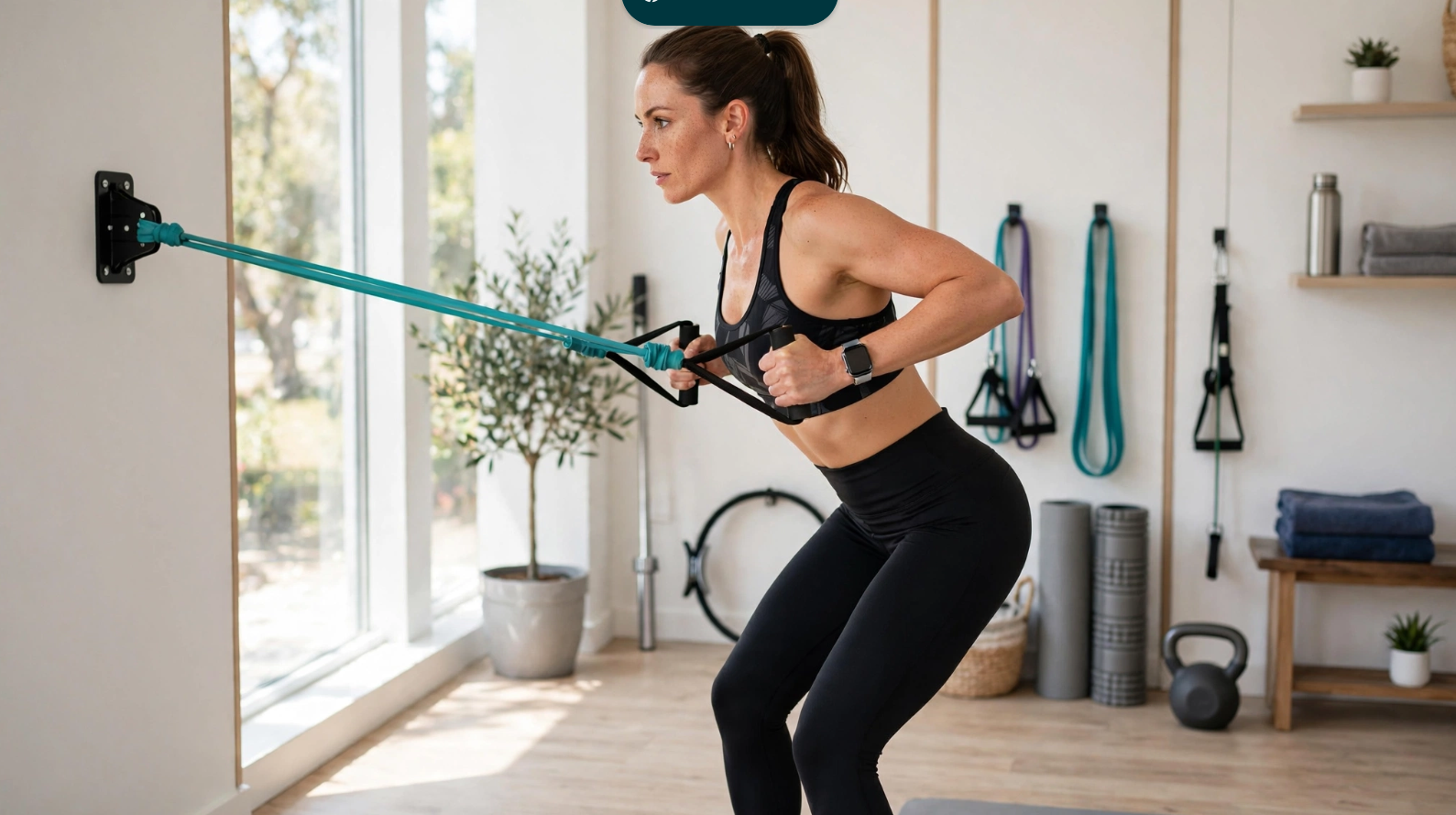
Exercise 5: Band Rows
| Detail | Information |
|---|---|
| Muscles Worked | Lats, rhomboids, biceps, rear delts |
| Setup | Anchor band at chest height (door anchor or sturdy object) |
| Form | Grip handles, pull toward your chest, squeeze shoulder blades, control the return |
| Sets & Reps | 3–4 x 10–15 reps |
Exercise 6: Band Pull-Aparts
| Detail | Information |
|---|---|
| Muscles Worked | Rear delts, rhomboids, upper back |
| Setup | Hold band with both hands at chest height |
| Form | Pull hands apart, stretching the band across your chest, squeeze shoulder blades |
| Sets & Reps | 3–4 x 12–20 reps |
Exercise 7: Band Lat Pulldowns
| Detail | Information |
|---|---|
| Muscles Worked | Lats, biceps, upper back |
| Setup | Anchor band above head height |
| Form | Grip handles, pull down to chest height, squeeze shoulder blades, control the return |
| Sets & Reps | 3–4 x 10–15 reps |
Exercise 8: Band Bicep Curls
| Detail | Information |
|---|---|
| Muscles Worked | Biceps |
| Setup | Stand on band or anchor at floor level |
| Form | Grip handles, curl upward, squeeze biceps, control the return |
| Sets & Reps | 3–4 x 12–15 reps |
Lower Body
Exercise 9: Band Squats
| Detail | Information |
|---|---|
| Muscles Worked | Quads, glutes, hamstrings, core |
| Setup | Loop band around your back (or hold band handles at shoulders) |
| Form | Squat down, keeping chest up, drive through heels, use band resistance on the way up |
| Sets & Reps | 3–4 x 10–15 reps |
Exercise 10: Band Deadlifts
| Detail | Information |
|---|---|
| Muscles Worked | Hamstrings, glutes, lower back |
| Setup | Stand on band, hold handles at hip height |
| Form | Hinge at hips, keeping back straight, lower band, drive hips forward to return |
| Sets & Reps | 3–4 x 10–15 reps |
Exercise 11: Band Lateral Walks
| Detail | Information |
|---|---|
| Muscles Worked | Glute medius, hips, core |
| Setup | Loop band around ankles or above knees |
| Form | Walk sideways, maintaining tension on the band, small steps |
| Sets & Reps | 3 x 10–15 steps each direction |
Exercise 12: Band Glute Bridges
| Detail | Information |
|---|---|
| Muscles Worked | Glutes, hamstrings, core |
| Setup | Loop band above knees, lie on back with knees bent |
| Form | Drive hips upward, squeezing glutes, feel band resistance, lower with control |
| Sets & Reps | 3–4 x 12–20 reps |
Exercise 13: Band Leg Curls
| Detail | Information |
|---|---|
| Muscles Worked | Hamstrings |
| Setup | Anchor band at floor level behind you, attach to ankle |
| Form | Curl your heel toward your glutes, control the return |
| Sets & Reps | 3–4 x 10–15 reps per leg |
Exercise 14: Band Calf Raises
| Detail | Information |
|---|---|
| Muscles Worked | Calves |
| Setup | Stand on band, hold handles at shoulders |
| Form | Rise onto your toes, squeeze calves, lower with control |
| Sets & Reps | 3–4 x 15–20 reps |
Core
Exercise 15: Band Pallof Press
| Detail | Information |
|---|---|
| Muscles Worked | Core (anti-rotation), obliques |
| Setup | Anchor band at chest height, stand perpendicular |
| Form | Press band straight forward, resist rotation, hold for 2 seconds, return |
| Sets & Reps | 3 x 10–12 reps per side |
Exercise 16: Band Woodchoppers
| Detail | Information |
|---|---|
| Muscles Worked | Core, obliques, shoulders |
| Setup | Anchor band at high or low point |
| Form | Pull band diagonally across your body (high to low or low to high) |
| Sets & Reps | 3 x 10–12 reps per side |
Exercise 17: Band Russian Twists
| Detail | Information |
|---|---|
| Muscles Worked | Core, obliques |
| Setup | Sit on floor, hold band with both hands (band anchored) |
| Form | Rotate torso from side to side, pulling band across body |
| Sets & Reps | 3 x 12–15 reps per side |
Exercise 18: Band Plank
| Detail | Information |
|---|---|
| Muscles Worked | Core, shoulders, glutes |
| Setup | Loop band across your back (or above your shoulders) |
| Form | Hold a plank position with band providing added resistance |
| Sets & Reps | 3 x 30–60 seconds |
Section 4: Sample Workouts
Workout A: Full Body Beginner (30 Minutes)
| Exercise | Sets | Reps | Rest |
|---|---|---|---|
| Band Squats | 3 | 12–15 | 45 sec |
| Band Rows | 3 | 12–15 | 45 sec |
| Band Chest Press | 3 | 12–15 | 45 sec |
| Band Glute Bridges | 3 | 15–20 | 45 sec |
| Band Pallof Press | 3 | 10–12 per side | 45 sec |
Workout B: Full Body Intermediate (35 Minutes)
| Exercise | Sets | Reps | Rest |
|---|---|---|---|
| Band Deadlifts | 4 | 10–12 | 60 sec |
| Band Push-ups | 4 | 8–12 | 60 sec |
| Band Rows | 4 | 10–12 | 60 sec |
| Band Squats | 4 | 10–12 | 60 sec |
| Band Woodchoppers | 3 | 10–12 per side | 45 sec |
Workout C: Upper/Lower Split (4 Days/Week)
Monday: Upper Body
| Exercise | Sets | Reps | Rest |
|---|---|---|---|
| Band Overhead Press | 4 | 10–12 | 60 sec |
| Band Rows | 4 | 10–12 | 60 sec |
| Band Chest Press | 4 | 10–12 | 60 sec |
| Band Pull-Aparts | 3 | 15–20 | 45 sec |
| Band Bicep Curls | 3 | 12–15 | 45 sec |
| Band Tricep Pushdowns | 3 | 12–15 | 45 sec |
Tuesday: Lower Body
| Exercise | Sets | Reps | Rest |
|---|---|---|---|
| Band Squats | 4 | 10–12 | 60 sec |
| Band Deadlifts | 4 | 10–12 | 60 sec |
| Band Lateral Walks | 3 | 15 steps each | 45 sec |
| Band Glute Bridges | 3 | 15–20 | 45 sec |
| Band Calf Raises | 3 | 15–20 | 45 sec |
Thursday: Upper Body (Repeat Monday)
Friday: Lower Body (Repeat Tuesday)
Workout D: Travel Workout (20 Minutes)
| Exercise | Sets | Reps | Rest |
|---|---|---|---|
| Band Squats | 3 | 15–20 | 45 sec |
| Band Rows (door anchor) | 3 | 12–15 | 45 sec |
| Band Chest Press | 3 | 12–15 | 45 sec |
| Band Glute Bridges | 3 | 15–20 | 45 sec |
| Band Bicep Curls | 3 | 12–15 | 45 sec |
Workout E: Conditioning Circuit (25 Minutes)
Circuit Format: 45 seconds work, 15 seconds rest, move to next exercise
| Exercise | Duration | Rest |
|---|---|---|
| Band Squats | 45 sec | 15 sec |
| Band Rows | 45 sec | 15 sec |
| Band Chest Press | 45 sec | 15 sec |
| Band Glute Bridges | 45 sec | 15 sec |
| Band Push-ups | 45 sec | 15 sec |
Repeat: 3 rounds
Section 5: Band Safety and Form
Safety Tips
| Tip | Why |
|---|---|
| Inspect bands before use | Check for tears, wear, or damage |
| Avoid overstretching | Don’t stretch band more than 2.5x its length |
| Secure anchors properly | Ensure door anchor is locked securely |
| Use proper grip | Wrap band securely around hands or use handles |
| Don’t release under tension | Slowly release tension (don’t snap back) |
| Start light | Learn form before using heavy resistance |
Common Mistakes
| Mistake | Fix |
|---|---|
| Snapping the band | Control the return; don’t let it snap back |
| Not enough tension | Start with more distance or shorter band |
| Too much tension | Use a lighter band or stand closer to anchor |
| Poor form | Focus on controlled, full-range movements |
| Only using one resistance level | Use different bands for different exercises |
Section 6: Progressive Overload with Bands
How to Progress
| Method | How to Apply |
|---|---|
| Increase Resistance | Use a heavier band or combine bands |
| Increase Reps | Add 1–2 reps per set |
| Increase Sets | Add 1 set per exercise |
| Decrease Rest | Shorten rest periods (60 sec → 45 sec) |
| Change Band Position | Stand farther from anchor for more resistance |
| Slow the Tempo | Increase time under tension (3 sec down, 3 sec up) |
| Add Isometric Holds | Hold at peak contraction for 2–3 seconds |
The “2-Rep Rule”
When you can complete 2 more reps than your target with good form, increase the resistance.
Example:
- Target: 3 sets of 10 reps
- If you can do 3 sets of 12 reps → Use a heavier band
Section 7: Combining Bands with Other Training
Option 1: Band + Bodyweight (The Ultimate Hybrid)
| Day | Focus | Exercises |
|---|---|---|
| Monday | Full Body | Band Squats + Push-ups + Rows |
| Wednesday | Full Body | Band Deadlifts + Dips + Pull-ups |
| Friday | Full Body | Band Glute Bridges + Push-ups + Rows |
Option 2: Band + Dumbbells
| Scenario | How to Combine |
|---|---|
| Add Resistance | Use bands with dumbbells for added tension |
| Warm-Up | Use bands for warm-ups and activation |
| Finishers | Use bands for burnout sets |
| Travel | Bands when you can’t bring dumbbells |
Option 3: Band as Accessory to Barbell Training
| When | How to Use |
|---|---|
| Before Lifts | Band pull-aparts for shoulder health |
| Between Sets | Band pull-aparts, band rows |
| After Lifts | Band rotator cuff work, band face pulls |
| On Rest Days | Light band work for mobility |
Section 8: Band Workout Benefits for Americans Over 40
Why Bands Are Ideal for Midlife
| Benefit | How It Helps |
|---|---|
| Joint-Friendly | Less stress on joints than heavy weights |
| Affordable | One set costs less than a month at the gym |
| Convenient | Work out anywhere, anytime |
| Portable | Take them on vacation, business trips, or to the office |
| Versatile | Hundreds of exercises; every muscle group |
| Safe | No heavy weights to drop |
| Progressive | Multiple resistance levels for progression |
Modifications for Older Adults
| Exercise | Modification |
|---|---|
| Squats | Lighter band, shorter range of motion |
| Rows | Lighter band, focus on form |
| Presses | Lighter band, seated position |
| Glute Bridges | Lighter band, controlled movement |
| Pallof Press | Lighter band, shorter range of motion |
Section 9: FAQ—Your Top Resistance Band Questions
Q: Can you build muscle with resistance bands?
A: Yes. Research shows that resistance bands produce comparable muscle growth to traditional weights—especially for beginners and intermediates. The key is progressive overload (increasing resistance, reps, or difficulty).
Q: Are resistance bands as good as weights?
A: They’re different, not necessarily better or worse. Bands offer variable resistance (harder at peak contraction), less joint stress, and more portability. Weights offer more precise progressive overload and are better for maximal strength. Both are effective.
Q: How many resistance bands do I need?
A: A set of 3–5 bands (light to extra heavy) is sufficient for most people. Start with a set that includes a door anchor, handles, and ankle straps.
Q: Can I do a full-body workout with just bands?
A: Yes. With a set of bands and a door anchor, you can perform exercises for every muscle group—chest, back, shoulders, arms, legs, and core.
Q: Are resistance bands good for older adults?
A: Yes. Bands are joint-friendly, safe, and effective for building strength in older adults. They’re also excellent for rehabilitation and mobility work.
Q: How often should I train with bands?
A: 3–4 days per week is ideal. This provides enough frequency for progress while allowing adequate recovery. Two days per week is sufficient for maintenance or beginners.
Q: Do I need a door anchor to use bands?
A: Not necessarily—but it helps. A door anchor allows you to perform cable-style exercises (chest presses, lat pulldowns). Without one, you can still do squats, deadlifts, bicep curls, rows (with your foot), and many other exercises.
Q: How do I know which band to use?
A: Choose a band that allows you to complete 8–15 reps with good form. If you can do 15+ reps easily, the band is too light. If you can’t do 8 reps with good form, the band is too heavy.
The VigorForty Take
Resistance bands are one of the most versatile, affordable, and effective fitness tools available. They’re perfect for:
- Home workouts (no gym needed)
- Travel (fits in a carry-on)
- Older adults (joint-friendly)
- Beginners (safe, easy to learn)
- Intermediates and advanced (progressive resistance)
The principles:
- Start with a set (light to extra heavy, includes accessories)
- Learn the exercises (form is key)
- Progress consistently (increase resistance, reps, or difficulty)
- Train regularly (3–4 days per week)
- Have fun (variety keeps it interesting)
The benefits:
- Build strength and muscle
- Improve joint health
- Train anywhere, anytime
- Save money (compared to gym membership)
- Reduce injury risk
You don’t need a gym to get stronger. You don’t need heavy weights to build muscle. You just need a band and the commitment to use it.
This article was reviewed by the Vigor Forty Editorial Review Board on July 21, 2026.
🔗 Related Articles
- Beyond Crunches: The Best Exercises for True Core Stability
- Core Stability for Lifters: How a Strong Core Protects Your Lower Back
- The Connection Between Core Strength and Better Posture
- Top 5 Strength Training Myths Debunked
- “I’m Too Old to Start Lifting”: Why Strength Training is for Everyone
- “I Don’t Want to Get Bulky”: The Truth About Weightlifting and Muscle Growth
- Can You Build Muscle with Just Bodyweight Exercises?
- The Role of Nutrition in Strength Training: Fueling Your Gains
- The Importance of Rest and Recovery for Building Muscle
- Supplements 101: What Actually Works for Strength Athletes?
- Sleep and Strength: How Better Sleep Can Improve Your Lifts
- 5-Minute Daily Core Routine for Busy Americans
- The Science of Hypertrophy: How to Build Muscle Effectively
- Periodization: How to Plan Your Training for Long-Term Success
- Drop Sets, Supersets, and AMRAPs: Advanced Training Techniques Explained
- Strength Training for Fat Loss: A Comprehensive Guide
- How to Build Muscle and Strength with a Busy Schedule
- The Ultimate Guide to Kettlebell Training for Strength and Conditioning
- Resistance Band Workout: A Full-Body Strength Routine
- Dumbbell Only Workout: Build Muscle Anywhere
- Hybrid Training: Combining Calisthenics and Powerlifting
- The Importance of Mobility for Strength Athletes
- 5 Dynamic Warm-Up Exercises to Do Before Every Workout
- The Best of Both Worlds: Why You Should Combine Calisthenics and Weights
- Your 2027 Strength Training Roadmap: Setting Goals and Staying Consistent
- Strength Training for Life: Building a Sustainable Fitness Habit
- The 12 Best Strength Training Exercises for Americans
Affiliate Disclosure: Some links in this article may be affiliate links. If you make a purchase through these links, Vigor Forty may earn a small commission at no extra cost to you. We only recommend products we trust.