
Author: Vigor Forty Editorial Team
Medically Reviewed By: Editorial Review Board
Disclaimer: This article is for informational purposes only and is not a substitute for professional medical advice. Read our full Medical Disclaimer.
📌 Key Takeaways
- You don’t need hours to build a strong core: Just 5 minutes a day, consistently, can significantly improve core stability, reduce back pain, and enhance your overall strength.
- This routine requires no equipment: You can do it in your living room, hotel room, or office. No gym membership, no special gear—just you and a small space.
- Consistency beats duration: Doing 5 minutes every day is far more effective than doing 30 minutes once a week. Daily practice builds the habit and reinforces neural pathways.
- The exercises target all core functions: Anti-extension (plank), anti-rotation (bird dog), anti-lateral flexion (side plank), and deep core activation (dead bug).
- Perfect for busy schedules: Whether you’re a working professional, a parent, or a traveler, this routine fits into any schedule. Do it first thing in the morning, during lunch, or before bed.
Introduction: The 5-Minute Solution
“I don’t have time for core work.”
“I’ll do it later.”
“I’m too tired after my workout.”
These are the most common excuses for skipping core training. And they’re understandable—life is busy. Work, family, commuting, and other responsibilities leave little time for exercise, let alone dedicated core work.
But here’s the truth: You don’t need a 30-minute core workout. You don’t need complex exercises or expensive equipment. You just need 5 minutes a day and the commitment to do it.
The Power of 5 Minutes:
| Approach | Time Commitment | Weekly Total | Effectiveness |
|---|---|---|---|
| Daily 5-Minute Routine | 5 min/day | 35 minutes/week | High (consistency) |
| Weekly Core Session | 30 min/week | 30 minutes/week | Moderate (less frequent) |
| Sporadic Core Work | Varies | Varies | Low (inconsistent) |
Why Daily 5 Minutes Works:
- Builds the habit: Daily practice creates automaticity
- Reinforces neural pathways: Your body learns the movement patterns
- Accumulates volume: 35 minutes of quality core work per week is significant
- Fits any schedule: 5 minutes is manageable for almost everyone
This guide will show you a simple, effective 5-minute core routine that you can do anywhere, anytime. No equipment. No excuses. Just results.
Section 1: The 5-Minute Core Routine
The Big Picture
The routine consists of 5 exercises, each performed for 1 minute (or 30–60 seconds, depending on the exercise). Total time: 5 minutes.
| Exercise | Duration | Focus |
|---|---|---|
| Dead Bugs | 1 minute | Deep core activation (anti-extension) |
| Plank | 1 minute | Core stability (anti-extension) |
| Side Plank (Left) | 45 seconds | Lateral stability (anti-lateral flexion) |
| Side Plank (Right) | 45 seconds | Lateral stability (anti-lateral flexion) |
| Bird Dogs | 1 minute | Spinal stability (anti-rotation) |
| Total | 5 minutes | Complete core activation |
Section 2: Exercise Breakdown
Exercise 1: Dead Bugs (1 Minute)
Purpose: Activate deep core muscles (transverse abdominis), teach core control, and warm up the core.
Form:
- Lie on your back with arms extended toward the ceiling
- Lift your legs to tabletop position (knees at 90 degrees)
- Press your lower back firmly into the floor
- Slowly extend your right arm and left leg toward the floor
- Return to start and repeat on the opposite side
- Continue alternating for 1 minute
Tips:
- Keep your lower back pressed into the floor throughout
- Move slowly and with control (not speed)
- Breathe steadily—exhale as you extend, inhale as you return
- If your back lifts off the floor, you’re going too far
Modifications:
- Easier: Extend only your arms (keep legs in tabletop)
- Easier: Keep both knees bent at 90 degrees (don’t extend legs)
- Easier: Slow down the movement
Target Reps: 8–12 reps per side (depending on speed)
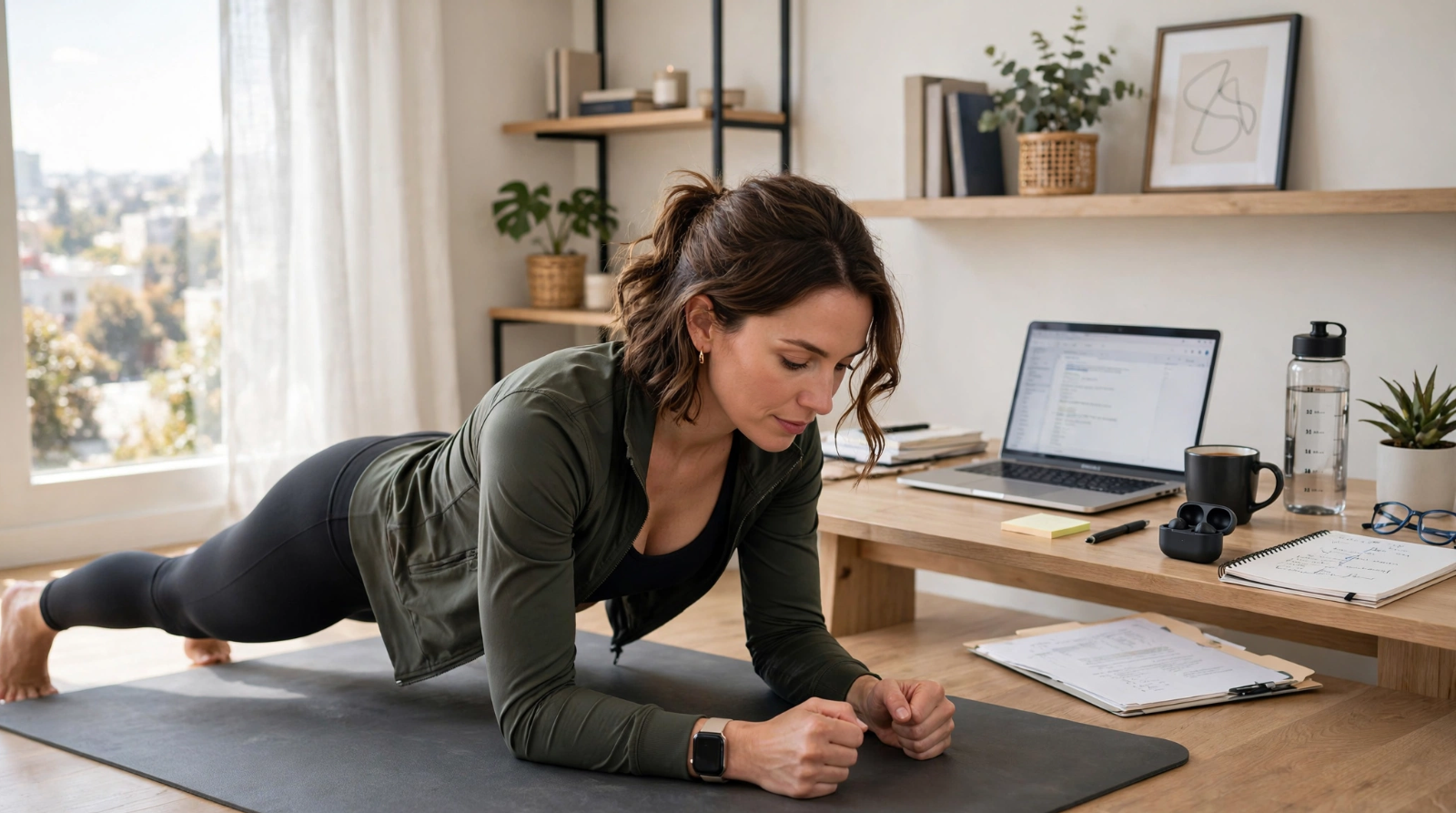
Exercise 2: Plank (1 Minute)
Purpose: Build core stability and endurance (anti-extension).
Form:
- Forearms on the floor, elbows directly under shoulders
- Body forms a straight line from head to heels
- Squeeze your glutes and engage your core
- Hold for 1 minute, breathing steadily
Tips:
- Don’t let your hips sag or pike up
- Squeeze your glutes to maintain pelvic position
- Breathe steadily—don’t hold your breath
- Look at the floor slightly in front of your hands
Modifications:
- Easier: Knee Plank (knees on floor)
- Easier: Incline Plank (hands on bench or wall)
- Harder: High Plank (hands on floor instead of forearms)
- Harder: Weighted Plank (backpack with books)
Target: Hold for 60 seconds
Exercise 3: Side Plank (Left) — 45 Seconds
Purpose: Build lateral core stability (anti-lateral flexion).
Form:
- Lie on your left side, left forearm on the floor, elbow under shoulder
- Stack your feet (one on top of the other)
- Lift your hips, forming a straight line from head to heels
- Hold for 45 seconds, breathing steadily
Tips:
- Don’t let your hips sag toward the floor
- Keep your body in a straight line
- Engage your core and glutes
- Look straight ahead or slightly down
Modifications:
- Easier: Knee Side Plank (knees on floor)
- Easier: Modified Side Plank (feet staggered)
- Harder: Side Plank with Leg Lift (lift top leg)
Target: Hold for 45 seconds
Exercise 4: Side Plank (Right) — 45 Seconds
Purpose: Build lateral core stability on the other side.
Form:
- Lie on your right side, right forearm on the floor, elbow under shoulder
- Stack your feet (one on top of the other)
- Lift your hips, forming a straight line from head to heels
- Hold for 45 seconds, breathing steadily
Tips:
- Same as left side—keep your body straight
- Don’t let your hips sag
- Breathe steadily
Modifications:
- Easier: Knee Side Plank
- Harder: Side Plank with Leg Lift
Target: Hold for 45 seconds
Exercise 5: Bird Dogs (1 Minute)
Purpose: Build spinal stability, balance, and coordination (anti-rotation).
Form:
- Start on all fours, hands under shoulders, knees under hips
- Keep your back flat and core engaged
- Extend your right arm forward and left leg back simultaneously
- Hold for 2 seconds, maintaining a flat back and level hips
- Return to start and repeat on the opposite side
- Continue alternating for 1 minute
Tips:
- Keep your back flat—don’t arch or round
- Keep your hips level—don’t rotate
- Move slowly and with control
- Breathe steadily
Modifications:
- Easier: Extend only your arms (keep legs on floor)
- Easier: Extend only your legs (keep hands on floor)
- Easier: Shorten the range of motion
- Harder: Hold the extended position for 3–5 seconds
- Harder: Add ankle or wrist weights
Target Reps: 10–12 reps per side (depending on speed)
Section 3: The Complete 5-Minute Routine
Option A: Standard Version
| Exercise | Duration | Total Time |
|---|---|---|
| Dead Bugs | 1 minute | 1 minute |
| Plank | 1 minute | 2 minutes |
| Side Plank (Left) | 45 seconds | 2:45 |
| Side Plank (Right) | 45 seconds | 3:30 |
| Bird Dogs | 1 minute | 4:30 |
| Total | — | ~5 minutes |
Option B: Quick Version (3 Minutes)
| Exercise | Duration | Total Time |
|---|---|---|
| Plank | 1 minute | 1 minute |
| Side Plank (Left) | 30 seconds | 1:30 |
| Side Plank (Right) | 30 seconds | 2:00 |
| Bird Dogs | 1 minute | 3:00 |
| Total | — | ~3 minutes |
Option C: Advanced Version (7 Minutes)
| Exercise | Duration | Total Time |
|---|---|---|
| Dead Bugs | 1 minute | 1 minute |
| Plank | 1:30 | 2:30 |
| Side Plank (Left) | 1 minute | 3:30 |
| Side Plank (Right) | 1 minute | 4:30 |
| Bird Dogs | 1:30 | 6:00 |
| Total | — | ~6–7 minutes |
Section 4: When to Do the Routine
Option 1: Morning (Best for Consistency)
Why Morning Works:
- No excuses—get it done before the day gets busy
- Wakes up your core for the day
- Sets a positive tone for the day
Sample Morning Schedule:
- Wake up
- 5-minute core routine
- Shower and get ready
- Start your day
Option 2: Pre-Workout (Core Activation)
Why Pre-Workout Works:
- Activates your core before heavier lifts
- Improves bracing during main lifts
- Part of your warm-up routine
Sample Pre-Workout Schedule:
- Arrive at gym or home workout space
- 5-minute core routine (as warm-up)
- Main workout
- Cool-down
Option 3: Post-Workout (Core Finisher)
Why Post-Workout Works:
- Finishes off your core after main lifts
- Doesn’t fatigue your core before heavy lifts
- Part of your cool-down
Sample Post-Workout Schedule:
- Main workout
- 5-minute core routine (as finisher)
- Cool-down and stretching
Option 4: Lunch Break (Midday Reset)
Why Lunch Break Works:
- Breaks up sedentary workday
- Resets posture and energy
- Combats “afternoon slump”
Sample Lunch Break Schedule:
- Lunch
- 5-minute core routine
- Short walk
- Return to work
Option 5: Evening (Before Bed)
Why Evening Works:
- Signals the end of the day
- Promotes relaxation (if done gently)
- Fits into wind-down routine
Sample Evening Schedule:
- Finish dinner
- 5-minute core routine (gentle version)
- Wind-down activities (reading, stretching)
- Bedtime
Section 5: Progression—Making It Harder Over Time
The 4-Week Progression Plan
| Week | Dead Bugs | Plank | Side Plank (per side) | Bird Dogs |
|---|---|---|---|---|
| 1 | 1 minute | 45 sec | 30 sec | 1 minute |
| 2 | 1 minute | 60 sec | 35 sec | 1 minute |
| 3 | 1 minute | 75 sec | 40 sec | 1 minute |
| 4 | 1 minute | 90 sec | 45 sec | 1 minute |
Progression Options
| Method | Example |
|---|---|
| Increase Time | Plank: 60 sec → 75 sec → 90 sec |
| Harder Variation | Knee Plank → Full Plank → Weighted Plank |
| Add Movement | Plank → Plank with Shoulder Taps |
| Add Weight | Weighted vest, backpack with books |
| Reduce Stability | Plank on unstable surface (Bosu ball, cushion) |
The “3-Rep Rule” for Progression
When you can comfortably complete the 5-minute routine with perfect form for 3 consecutive days, progress to the next level.
Section 6: Incorporating the Routine into Your Day
For Busy Professionals
Strategy: Do the routine during a work break.
| Time | Activity |
|---|---|
| 12:00 PM | Lunch |
| 12:20 PM | 5-minute core routine (office or private space) |
| 12:25 PM | Brief walk |
| 12:30 PM | Return to work |
Tip: Use a private office, empty conference room, or bathroom stall (clean!) for privacy.
For Parents
Strategy: Do the routine with your children.
| Time | Activity |
|---|---|
| 6:30 PM | Playtime with kids |
| 6:45 PM | 5-minute core routine (kids join in) |
| 6:50 PM | Continue playtime |
Benefit: Teaches children healthy habits and makes core work fun.
For Travelers
Strategy: Do the routine in your hotel room.
| Time | Activity |
|---|---|
| 6:30 AM | Wake up |
| 6:35 AM | 5-minute core routine |
| 6:40 AM | Shower and get ready |
Tip: No equipment needed—just a small space on the floor.
Section 7: Why This Routine Works
Science-Backed Principles
| Principle | How the Routine Applies |
|---|---|
| Specificity | The exercises target specific core functions (anti-extension, anti-rotation, anti-lateral flexion) |
| Progressive Overload | You can increase time, add weight, or progress to harder variations |
| Consistency | Daily 5-minute sessions build the habit and reinforce neural pathways |
| Frequency | More frequent training (daily) yields better results than infrequent training |
| Variety | The routine includes different exercises to hit all core muscles |
Benefits of Daily Core Work
| Benefit | How It Happens |
|---|---|
| Reduced Back Pain | Stronger core supports the spine |
| Better Posture | Core stability maintains spinal alignment |
| Improved Lifts | Stronger core transmits force more efficiently |
| Enhanced Balance | Core stability supports balance and coordination |
| Injury Prevention | Stronger core protects the spine during daily activities |
| Better Body Awareness | Daily practice improves proprioception |
Section 8: Common Mistakes
Mistake 1: Sacrificing Form for Duration
The Problem: Holding a plank for 2 minutes with sagging hips.
The Fix: Quality over quantity. A 30-second perfect plank is more effective than a 2-minute sloppy plank. If your form breaks, stop.
Mistake 2: Holding Your Breath
The Problem: Holding your breath throughout the exercises.
The Fix: Breathe steadily. Exhale during the exertion phase, inhale during the easier phase.
Mistake 3: Rushing Through the Routine
The Problem: Moving too quickly to “get it done.”
The Fix: Slow down. Controlled movements are more effective and safer. Quality over speed.
Mistake 4: Not Engaging Your Core
The Problem: Going through the motions without actually engaging your core.
The Fix: Imagine someone is about to punch you in the stomach—that’s the tension you want. Keep it throughout the exercise.
Mistake 5: Skipping the Routine Because You’re “Too Busy”
The Problem: Skipping core work because you don’t have time.
The Fix: 5 minutes is manageable for almost everyone. Do it while coffee is brewing, during a work break, or before showering. There’s always time.
Mistake 6: Not Progressing
The Problem: Doing the same routine month after month without increasing difficulty.
The Fix: When the routine becomes easy, progress. Add time, add weight, or move to harder variations.
Section 9: The 30-Day Core Challenge
Goal: Build a consistent core routine habit.
Structure: 5-minute core routine every day for 30 days.
| Week | Focus | Notes |
|---|---|---|
| Week 1 | Build the habit | Just show up and do it. Focus on form. |
| Week 2 | Improve form | Pay attention to technique. Quality over quantity. |
| Week 3 | Increase intensity | Add more time or progress to harder variations. |
| Week 4 | Perfect the routine | By week 4, the routine should feel automatic. |
Tracking Your Progress
| Day | Date | Completed? | Notes |
|---|---|---|---|
| 1 | — | ☐ | — |
| 2 | — | ☐ | — |
| 3 | — | ☐ | — |
| … | — | ☐ | — |
| 30 | — | ☐ | — |
Reward: After 30 days, treat yourself to something (new workout gear, massage, etc.).
Section 10: FAQ—Your Top Core Routine Questions
Q: Can I really build a strong core in just 5 minutes a day?
A: Yes—if you’re consistent and perform the exercises with quality. 5 minutes of focused core work daily (35 minutes per week) is significant volume. The key is consistency and progression.
Q: Do I need to do the routine every day?
A: For best results, yes. Daily practice builds the habit and reinforces neural pathways. However, if you’re sore or need a rest day, it’s okay to skip occasionally. Just get back to it the next day.
Q: Can I do the routine if I have lower back pain?
A: Yes—with modifications. Start with easier variations (knee planks, modified bird dogs) and stop if you feel pain (not muscle burn). Consult your doctor or physical therapist before starting if you have chronic back pain.
Q: What if I don’t have 5 minutes?
A: Do 3 minutes (plank, side planks, bird dogs). Something is always better than nothing. Even 1 minute of plank is beneficial.
Q: Should I warm up before the routine?
A: The routine itself serves as a warm-up for your core. However, if you’re doing it first thing in the morning, you may want to do a few gentle stretches first.
Q: Can I do the routine more than once a day?
A: Yes, but it’s not necessary. Once a day is sufficient. If you want more, you can do it twice (morning and evening) but be mindful of overtraining.
Q: How long before I see results?
A: Most people notice reduced back pain and improved stability within 2–4 weeks. Visible changes in core definition typically take 6–12 weeks with consistent training and proper nutrition.
Q: Is this routine suitable for beginners?
A: Yes. The routine is designed for all levels. Beginners can use the easier modifications (knee planks, etc.). Advanced users can progress to harder variations.
The VigorForty Take
Five minutes. That’s all it takes.
No gym membership. No equipment. No complex exercises. Just you, a small space, and 5 minutes of your day.
The routine is simple:
- Dead Bugs (1 minute)
- Plank (1 minute)
- Side Plank Left (45 seconds)
- Side Plank Right (45 seconds)
- Bird Dogs (1 minute)
The benefits are profound:
- Stronger core
- Reduced back pain
- Better posture
- Improved lifts
- Enhanced balance
- Injury prevention
- Better body awareness
The key is consistency:
- Do it every day
- Focus on form
- Progress when it gets easy
- Don’t skip it—5 minutes is manageable
You don’t need hours to build a strong core. You just need 5 minutes and the commitment to show up.
Start today. Your core will thank you.
This article was reviewed by the Vigor Forty Editorial Review Board on July 20, 2026.
🔗 Related Articles
- Beyond Crunches: The Best Exercises for True Core Stability
- Core Stability for Lifters: How a Strong Core Protects Your Lower Back
- The Connection Between Core Strength and Better Posture
- Top 5 Strength Training Myths Debunked
- “I’m Too Old to Start Lifting”: Why Strength Training is for Everyone
- “I Don’t Want to Get Bulky”: The Truth About Weightlifting and Muscle Growth
- Can You Build Muscle with Just Bodyweight Exercises?
- The Role of Nutrition in Strength Training: Fueling Your Gains
- The Importance of Rest and Recovery for Building Muscle
- Supplements 101: What Actually Works for Strength Athletes?
- Sleep and Strength: How Better Sleep Can Improve Your Lifts
- 5-Minute Daily Core Routine for Busy Americans
- The Science of Hypertrophy: How to Build Muscle Effectively
- Periodization: How to Plan Your Training for Long-Term Success
- Drop Sets, Supersets, and AMRAPs: Advanced Training Techniques Explained
- Strength Training for Fat Loss: A Comprehensive Guide
- How to Build Muscle and Strength with a Busy Schedule
- The Ultimate Guide to Kettlebell Training for Strength and Conditioning
- Resistance Band Workout: A Full-Body Strength Routine
- Dumbbell Only Workout: Build Muscle Anywhere
- Hybrid Training: Combining Calisthenics and Powerlifting
- The Importance of Mobility for Strength Athletes
- 5 Dynamic Warm-Up Exercises to Do Before Every Workout
- The Best of Both Worlds: Why You Should Combine Calisthenics and Weights
- Your 2027 Strength Training Roadmap: Setting Goals and Staying Consistent
- Strength Training for Life: Building a Sustainable Fitness Habit
- The 12 Best Strength Training Exercises for Americans
Affiliate Disclosure: Some links in this article may be affiliate links. If you make a purchase through these links, Vigor Forty may earn a small commission at no extra cost to you. We only recommend products we trust.