

Author: Vigor Forty Editorial Team
Medically Reviewed By: Editorial Review Board
Disclaimer: This article is for informational purposes only and is not a substitute for professional medical advice. Read our full Medical Disclaimer.
📌 Key Takeaways
- It’s never too late to start strength training: People in their 60s, 70s, and even 80s and 90s can build significant strength and muscle. Age is not a barrier—it’s a reason to start.
- Sarcopenia (age-related muscle loss) is reversible: The decline in muscle mass and strength that begins after age 30 is not inevitable. Strength training can reverse this process at any age.
- The benefits become more critical with age: Strength training reduces fall risk, maintains independence, improves bone density, enhances cognitive function, and extends healthspan more than any other intervention.
- You don’t need to lift heavy to get started: Bodyweight exercises, light dumbbells, and resistance bands are perfect for beginners of any age. Progress at your own pace.
- The research is clear: Studies show that even individuals in their 80s and 90s can double their strength within weeks of starting a strength training program.
Introduction: The Lie That Keeps You Weak
“I’m too old to start lifting.”
“That’s for young people.”
“I’m afraid I’ll hurt myself.”
“I’ve never done it before. It’s too late to learn.”
If you’ve ever thought these thoughts, you’re not alone. Millions of Americans over 40, 50, 60, and beyond believe that strength training is for the young—that the window for building strength has closed.
This is one of the most damaging lies in fitness.
The truth is: your muscles don’t care how old you are. They only know tension. When you challenge them, they respond—at 20, at 50, at 70, and at 90. The physiological mechanisms that build strength work the same at every age.
The Only Difference:
| Factor | Younger Adults | Older Adults |
|---|---|---|
| Muscle Protein Synthesis | Faster | Slower (but still responsive) |
| Recovery Speed | Faster | Slower (but still recovers) |
| Rate of Progress | Faster | Slower (but still progresses) |
| Trainability | High | High (still trainable) |
| Benefits | Good | Critical |
Key Point: Yes, it may take a little longer to see results. Yes, you may need more recovery time. But you will see results. And the benefits become more important—not less—as you age.
This guide will show you that it’s never too late to start lifting. You’ll learn the science of aging and muscle, the benefits of strength training at any age, how to start safely, and why the best time to begin is right now.
Section 1: The Science of Aging and Muscle
What Is Sarcopenia?
Sarcopenia is the age-related loss of muscle mass and strength. It begins around age 30 and accelerates after age 60.
The Numbers:
| Age | Average Muscle Loss | Effect |
|---|---|---|
| 30–40 | 3–5% per decade | Subtle changes, usually unnoticed |
| 40–50 | 5–8% per decade | Noticeable loss of strength and stamina |
| 50–60 | 8–10% per decade | Significant loss; tasks become harder |
| 60–70 | 10–15% per decade | Substantial loss; increased fall risk |
| 70–80 | 15–20% per decade | Severe loss; functional decline |
| 80+ | 20–30%+ | Significant disability risk |
Why It Matters:
| Effect of Muscle Loss | Consequence |
|---|---|
| Reduced strength | Difficulty with daily activities |
| Reduced balance | Increased fall risk |
| Reduced metabolism | Weight gain, metabolic issues |
| Reduced bone density | Increased fracture risk |
| Reduced glucose uptake | Increased diabetes risk |
| Reduced mobility | Loss of independence |
How Strength Training Reverses Sarcopenia
The Process:
- Mechanical Tension: Lifting weights creates tension in muscle fibers
- Muscle Damage: Microscopic damage triggers repair
- Metabolic Stress: Fatigue triggers growth signals
- Muscle Protein Synthesis: Your body repairs and builds new muscle tissue
Key Research Findings:
| Study | Finding |
|---|---|
| Tufts University (2000s) | Nursing home residents in their 80s and 90s doubled their leg strength in 12 weeks of strength training |
| Harvard Study (2018) | Strength training in older adults significantly reduces all-cause mortality risk |
| Meta-Analysis (2019) | Resistance training improves physical function in adults over 60, regardless of previous training history |
| Review (2020) | Strength training is the most effective intervention for sarcopenia |
Your Muscles Are Not “Too Old”
The Myth: “My muscles are too old to respond to training.”
The Reality: Muscle protein synthesis (the process of building new muscle) decreases with age, but it does not stop. It remains highly responsive to resistance training.
What Happens When You Train at 60+:
- Muscle fibers grow: Satellite cells are activated to repair and build new tissue
- Neural adaptations improve: Your nervous system becomes more efficient at recruiting muscle fibers
- Connective tissue strengthens: Tendons and ligaments adapt to load
- Bone density increases: Loading stimulates bone formation
Section 2: The Benefits of Strength Training After 40
Benefit 1: Fall Prevention
The Problem:
- Falls are the leading cause of injury among older adults
- 1 in 4 Americans over 65 falls each year
- Falls are the leading cause of fatal and nonfatal injuries in older adults
- Hip fractures significantly increase mortality risk
How Strength Training Helps:
| Factor | Effect |
|---|---|
| Leg Strength | Stronger legs = better balance and stability |
| Core Strength | Better balance and posture |
| Reaction Time | Improved neuromuscular response |
| Bone Density | Reduced fracture risk if you do fall |
| Confidence | More willing to be active and mobile |
Benefit 2: Independent Living
The Challenge:
Activities of daily living (ADLs) become more difficult with age:
- Getting out of a chair
- Climbing stairs
- Carrying groceries
- Lifting grandchildren
- Getting up from the floor
How Strength Training Helps:
| Activity | Supporting Muscle | Strength Training Solution |
|---|---|---|
| Getting out of a chair | Quads, glutes | Squats, lunges, step-ups |
| Climbing stairs | Quads, glutes, calves | Step-ups, lunges, calf raises |
| Carrying groceries | Grip, biceps, back | Farmer’s carries, rows |
| Lifting grandchildren | Full body | Deadlifts, squats, rows |
| Getting up from the floor | Full body | Squats, lunges, mobility work |
Benefit 3: Bone Health
The Problem:
- Osteoporosis affects 10 million Americans
- Another 44 million have low bone density (osteopenia)
- 1 in 2 women over 50 will have an osteoporosis-related fracture
- 1 in 4 men over 50 will have an osteoporosis-related fracture
How Strength Training Helps:
| Mechanism | Effect |
|---|---|
| Mechanical Loading | Weight-bearing exercise stimulates bone-forming cells |
| Muscle Pull | Muscles pulling on bones stimulates bone growth |
| Impact | Jumping and high-impact activities stimulate bone formation |
The Research:
- Bone Density Gains: Resistance training can increase bone mineral density by 1–3% per year
- Fracture Risk Reduction: Significant reduction in fracture risk with consistent strength training
Benefit 4: Metabolic Health
The Problem:
- Type 2 diabetes affects 34 million Americans
- Prediabetes affects 88 million Americans
- Risk increases significantly with age
How Strength Training Helps:
| Mechanism | Effect |
|---|---|
| Insulin Sensitivity | Strength training improves how your body processes glucose |
| Glucose Uptake | Muscle tissue is a primary site of glucose disposal |
| Muscle Mass | More muscle = better metabolic health |
| Inflammation | Strength training reduces inflammatory markers |
The Research:
- Meta-Analysis (2019): Resistance training reduces HbA1c (blood sugar marker) in type 2 diabetics
- Study (2020): Strength training reduces diabetes risk by 30–40%
Benefit 5: Heart Health
The Problem:
- Cardiovascular disease is the leading cause of death in the US
- Risk increases significantly with age
- Heart disease kills more Americans than all cancers combined
How Strength Training Helps:
| Mechanism | Effect |
|---|---|
| Blood Pressure | Reduces resting blood pressure |
| Cholesterol | Improves lipid profile (increases HDL, lowers LDL) |
| Vascular Function | Improves endothelial function |
| Body Composition | Reduces body fat, increases muscle mass |
The Research:
- Harvard Study (2018): Strength training was associated with a 23% lower risk of cardiovascular death
- Meta-Analysis (2019): Resistance training reduced cardiovascular disease risk by 15–20%
Benefit 6: Cognitive Function
The Problem:
- Dementia affects 6 million Americans
- Alzheimer’s disease is the 6th leading cause of death
- Risk increases significantly with age
How Strength Training Helps:
| Mechanism | Effect |
|---|---|
| Blood Flow | Increases blood flow to the brain |
| Brain-Derived Neurotrophic Factor (BDNF) | Promotes neuroplasticity and brain health |
| Inflammation | Reduces inflammatory markers linked to cognitive decline |
| Insulin Sensitivity | Improves metabolic health linked to brain health |
The Research:
- Multiple Studies: Strength training improves cognitive function in older adults
- Study (2020): Strength training reduces dementia risk by 30–40%
Section 3: Starting at Any Age—A Practical Guide
Step 1: Get Medical Clearance
Before starting any exercise program, consult your doctor—especially if you have:
- Heart disease or high blood pressure
- Joint issues or arthritis
- Diabetes or metabolic conditions
- Osteoporosis
- Any chronic condition
What to Ask Your Doctor:
- “Is it safe for me to start strength training?”
- “Are there any exercises I should avoid?”
- “How should I modify exercises for my condition?”
- “What signs should I watch for?”
Step 2: Start with Bodyweight
The safest way to start—at any age—is with your own body weight.
Bodyweight Exercises for Beginners:
| Exercise | Sets | Reps | Notes |
|---|---|---|---|
| Bodyweight Squats (to a chair) | 3 | 10–15 | Use a chair for support |
| Incline Push-ups (on a wall or counter) | 3 | 8–12 | Easier than floor push-ups |
| Glute Bridges | 3 | 12–15 | Great for lower back and glutes |
| Planks (knee or full) | 3 | 20–30 sec | Build core stability |
| Bird Dogs | 3 | 10 per side | Improves balance and core |
Step 3: Add Light Weights
Once you’ve mastered bodyweight exercises, add light weights:
Starting Weights:
| Exercise | Recommended Starting Weight |
|---|---|
| Dumbbell Squats | 5–10 lbs per hand |
| Dumbbell Press | 3–8 lbs per hand |
| Dumbbell Rows | 5–10 lbs per hand |
| Dumbbell Curls | 3–5 lbs per hand |
| Dumbbell Overhead Press | 3–8 lbs per hand |
The Rule: Choose a weight you can lift for 10–15 reps with good form. If you can’t complete 10 reps, the weight is too heavy. If you can easily do 15 reps, it’s too light.
Step 4: Progress Slowly
The Golden Rule for Older Beginners: Progress in small increments.
| Progress Method | Recommendation |
|---|---|
| Weight Increase | 1–2.5 lbs at a time |
| Rep Increase | 1–2 reps per week |
| Frequency | Start with 2 sessions per week |
| Rest | At least 48 hours between sessions |
Step 5: Focus on Form
Form Matters More Than Weight:
| Tip | Why |
|---|---|
| Full range of motion | Builds strength and mobility |
| Controlled tempo | Reduces injury risk |
| No momentum | Forces muscles to do the work |
| Breathe | Oxygen for muscles |
| Stop if it hurts | Pain is a signal |
Step 6: Prioritize Recovery
| Recovery Factor | Recommendation |
|---|---|
| Sleep | 7–9 hours per night |
| Protein | 1.0–1.2g per pound of body weight |
| Hydration | 8–10 cups of water per day |
| Rest Days | At least 1–2 days between sessions |
| Stretching | Light stretching on rest days |
Section 4: Sample Workout Plans for Older Beginners
Plan A: 2-Day Beginner Program
Schedule: Tuesday and Friday
Tuesday Workout:
| Exercise | Sets | Reps | Rest |
|---|---|---|---|
| Bodyweight Squats (to chair) | 3 | 10–15 | 60 sec |
| Incline Push-ups (wall) | 3 | 8–12 | 60 sec |
| Glute Bridges | 3 | 12–15 | 60 sec |
| Bird Dogs | 3 | 10 per side | 60 sec |
| Plank (knee) | 3 | 20–30 sec | 60 sec |
Friday Workout:
| Exercise | Sets | Reps | Rest |
|---|---|---|---|
| Dumbbell Squats (light) | 3 | 10–12 | 60 sec |
| Dumbbell Rows (light) | 3 | 10–12 | 60 sec |
| Dumbbell Overhead Press (light) | 3 | 10–12 | 60 sec |
| Glute Bridges | 3 | 15 | 60 sec |
| Bird Dogs | 3 | 10 per side | 60 sec |
Plan B: 3-Day Intermediate Program
Schedule: Monday, Wednesday, Friday
Monday Workout:
| Exercise | Sets | Reps | Rest |
|---|---|---|---|
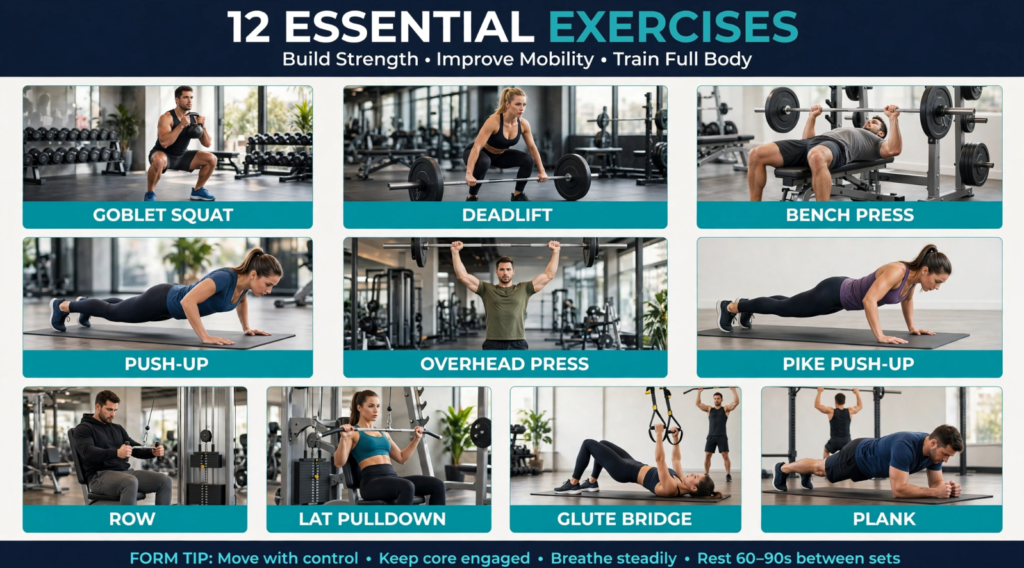
| Goblet Squats | 3 | 10–12 | 60–90 sec |
| Dumbbell Bench Press | 3 | 10–12 | 60–90 sec |
| Dumbbell Rows | 3 | 10–12 | 60–90 sec |
| Plank | 3 | 30–45 sec | 60 sec |
Wednesday Workout:
| Exercise | Sets | Reps | Rest |
|---|---|---|---|
| Dumbbell Lunges | 3 | 10 per leg | 60–90 sec |
| Dumbbell Overhead Press | 3 | 10–12 | 60–90 sec |
| Dumbbell Curls | 3 | 12–15 | 60 sec |
| Side Plank | 3 | 20–30 sec per side | 60 sec |
Friday Workout:
| Exercise | Sets | Reps | Rest |
|---|---|---|---|
| Dumbbell Deadlifts (RDL) | 3 | 10–12 | 60–90 sec |
| Incline Dumbbell Press | 3 | 10–12 | 60–90 sec |
| Dumbbell Rows | 3 | 10–12 | 60–90 sec |
| Dead Bugs | 3 | 10 per side | 60 sec |
Section 5: Success Stories—Real People, Real Results
Case Study 1: John (Age 68)
Before: Retired teacher, could not get up from the floor without help. Struggled with grocery bags. Had lower back pain.
After 6 Months of Strength Training:
- Can get up from the floor independently
- Carries 2 grocery bags without difficulty
- No lower back pain
- Improved energy and mood
- Lost 15 pounds
His Routine:
- 3 days per week, 45 minutes per session
- Bodyweight exercises + light dumbbells
- Progressive overload (gradually increasing weight)
Case Study 2: Margaret (Age 72)
Before: Diagnosed with osteopenia. Fearful of falling. Minimal physical activity.
After 8 Months of Strength Training:
- Bone density improved (no longer osteopenic in some areas)
- No falls
- Increased confidence and mobility
- Can play with grandchildren
- Improved balance
Her Routine:
- 2 days per week, 30 minutes per session
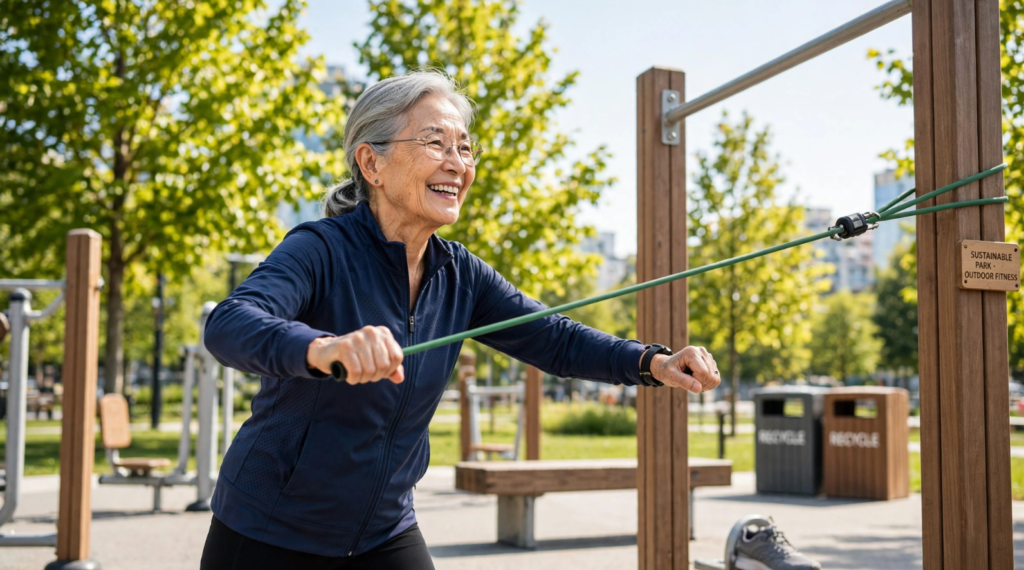
- Bodyweight exercises + resistance bands
- Focus on balance and stability exercises
Case Study 3: Robert (Age 81)
Before: Recent hip replacement. Walking with a cane. Low energy.
After 12 Months of Strength Training:
- Walking without a cane
- Significantly improved energy
- Increased independence
- Better mood and outlook
His Routine:
- 2 days per week, 30 minutes per session
- Physical therapy exercises + light strength training
- Focus on mobility and functional strength
Section 6: Exercises to Modify for Safety
Squat Modifications
| Modification | How To | Why |
|---|---|---|
| Chair Squats | Squat to a chair | Reduces depth, provides support |
| Wall Squats | Lean against a wall | Provides support, builds leg strength |
| Squats with Support | Hold a chair or wall | Improves balance |
| Shallow Squats | Partial depth | Reduces stress on knees |
Push-Up Modifications
| Modification | How To | Why |
|---|---|---|
| Wall Push-ups | Hands on wall | Lowest intensity |
| Counter Push-ups | Hands on counter | Moderate intensity |
| Incline Push-ups | Hands on bench or stairs | Easier than floor push-ups |
| Knee Push-ups | Knees on floor | Reduces load |
Plank Modifications
| Modification | How To | Why |
|---|---|---|
| Knee Planks | Knees on floor | Reduces load on core and back |
| Wall Planks | Hands on wall | Easier than floor planks |
| Plank with Hands on Bench | Hands elevated | Reduces load |
| Short Duration Planks | 10–15 seconds | Builds endurance safely |
Section 7: Signs You’re Doing It Right (and Signs You’re Not)
Signs of Good Form
| Sign | What It Means |
|---|---|
| Smooth, controlled movement | Good tempo, no momentum |
| Full range of motion | Muscles working through full range |
| No pain (joint or back) | Good alignment |
| Feel the target muscle working | Correct muscle activation |
| Breathing steadily | Not holding breath |
| Slight fatigue at the end | Proper intensity |
Signs You Need to Adjust
| Sign | What to Do |
|---|---|
| Joint pain | Stop the exercise, modify or reduce weight |
| Dizziness | Rest, breathe, check blood pressure |
| Sharp pain | Stop immediately, consult doctor |
| Can’t maintain form | Reduce weight or modify |
| Muscle strain that doesn’t improve | Rest, ice, consult doctor |
| Excessive fatigue | Reduce volume or weight |
When to Stop and Seek Help
| Symptom | Action |
|---|---|
| Chest pain or pressure | Stop immediately, call 911 |
| Severe dizziness or fainting | Stop, rest, consult doctor |
| Shortness of breath | Stop, rest, consult doctor |
| Joint pain that persists | Consult doctor or physical therapist |
| Unusual fatigue | Reduce intensity, consult doctor |
Section 8: FAQ—Your Top “Too Old” Questions
Q: Is it really safe to start strength training at my age?
A: Yes—with proper precautions. Strength training is one of the safest and most effective interventions for older adults. Start with bodyweight exercises, progress slowly, focus on form, and consult your doctor before starting.
Q: Will I see results at my age?
A: Yes. Research shows that individuals in their 60s, 70s, and even 80s and 90s build significant strength and muscle with consistent training. Results may be slower than for younger people, but they are real and significant.
Q: What if I have arthritis or joint pain?
A: Strength training can actually help arthritis by strengthening the muscles that support your joints. Start with light weights, use full range of motion (but not through pain), and consider working with a physical therapist or qualified trainer.
Q: How often should I train?
A: Start with 2 sessions per week. This gives you enough stimulus for growth while allowing adequate recovery. As you get stronger, you can add a third session.
Q: Should I warm up before each session?
A: Yes. A 5–10 minute warm-up is essential at any age, and even more important as you get older. Light cardio (walking, cycling), dynamic stretches, and light exercise reps prepare your body for the work ahead.
Q: Do I need to work with a trainer?
A: A trainer can be very helpful, especially for beginners. They can check your form, suggest appropriate weights, and create a program that matches your needs. If you can’t afford a trainer, consider a few sessions to get started, or watch reputable online videos.
Q: What if I’ve never exercised before?
A: That’s fine! Everyone starts somewhere. Start with bodyweight exercises, use support (chairs, walls), and progress at your own pace. Consistency matters more than intensity.
Q: Can I do strength training if I have osteoporosis?
A: Yes—with modifications. Avoid high-impact exercises and heavy loading that could cause fractures. Focus on bodyweight exercises, light weights, and exercises that improve bone density safely. Consult your doctor or physical therapist for a program tailored to you.
The VigorForty Take
The belief that you’re “too old” to start strength training is a myth—and it’s a dangerous one. It keeps people from experiencing one of the most powerful health interventions available.
The Truth:
- Your muscles respond to training at any age
- The benefits become more critical as you get older
- It’s never too late to start
- You don’t need to lift heavy to see results
- Safety is about how you train, not how old you are
The Benefits Are Real:
| Benefit | Impact |
|---|---|
| Fall Prevention | Reduced risk of falls and fractures |
| Independent Living | Maintained ability to perform daily activities |
| Bone Health | Improved bone density, reduced fracture risk |
| Metabolic Health | Reduced diabetes risk, improved blood sugar |
| Heart Health | Reduced cardiovascular risk |
| Cognitive Function | Improved brain health, reduced dementia risk |
| Quality of Life | More energy, better mood, greater confidence |
The best time to start strength training was 20 years ago. The second best time is today.
No matter your age, no matter your fitness level, you can start. You can build strength. You can improve your health. You can transform your life.
Your muscles are waiting. Your bones are waiting. Your future self is waiting.
Start today.
This article was reviewed by the Vigor Forty Editorial Review Board on July 19, 2026.
🔗 Related Articles
- Beyond Crunches: The Best Exercises for True Core Stability
- Core Stability for Lifters: How a Strong Core Protects Your Lower Back
- The Connection Between Core Strength and Better Posture
- Top 5 Strength Training Myths Debunked
- “I’m Too Old to Start Lifting”: Why Strength Training is for Everyone
- “I Don’t Want to Get Bulky”: The Truth About Weightlifting and Muscle Growth
- Can You Build Muscle with Just Bodyweight Exercises?
- The Role of Nutrition in Strength Training: Fueling Your Gains
- The Importance of Rest and Recovery for Building Muscle
- Supplements 101: What Actually Works for Strength Athletes?
- Sleep and Strength: How Better Sleep Can Improve Your Lifts
- 5-Minute Daily Core Routine for Busy Americans
- The Science of Hypertrophy: How to Build Muscle Effectively
- Periodization: How to Plan Your Training for Long-Term Success
- Drop Sets, Supersets, and AMRAPs: Advanced Training Techniques Explained
- Strength Training for Fat Loss: A Comprehensive Guide
- How to Build Muscle and Strength with a Busy Schedule
- The Ultimate Guide to Kettlebell Training for Strength and Conditioning
- Resistance Band Workout: A Full-Body Strength Routine
- Dumbbell Only Workout: Build Muscle Anywhere
- Hybrid Training: Combining Calisthenics and Powerlifting
- The Importance of Mobility for Strength Athletes
- 5 Dynamic Warm-Up Exercises to Do Before Every Workout
- The Best of Both Worlds: Why You Should Combine Calisthenics and Weights
- Your 2027 Strength Training Roadmap: Setting Goals and Staying Consistent
- Strength Training for Life: Building a Sustainable Fitness Habit
- The 12 Best Strength Training Exercises for Americans
Affiliate Disclosure: Some links in this article may be affiliate links. If you make a purchase through these links, Vigor Forty may earn a small commission at no extra cost to you. We only recommend products we trust.