Author: Vigor Forty Editorial Team
Medically Reviewed By: Editorial Review Board
Disclaimer: This article is for informational purposes only and is not a substitute for professional medical advice. Read our full Medical Disclaimer.
📌 Key Takeaways
- Kettlebells are one of the most versatile fitness tools available: They combine strength, cardio, and mobility training into a single, efficient workout. One piece of equipment can replace an entire gym’s worth of machines.
- Kettlebell training builds functional, real-world strength: The off-center weight distribution forces your core and stabilizing muscles to work harder, developing strength that translates directly to daily activities.
- It’s highly effective for fat loss and conditioning: The combination of strength and cardio in kettlebell workouts burns significant calories, builds muscle, and improves cardiovascular fitness simultaneously.
- Kettlebell training is joint-friendly: The ballistic movements (swings, snatches) are low-impact, making them ideal for older adults or those with joint issues.
- You can start with just one kettlebell: You don’t need a full set to begin. One kettlebell in the right weight can provide a complete workout for your entire body.
- Proper form is critical: Kettlebell exercises are powerful but technical. Learning proper form prevents injury and maximizes results.
Introduction: The Cast-Iron Solution
If you had to choose one piece of fitness equipment to own, what would it be? A barbell? A set of dumbbells? A pull-up bar?
For many fitness enthusiasts, the answer is a kettlebell.
This simple cast-iron ball with a handle has taken the fitness world by storm—and for good reason. Kettlebells are versatile, efficient, and incredibly effective. They combine strength training, cardiovascular conditioning, and mobility work into a single, powerful tool.
The Kettlebell Advantage:
| Benefit | How It Helps |
|---|---|
| Full-Body Workouts | One exercise can work multiple muscle groups |
| Functional Strength | Off-center weight builds stabilizer muscles |
| Cardio + Strength | Combines resistance and cardiovascular training |
| Time Efficiency | Complete workouts in 20–30 minutes |
| Joint-Friendly | Ballistic movements are low-impact |
| Portable | One kettlebell can go anywhere |
| Cost-Effective | One piece of equipment replaces many |
Kettlebells vs. Dumbbells:
| Factor | Kettlebell | Dumbbell |
|---|---|---|
| Weight Distribution | Off-center | Centered |
| Core Activation | Higher | Lower |
| Ballistic Movements | Excellent | Limited |
| Grip Strength | Develops | Develops |
| Versatility | High | Very High |
| Learning Curve | Steeper | Gentler |
| Joint Impact | Low | Low |
This guide will teach you everything you need to know about kettlebell training. You’ll learn the fundamental movements, how to choose the right weight, sample workouts, and how to integrate kettlebells into your existing routine.
Section 1: The Kettlebell Essentials
Types of Kettlebells
| Type | Description | Best For |
|---|---|---|
| Cast Iron | Traditional, single piece of cast iron | Most exercises, durability |
| Competition | Uniform size (regardless of weight), steel construction | Sport-style training, consistency |
| Adjustable | Add or remove weight plates | Beginners, limited space, multiple users |
| Vinyl Coated | Cast iron with vinyl coating | Home use, protects floors |
Kettlebell Weights
How to Choose Your Starting Weight:
| Gender | Beginner | Intermediate | Advanced |
|---|---|---|---|
| Women | 8–12 kg (18–26 lbs) | 12–16 kg (26–35 lbs) | 16–20 kg (35–44 lbs) |
| Men | 12–16 kg (26–35 lbs) | 16–20 kg (35–44 lbs) | 20–24 kg (44–53 lbs) |
Weight Selection Guide:
| Exercise Type | Recommended Starting Weight |
|---|---|
| Swings | Women: 8–12 kg, Men: 12–16 kg |
| Goblet Squats | Women: 8–12 kg, Men: 12–16 kg |
| Presses | Women: 6–8 kg, Men: 8–12 kg |
| Rows | Women: 8–12 kg, Men: 12–16 kg |
| Turkish Get-Ups | Women: 4–8 kg, Men: 8–12 kg |
The Rule: Choose a weight that challenges you but allows you to maintain proper form. It’s better to start lighter and progress than to start too heavy and risk injury.
The Fundamental Grip
The Handle Grip:
| Grip Type | How To | When to Use |
|---|---|---|
| Standard Grip | Fingers wrapped around the handle, thumb over fingers | Swings, rows, deadlifts |
| Rack Position | Kettlebell resting in the crook of your arm | Squats, cleans, presses |
| Pinch Grip | Pinch the handle between thumb and fingers | Carries, some conditioning work |
Section 2: The Fundamental Kettlebell Movements
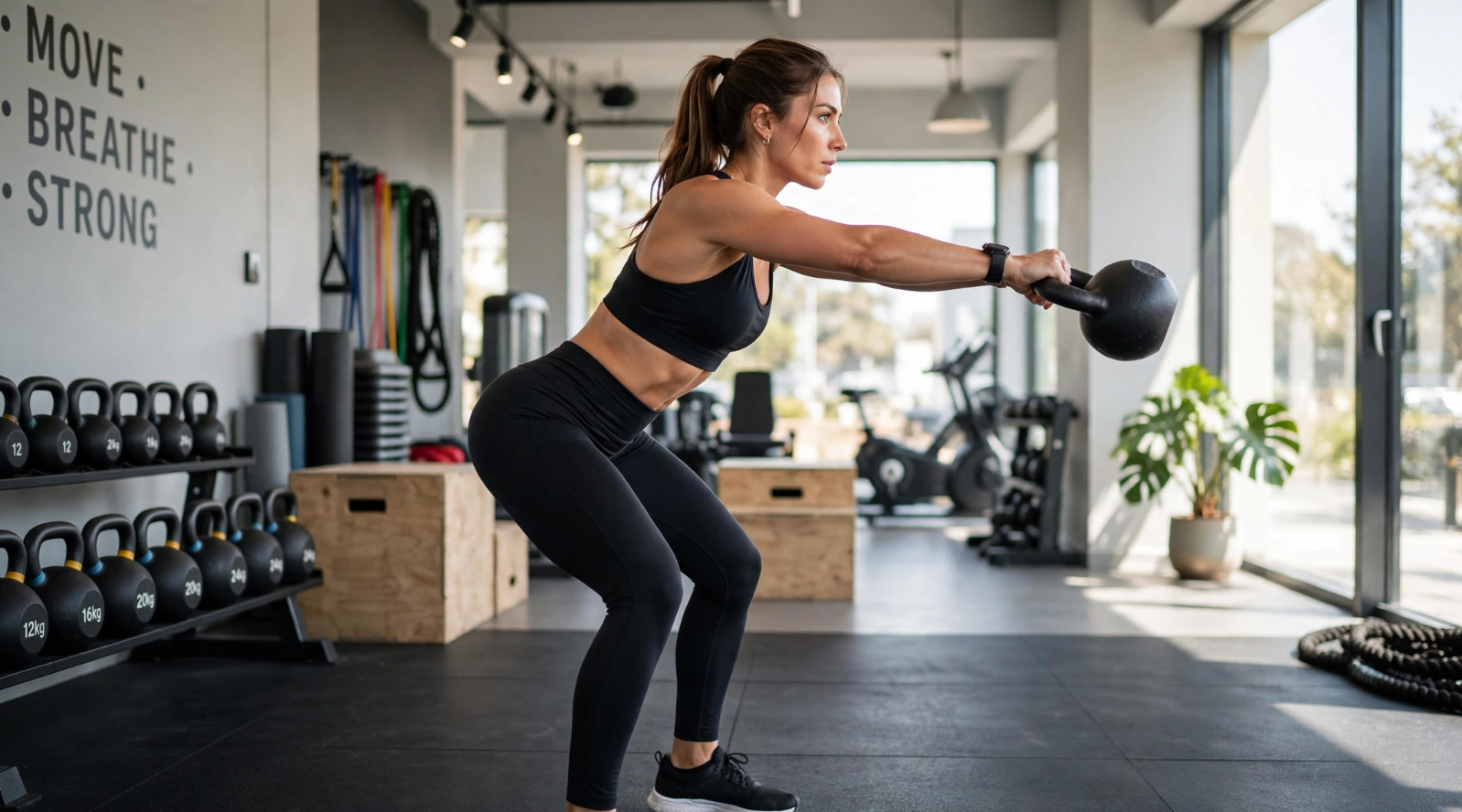
Exercise 1: The Kettlebell Swing
The King of Kettlebell Exercises: The swing is the foundational kettlebell movement. It builds power, strength, and cardiovascular fitness simultaneously.
Muscles Worked: Glutes, hamstrings, core, back, shoulders, grip
Form:
- Setup: Stand with feet shoulder-width apart, kettlebell on the floor between your feet
- Hinge: Bend at your hips, keep your back straight, grab the handle with both hands
- Hike: Hike the kettlebell back between your legs (like a football hike)
- Explode: Drive your hips forward, squeezing your glutes, to swing the kettlebell to chest height
- Control: Let the kettlebell swing back between your legs, control the descent, repeat
Key Points:
- The power comes from your hips and glutes—not your arms
- Keep your back straight throughout (no rounding)
- Let the kettlebell “float” at the top—don’t pull it up with your arms
- Breathe: Exhale on the forward swing, inhale on the backswing
Common Mistakes:
| Mistake | Fix |
|---|---|
| Using Arms Instead of Hips | Focus on hip drive; arms should be loose |
| Rounding Lower Back | Keep back straight; hinge at hips |
| Squatting Instead of Hinging | It’s a hip hinge, not a squat |
| Overextending at the Top | Stop at chest height; don’t lean back |
Russian Swing vs. American Swing:
| Type | Height | Focus |
|---|---|---|
| Russian Swing | Chest height | Power, glutes, hamstrings |
| American Swing | Overhead | Full body, shoulder mobility |
Start with Russian swings—they’re safer and more effective for most people.
Sets & Reps: 3–5 sets of 10–20 reps, 45–60 seconds rest
Exercise 2: The Goblet Squat
The Perfect Squat Teacher: The goblet squat teaches proper squat form by forcing an upright torso.
Muscles Worked: Quads, glutes, hamstrings, core, upper back
Form:
- Setup: Hold the kettlebell at chest height, resting against your chest
- Stance: Feet shoulder-width apart, toes slightly turned out
- Descend: Squat down as if sitting in a chair, keeping your chest up and back straight
- Depth: Go as low as your mobility allows (at least parallel)
- Ascent: Drive through your heels to return to standing
Key Points:
- Keep your chest up and core braced
- Push your knees out (track over your toes)
- Keep the kettlebell tight against your chest
Sets & Reps: 3–4 sets of 8–12 reps, 60 seconds rest
Exercise 3: The Turkish Get-Up (TGU)
The Ultimate Full-Body Exercise: The Turkish get-up requires strength, mobility, stability, and coordination.
Muscles Worked: Full body—core, shoulders, legs, hips, stabilizing muscles
Step-by-Step Form:
- Start: Lie on your back, kettlebell in your right hand, arm extended straight up
- Bend Knee: Bend your right knee (same side as the kettlebell), foot flat on the floor
- Roll: Roll onto your left side (the side without the kettlebell)
- Prop Up: Prop yourself up on your left elbow, then left hand
- Sweep: Sweep your left leg behind you, coming to a kneeling position
- Half Kneeling: Come to a half-kneeling position, keep the kettlebell overhead
- Stand: Stand up fully, keep the kettlebell overhead
- Reverse: Reverse the steps to return to the floor
Key Points:
- Keep your eyes on the kettlebell throughout
- The kettlebell stays overhead (don’t let it drift)
- Move slowly and with control—it’s not a speed exercise
- Use a lighter weight (4–8 kg for women, 8–12 kg for men)
Sets & Reps: 3–5 reps per side, 2–3 sets, 60 seconds rest
Exercise 4: The Kettlebell Clean
The Gateway to Overhead Work: The clean is the first step to overhead pressing and snatching.
Muscles Worked: Glutes, hamstrings, core, shoulders, grip
Form:
- Setup: Start in the same position as a swing
- Hike: Hike the kettlebell back between your legs
- Explode: Drive your hips forward, pulling the kettlebell up
- Catch: As the kettlebell reaches chest height, rotate your hand and “catch” it in the rack position (resting on your forearm)
- Control: Control the descent back to the start
Key Points:
- The power comes from your hips—not your arms
- The “catch” should be soft and controlled
- Keep your wrist straight (avoid bending it back)
Sets & Reps: 3–4 sets of 5–8 reps per side, 60 seconds rest
Exercise 5: The Kettlebell Overhead Press
Builds Strong, Stable Shoulders: The kettlebell press develops shoulder strength and stability.
Muscles Worked: Shoulders, triceps, core, upper back
Form:
- Start: Clean the kettlebell to the rack position
- Press: Press the kettlebell overhead, keeping your core tight
- Lockout: Fully extend your arm, keep the kettlebell over your shoulder
- Lower: Control the descent back to the rack position
Key Points:
- Keep your core braced throughout
- Don’t lean back—keep your body straight
- Keep your wrist straight (palm facing forward or slightly inward)
Sets & Reps: 3–4 sets of 5–8 reps per side, 60 seconds rest
Exercise 6: The Kettlebell Row
Builds a Strong, Defined Back: Rows are essential for posture and pulling strength.
Muscles Worked: Lats, rhomboids, biceps, rear delts, core
Form:
- Setup: Place your free hand on a bench, knee on the bench (or stand and hinge at the hips)
- Grip: Hold the kettlebell in your opposite hand
- Row: Pull the kettlebell up toward your hip, squeezing your shoulder blade
- Control: Lower the kettlebell with control, fully extending your arm
Key Points:
- Keep your back straight (don’t round)
- Squeeze your shoulder blade at the top
- Control the descent (don’t drop)
Sets & Reps: 3–4 sets of 8–12 reps per side, 60 seconds rest
Exercise 7: The Kettlebell Snatch
The Most Powerful Kettlebell Exercise: The snatch is an explosive full-body movement that builds power, strength, and cardiovascular fitness.
Muscles Worked: Full body—glutes, hamstrings, core, shoulders, back, grip
Form:
- Setup: Same start as the swing
- Explode: Drive your hips forward, pulling the kettlebell up
- Punch: At the top, “punch” through the kettlebell, fully extending your arm overhead
- Control: Control the descent back to the start
Key Points:
- The power comes from your hips
- The movement is continuous (not two separate movements)
- Keep your wrist straight throughout
- Use a lighter weight for snatches
Sets & Reps: 3–4 sets of 5–8 reps per side, 60–90 seconds rest
Section 3: Sample Kettlebell Workouts
Workout A: Beginner Full Body (30 Minutes)
| Exercise | Sets | Reps | Rest |
|---|---|---|---|
| Russian Swings | 4 | 15–20 | 45–60 sec |
| Goblet Squats | 3 | 10–12 | 45–60 sec |
| Rows | 3 | 8–10 per side | 45–60 sec |
| Overhead Press | 3 | 5–8 per side | 45–60 sec |
| Plank (with kettlebell) | 3 | 30–45 sec | 30 sec |
Workout B: Intermediate Conditioning (25 Minutes)
Circuit Format: Perform each exercise for 45 seconds, rest 15 seconds, move to the next.
| Round | Exercise | Duration | Rest |
|---|---|---|---|
| 1 | Swings | 45 sec | 15 sec |
| 2 | Goblet Squats | 45 sec | 15 sec |
| 3 | Rows (Right) | 45 sec | 15 sec |
| 4 | Rows (Left) | 45 sec | 15 sec |
| 5 | Overhead Press (Right) | 45 sec | 15 sec |
| 6 | Overhead Press (Left) | 45 sec | 15 sec |
Repeat: 3 rounds, rest 60–90 seconds between rounds
Workout C: Advanced Complex (20 Minutes)
The “Armor Building” Complex:
| Exercise | Reps | Rest |
|---|---|---|
| Swings | 10 | 0 sec |
| Cleans (Right) | 5 | 0 sec |
| Presses (Right) | 5 | 0 sec |
| Cleans (Left) | 5 | 0 sec |
| Presses (Left) | 5 | 0 sec |
| Squats (Goblet) | 10 | — |
Perform: 5 rounds with 60–90 seconds rest between rounds
Workout D: The 20-Minute HIIT Kettlebell Workout
| Exercise | Duration | Rest |
|---|---|---|
| Swings | 40 sec | 20 sec |
| Goblet Squats | 40 sec | 20 sec |
| Rows (alternating) | 40 sec | 20 sec |
| Presses (alternating) | 40 sec | 20 sec |
| Plank (with kettlebell) | 40 sec | 20 sec |
Repeat: 3 rounds
Workout E: Turkish Get-Up Focus (30 Minutes)
| Exercise | Sets | Reps | Rest |
|---|---|---|---|
| Turkish Get-Ups | 3–5 | 1–2 per side | 60–90 sec |
| Swings | 3 | 10–15 | 60 sec |
| Goblet Squats | 3 | 10–12 | 60 sec |
| Rows | 3 | 8–10 per side | 60 sec |
Section 4: Integrating Kettlebells into Your Routine
Option 1: Full Kettlebell Program
Schedule: 3–4 days per week, 30–45 minutes
| Day | Focus | Workout |
|---|---|---|
| Monday | Full Body | Workout A or B |
| Wednesday | Full Body | Workout A or B |
| Friday | Full Body | Workout A or B |
Option 2: Kettlebell + Traditional Strength Training
Schedule: 3–4 days per week
| Day | Focus | Details |
|---|---|---|
| Monday | Kettlebell Conditioning | Workout B or D |
| Tuesday | Traditional Strength | Squats, Bench Press, Rows |
| Thursday | Kettlebell Strength | Workout A or C |
| Friday | Traditional Strength | Deadlifts, Overhead Press, Pull-ups |
Option 3: Kettlebell as Finisher
Schedule: After main strength training
| Exercise | Duration | Rest |
|---|---|---|
| Swings | 30–60 sec | 30 sec |
| Goblet Squats | 30–60 sec | 30 sec |
| Rows | 30–60 sec | 30 sec |
| Presses | 30–60 sec | 30 sec |
Repeat: 2–3 rounds
Section 5: Kettlebell Progression
Progression Strategy
| Phase | Focus | Exercises | Duration |
|---|---|---|---|
| Phase 1 | Form (1–4 weeks) | Swings, Goblet Squats, Rows | 20–30 min |
| Phase 2 | Strength (4–8 weeks) | Add Presses, Cleans, TGUs | 30–40 min |
| Phase 3 | Conditioning (8–12 weeks) | Add Snatches, HIIT workouts | 20–30 min |
| Phase 4 | Advanced (12+ weeks) | Heavy swings, complex work | 30–45 min |
How to Progress
| Method | Example |
|---|---|
| Increase Weight | 16 kg → 20 kg |
| Increase Reps | 10 reps → 12 reps → 15 reps |
| Increase Sets | 3 sets → 4 sets → 5 sets |
| Increase Duration | 20 minutes → 30 minutes |
| Decrease Rest | 60 sec → 45 sec → 30 sec |
Section 6: Kettlebell Safety
Common Injuries and Prevention
| Injury | Cause | Prevention |
|---|---|---|
| Lower Back Pain | Poor form, rounding back | Hinge at hips, keep back straight |
| Wrist Pain | Improper rack position | Keep wrist straight, handle diagonal |
| Shoulder Pain | Overhead with poor form | Use lighter weight, control the movement |
| Hand Blisters | Poor grip, too much friction | Use chalk, proper grip, don’t grip too tightly |
Safety Rules
| Rule | Why |
|---|---|
| Start Light | Learn form before adding weight |
| Master the Swing First | Foundation for all other exercises |
| Keep a Straight Back | Prevents lower back injury |
| Use a Soft Catch | Don’t “slam” the kettlebell into position |
| Warm Up | Prepare your muscles and joints |
| Choose the Right Surface | Avoid concrete (use rubber mats) |
| Wear Shoes or Go Barefoot | Avoid unstable footwear |
Section 7: Kettlebell Benefits for Americans Over 40
Why Kettlebells Are Ideal for Midlife
| Benefit | How It Helps |
|---|---|
| Joint-Friendly | Low-impact ballistic movements |
| Functional Strength | Translates to daily activities |
| Core Stability | Off-center weight builds strong core |
| Cardio + Strength | Time-efficient workouts |
| Bone Density | Weight-bearing exercise |
| Balance and Coordination | TGUs and unilateral work |
| Grip Strength | Builds functional grip |
| Metabolic Boost | HIIT-style kettlebell work |
Kettlebell Modifications for Older Adults
| Exercise | Modification |
|---|---|
| Swings | Lighter weight, shorter range of motion |
| Squats | Goblet squats (easier to maintain form) |
| Rows | Lighter weight, more reps |
| Presses | Lighter weight, focus on form |
| TGUs | Use a shoe or very light weight |
Section 8: FAQ—Your Top Kettlebell Questions
Q: What weight kettlebell should I start with?
A: Women: 8–12 kg (18–26 lbs); Men: 12–16 kg (26–35 lbs). This weight is challenging for swings and squats while light enough for presses and TGUs. If in doubt, choose lighter.
Q: Can I build muscle with kettlebells?
A: Yes. Kettlebells build significant muscle—especially in the glutes, hamstrings, back, and shoulders. They may be less effective for chest and bicep isolation than dumbbells, but they’re excellent for overall muscle development.
Q: Are kettlebells better than dumbbells?
A: Neither is “better”—they have different strengths. Kettlebells excel at ballistic movements, core activation, and conditioning. Dumbbells excel at isolation exercises and traditional strength training. Both are valuable.
Q: Can kettlebells replace my entire gym?
A: For many people, yes. A single kettlebell can provide a complete full-body workout. You’ll miss chest isolation and bicep curls, but for functional strength and conditioning, kettlebells are hard to beat.
Q: Is kettlebell training safe for beginners?
A: Yes—with proper instruction. Start with light weight, learn the form, and progress slowly. Consider working with a qualified instructor or watching reputable videos.
Q: How often should I train with kettlebells?
A: 3–4 days per week is ideal. This provides enough frequency for progress while allowing adequate recovery. Training every day with kettlebells is not recommended due to the high-intensity nature of the movements.
Q: Can I do kettlebell training if I have lower back pain?
A: Proceed with caution. Poor form can aggravate back issues. Start with light weight, prioritize perfect form, and consult a doctor or physical therapist before starting. Goblet squats and light swings may be safe, but heavy swings or TGUs may not be appropriate.
Q: Do I need special shoes for kettlebell training?
A: No. Flat-soled shoes (like Converse) or barefoot are best. Avoid running shoes with thick, cushioned heels—they destabilize you during kettlebell movements.
The VigorForty Take
Kettlebells are one of the most versatile and effective fitness tools available. They combine strength, power, cardiovascular conditioning, and mobility into a single, efficient workout.
The principles:
- Start light — learn form before adding weight
- Master the swing — the foundation for all kettlebell work
- Progress slowly — increase weight, reps, or sets gradually
- Focus on form — quality over quantity
- Be consistent — 3–4 days per week for best results
The benefits:
- Full-body strength and conditioning
- Functional, real-world strength
- Joint-friendly exercise
- Time-efficient workouts
- Portability and versatility
One kettlebell. 30 minutes. Full-body workout. No excuses.
This article was reviewed by the Vigor Forty Editorial Review Board on July 20, 2026.
🔗 Related Articles
- Beyond Crunches: The Best Exercises for True Core Stability
- Core Stability for Lifters: How a Strong Core Protects Your Lower Back
- The Connection Between Core Strength and Better Posture
- Top 5 Strength Training Myths Debunked
- “I’m Too Old to Start Lifting”: Why Strength Training is for Everyone
- “I Don’t Want to Get Bulky”: The Truth About Weightlifting and Muscle Growth
- Can You Build Muscle with Just Bodyweight Exercises?
- The Role of Nutrition in Strength Training: Fueling Your Gains
- The Importance of Rest and Recovery for Building Muscle
- Supplements 101: What Actually Works for Strength Athletes?
- Sleep and Strength: How Better Sleep Can Improve Your Lifts
- 5-Minute Daily Core Routine for Busy Americans
- The Science of Hypertrophy: How to Build Muscle Effectively
- Periodization: How to Plan Your Training for Long-Term Success
- Drop Sets, Supersets, and AMRAPs: Advanced Training Techniques Explained
- Strength Training for Fat Loss: A Comprehensive Guide
- How to Build Muscle and Strength with a Busy Schedule
- The Ultimate Guide to Kettlebell Training for Strength and Conditioning
- Resistance Band Workout: A Full-Body Strength Routine
- Dumbbell Only Workout: Build Muscle Anywhere
- Hybrid Training: Combining Calisthenics and Powerlifting
- The Importance of Mobility for Strength Athletes
- 5 Dynamic Warm-Up Exercises to Do Before Every Workout
- The Best of Both Worlds: Why You Should Combine Calisthenics and Weights
- Your 2027 Strength Training Roadmap: Setting Goals and Staying Consistent
- Strength Training for Life: Building a Sustainable Fitness Habit
- The 12 Best Strength Training Exercises for Americans
Affiliate Disclosure: Some links in this article may be affiliate links. If you make a purchase through these links, Vigor Forty may earn a small commission at no extra cost to you. We only recommend products we trust.