Author: Vigor Forty Editorial Team
Medically Reviewed By: Editorial Review Board
Disclaimer: This article is for informational purposes only and is not a substitute for professional medical advice. Read our full Medical Disclaimer.
📌 Key Takeaways
- Getting “bulky” is incredibly difficult: Building significant muscle mass requires years of dedicated training, specific nutrition, favorable genetics, and often hormonal support. It does not happen accidentally.
- The average person’s strength training results are lean and toned: Most people who lift weights develop a defined, functional physique with improved body composition—not a bulky bodybuilder physique.
- Women are biologically less likely to get bulky: Women have significantly less testosterone than men, which means they have much lower muscle-building potential without specific, intensive training.
- “Toning” is just muscle building + fat loss: There is no special “toning” exercise. To look toned, you need to build muscle and lose fat—both of which are achieved through strength training and proper nutrition.
- You control your results: Your training program, nutrition, and genetics determine your physique. You can choose to build as much muscle as you want—or stop at a level you’re comfortable with.
Introduction: The Fear That Keeps People from Getting Stronger
“I want to get toned, but I don’t want to get bulky.”
This is the most common concern women—and many men—have about strength training. It’s the reason millions of Americans avoid lifting weights or stick to pink dumbbells and high-rep circuits that don’t actually build strength.
The fear is understandable:
- We’ve seen images of bodybuilders with massive muscles
- We’ve heard stories of women who “got too big” from lifting
- We’ve been told that heavy weights = bulky muscles
But the fear is based on a misunderstanding:
- Bodybuilders train for years with specific protocols to achieve that look
- The women who “got too big” often used performance-enhancing substances
- Heavy weights build strength, not bulk—unless you combine them with specific nutrition and training
The reality is this: Getting bulky is one of the hardest things you can do in the gym. It requires extraordinary effort, extreme consistency, and often significant lifestyle changes. The average person who lifts weights 2–3 times per week will never, ever get bulky.
What they will get:
- A stronger, more capable body
- Improved muscle definition (“toning”)
- Better body composition (more muscle, less fat)
- Increased confidence and energy
- Better health and function
This guide will explain exactly why the “bulky” fear is unfounded. You’ll learn the science of muscle growth, why women and men respond differently to training, how to achieve the physique you want, and why strength training is the most effective way to get “toned.”
Section 1: The Science of Getting “Bulky”
What Does “Bulky” Actually Mean?
“Bulky” is a subjective term. Most people use it to describe a physique with:
- Significant muscle mass (hypertrophy)
- Low body fat (visible muscle definition)
- A “large” or “thick” appearance
But here’s the truth: For most people, “bulky” is not a physique they can accidentally achieve. It requires:
| Factor | What It Takes |
|---|---|
| Training Volume | 4–6+ hours per week, often 1–2 hours per session |
| Training Intensity | Heavy weights, high volume, specific protocols |
| Nutrition | Caloric surplus (eating more than you burn) |
| Protein Intake | 1.2–1.6g per pound of body weight daily |
| Consistency | Years of dedicated, uninterrupted training |
| Genetics | Favorable muscle-building genetics |
| Hormones | Optimal testosterone (men) or specific protocols (women) |
| Recovery | 8+ hours of sleep, minimal stress |
The Muscle-Building Process
How Muscle Grows:
- Mechanical Tension: Lifting weights creates tension in muscle fibers
- Muscle Damage: Microscopic tears occur in muscle fibers
- Metabolic Stress: Fatigue and “the burn” trigger growth signals
- Muscle Protein Synthesis: Your body repairs and builds new muscle tissue
The Timeframe:
| Timeframe | What Happens |
|---|---|
| First 8–12 Weeks | Neural adaptations (your nervous system gets more efficient) |
| 3–6 Months | Visible muscle growth begins (1–2 lbs of muscle per month) |
| 6–12 Months | Significant muscle growth (2–4 lbs of muscle per month) |
| 1–2 Years | Maximum natural growth potential begins to slow |
| 2–3+ Years | Very slow gains; requires advanced programming |
Key Point: Building significant muscle mass takes years. Even with optimal training and nutrition, the average person gains 1–2 pounds of muscle per month in the first year. After that, the rate slows significantly.
Section 2: Why Women Don’t Get “Bulky”
The Hormonal Reality
The Key Difference:
| Hormone | Women | Men | Effect on Muscle Growth |
|---|---|---|---|
| Testosterone | 15–70 ng/dL | 300–1000 ng/dL | Primary driver of muscle growth |
| Growth Hormone | Similar | Similar | Supports muscle growth |
| Estrogen | 30–400 pg/mL | 10–40 pg/mL | Supports bone density, not muscle growth |
The Numbers:
- Women have 10–20 times less testosterone than men
- Testosterone is the primary hormone for muscle growth
- Even men with high testosterone struggle to build significant muscle
- Women have a fraction of the muscle-building potential
What This Means for Women
| Factor | Reality |
|---|---|
| Muscle Growth Rate | Women gain muscle at about 60–70% the rate of men |
| Maximal Muscle Mass | Women have significantly less total muscle potential |
| Hypertrophy Response | Same percentage increase, but lower absolute numbers |
| Strength Gains | Similar relative gains, lower absolute numbers |
The Research:
- Meta-Analysis (2019): Women gain the same percentage of muscle as men when training, but have significantly lower absolute muscle mass.
- Study (2020): Women who lift heavy weights (80%+ of max) do not gain more muscle than women who lift lighter weights (60% of max). The key is taking sets close to failure—not the absolute weight.
- Long-Term Studies: Even with years of dedicated training, women’s muscle mass remains significantly lower than men’s.
The Bottom Line: Women who strength train do not get “bulky.” They get stronger, more toned, and more defined—but they do not develop massive muscles without extraordinary effort and often hormonal interventions.
Section 3: What “Toned” Actually Means
The Real Definition
Toned is a marketing term, not a scientific one. What people actually mean when they say “toned” is:
- Muscle Definition: Visible muscle shape and contour
- Low Body Fat: Enough fat loss to see muscle definition
- Functional Strength: Strength that translates to daily activities
The Reality: To look “toned,” you need to do two things:
| Requirement | How to Achieve It |
|---|---|
| Build Muscle | Strength training (resistance training) |
| Lose Fat | Nutrition (caloric deficit) + cardio (optional) |
Key Point: You cannot “tone” a muscle without building it. The “toned” look is simply muscle + low body fat. Strength training builds the muscle; nutrition reveals it.
Why Cardio Alone Doesn’t Work
| Approach | Result |
|---|---|
| Cardio Only | Burns calories, but doesn’t build muscle. You may lose weight, but you’ll look “skinny fat” (low muscle, still some fat). |
| Strength Training Only | Builds muscle, but may not reveal it if you have excess body fat. |
| Strength Training + Nutrition | Builds muscle AND reveals it. This is the “toned” look. |
Section 4: The Truth About Heavy Weights
Myth: “Heavy Weights Make You Bulky”
The Reality: Heavy weights build strength, not bulk. Bulk comes from:
- High volume (lots of sets and reps)
- Caloric surplus (eating more than you burn)
- Specific hypertrophy protocols
- Years of consistent training
- Favorable genetics and hormones
What Heavy Weights Actually Do:
| Benefit | How It Works |
|---|---|
| Maximal Strength | Increases neural efficiency and muscle fiber recruitment |
| Bone Density | Heavy loading stimulates bone formation |
| Connective Tissue Strength | Strengthens tendons and ligaments |
| Metabolic Boost | Heavy lifting creates a significant afterburn effect |
Myth: “Light Weights with High Reps Are Better for Toning”
The Reality: Light weights with high reps build endurance, not definition. The “toned” look comes from building muscle and losing fat—not from using light weights.
What Actually Matters:
| Factor | Why It Matters |
|---|---|
| Progressive Overload | Continuously challenging your muscles is what builds them |
| Intensity (RPE) | Taking sets close to failure (RPE 7–8) builds muscle |
| Consistency | Training regularly over time |
| Nutrition | Building muscle and losing fat requires proper nutrition |
The Science: Research shows that light weights taken close to failure build the same amount of muscle as heavy weights taken close to failure. The key is intensity—not the absolute weight.
Section 5: How to Train for Your Desired Physique
Option 1: The “Lean and Toned” Look
Goal: Build muscle definition without significant bulk.
Training Approach:
| Training Variable | Recommendation |
|---|---|
| Frequency | 2–3 days per week |
| Volume | 3–4 sets per exercise |
| Reps | 8–15 reps per set |
| Intensity | RPE 7–8 (2–3 reps left in the tank) |
| Exercises | Compound lifts + isolation work |
| Cardio | 2–3 sessions per week (moderate intensity) |
| Nutrition | Maintenance calories or slight deficit |
Sample Workout:
| Exercise | Sets | Reps |
|---|---|---|
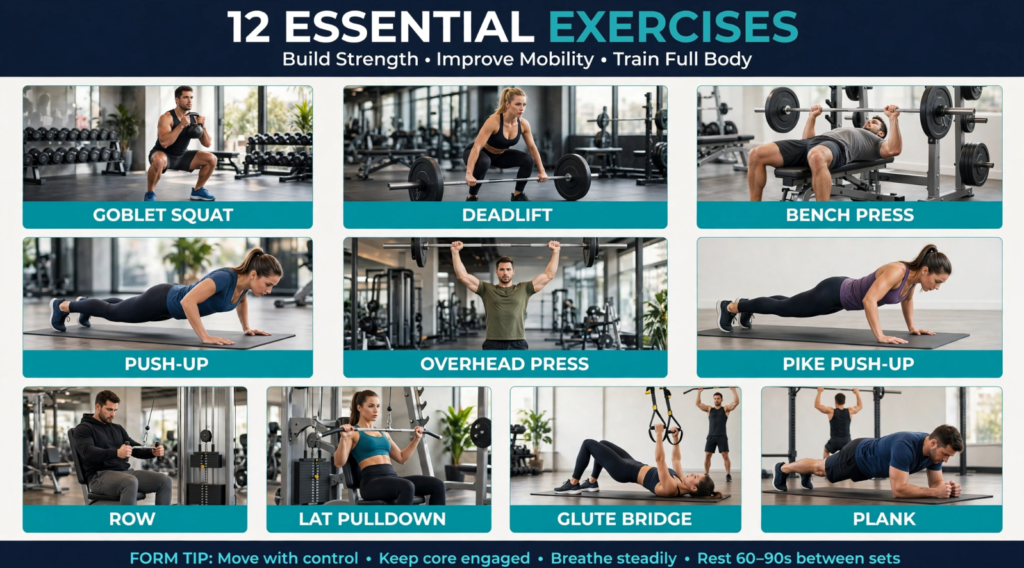
| Goblet Squats | 3 | 10–12 |
| Dumbbell Rows | 3 | 10–12 |
| Dumbbell Bench Press | 3 | 10–12 |
| Plank | 3 | 45–60 sec |
| Dumbbell Bicep Curls | 3 | 12–15 |
Option 2: The “Strong and Athletic” Look
Goal: Build significant strength and moderate muscle mass.
Training Approach:
| Training Variable | Recommendation |
|---|---|
| Frequency | 3–4 days per week |
| Volume | 4–5 sets per exercise |
| Reps | 6–10 reps per set |
| Intensity | RPE 8 (1–2 reps left in the tank) |
| Exercises | Compound lifts primarily |
| Cardio | 2–3 sessions per week (varied) |
| Nutrition | Maintenance or slight surplus |
Sample Workout:
| Exercise | Sets | Reps |
|---|---|---|
| Barbell Squats | 4 | 6–8 |
| Barbell Bench Press | 4 | 6–8 |
| Bent-Over Rows | 4 | 8–10 |
| Overhead Press | 3 | 8–10 |
| Deadlifts | 3 | 5–6 |
Option 3: The “Muscular and Defined” Look
Goal: Build significant muscle mass with low body fat.
Training Approach:
| Training Variable | Recommendation |
|---|---|
| Frequency | 4–5 days per week |
| Volume | 5+ sets per exercise |
| Reps | 6–12 reps per set |
| Intensity | RPE 8–9 (0–1 reps left in the tank) |
| Exercises | Compound + isolation work |
| Cardio | 2–3 sessions per week (varied) |
| Nutrition | Caloric surplus for bulking, deficit for cutting |
Note: This approach requires significant time, effort, and consistency. It’s the “bodybuilding” approach and is not something most people accidentally achieve.
Section 6: Nutrition and Body Composition
Building Muscle
Calories: To build muscle, you need a caloric surplus (eating more than you burn).
| Caloric Status | Result |
|---|---|
| Caloric Surplus | Builds muscle (and some fat) |
| Maintenance | Maintains muscle (and body weight) |
| Caloric Deficit | Loses fat (and some muscle, if not training) |
Protein: To build muscle, you need adequate protein.
| Protein Intake | Recommendation |
|---|---|
| Minimum | 0.8g per pound of body weight |
| Optimal | 1.0–1.2g per pound of body weight |
| Example (150 lbs) | 120–180g protein per day |
Losing Fat
Calories: To lose fat, you need a caloric deficit (eating less than you burn).
| Caloric Deficit | Rate of Fat Loss |
|---|---|
| 300–500 calories/day | 1–2 lbs per week (sustainable) |
| 500+ calories/day | 2+ lbs per week (aggressive, hard to sustain) |
Preserving Muscle During Fat Loss:
| Strategy | Why It Works |
|---|---|
| Strength Train | Signals your body to preserve muscle |
| High Protein | Provides building blocks for muscle repair |
| Moderate Deficit | Avoids rapid muscle loss |
| Adequate Sleep | Supports recovery and hormonal balance |
The “Toned” Look
To look “toned,” you need:
- Muscle: Built through strength training
- Low Body Fat: Achieved through nutrition and (optional) cardio
Body Fat Percentages for a “Toned” Look:
| Gender | Visible Abs | “Toned” Look | Athletic Look | Average |
|---|---|---|---|---|
| Women | 14–20% | 18–24% | 20–28% | 25–31% |
| Men | 6–12% | 10–16% | 12–18% | 18–24% |
Section 7: Genetics and Body Composition
The Genetic Reality
Genetics Influence:
| Factor | Genetic Component |
|---|---|
| Muscle Insertion Points | Determines muscle shape and appearance |
| Muscle Fiber Type | Determines strength vs. endurance potential |
| Body Fat Distribution | Determines where you store fat |
| Metabolic Rate | Determines how easily you gain/lose weight |
| Hormone Levels | Determines muscle-building potential |
What This Means:
| Reality | Implication |
|---|---|
| Everyone’s “Toned” Looks Different | Your genetics determine your specific muscle shape and fat distribution |
| Comparison Is Unhelpful | You cannot achieve someone else’s physique |
| You Can Only Be the Best Version of Yourself | Work with your genetics, not against them |
What You Can Control
| Factor | How to Control It |
|---|---|
| Training | Choose your program, frequency, and intensity |
| Nutrition | Control your calories and macros |
| Sleep | Prioritize 7–9 hours per night |
| Stress | Manage stress through lifestyle choices |
| Consistency | Show up consistently over time |
What You Can’t Control:
| Factor | Why You Can’t Control It |
|---|---|
| Height | Determined by genetics |
| Frame Size | Determined by bone structure |
| Muscle Insertion Points | Determined by genetics |
| Body Fat Distribution | Determined by genetics and hormones |
| Hormone Levels | Largely determined by genetics |
Section 8: Common Mistakes in Pursuit of “Toned”
Mistake 1: Avoiding Heavy Weights
The Problem: Using light weights because you’re afraid of getting bulky.
The Reality: Light weights won’t build the muscle needed for a “toned” look. Heavy weights (taken close to failure) build muscle more efficiently.
The Fix: Use weights that challenge you. Aim for RPE 7–8 (2–3 reps left in the tank). This builds muscle without excessive bulk.
Mistake 2: Doing Only Cardio
The Problem: Thinking cardio alone will give you a “toned” look.
The Reality: Cardio burns calories but doesn’t build muscle. Without muscle, you won’t have definition. You’ll just be smaller—not “toned.”
The Fix: Combine strength training (for muscle) with cardio (for cardiovascular health and caloric expenditure).
Mistake 3: Eating Too Little
The Problem: Severely restricting calories while strength training.
The Reality: You need fuel to build muscle. Eating too little prevents muscle growth and leaves you feeling weak and fatigued.
The Fix: Eat at maintenance or a slight deficit (300–500 calories below maintenance). Don’t starve yourself.
Mistake 4: Not Eating Enough Protein
The Problem: Not consuming adequate protein for muscle repair and growth.
The Reality: Protein is the building block of muscle. Without it, you can’t build muscle—no matter how hard you train.
The Fix: Aim for 0.8–1.2g of protein per pound of body weight. Distribute it across meals (20–40g per meal).
Mistake 5: Inconsistency
The Problem: Training sporadically—a few weeks on, a few weeks off.
The Reality: Muscle growth requires consistent stimulus over time. Inconsistent training = minimal results.
The Fix: Commit to 2–3 sessions per week, every week. Consistency builds results.
Mistake 6: Comparing Yourself to Others
The Problem: Comparing your physique to someone else’s.
The Reality: Genetics, training history, and lifestyle factors vary enormously. You can’t achieve someone else’s physique.
The Fix: Focus on your own progress. Track your own results. Be the best version of yourself.
Section 9: The Psychological Shift
Redefining “Bulky”
| Old Definition | New Definition |
|---|---|
| “Bulky” = big, unattractive | “Bulky” = strong, capable, functional |
| “Bulky” = masculine | “Bulky” = healthy, empowered |
| “Bulky” = something to avoid | “Bulky” = something you won’t accidentally achieve |
Redefining “Toned”
| Old Definition | New Definition |
|---|---|
| “Toned” = skinny | “Toned” = strong + lean |
| “Toned” = achieved by light weights | “Toned” = achieved by strength training + nutrition |
| “Toned” = a look | “Toned” = a function (strength and health) |
The Mindset Shift
| Old Mindset | New Mindset |
|---|---|
| “I’m afraid of getting bulky” | “Bulky doesn’t happen by accident” |
| “I’ll just do cardio” | “I need strength training for results” |
| “I don’t want to look masculine” | “Strength is empowering and attractive” |
| “Light weights are safer” | “Proper form with challenging weights is safe” |
| “I’ll never look like that” | “I can achieve my own best physique” |
Section 10: FAQ—Your Top “Bulky” Questions
Q: Will lifting weights make me bulky?
A: No—not unless you train specifically for that goal. Building significant muscle mass requires years of dedicated training, specific nutrition, and often favorable genetics. The average person who lifts weights 2–3 times per week becomes more toned and defined, not bulky.
Q: What if I’m a woman and I lift heavy weights?
A: Women have significantly less testosterone than men, which means they have much lower muscle-building potential. Women who lift heavy weights become stronger, more defined, and more toned—not bulky. Heavy weights are actually the most efficient way to build the muscle that gives a “toned” appearance.
Q: How do I get “toned” without getting bulky?
A: The “toned” look comes from two things: building muscle and losing fat. Strength training builds the muscle; nutrition (and optionally cardio) reveals it. You can train for your desired physique by choosing appropriate volume, intensity, and nutrition.
Q: Do I need to use light weights to avoid getting bulky?
A: No. Light weights don’t build the muscle needed for a “toned” look. Heavy weights (taken close to failure) build muscle more efficiently. The key is intensity (RPE)—not the absolute weight. Lighter weights taken close to failure can also build muscle.
Q: What if I start getting bulky and don’t like it?
A: Building significant muscle takes time—months to years. If you start seeing more muscle than you want, simply reduce your training volume or change your nutrition. You are in control. You will not wake up one day suddenly “bulky.”
Q: Is it true that women shouldn’t lift heavy?
A: No. This is a myth. Heavy lifting is safe and effective for women. It builds the muscle needed for strength, function, and a “toned” appearance. Women who lift heavy don’t get bulky—they get strong and capable.
Q: Will lifting heavy make me look masculine?
A: No. Lifting heavy builds muscle, but it doesn’t change your fundamental physique or appearance. Women who lift heavy look like stronger, more athletic versions of themselves—not like men.
Q: How long does it take to see results?
A: Many people notice improved energy and confidence within 2–4 weeks. Visible changes in muscle definition typically appear in 6–12 weeks with consistent training and proper nutrition. Significant muscle growth takes months to years.
The VigorForty Take
The fear of getting “bulky” is one of the most pervasive and damaging myths in fitness. It keeps people from experiencing the life-changing benefits of strength training—and it’s based on a misunderstanding of how muscle growth actually works.
The truth is this:
- Getting bulky is incredibly difficult. It requires years of dedicated training, specific nutrition, favorable genetics, and often hormonal support. It does not happen accidentally.
- The average person’s results are lean and defined. Strength training builds the muscle that gives a “toned” appearance. Combined with proper nutrition, it reveals that muscle.
- Women are biologically less likely to get bulky. Women have significantly less testosterone than men, which means they have much lower muscle-building potential.
- You control your results. Your training program, nutrition, and genetics determine your physique. You can choose to build as much muscle as you want—or stop at a level you’re comfortable with.
- “Toning” is just muscle building + fat loss. There is no special “toning” exercise. To look toned, you need to build muscle and lose fat—both of which are achieved through strength training and proper nutrition.
The fear of getting bulky is a reason not to start. But the benefits of strength training are too important to ignore:
- Stronger, more capable body
- Better health and function
- Improved body composition
- Reduced chronic disease risk
- Increased confidence and energy
Don’t let a myth hold you back. Start lifting. Get strong. Get toned. Get healthy.
You won’t get bulky. You’ll get strong.
This article was reviewed by the Vigor Forty Editorial Review Board on July 19, 2026.
🔗 Related Articles
- Beyond Crunches: The Best Exercises for True Core Stability
- Core Stability for Lifters: How a Strong Core Protects Your Lower Back
- The Connection Between Core Strength and Better Posture
- Top 5 Strength Training Myths Debunked
- “I’m Too Old to Start Lifting”: Why Strength Training is for Everyone
- “I Don’t Want to Get Bulky”: The Truth About Weightlifting and Muscle Growth
- Can You Build Muscle with Just Bodyweight Exercises?
- The Role of Nutrition in Strength Training: Fueling Your Gains
- The Importance of Rest and Recovery for Building Muscle
- Supplements 101: What Actually Works for Strength Athletes?
- Sleep and Strength: How Better Sleep Can Improve Your Lifts
- 5-Minute Daily Core Routine for Busy Americans
- The Science of Hypertrophy: How to Build Muscle Effectively
- Periodization: How to Plan Your Training for Long-Term Success
- Drop Sets, Supersets, and AMRAPs: Advanced Training Techniques Explained
- Strength Training for Fat Loss: A Comprehensive Guide
- How to Build Muscle and Strength with a Busy Schedule
- The Ultimate Guide to Kettlebell Training for Strength and Conditioning
- Resistance Band Workout: A Full-Body Strength Routine
- Dumbbell Only Workout: Build Muscle Anywhere
- Hybrid Training: Combining Calisthenics and Powerlifting
- The Importance of Mobility for Strength Athletes
- 5 Dynamic Warm-Up Exercises to Do Before Every Workout
- The Best of Both Worlds: Why You Should Combine Calisthenics and Weights
- Your 2027 Strength Training Roadmap: Setting Goals and Staying Consistent
- Strength Training for Life: Building a Sustainable Fitness Habit
- The 12 Best Strength Training Exercises for Americans
Affiliate Disclosure: Some links in this article may be affiliate links. If you make a purchase through these links, Vigor Forty may earn a small commission at no extra cost to you. We only recommend products we trust.