

Author: Vigor Forty Editorial Team
Medically Reviewed By: Editorial Review Board
Disclaimer: This article is for informational purposes only and is not a substitute for professional medical advice. Read our full Medical Disclaimer.
📌 Key Takeaways
- Strength training is superior to cardio for sustainable fat loss: It builds muscle, which increases your resting metabolic rate, allowing you to burn more calories 24/7—not just during exercise.
- Muscle is metabolically active tissue: Each pound of muscle burns approximately 6 calories per day at rest, compared to 2 calories per pound of fat. More muscle = higher metabolism.
- The afterburn effect (EPOC) continues for hours after training: Strength training creates a significant “afterburn” that keeps your metabolism elevated long after you leave the gym.
- You can build muscle and lose fat simultaneously: Body recomposition is possible—especially for beginners, those returning to training, and individuals with higher body fat percentages.
- Nutrition is the key to fat loss: You can’t out-train a poor diet. A caloric deficit is essential for fat loss, but adequate protein protects muscle mass.
- This approach is ideal for Americans over 40: As metabolism naturally slows with age, strength training becomes even more critical for maintaining a healthy body composition and preventing age-related weight gain.
Introduction: The Fat Loss Revolution
For decades, the standard advice for fat loss was simple: do more cardio, eat less food. Run on the treadmill. Take spin classes. Cut calories drastically.
The problem: This approach doesn’t work for most people. It leads to muscle loss, metabolic slowdown, and weight regain. It’s the reason 95% of dieters regain the weight they lost within 1–5 years.
The solution: Strength training.
When you strength train for fat loss, you’re not just burning calories during your workout—you’re building muscle that burns calories 24/7. You’re preserving your metabolism while losing fat. You’re creating a body that’s efficient at burning calories, even at rest.
The Difference:
| Approach | Cardio-Only | Strength Training + Nutrition |
|---|---|---|
| Calories Burned | During exercise only | During exercise + afterburn + resting metabolism |
| Muscle Mass | Lost (muscle wasting) | Preserved or built |
| Metabolism | Decreases | Increases or maintains |
| Body Composition | “Skinny fat” (low muscle, some fat) | Toned, defined, strong |
| Long-Term Success | Low (weight regain) | High (sustainable) |
The Science:
- Resting Metabolic Rate (RMR): Muscle tissue burns more calories at rest than fat tissue (6 vs. 2 calories per pound)
- Excess Post-Exercise Oxygen Consumption (EPOC): Strength training elevates metabolism for 24–48 hours after training
- Hormonal Response: Strength training improves insulin sensitivity, growth hormone release, and fat oxidation
This guide will show you exactly how to use strength training for fat loss. You’ll learn the science, the training principles, the nutrition strategies, and how to create a sustainable plan that works for you—especially if you’re over 40.
Section 1: Why Strength Training for Fat Loss?
Myth: Cardio Is Best for Fat Loss
The Reality: Cardio burns calories during the activity, but it doesn’t build muscle. Without muscle, your metabolism slows down. You lose weight, but you also lose muscle—leading to the “skinny fat” appearance and eventual weight regain.
The Numbers:
| Factor | Cardio-Only | Strength Training |
|---|---|---|
| Calories Burned During Exercise | High | Moderate |
| Calories Burned After Exercise (EPOC) | Low (minimal afterburn) | High (24–48 hour afterburn) |
| Resting Metabolic Rate (RMR) | Decreases (muscle loss) | Increases (muscle gain) |
| Muscle Mass | Lost | Preserved or built |
| Long-Term Metabolic Health | Limited | Significant |
The EPOC Effect
EPOC (Excess Post-Exercise Oxygen Consumption) is the “afterburn” effect—the calories your body continues to burn after exercise to return to a resting state.
| Exercise Type | EPOC Duration | EPOC Magnitude |
|---|---|---|
| Cardio (Steady State) | 1–2 hours | Low (5–10% of workout calories) |
| High-Intensity Cardio | 6–12 hours | Moderate (10–15% of workout calories) |
| Strength Training | 24–48 hours | High (15–25% of workout calories) |
| Strength Training + Intensity | 48+ hours | Very High (20–30% of workout calories) |
Why Strength Training EPOC Is Higher:
- Muscles need oxygen to recover (glycogen replenishment, tissue repair)
- Greater muscle damage requires more repair energy
- Increased protein synthesis demands energy
- Neural recovery requires energy
The Muscle Metabolism Advantage
| Tissue | Calories Burned Per Pound Per Day |
|---|---|
| Muscle | 6 calories |
| Fat | 2 calories |
The Math:
| Scenario | Muscle Mass | Fat Mass | Daily Resting Calories |
|---|---|---|---|
| Before Training | 100 lbs | 50 lbs | 100 x 6 = 600 + 50 x 2 = 100 = 700 |
| After 6 Months Training | 110 lbs | 40 lbs | 110 x 6 = 660 + 40 x 2 = 80 = 740 |
| Cardio-Only (Muscle Loss) | 90 lbs | 50 lbs | 90 x 6 = 540 + 50 x 2 = 100 = 640 |
The Difference: 100 additional calories burned per day, every day—without doing anything. That’s 10 pounds of fat loss per year, just from having more muscle.
Section 2: The Science of Body Recomposition
What Is Body Recomposition?
Body recomposition is the process of losing fat and gaining muscle simultaneously. It’s the ideal outcome for fat loss—you get leaner, stronger, and more toned.
Who Can Achieve Recomposition:
| Type | Likelihood of Recomposition |
|---|---|
| Beginners | Very High |
| Returning to Training | High |
| Individuals with Higher Body Fat | High |
| Moderately Trained | Moderate |
| Advanced Lifters | Low (difficult) |
| Very Lean Individuals | Low (difficult) |
The Mechanism:
| Phase | What Happens |
|---|---|
| 1 | Strength training creates the stimulus for muscle growth |
| 2 | Caloric deficit creates the stimulus for fat loss |
| 3 | Adequate protein supports muscle repair and growth |
| 4 | The body uses fat stores for energy while preserving muscle |
The Hormonal Response
Strength Training for Fat Loss:
| Hormone | Effect of Strength Training | Fat Loss Benefit |
|---|---|---|
| Growth Hormone | Increased | Fat mobilization, muscle preservation |
| Testosterone | Increased | Muscle growth, fat oxidation |
| Insulin Sensitivity | Improved | Better glucose utilization, less fat storage |
| Cortisol | Reduced (with proper recovery) | Less fat storage (visceral fat) |
| Leptin | Improved sensitivity | Better appetite regulation |
Section 3: How to Structure Your Fat Loss Program
Principle 1: Caloric Deficit—The Foundation
The Rule: You must consume fewer calories than you burn to lose fat.
| Caloric Status | Result |
|---|---|
| Deficit (-300–500 cal/day) | Fat loss (0.5–1 lb per week) |
| Maintenance | No change (weight stable) |
| Surplus (+300–500 cal/day) | Muscle gain (with training) |
How to Create a Deficit:
| Method | Approach |
|---|---|
| Reduce Intake | Eat 300–500 calories less per day |
| Increase Activity | Add 300–500 calories of activity per day |
| Combine | Reduce intake by 250 calories + increase activity by 250 calories |
Caution: Too large a deficit (-1000+ calories/day) leads to muscle loss, metabolic slowdown, and weight regain.
Principle 2: High Protein Intake
| Factor | Recommendation |
|---|---|
| Daily Intake | 1.0–1.2g per pound of body weight |
| Per Meal | 20–40g (3–4 meals) |
| Post-Workout | 20–40g within 1 hour |
| Before Bed | 20–30g casein (optional) |
Why Protein Matters for Fat Loss:
| Reason | Mechanism |
|---|---|
| Muscle Preservation | Prevents muscle loss during the deficit |
| Satiety | Keeps you full and reduces hunger |
| Thermic Effect | Protein burns more calories during digestion |
| Metabolic Rate | Supports resting metabolic rate |
Principle 3: Progressive Overload
The Rule: Gradually increase the challenge to your muscles to signal growth and preservation.
How to Progress:
| Method | Example |
|---|---|
| Increase Weight | Add 2.5–5 lbs when you can complete all reps |
| Increase Reps | Add 1–2 reps per set |
| Increase Sets | Add 1 set per exercise |
| Improve Form | Full range of motion, controlled tempo |
Key Point: During a fat loss phase, you may not gain strength as quickly as in a surplus—but you should maintain or slightly improve your strength. If strength decreases significantly, you’re losing muscle.
Principle 4: Frequency
| Factor | Recommendation |
|---|---|
| Training Days | 3–4 days per week |
| Rest Days | 1–2 days per week |
| Active Recovery | 1–2 days (walking, light cardio) |
Why Frequency Matters:
| Benefit | How It Works |
|---|---|
| Muscle Preservation | Frequent stimulation signals muscle to stay |
| Metabolic Boost | Regular activity increases daily calorie burn |
| Consistency | Regular training builds habit and adherence |
Principle 5: Compound Movements
The Rule: Prioritize compound exercises that work multiple muscle groups.
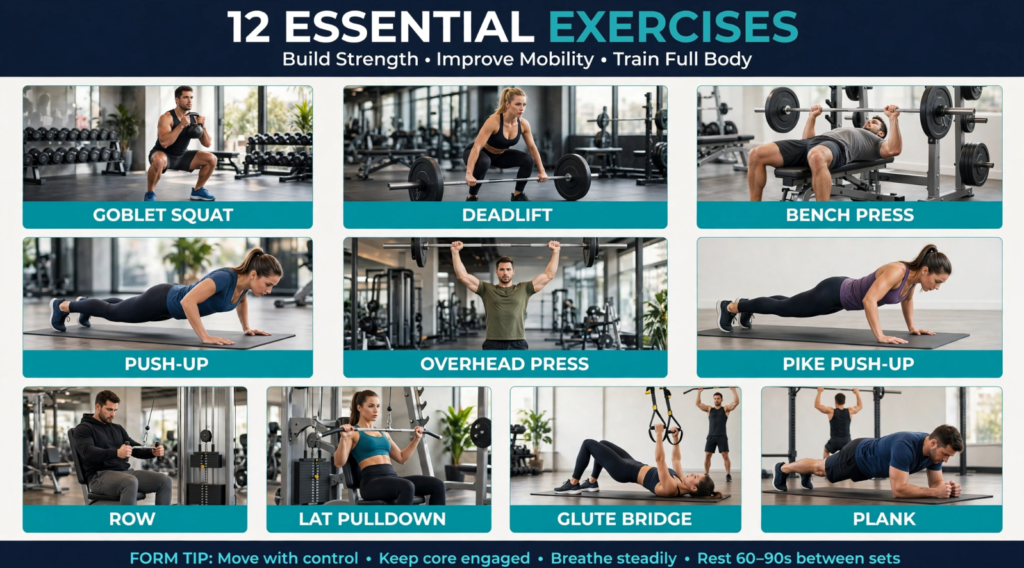
| Exercise | Muscles Worked | Why It’s Effective |
|---|---|---|
| Squat | Legs, glutes, core | High calorie burn, muscle mass |
| Deadlift | Full posterior chain | High calorie burn, full-body activation |
| Bench Press | Chest, shoulders, triceps | Upper body mass |
| Row | Back, biceps | Upper body mass, posture |
| Overhead Press | Shoulders, triceps | Upper body strength |
Isolation Exercises:
| Exercise | Purpose |
|---|---|
| Bicep Curls | Add volume to small muscles |
| Tricep Extensions | Add volume to small muscles |
| Lateral Raises | Shoulder development |
| Leg Extensions | Quad development |
Balance: 70–80% compound exercises, 20–30% isolation exercises.
Section 4: Sample Fat Loss Workout Program
Program A: 3-Day Full Body (Beginners)
Schedule: Monday, Wednesday, Friday
| Exercise | Sets | Reps | Rest |
|---|---|---|---|
| Goblet Squats | 3 | 10–12 | 60–90 sec |
| Dumbbell Bench Press | 3 | 10–12 | 60–90 sec |
| Bent-Over Rows | 3 | 10–12 | 60–90 sec |
| Overhead Press | 3 | 10–12 | 60–90 sec |
| Plank | 3 | 45–60 sec | 45–60 sec |
| Bicep Curls | 2 | 12–15 | 45–60 sec |
Progression: Increase weight when you can complete all reps with good form.
Program B: 4-Day Upper/Lower (Intermediate)
Schedule: Monday, Tuesday, Thursday, Friday
Monday (Upper Body):
| Exercise | Sets | Reps | Rest |
|---|---|---|---|
| Bench Press | 4 | 8–10 | 60–90 sec |
| Bent-Over Rows | 4 | 8–10 | 60–90 sec |
| Overhead Press | 3 | 8–10 | 60–90 sec |
| Pull-ups | 3 | 5–8 | 60–90 sec |
| Lateral Raises | 3 | 10–12 | 45–60 sec |
| Face Pulls | 3 | 12–15 | 45–60 sec |
Tuesday (Lower Body):
| Exercise | Sets | Reps | Rest |
|---|---|---|---|
| Barbell Squats | 4 | 8–10 | 60–90 sec |
| Romanian Deadlifts | 4 | 10–12 | 60–90 sec |
| Leg Press | 3 | 10–12 | 60–90 sec |
| Leg Curls | 3 | 10–12 | 45–60 sec |
| Calf Raises | 3 | 12–15 | 45–60 sec |
| Plank | 3 | 45–60 sec | 45–60 sec |
Thursday (Upper Body):
| Exercise | Sets | Reps | Rest |
|---|---|---|---|
| Incline Dumbbell Press | 4 | 8–10 | 60–90 sec |
| Dumbbell Rows | 4 | 8–10 | 60–90 sec |
| Seated Shoulder Press | 3 | 8–10 | 60–90 sec |
| Lat Pulldowns | 3 | 8–10 | 60–90 sec |
| Bicep Curls | 3 | 10–12 | 45–60 sec |
| Tricep Extensions | 3 | 10–12 | 45–60 sec |
Friday (Lower Body):
| Exercise | Sets | Reps | Rest |
|---|---|---|---|
| Dumbbell Lunges | 4 | 10–12 per leg | 60–90 sec |
| Hip Thrusts | 4 | 10–12 | 60–90 sec |
| Leg Extensions | 3 | 10–12 | 45–60 sec |
| Leg Curls | 3 | 10–12 | 45–60 sec |
| Calf Raises | 3 | 12–15 | 45–60 sec |
| Dead Bugs | 3 | 10 per side | 45–60 sec |
Program C: Advanced Push/Pull/Legs (5 Days)
Schedule: Monday, Tuesday, Wednesday, Friday, Saturday
Monday (Push): Chest, Shoulders, Triceps
Tuesday (Pull): Back, Biceps, Rear Delts
Wednesday (Legs): Quads, Hamstrings, Glutes, Calves
Thursday (Rest or Active Recovery)
Friday (Push): Chest, Shoulders, Triceps
Saturday (Pull): Back, Biceps, Rear Delts
Sunday (Rest)
Volume: 15–20 sets per muscle group per week
Section 5: Cardio Integration
How Much Cardio?
| Goal | Recommendation |
|---|---|
| Fat Loss Only | 2–3 sessions/week (20–30 min) |
| Fat Loss + Heart Health | 3–4 sessions/week (20–30 min) |
| Fat Loss + Endurance | 4–5 sessions/week (30–45 min) |
Types of Cardio
Low-Intensity Steady State (LISS):
| Activity | Intensity | Duration |
|---|---|---|
| Walking | Light | 20–45 min |
| Biking | Light | 20–45 min |
| Swimming | Light | 20–45 min |
High-Intensity Interval Training (HIIT):
| Activity | Intensity | Duration |
|---|---|---|
| Sprints | High | 15–20 min |
| Cycling Intervals | High | 15–20 min |
| Bodyweight Circuits | High | 15–20 min |
When to Do Cardio
| Timing | Best For |
|---|---|
| After Strength Training | Preserves energy for lifting |
| On Rest Days | Active recovery |
| Separate Sessions | Morning cardio, afternoon lifting |
Section 6: Nutrition for Fat Loss
The Fat Loss Nutrition Framework
| Factor | Recommendation |
|---|---|
| Caloric Deficit | 300–500 calories/day |
| Protein | 1.0–1.2g per pound of body weight |
| Carbohydrates | 0.8–1.5g per pound of body weight |
| Fats | 0.3–0.5g per pound of body weight |
Sample Daily Meal Plan (180 lb Person)
Calories: ~2,000–2,200
Protein: ~180–200g
Carbs: ~180–220g
Fats: ~55–65g
| Meal | Foods | Protein | Carbs | Fat |
|---|---|---|---|---|
| Breakfast | 3 eggs, 1 cup egg whites, 1 cup oatmeal | 40g | 40g | 12g |
| Lunch | 6 oz chicken breast, 1 cup brown rice, 2 cups vegetables | 45g | 50g | 8g |
| Snack | Greek yogurt, 1/2 cup berries | 25g | 15g | 3g |
| Dinner | 8 oz salmon, 1 sweet potato, 2 cups vegetables | 45g | 40g | 18g |
| Post-Workout | Protein shake | 25g | — | 2g |
| Totals | — | ~180g | ~145g | ~43g |
Hydration
| Factor | Recommendation |
|---|---|
| Daily | 8–10 cups (64–80 oz) |
| Pre-Workout | 16–20 oz (2–3 hours before) |
| During Workout | 8–16 oz per hour |
| Post-Workout | 16–24 oz per pound lost |
Section 7: The 12-Week Fat Loss Transformation Plan
Phase 1: Foundation (Weeks 1–4)
Goal: Build the habit, establish form, create consistency
| Focus | Details |
|---|---|
| Training | 3 days/week (Full Body) |
| Nutrition | 300-calorie deficit |
| Protein | 1.0g per pound of body weight |
| Cardio | 2 days/week (20 min LISS) |
| Sleep | 7+ hours/night |
| Hydration | 8+ cups/day |
Expected Results: 2–4 lbs fat loss, improved energy, better sleep
Phase 2: Intensification (Weeks 5–8)
Goal: Increase intensity, see visible changes
| Focus | Details |
|---|---|
| Training | 4 days/week (Upper/Lower) |
| Nutrition | 400-calorie deficit |
| Protein | 1.1g per pound of body weight |
| Cardio | 3 days/week (20–30 min LISS or 15 min HIIT) |
| Sleep | 7–8 hours/night |
| Hydration | 9–10 cups/day |
Expected Results: 3–5 lbs fat loss, visible muscle definition, strength gains
Phase 3: Peak (Weeks 9–12)
Goal: Maximize results, see significant transformation
| Focus | Details |
|---|---|
| Training | 4–5 days/week (Upper/Lower or PPL) |
| Nutrition | 500-calorie deficit |
| Protein | 1.2g per pound of body weight |
| Cardio | 4 days/week (20–30 min LISS + 1 HIIT) |
| Sleep | 8 hours/night |
| Hydration | 10+ cups/day |
Expected Results: 4–6 lbs fat loss, significant body composition change, defined muscles
Section 8: Common Fat Loss Mistakes
Mistake 1: Too Large a Caloric Deficit
The Problem: Starving yourself (1000+ calorie deficit) leads to muscle loss, metabolic slowdown, and bingeing.
The Fix: Aim for 300–500 calorie deficit. Slow and steady wins the race.
Mistake 2: Not Eating Enough Protein
The Problem: Muscle loss during fat loss.
The Fix: 1.0–1.2g of protein per pound of body weight. Protein is the most important nutrient during a fat loss phase.
Mistake 3: Doing Only Cardio
The Problem: Muscle loss, “skinny fat” appearance, metabolic slowdown.
The Fix: Prioritize strength training. Cardio is secondary—supportive, not primary.
Mistake 4: Not Tracking Calories
The Problem: Underestimating intake, overestimating expenditure.
The Fix: Track your food for a few weeks. Use an app (MyFitnessPal, Cronometer). You can’t manage what you don’t measure.
Mistake 5: Not Progressing in Training
The Problem: Doing the same workout with the same weights.
The Fix: Apply progressive overload. Increase weight, reps, or sets when you can.
Mistake 6: Ignoring Sleep
The Problem: Sleep deprivation increases cortisol, decreases growth hormone, impairs recovery.
The Fix: Prioritize 7–9 hours of quality sleep. Sleep is when fat loss and muscle growth occur.
Mistake 7: Eating Back Exercise Calories
The Problem: Overestimating calories burned and eating them back.
The Fix: Don’t eat back exercise calories. The deficit is your fat loss engine.
Mistake 8: No Active Recovery
The Problem: Going hard every day, no rest.
The Fix: Include rest days and active recovery (walking, stretching). Recovery is part of the process.
Section 9: Plateau Busting
Why Plateaus Happen
| Reason | Mechanism |
|---|---|
| Adaptation | Body has adapted to the deficit |
| Metabolic Adaptation | Metabolism has slowed to match intake |
| Decreased Activity | NEAT (non-exercise activity) decreases |
| Muscle Loss | Some muscle may have been lost |
| Inconsistent Tracking | Slip in tracking or compliance |
How to Break a Plateau
| Strategy | How It Works |
|---|---|
| Re-Calculate Calories | Your calorie needs decrease as you lose weight |
| Increase Activity | Add 10–15 min of cardio per day |
| Refeed Day | Increase calories by 20–30% for 1 day (resets hormones) |
| Increase Protein | Add 10–20g of protein per day |
| Vary Training | Change exercises, rep ranges, or techniques |
| Check Sleep/Stress | Improve sleep quality and reduce stress |
When to Maintain
| When to Stop Deficit | Why |
|---|---|
| Reached Goal Weight | Transition to maintenance |
| Significant Fatigue | Body needs a break from the deficit |
| Hormonal Issues | Deficits can affect hormones (especially in women) |
| Diet Fatigue | Mental burnout |
Section 10: FAQ—Your Top Fat Loss Questions
Q: Can I build muscle while losing fat?
A: Yes—especially if you’re a beginner, returning to training, or have higher body fat. This is called body recomposition. With proper training and nutrition, you can lose fat and gain muscle simultaneously.
Q: Should I do cardio or strength training for fat loss?
A: Strength training should be your priority. It preserves muscle, increases metabolism, and creates the “toned” appearance. Cardio is supportive—use it for additional calorie burn and heart health.
Q: How fast should I lose fat?
A: 0.5–1 lb per week is sustainable and maintainable. Faster weight loss (2+ lbs/week) often leads to muscle loss, metabolic slowdown, and weight regain. Slow and steady wins the race.
Q: What’s the best diet for fat loss?
A: The best diet is one you can stick to. Focus on:
- Caloric deficit (300–500 calories)
- High protein (1.0–1.2g/lb)
- Whole foods (vegetables, lean proteins, whole grains, healthy fats)
- Consistency (stick to it 80–90% of the time)
Q: How much protein do I need during fat loss?
A: 1.0–1.2g per pound of body weight. This is higher than the standard recommendation (0.8g/lb) because protein preserves muscle during the deficit.
Q: Will I lose muscle if I’m in a calorie deficit?
A: You may lose some muscle, but proper training and high protein intake minimize muscle loss. Strength training signals your body to preserve muscle while using fat for energy.
Q: Can I lose belly fat with strength training?
A: You can’t spot-reduce fat (lose fat from one specific area). However, strength training builds muscle and burns fat overall—including belly fat. As you lose overall body fat, you’ll lose belly fat. Building muscle also improves the appearance of your midsection.
Q: What if I’m over 40—can I still lose fat?
A: Yes—but metabolism naturally slows with age. Strength training becomes even more important. Focus on:
- Adequate protein (1.0–1.2g/lb)
- Progressive overload (maintain strength)
- Consistent training (3–4 days/week)
- Sleep and recovery (7–8 hours/night)
The VigorForty Take
Strength training is the most effective strategy for sustainable fat loss—especially as you age. It preserves muscle, boosts metabolism, and creates a body that burns calories efficiently 24/7.
The principles:
- Create a moderate caloric deficit (300–500 calories)
- Eat high protein (1.0–1.2g per pound)
- Strength train consistently (3–4 days/week)
- Apply progressive overload (get stronger over time)
- Prioritize sleep and recovery (7–9 hours/night)
- Be patient (0.5–1 lb of fat loss per week)
The results:
- Sustainable fat loss
- Preserved or built muscle
- Increased metabolism
- Improved body composition
- Better health and function
- Long-term success
You can’t out-train a poor diet. But with proper nutrition and strength training, you can transform your body—and keep it that way.
This article was reviewed by the Vigor Forty Editorial Review Board on July 20, 2026.
🔗 Related Articles
- Beyond Crunches: The Best Exercises for True Core Stability
- Core Stability for Lifters: How a Strong Core Protects Your Lower Back
- The Connection Between Core Strength and Better Posture
- Top 5 Strength Training Myths Debunked
- “I’m Too Old to Start Lifting”: Why Strength Training is for Everyone
- “I Don’t Want to Get Bulky”: The Truth About Weightlifting and Muscle Growth
- Can You Build Muscle with Just Bodyweight Exercises?
- The Role of Nutrition in Strength Training: Fueling Your Gains
- The Importance of Rest and Recovery for Building Muscle
- Supplements 101: What Actually Works for Strength Athletes?
- Sleep and Strength: How Better Sleep Can Improve Your Lifts
- 5-Minute Daily Core Routine for Busy Americans
- The Science of Hypertrophy: How to Build Muscle Effectively
- Periodization: How to Plan Your Training for Long-Term Success
- Drop Sets, Supersets, and AMRAPs: Advanced Training Techniques Explained
- Strength Training for Fat Loss: A Comprehensive Guide
- How to Build Muscle and Strength with a Busy Schedule
- The Ultimate Guide to Kettlebell Training for Strength and Conditioning
- Resistance Band Workout: A Full-Body Strength Routine
- Dumbbell Only Workout: Build Muscle Anywhere
- Hybrid Training: Combining Calisthenics and Powerlifting
- The Importance of Mobility for Strength Athletes
- 5 Dynamic Warm-Up Exercises to Do Before Every Workout
- The Best of Both Worlds: Why You Should Combine Calisthenics and Weights
- Your 2027 Strength Training Roadmap: Setting Goals and Staying Consistent
- Strength Training for Life: Building a Sustainable Fitness Habit
- The 12 Best Strength Training Exercises for Americans
Affiliate Disclosure: Some links in this article may be affiliate links. If you make a purchase through these links, Vigor Forty may earn a small commission at no extra cost to you. We only recommend products we trust.