
Author: Vigor Forty Editorial Team
Medically Reviewed By: Editorial Review Board
Disclaimer: This article is for informational purposes only and is not a substitute for professional medical advice. Read our full Medical Disclaimer.
📌 Key Takeaways
- A proper warm-up is essential for safe, effective training: It increases blood flow, raises muscle temperature, improves joint mobility, and prepares your nervous system for the work ahead.
- Dynamic warm-ups are superior to static stretching before training: Dynamic movements (active, movement-based) prepare your body for activity, while static stretching (holding positions) can temporarily reduce strength and power output.
- Just 5–10 minutes of dynamic warm-up reduces injury risk: A proper warm-up reduces muscle stiffness, improves range of motion, and activates key muscles—all of which lower injury risk.
- The warm-up should be specific to the workout: Your warm-up should mimic the movements you’ll be doing in your workout. A squat session requires different preparation than a pressing session.
- Consistency matters: A proper warm-up should be done before every workout—no exceptions. It’s not optional; it’s essential.
Introduction: The Most Important 5 Minutes of Your Workout
You’re at the gym. You’re ready to lift. But you’re also short on time. So you skip the warm-up and head straight to the squat rack or bench.
Mistake.
The warm-up is not optional. It’s the most important 5–10 minutes of your workout. It prepares your body, mind, and nervous system for the work ahead. It reduces injury risk. It improves performance. It makes your training more effective.
Without a proper warm-up:
- Your muscles are cold and stiff
- Your joints have limited mobility
- Your nervous system isn’t activated
- Your injury risk is elevated
- Your performance is compromised
With a proper warm-up:
- Your muscles are warm and pliable
- Your joints have full mobility
- Your nervous system is ready
- Your injury risk is reduced
- Your performance is optimized
The Difference:
| Factor | Cold Muscles | Warm Muscles |
|---|---|---|
| Temperature | ~97°F | ~100°F |
| Blood Flow | Limited | Increased |
| Oxygen Delivery | Limited | Increased |
| Nerve Conduction | Slower | Faster |
| Muscle Elasticity | Reduced | Increased |
| Injury Risk | Higher | Lower |
This guide will show you exactly how to warm up properly. You’ll learn the science of warming up, five essential dynamic exercises, sample warm-up routines for different workouts, and common mistakes to avoid.
Section 1: The Science of Warming Up
Why Warm Up?
| Benefit | How It Works |
|---|---|
| Increased Muscle Temperature | Warm muscles contract more forcefully and relax more quickly |
| Increased Blood Flow | More oxygen and nutrients delivered to working muscles |
| Improved Joint Mobility | Synovial fluid production increases, lubricating joints |
| Nervous System Activation | Prepares your brain-muscle connection for explosive movements |
| Mental Preparation | Focuses your mind on the upcoming workout |
| Injury Prevention | Reduces muscle stiffness and improves flexibility |
Dynamic vs. Static Stretching
| Type | Description | Best For |
|---|---|---|
| Dynamic Stretching | Movement-based stretching, active | Before workouts (warm-up) |
| Static Stretching | Holding a stretch in a fixed position | After workouts (cool-down) |
The Research:
- Study (2019): Static stretching before exercise can reduce muscle strength and power by 3–5% for up to 60 minutes.
- Study (2020): Dynamic stretching improves performance and reduces injury risk.
- Systematic Review (2021): Dynamic warm-ups are superior to static stretching for preparing the body for athletic activity.
Key Point: Save static stretching for after your workout. Use dynamic stretching before.
Section 2: The 5 Essential Dynamic Warm-Up Exercises
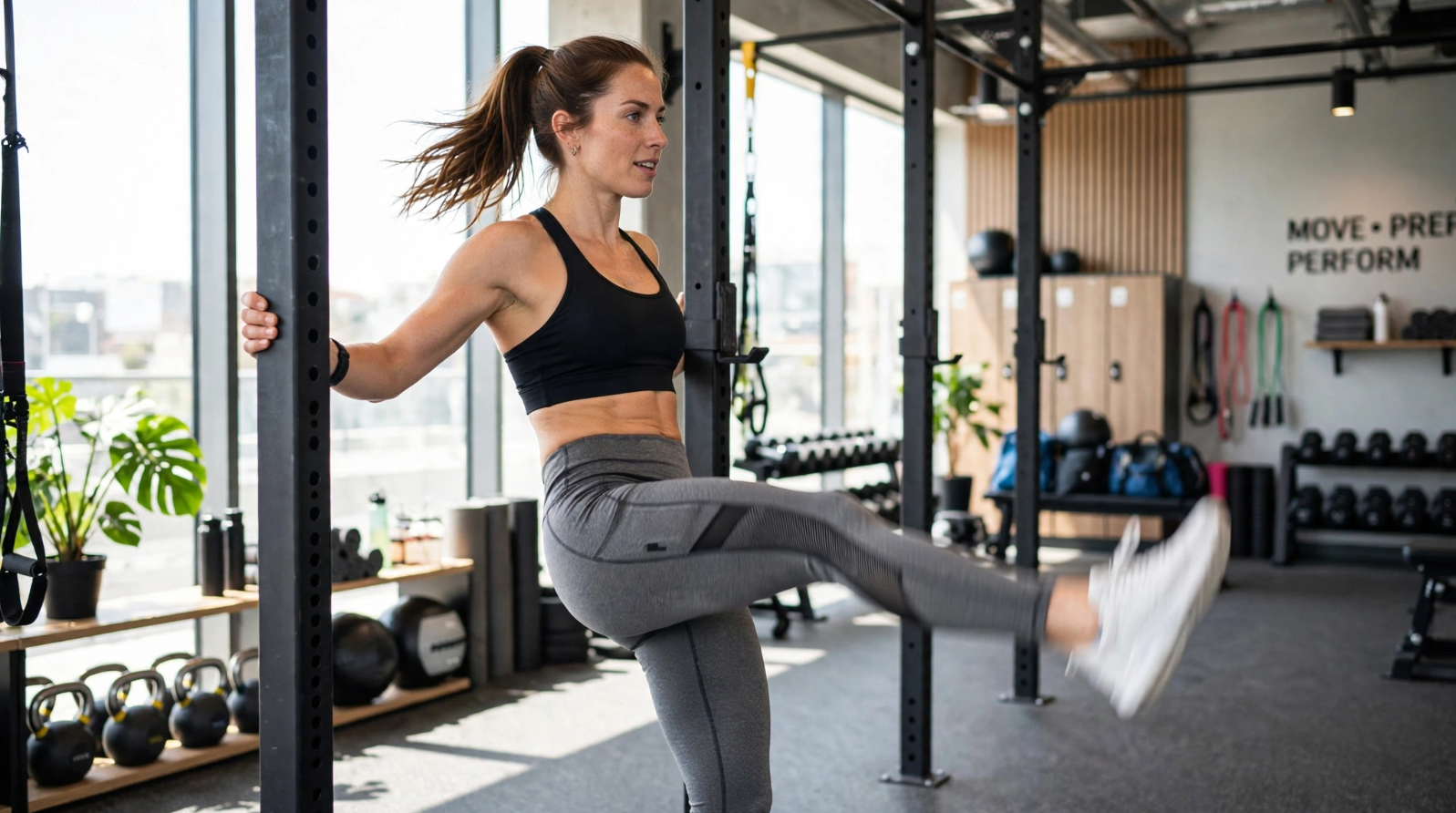
Exercise 1: Leg Swings (Front-to-Back and Side-to-Side)
Why It Matters: Activates the hip flexors, glutes, and hamstrings. Improves hip mobility and prepares the legs for squatting, lunging, and deadlifting.
Front-to-Back Leg Swings:
- Stand facing a wall or sturdy object, holding it for balance
- Swing one leg forward and backward like a pendulum
- Start with a small range of motion, gradually increasing
- Keep your core engaged and back straight
- Duration: 10–15 swings per leg
Side-to-Side Leg Swings:
- Stand facing a wall or sturdy object, holding it for balance
- Swing one leg side to side across your body
- Start with a small range of motion, gradually increasing
- Keep your core engaged and back straight
- Duration: 10–15 swings per leg
Key Points:
- Control the movement—don’t let momentum take over
- Keep your core engaged to stabilize your torso
- Start with small swings, gradually increase range
Exercise 2: Arm Circles
Why It Matters: Activates the shoulders, upper back, and chest. Improves shoulder mobility and prepares the upper body for pressing, rowing, and pulling.
Forward Arm Circles:
- Stand with feet shoulder-width apart
- Extend your arms straight out to the sides
- Make small circles forward (about 1 foot in diameter)
- Increase the circle size gradually
- Duration: 10–15 circles, then reverse direction
Backward Arm Circles:
- Same setup
- Make small circles backward
- Increase the circle size gradually
- Duration: 10–15 circles
Key Points:
- Keep your arms straight (slight bend at elbows is fine)
- Gradually increase the range of motion
- Don’t hunch your shoulders—keep them down
Exercise 3: Torso Twists (Spinal Rotation)
Why It Matters: Activates the core, obliques, and spinal muscles. Improves thoracic spine mobility, which is essential for overhead pressing, squatting, and deadlifting.
Standing Torso Twists:
- Stand with feet shoulder-width apart
- Extend your arms straight out to the sides
- Twist your torso to the right, keeping your hips facing forward
- Return to center and twist to the left
- Duration: 10–15 reps per side
Seated Torso Twists (Modified):
- Sit on the floor with legs extended
- Twist torso to one side, placing your hand on the floor behind you
- Hold for 2–3 seconds, return to center, twist to other side
- Duration: 8–10 reps per side
Key Points:
- Keep your hips facing forward—the rotation comes from your spine
- Don’t force the movement—go as far as comfortable
- Keep your core engaged throughout
Exercise 4: Cat-Cow Stretch (Spinal Mobilization)
Why It Matters: Mobilizes the entire spine, improves thoracic and lumbar mobility, and prepares the back for loaded movements (squats, deadlifts, rows).
Form:
- Start on all fours, hands under shoulders, knees under hips
- Cat: Round your back toward the ceiling, tucking your chin to your chest
- Cow: Arch your back, dropping your belly toward the floor, lifting your head and tailbone
- Move slowly and with control
- Duration: 8–10 reps (one rep = cat + cow)
Key Points:
- Move slowly and with control
- Coordinate your breathing: inhale as you arch (cow), exhale as you round (cat)
- This exercise should feel good—don’t force it
Exercise 5: Bodyweight Squats (or Squat Variations)
Why It Matters: Activates the quads, glutes, hamstrings, and core. Prepares the lower body for squatting, lunging, and deadlifting. Improves ankle and hip mobility.
Bodyweight Squats:
- Stand with feet shoulder-width apart, toes slightly turned out
- Squat down as if sitting in a chair, keeping your chest up
- Go as deep as comfortable (aim for at least parallel)
- Drive through your heels to return to standing
- Duration: 10–15 reps
Inchworm Variation (Advanced):
- Start in a standing position
- Bend over and walk your hands out into a push-up position
- Walk your feet toward your hands to return to standing
- Duration: 5–8 reps
Key Points:
- Keep your chest up and back straight
- Don’t let your knees cave inward—push them out
- Control the movement (no bouncing)
Section 3: The Complete Dynamic Warm-Up Routine
Workout A: Lower Body Focus (Squats, Deadlifts, Lunges)
| Exercise | Duration/Reps |
|---|---|
| Leg Swings (Front-to-Back) | 10–15 per side |
| Leg Swings (Side-to-Side) | 10–15 per side |
| Bodyweight Squats | 10–15 reps |
| Cat-Cow Stretch | 8–10 reps |
| Torso Twists | 10–15 reps per side |
| Light Cardio (Jogging, Jumping Jacks) | 2–3 minutes |
| Total Time | 5–7 minutes |
Workout B: Upper Body Focus (Presses, Rows, Pull-ups)
| Exercise | Duration/Reps |
|---|---|
| Arm Circles (Forward/Back) | 10–15 each direction |
| Band Pull-Aparts | 10–15 reps |
| Cat-Cow Stretch | 8–10 reps |
| Torso Twists | 10–15 reps per side |
| Light Cardio (Jumping Jacks, Arm Swings) | 2–3 minutes |
| Total Time | 5–7 minutes |
Workout C: Full Body Focus (All Lifts)
| Exercise | Duration/Reps |
|---|---|
| Light Cardio (Jogging, Jumping Jacks) | 2–3 minutes |
| Leg Swings (Front-to-Back) | 10–15 per side |
| Leg Swings (Side-to-Side) | 10–15 per side |
| Arm Circles (Forward/Back) | 10–15 each direction |
| Bodyweight Squats | 10–15 reps |
| Cat-Cow Stretch | 8–10 reps |
| Torso Twists | 10–15 reps per side |
| Total Time | 7–10 minutes |
Workout D: Time-Saver (3 Minutes)
Perfect for: When you’re short on time
| Exercise | Duration/Reps |
|---|---|
| Arm Circles + Torso Twists | 30 seconds each |
| Bodyweight Squats | 10 reps |
| Light Cardio (Jumping Jacks) | 1 minute |
| Total Time | ~3 minutes |
Section 4: Integration with Main Workout
The Warm-Up Progression
| Phase | Activity | Duration |
|---|---|---|
| Phase 1 | Light Cardio (jogging, jumping jacks) | 2–3 min |
| Phase 2 | Dynamic Stretches (leg swings, arm circles) | 2–3 min |
| Phase 3 | Specific Activation (light reps of main lifts) | 1–2 min |
| Phase 4 | Working Sets (your main workout) | — |
Specific Activation Examples
Squat Workout:
| Sets | Weight | Reps |
|---|---|---|
| Set 1 | Bar only (45 lbs) | 10 reps |
| Set 2 | 95 lbs | 5 reps |
| Set 3 | 135 lbs | 3 reps |
| Set 4+ | Working weight | 8–10 reps |
Bench Press Workout:
| Sets | Weight | Reps |
|---|---|---|
| Set 1 | Bar only (45 lbs) | 10 reps |
| Set 2 | 95 lbs | 5 reps |
| Set 3 | 135 lbs | 3 reps |
| Set 4+ | Working weight | 8–10 reps |
Deadlift Workout:
| Sets | Weight | Reps |
|---|---|---|
| Set 1 | 95 lbs | 8 reps |
| Set 2 | 135 lbs | 5 reps |
| Set 3 | 185 lbs | 3 reps |
| Set 4+ | Working weight | 5–8 reps |
Section 5: Exercise-Specific Warm-Ups
Squat Warm-Up
| Exercise | Duration/Reps |
|---|---|
| Leg Swings | 10–15 per side |
| Bodyweight Squats | 10–15 reps |
| Deep Squat Hold | 30–60 sec |
| Ankle Dorsiflexion Stretch | 30 sec per side |
| Light Jogging/Stationary Bike | 2–3 min |
| Squat Activation (Bar) | 10 reps |
Deadlift Warm-Up
| Exercise | Duration/Reps |
|---|---|
| Leg Swings | 10–15 per side |
| Hip Flexor Stretch | 30 sec per side |
| Cat-Cow Stretch | 8–10 reps |
| Light Jogging/Stationary Bike | 2–3 min |
| Deadlift Activation (Light Weight) | 8 reps |
Bench Press Warm-Up
| Exercise | Duration/Reps |
|---|---|
| Arm Circles | 10–15 each direction |
| Band Pull-Aparts | 10–15 reps |
| External Rotation (Band) | 10–15 per side |
| Cat-Cow Stretch | 8–10 reps |
| Bench Press Activation (Bar) | 10 reps |
Overhead Press Warm-Up
| Exercise | Duration/Reps |
|---|---|
| Arm Circles | 10–15 each direction |
| Band Pull-Aparts | 10–15 reps |
| Thoracic Extension (Foam Roller) | 30–60 sec |
| Cat-Cow Stretch | 8–10 reps |
| Overhead Press Activation (Light) | 8 reps |
Section 6: Common Warm-Up Mistakes
Mistake 1: Skipping the Warm-Up
The Problem: Going straight into working sets with cold muscles.
The Fix: Dedicate 5–10 minutes to warming up. It’s not optional—it’s essential for safety and performance.
Mistake 2: Static Stretching Before Workouts
The Problem: Holding static stretches before training (reduces strength and power).
The Fix: Use dynamic stretching before workouts. Save static stretches for after.
Mistake 3: Not Specific Enough
The Problem: Doing a generic warm-up that doesn’t prepare you for your specific lifts.
The Fix: Tailor your warm-up to the workout. Squat day requires different preparation than bench day.
Mistake 4: Rushing Through It
The Problem: Going through the motions without actually warming up.
The Fix: Focus on each movement. You should feel warmer and more mobile after your warm-up.
Mistake 5: Overdoing It
The Problem: Doing too much, getting fatigued before your workout.
The Fix: The warm-up should prepare you—not tire you out. Keep it light and focused.
Mistake 6: Ignoring Mobility Issues
The Problem: Not addressing specific mobility limitations (e.g., ankle stiffness, hip tightness).
The Fix: Use the warm-up to address your specific limitations. Spend extra time on problem areas.
Section 7: Mobility Integration in Warm-Up
Addressing Common Limitations
Limited Ankle Mobility:
| Exercise | Duration |
|---|---|
| Ankle Dorsiflexion Stretch | 30–60 sec per side |
| Band-Assisted Ankle Mobilization | 10–15 reps per side |
| Heel-Elevated Squat Hold | 30–60 sec |
Limited Hip Mobility:
| Exercise | Duration |
|---|---|
| Hip Flexor Stretch | 30–60 sec per side |
| Deep Squat Hold | 30–60 sec |
| Figure-4 Stretch | 30–60 sec per side |
Limited Shoulder Mobility:
| Exercise | Duration |
|---|---|
| Band Pull-Aparts | 15 reps |
| External Rotation (Band) | 15 per side |
| Shoulder Dislocates | 10 reps |
Section 8: Sample Warm-Up Script
Full Body Workout Warm-Up (7 Minutes)
Minute 1–2: Light Cardio
- Jog in place or jump rope (light)
- Purpose: Increase heart rate, blood flow, and body temperature
Minute 2–3: Leg Swings
- Front-to-back swings (10 per side)
- Side-to-side swings (10 per side)
- Purpose: Hip mobility, leg activation
Minute 3–4: Upper Body Activation
- Arm circles (10 forward, 10 backward)
- Band pull-aparts (10–15 reps)
- Purpose: Shoulder mobility, upper back activation
Minute 4–5: Bodyweight Squats
- 10–15 squats (deep, controlled)
- Purpose: Leg activation, hip/ankle mobility
Minute 5–6: Core and Spine
- Cat-Cow stretch (8–10 reps)
- Purpose: Spinal mobility, core activation
Minute 6–7: Specific Activation
- Light reps of the main lift (e.g., bar squats, light bench)
- Purpose: Prepare movement pattern, activate specific muscles
Section 9: FAQ—Your Top Warm-Up Questions
Q: Can I skip the warm-up if I’m short on time?
A: No. A proper warm-up reduces injury risk and improves performance. Even 3–5 minutes is better than nothing. Don’t skip it.
Q: Is static stretching completely bad before workouts?
A: Not “bad,” but it’s suboptimal. Static stretching before exercise can temporarily reduce strength and power. Save it for after workouts.
Q: How long should a warm-up be?
A: 5–10 minutes is sufficient for most workouts. If you’re doing heavy lifting or competition, 10–15 minutes may be appropriate. The warm-up should prepare you—not tire you out.
Q: Should I warm up differently for different exercises?
A: Yes. A squat warm-up should focus on the lower body (ankles, hips, legs). A bench warm-up should focus on the upper body (shoulders, chest, upper back).
Q: What if I’m training at home?
A: You can still warm up. Jog in place, do jumping jacks, or use a jump rope for light cardio. Dynamic stretches and light reps of your exercises work anywhere.
Q: Can I warm up with bodyweight exercises only?
A: Yes. Bodyweight squats, leg swings, arm circles, and light cardio are sufficient for most workouts. Add specific activation with light weights if available.
Q: Should I warm up even for light workouts?
A: Yes. Even light workouts benefit from a warm-up—it prepares your joints, muscles, and nervous system. Just adjust the intensity of the warm-up.
Q: How do I know if I’m warmed up enough?
A: Signs of being warmed up:
- Mild sweating
- Feeling warm in your muscles
- Good range of motion
- Ready to move
- Not fatigued
The VigorForty Take
The warm-up is not optional. It’s the most important 5–10 minutes of your workout. It prepares your body, mind, and nervous system for the work ahead. It reduces injury risk and improves performance.
The principles:
- Never skip the warm-up — it’s essential
- Use dynamic movements — save static stretches for after
- Tailor to the workout — squat day vs. bench day
- Address limitations — spend extra time on mobility issues
- Progress gradually — increase intensity, not all at once
The benefits:
- Reduced injury risk
- Better performance
- Improved mobility
- Better mind-muscle connection
- More effective workouts
A good warm-up is a gift to your body. Treat it as such.
This article was reviewed by the Vigor Forty Editorial Review Board on July 21, 2026.
🔗 Related Articles
- Beyond Crunches: The Best Exercises for True Core Stability
- Core Stability for Lifters: How a Strong Core Protects Your Lower Back
- The Connection Between Core Strength and Better Posture
- Top 5 Strength Training Myths Debunked
- “I’m Too Old to Start Lifting”: Why Strength Training is for Everyone
- “I Don’t Want to Get Bulky”: The Truth About Weightlifting and Muscle Growth
- Can You Build Muscle with Just Bodyweight Exercises?
- The Role of Nutrition in Strength Training: Fueling Your Gains
- The Importance of Rest and Recovery for Building Muscle
- Supplements 101: What Actually Works for Strength Athletes?
- Sleep and Strength: How Better Sleep Can Improve Your Lifts
- 5-Minute Daily Core Routine for Busy Americans
- The Science of Hypertrophy: How to Build Muscle Effectively
- Periodization: How to Plan Your Training for Long-Term Success
- Drop Sets, Supersets, and AMRAPs: Advanced Training Techniques Explained
- Strength Training for Fat Loss: A Comprehensive Guide
- How to Build Muscle and Strength with a Busy Schedule
- The Ultimate Guide to Kettlebell Training for Strength and Conditioning
- Resistance Band Workout: A Full-Body Strength Routine
- Dumbbell Only Workout: Build Muscle Anywhere
- Hybrid Training: Combining Calisthenics and Powerlifting
- The Importance of Mobility for Strength Athletes
- 5 Dynamic Warm-Up Exercises to Do Before Every Workout
- The Best of Both Worlds: Why You Should Combine Calisthenics and Weights
- Your 2027 Strength Training Roadmap: Setting Goals and Staying Consistent
- Strength Training for Life: Building a Sustainable Fitness Habit
- The 12 Best Strength Training Exercises for Americans
Affiliate Disclosure: Some links in this article may be affiliate links. If you make a purchase through these links, Vigor Forty may earn a small commission at no extra cost to you. We only recommend products we trust.