
Author: Vigor Forty Editorial Team
Medically Reviewed By: Editorial Review Board
Disclaimer: This article is for informational purposes only and is not a substitute for professional medical advice. Read our full Medical Disclaimer.
📌 Key Takeaways
- Most supplements are unnecessary: Whole foods should provide the foundation of your nutrition. Supplements are exactly that—supplements to fill gaps, not replacements for real food.
- Only a handful of supplements have strong scientific support: Creatine, protein powder, and caffeine are the most evidence-backed supplements for strength training. Everything else has limited or mixed evidence.
- The supplement industry is largely unregulated: Many products don’t contain what they claim. Look for third-party testing (NSF, Informed Sport, USP) to ensure quality and safety.
- Supplements won’t replace hard work: No supplement can make up for poor training, inadequate nutrition, or insufficient sleep. They are the final 5–10% of the equation.
- Start with the basics: Before spending money on exotic supplements, ensure your training, nutrition, sleep, and recovery are optimized. These are the foundation of your results.
Introduction: The Supplement Confusion
Walk into any supplement store, and you’ll be overwhelmed. Hundreds of products. Dozens of promises. Muscle growth, fat loss, increased energy, faster recovery, better focus, improved sleep. Every container shouts its benefits in bold letters.
But here’s the truth: Most supplements are unnecessary. Many are ineffective. Some are even harmful. The supplement industry is largely unregulated, and what’s on the label doesn’t always match what’s in the bottle.
The Reality:
| Supplement Category | Reality |
|---|---|
| Proven Effective | Creatine, Protein, Caffeine |
| May Help | Beta-Alanine, Citrulline, Omega-3s |
| Unclear Benefit | BCAAs, Glutamine, ZMA, Vitamin D (if deficient) |
| Not Recommended | Testosterone boosters, fat burners, proprietary blends |
| Harmful | Some banned substances, contaminated products |
This guide will cut through the noise. You’ll learn which supplements work, which don’t, and how to make informed decisions about your supplement routine.
Section 1: The Supplement Tier System
Tier 1: Strong Scientific Evidence
These supplements have multiple human studies supporting their effectiveness and safety. They’re the foundation of any supplement routine.
| Supplement | Evidence Level | Primary Benefit |
|---|---|---|
| Creatine | Strong | Increases strength, muscle mass, and power output |
| Protein Powder | Strong | Supports muscle repair and growth |
| Caffeine | Strong | Improves performance, focus, and energy |
Tier 2: Moderate Scientific Evidence
These supplements have some research supporting their use, but the evidence is mixed or the benefits are modest.
| Supplement | Evidence Level | Primary Benefit |
|---|---|---|
| Beta-Alanine | Moderate | Reduces muscle fatigue, improves endurance |
| Citrulline Malate | Moderate | Improves blood flow, reduces fatigue |
| Omega-3s | Moderate | Reduces inflammation, supports joint health |
| Vitamin D | Moderate | Supports bone health, immune function (if deficient) |
| Magnesium | Moderate | Supports sleep, recovery, and muscle function |
Tier 3: Limited or Mixed Evidence
These supplements have some research, but the evidence is inconsistent, or the benefits are small.
| Supplement | Evidence Level | Primary Benefit |
|---|---|---|
| BCAAs | Limited | May reduce muscle breakdown (but not needed if protein intake is adequate) |
| Glutamine | Limited | May support immune function (minimal benefit for muscle growth) |
| ZMA | Limited | May improve sleep (mixed evidence) |
| HMB | Limited | May reduce muscle breakdown (minimal benefit for trained individuals) |
Tier 4: No Evidence or Not Recommended
These supplements lack scientific support and are often a waste of money.
| Supplement | Why Not Recommended |
|---|---|
| Testosterone Boosters | Little evidence; expensive; often ineffective |
| Fat Burners | Questionable safety; minimal benefit; expensive |
| Proprietary Blends | Unclear ingredients; often underdosed |
| Detox/Cleanse Products | No evidence; unnecessary; body already detoxes itself |
Section 2: The Essentials (Tier 1)
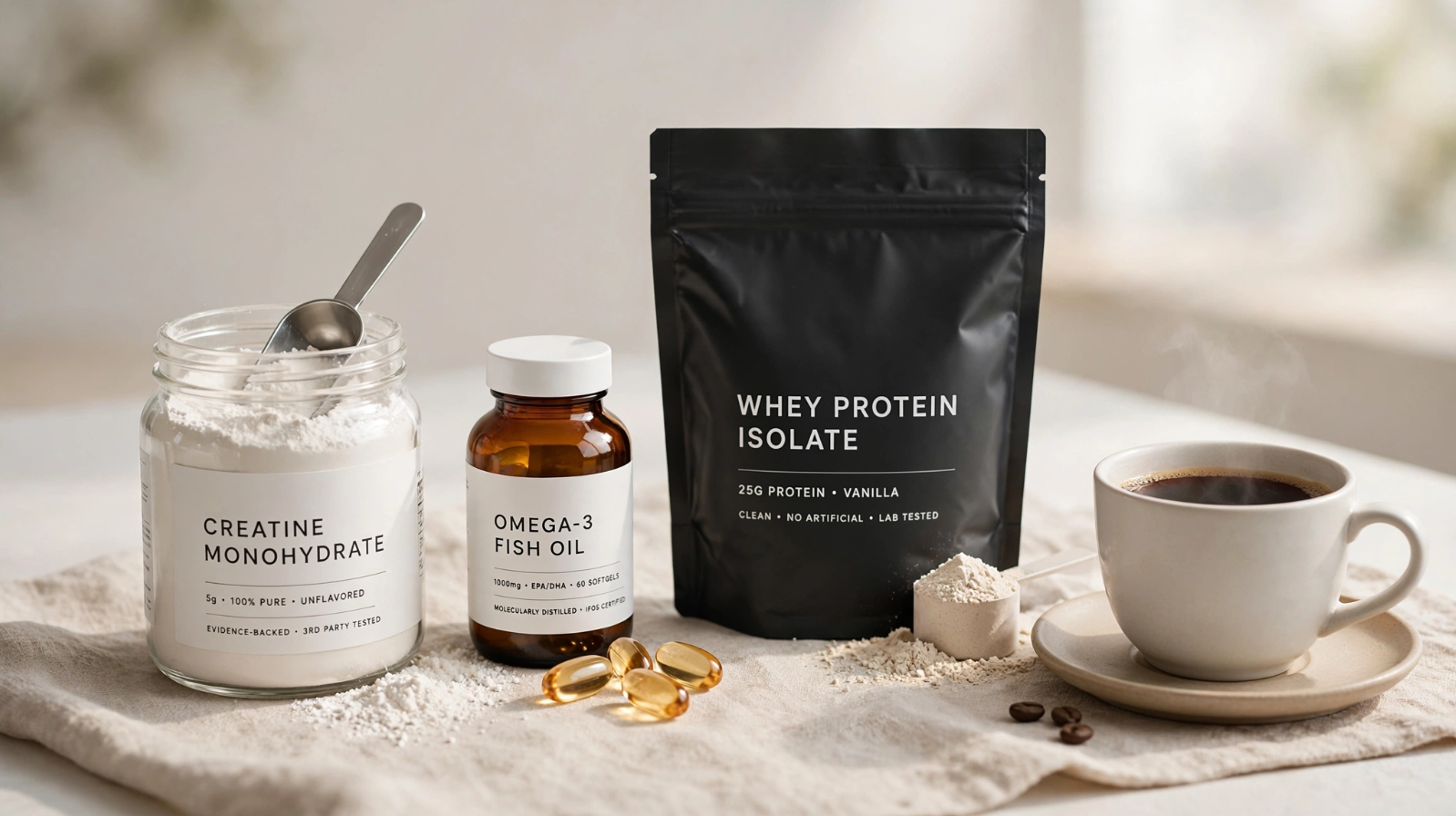
Creatine Monohydrate
What It Is: A naturally occurring compound found in meat and fish. It’s stored in your muscles and used for energy during high-intensity exercise.
How It Works:
- Increases ATP (energy) production in muscles
- Allows you to perform more reps at higher intensity
- Increases muscle cell volume (cell hydration)
- Supports muscle growth and strength gains
The Evidence:
- Over 500+ studies supporting its effectiveness
- Increases strength by 5–15%
- Increases muscle mass by 2–5 pounds over 12 weeks (combined with training)
- Safe for long-term use (decades of research)
| Fact | Detail |
|---|---|
| Dosage | 3–5g per day |
| When to Take | Daily (any time; post-workout is slightly better) |
| Loading Phase | 20g/day (5g x 4 times) for 5–7 days (optional) |
| Cycling | Not necessary |
| Cost | $0.10–$0.30 per serving |
| Side Effects | Minimal; may cause water retention (muscle fullness) |
What to Look For:
- Type: Creatine Monohydrate (most researched, most effective)
- Form: Powder (most cost-effective) or Capsules (more expensive)
- Quality: Look for Creapure® or third-party tested
Recommendation: Creatine is the single most effective supplement for strength training. Every strength athlete should consider taking it.
Protein Powder
What It Is: A concentrated source of protein derived from whey (milk), casein (milk), or plant sources (pea, rice, soy).
How It Works:
- Provides amino acids for muscle repair and growth
- Convenient way to meet daily protein needs
- Fast absorption (whey) or slow release (casein)
Types:
| Type | Absorption | Best For |
|---|---|---|
| Whey Protein | Fast (30–60 min) | Post-workout, breakfast |
| Casein Protein | Slow (6–8 hours) | Before bed, between meals |
| Plant Protein | Moderate | Vegans, dairy-sensitive |
| Blend (Whey + Casein) | Mixed | All-purpose |
The Evidence:
- Extensive research supporting protein supplementation
- Effective for muscle growth and recovery
- Convenient for meeting daily protein targets
| Fact | Detail |
|---|---|
| Dosage | 20–40g per serving |
| When to Take | Post-workout, breakfast, between meals |
| Total Daily | 0.8–1.2g per pound of body weight |
| Cost | $0.50–$2.00 per serving |
What to Look For:
- Protein per Serving: 20–30g per serving
- Source: Whey isolate (higher protein, less fat/lactose) or whey concentrate (more affordable)
- Flavor: Choose one you’ll enjoy
- Third-Party Testing: Look for NSF, Informed Sport, or USP certification
Recommendation: Protein powder is a convenient tool for meeting daily protein needs. It’s not essential if you can meet your needs through whole foods, but it’s helpful.
Caffeine
What It Is: A naturally occurring stimulant found in coffee, tea, and some plants.
How It Works:
- Blocks adenosine (a neurotransmitter that promotes sleep)
- Increases alertness and focus
- Reduces perceived effort during exercise
- Improves performance in strength and endurance
The Evidence:
- Extensive research supporting its effectiveness
- Improves performance by 3–5%
- Reduces perceived exertion
- Safe for most people (up to 400mg/day)
| Fact | Detail |
|---|---|
| Dosage | 100–200mg per serving (1–2 cups coffee) |
| When to Take | 30–60 minutes before workout |
| Daily Limit | 400mg (about 4 cups coffee) |
| Timing | Avoid late afternoon/evening (sleep disruption) |
| Cost | Low (coffee, tea, or supplements) |
Sources:
| Source | Caffeine Content |
|---|---|
| Coffee (8 oz) | 80–100mg |
| Tea (8 oz) | 30–50mg |
| Pre-Workout Supplement | 150–300mg |
| Caffeine Pill | 100–200mg |
| Energy Drink | 80–150mg |
Recommendation: Caffeine is a safe, effective performance enhancer. Use it strategically before workouts, but avoid dependence by cycling off periodically.
Section 3: The “May Help” Supplements (Tier 2)
Beta-Alanine
What It Is: An amino acid that increases muscle carnosine levels, which buffers acid buildup during exercise.
How It Works:
- Reduces muscle fatigue during high-intensity exercise
- Allows you to perform more reps at high intensity
- Improves endurance in sets of 60–240 seconds
The Evidence:
- Moderate evidence supporting its effectiveness
- Most effective for high-rep sets (8–20+ reps)
- Less effective for low-rep strength work (1–5 reps)
| Fact | Detail |
|---|---|
| Dosage | 3–6g per day (split doses) |
| When to Take | Daily (any time) |
| Loading Phase | Not necessary |
| Side Effects | Tingling sensation (paresthesia)—normal, harmless |
| Cost | $0.20–$0.50 per serving |
Recommendation: Beta-Alanine can help with high-rep training. Consider it if you do a lot of volume work (8–20+ reps).
Citrulline Malate
What It Is: An amino acid that increases arginine and nitric oxide levels in the blood.
How It Works:
- Improves blood flow and vasodilation
- Reduces muscle fatigue and soreness
- Improves “pump” during training
The Evidence:
- Moderate evidence supporting its effectiveness
- Most effective for endurance and fatigue reduction
- May improve performance in high-volume training
| Fact | Detail |
|---|---|
| Dosage | 3–6g per serving |
| When to Take | Pre-workout (30–60 min) |
| Side Effects | Minimal |
| Cost | $0.30–$0.60 per serving |
Recommendation: Citrulline Malate can help with blood flow and endurance. Consider it if you do high-volume training or want a better “pump.”
Omega-3 Fatty Acids
What It Is: Essential fatty acids found in fish oil, algae, and some plant sources.
How It Works:
- Reduces inflammation
- Supports joint health
- May improve recovery
- Supports heart and brain health
The Evidence:
- Strong evidence for general health benefits
- Moderate evidence for recovery and joint health
- More beneficial for overall health than performance
| Fact | Detail |
|---|---|
| Dosage | 1–3g combined EPA/DHA per day |
| When to Take | Daily (with meals) |
| Side Effects | Fish burps (enteric-coated capsules can help) |
| Cost | $0.20–$0.50 per serving |
Recommendation: Omega-3s are important for health. Consider them for general health, not specifically for performance.
Vitamin D
What It Is: A fat-soluble vitamin essential for bone health, immune function, and muscle function.
How It Works:
- Supports calcium absorption
- Supports immune function
- May support muscle function and recovery
The Evidence:
- Strong evidence for those deficient
- Mixed evidence for performance benefits
- Most beneficial for those with low levels
| Fact | Detail |
|---|---|
| Dosage | 1,000–4,000 IU per day (depending on blood levels) |
| When to Take | Daily (with a fat-containing meal) |
| Testing | Get blood levels tested before supplementing |
| Cost | Low ($0.05–$0.15 per serving) |
Recommendation: Get tested. If deficient, supplement. If not, don’t bother (or take a maintenance dose of 1,000–2,000 IU).
Magnesium
What It Is: An essential mineral involved in hundreds of bodily processes.
How It Works:
- Supports muscle function and relaxation
- Supports sleep quality
- Supports recovery
The Evidence:
- Strong evidence for sleep and relaxation
- Moderate evidence for recovery
- Most beneficial for those deficient
| Fact | Detail |
|---|---|
| Dosage | 300–400mg per day |
| When to Take | Evening (supports sleep) |
| Types | Glycinate (best for sleep), Citrate (best for digestion) |
| Cost | $0.10–$0.30 per serving |
Recommendation: Magnesium glycinate can support sleep and relaxation. Consider it if you struggle with sleep or recovery.
Section 4: The “Probably Not Worth It” Supplements (Tier 3)
BCAAs (Branched-Chain Amino Acids)
The Claim: Reduces muscle breakdown, improves recovery, reduces soreness.
The Reality: You get sufficient BCAAs from protein. If you’re eating enough protein, BCAAs are unnecessary. Research shows minimal benefit for muscle growth when protein intake is adequate.
| Fact | Detail |
|---|---|
| Dosage | 5–10g per serving |
| When to Take | Pre/post-workout |
| Cost | $0.50–$1.00 per serving |
| The Verdict | Not worth it if you’re eating enough protein |
The Alternative: Eat a protein-rich meal or protein powder (which contains all amino acids, including BCAAs).
Glutamine
The Claim: Supports immune function, improves recovery, reduces muscle breakdown.
The Reality: Most people get sufficient glutamine from their diet. Research shows minimal benefit for muscle growth or recovery in healthy individuals.
| Fact | Detail |
|---|---|
| Dosage | 5–10g per day |
| When to Take | Daily |
| Cost | $0.20–$0.50 per serving |
| The Verdict | Not worth it for muscle growth |
ZMA (Zinc, Magnesium, Aspartate)
The Claim: Improves sleep, increases testosterone, supports recovery.
The Reality: Zinc and magnesium are beneficial if deficient. However, most people aren’t deficient. The testosterone claims are exaggerated. You can get the same benefits from separate zinc and magnesium supplements (cheaper).
| Fact | Detail |
|---|---|
| Dosage | 30mg Zinc / 450mg Magnesium / 10mg B6 |
| When to Take | Before bed |
| Cost | $0.30–$0.60 per serving |
| The Verdict | Maybe if you’re deficient in zinc or magnesium (get tested first) |
HMB (Beta-Hydroxy Beta-Methylbutyrate)
The Claim: Reduces muscle breakdown, increases muscle growth.
The Reality: Beneficial for untrained individuals and in high doses (3g/day). Minimal benefit for trained individuals. More effective in catabolic states (bed rest, illness).
| Fact | Detail |
|---|---|
| Dosage | 3g per day |
| When to Take | Daily |
| Cost | $1.00–$2.00 per serving |
| The Verdict | Probably not worth it for trained individuals |
Section 5: Supplements to Avoid (Tier 4)
Testosterone Boosters
The Claim: Increases testosterone, builds muscle, improves performance.
The Reality: Most “testosterone boosters” contain ingredients that have little to no effect on testosterone levels. The few that do increase testosterone (like D-Aspartic Acid) have minimal impact on muscle growth. Expensive, ineffective.
Better Alternative: Optimize sleep, nutrition, training, and stress management—these are the most effective ways to maintain healthy testosterone levels.
Fat Burners
The Claim: Burns fat, increases metabolism, supports weight loss.
The Reality: Most fat burners contain stimulants (caffeine, synephrine) that slightly increase metabolism. The effect is small (50–100 calories/day). Expensive, potentially dangerous (heart issues, blood pressure).
Better Alternative: Nutrition and exercise. A caloric deficit is the only effective way to lose fat.
Proprietary Blends
The Claim: A “proprietary blend” of ingredients.
The Reality: You don’t know how much of each ingredient is in the product. Often, the active ingredients are underdosed. You’re paying for cheap fillers and marketing.
Better Alternative: Choose products with transparent labeling—each ingredient and its exact dosage listed.
Detox/Cleanse Products
The Claim: Removes toxins, cleanses your body.
The Reality: Your body already detoxes itself. Your liver, kidneys, and digestive system do this naturally. “Detox” products are unnecessary and often contain laxatives or diuretics.
Better Alternative: Drink water, eat vegetables, and support your body’s natural detoxification processes.
Section 6: Quality and Safety
The Problem with Supplements
| Issue | Reality |
|---|---|
| Lack of Regulation | Supplements are not FDA-approved for safety and effectiveness |
| Contamination | Some products contain banned substances, heavy metals, or other contaminants |
| Mislabeling | Products may not contain what they claim (ingredients and dosages) |
| Underdosing | Many products contain ineffective doses of active ingredients |
Third-Party Testing
What to Look For:
| Certification | What It Means |
|---|---|
| NSF Certified for Sport | Tests for banned substances; ensures label accuracy |
| Informed Sport | Tests for banned substances; ensures label accuracy |
| USP Verified | Tests for quality, purity, and label accuracy |
Tip: If a product doesn’t have third-party testing, consider another brand.
Section 7: Sample Supplement Stack
Beginner Stack (Minimal)
| Supplement | Dosage | When to Take |
|---|---|---|
| Creatine | 3–5g | Daily (any time) |
| Protein Powder | 20–40g | As needed (post-workout, breakfast) |
Cost: ~$0.50–$1.00 per day
Intermediate Stack
| Supplement | Dosage | When to Take |
|---|---|---|
| Creatine | 3–5g | Daily (any time) |
| Protein Powder | 20–40g | As needed (post-workout, breakfast) |
| Caffeine | 100–200mg | Pre-workout (30–60 min) |
| Omega-3s | 1–3g | Daily (with meals) |
Cost: ~$1.00–$2.00 per day
Advanced Stack
| Supplement | Dosage | When to Take |
|---|---|---|
| Creatine | 3–5g | Daily (any time) |
| Protein Powder | 20–40g | As needed (post-workout, breakfast) |
| Caffeine | 100–200mg | Pre-workout (30–60 min) |
| Omega-3s | 1–3g | Daily (with meals) |
| Beta-Alanine | 3–6g | Daily (split doses) |
| Citrulline Malate | 3–6g | Pre-workout |
Cost: ~$2.00–$4.00 per day
Section 8: When Not to Take Supplements
Medical Conditions
| Condition | Caution |
|---|---|
| Kidney Disease | Creatine and high protein may be problematic |
| High Blood Pressure | Caffeine and stimulants may raise blood pressure |
| Pregnancy | Many supplements are not studied in pregnancy |
| Medications | Some supplements interact with medications (blood thinners, diabetes drugs) |
When to Consult a Doctor
- Before starting any supplement, especially if you have medical conditions
- If you take medications (drug interactions possible)
- If you experience adverse effects
- If you’re pregnant or nursing
Section 9: FAQ—Your Top Supplement Questions
Q: Are supplements necessary for muscle growth?
A: No. Whole foods should provide the foundation of your nutrition. Supplements are exactly that—supplements to fill gaps. If you can meet your protein, creatine, and other needs through food, supplements aren’t necessary.
Q: Which supplement is most important for strength training?
A: Creatine is the most evidence-backed supplement for strength training. It’s safe, affordable, and effective for increasing strength and muscle mass. Protein powder is helpful for meeting daily protein needs. Caffeine is effective for performance enhancement.
Q: Is creatine safe for long-term use?
A: Yes. Creatine has been studied for decades and is safe for long-term use in healthy individuals. Thousands of studies support its safety and effectiveness.
Q: Will I lose muscle if I stop taking supplements?
A: No. Supplements don’t permanently change your body. If you stop taking creatine, you’ll lose the water weight in your muscles (muscle fullness), but you’ll maintain the actual muscle tissue as long as you continue training and eating adequately.
Q: Are plant-based proteins as effective as whey protein?
A: Yes—with proper planning. Plant proteins (pea, rice, hemp, soy) are effective for muscle growth. They may have slightly lower absorption rates, but with appropriate dosing (20–30g), they’re comparable to whey.
Q: Should I take supplements if I’m vegan?
A: Vegans may benefit from certain supplements:
- Protein: Plant-based protein powder
- Creatine: Vegan creatine is available
- Vitamin B12: Essential for vegans
- Vitamin D: Often low in vegans
- Omega-3s: Algae-based DHA/EPA
Q: What’s the best protein powder?
A: The best protein powder is one that:
- Tastes good (you’ll drink it consistently)
- Meets your dietary needs (whey, plant, etc.)
- Is affordable for your budget
- Has third-party testing
Popular options: Whey isolate (high protein, low fat/carbs), Whey concentrate (more affordable), Plant-based blends (pea + rice).
Q: How do I know if a supplement works?
A: Track your progress. If you’re getting stronger, recovering better, and feeling better, the supplement may be helping. If you see no change after 4–8 weeks, it’s not doing much for you.
The VigorForty Take
Supplements are the final piece of the puzzle—not the foundation. Before spending money on supplements, ensure:
- Training is optimized (consistent, challenging, progressive)
- Nutrition is solid (adequate calories, protein, and micronutrients)
- Sleep is prioritized (7–9 hours per night)
- Recovery is adequate (rest days, active recovery)
If you have these foundations in place, supplements can help:
- Creatine is the most effective supplement for strength training
- Protein powder is a convenient way to meet daily protein needs
- Caffeine improves performance and focus
Most other supplements are unnecessary:
- BCAAs, glutamine, and many others have minimal benefit
- Testosterone boosters, fat burners, and proprietary blends are often ineffective or harmful
- Whole foods should always come first
The bottom line: Supplements can help, but they won’t replace hard work. Train consistently, eat well, sleep enough, recover properly—and consider supplements as the final 5%.
Build the foundation first. Then supplement wisely.
This article was reviewed by the Vigor Forty Editorial Review Board on July 20, 2026.
🔗 Related Articles
- Beyond Crunches: The Best Exercises for True Core Stability
- Core Stability for Lifters: How a Strong Core Protects Your Lower Back
- The Connection Between Core Strength and Better Posture
- Top 5 Strength Training Myths Debunked
- “I’m Too Old to Start Lifting”: Why Strength Training is for Everyone
- “I Don’t Want to Get Bulky”: The Truth About Weightlifting and Muscle Growth
- Can You Build Muscle with Just Bodyweight Exercises?
- The Role of Nutrition in Strength Training: Fueling Your Gains
- The Importance of Rest and Recovery for Building Muscle
- Supplements 101: What Actually Works for Strength Athletes?
- Sleep and Strength: How Better Sleep Can Improve Your Lifts
- 5-Minute Daily Core Routine for Busy Americans
- The Science of Hypertrophy: How to Build Muscle Effectively
- Periodization: How to Plan Your Training for Long-Term Success
- Drop Sets, Supersets, and AMRAPs: Advanced Training Techniques Explained
- Strength Training for Fat Loss: A Comprehensive Guide
- How to Build Muscle and Strength with a Busy Schedule
- The Ultimate Guide to Kettlebell Training for Strength and Conditioning
- Resistance Band Workout: A Full-Body Strength Routine
- Dumbbell Only Workout: Build Muscle Anywhere
- Hybrid Training: Combining Calisthenics and Powerlifting
- The Importance of Mobility for Strength Athletes
- 5 Dynamic Warm-Up Exercises to Do Before Every Workout
- The Best of Both Worlds: Why You Should Combine Calisthenics and Weights
- Your 2027 Strength Training Roadmap: Setting Goals and Staying Consistent
- Strength Training for Life: Building a Sustainable Fitness Habit
- The 12 Best Strength Training Exercises for Americans
Affiliate Disclosure: Some links in this article may be affiliate links. If you make a purchase through these links, Vigor Forty may earn a small commission at no extra cost to you. We only recommend products we trust.