

Author: Vigor Forty Editorial Team
Medically Reviewed By: Editorial Review Board
Disclaimer: This article is for informational purposes only and is not a substitute for professional medical advice. Read our full Medical Disclaimer.
📌 Key Takeaways
- You don’t need hours in the gym to build muscle: With the right approach, 30–45 minutes, 3–4 days per week is enough to build significant strength and muscle.
- Efficiency is the key: Prioritize compound exercises, use supersets, and minimize rest to maximize results in minimal time.
- Consistency beats duration: A 30-minute workout you do consistently is far more effective than a 90-minute workout you rarely do.
- Meal prep and planning save time: Having healthy food ready reduces the temptation to make poor choices when you’re busy.
- Recovery is non-negotiable: With a busy schedule, sleep and stress management become even more critical for muscle growth and overall health.
Introduction: The Time Crunch Challenge
“I’d love to build muscle, but I’m just too busy.”
This is the most common excuse for not strength training. And it’s understandable—modern life is demanding. Work, family, commuting, and social obligations leave little time for exercise.
But here’s the truth: You don’t need hours in the gym to build muscle. With the right approach—efficient workouts, smart programming, and strategic planning—you can build significant strength and muscle with just 30–45 minutes, 3–4 days per week.
The Numbers:
| Time Available | What’s Possible | Approach |
|---|---|---|
| 2+ hours/day | Advanced bodybuilding | Long sessions, high volume |
| 1 hour/day | Significant muscle growth | Efficient workouts, good volume |
| 30–45 min/day | Solid muscle growth | Prioritize compounds, supersets |
| 15–20 min/day | Maintenance, some growth | Minimalist approach, high intensity |
Key Point: Even 30 minutes, 3 days per week can build significant muscle. The key is efficiency—not duration.
This guide will show you exactly how to build muscle and strength when you’re short on time. You’ll learn efficient workout strategies, smart programming, meal prep tips, and how to make the most of limited training time.
Section 1: The Efficiency Principles
Principle 1: Prioritize Compound Exercises
The Rule: Focus on exercises that work multiple muscle groups. They give you the most “bang for your buck” in terms of time and results.
| Exercise | Muscles Worked | Time Efficiency |
|---|---|---|
| Squat | Legs, glutes, core | Very High |
| Deadlift | Full posterior chain | Very High |
| Bench Press | Chest, shoulders, triceps | Very High |
| Row | Back, biceps, rear delts | Very High |
| Overhead Press | Shoulders, triceps | Very High |
| Pull-ups | Back, biceps, core | Very High |
Why Compounds Are Efficient:
| Benefit | How It Saves Time |
|---|---|
| Multiple Muscles | Train several muscles at once |
| Higher Calorie Burn | More energy expenditure in less time |
| Greater Hormonal Response | More growth hormone and testosterone release |
| Functional Strength | Strength that translates to daily activities |
The 80/20 Rule: 80% of your results come from 20% of your exercises—the compound movements. Spend 80% of your time on these exercises.
Principle 2: Use Supersets
The Rule: Pair exercises back-to-back with minimal rest to save time and increase intensity.
| Superset Type | Example | Time Saved |
|---|---|---|
| Antagonist | Bench Press + Rows | 30–40% |
| Upper/Lower | Push-ups + Squats | 30–40% |
| Same Muscle | Bicep Curls + Hammer Curls | 20–30% |
Sample Superset Structure:
| Superset | Exercise A | Exercise B | Rest |
|---|---|---|---|
| 1 | Squats | Pull-ups | 60 sec |
| 2 | Bench Press | Rows | 60 sec |
| 3 | Overhead Press | Bicep Curls | 60 sec |
Principle 3: Minimize Rest (Strategic Rest)
The Rule: Keep rest periods short (45–90 seconds) to maintain intensity and save time.
| Rest Period | Effect | Best For |
|---|---|---|
| 45–60 sec | High metabolic stress | Hypertrophy, time efficiency |
| 60–90 sec | Moderate recovery | Hypertrophy, strength |
| 90–120 sec | Full recovery | Strength, power |
Tip: Use a timer to keep rest periods consistent. This ensures you’re not wasting time between sets.
Principle 4: Use Intensity Techniques
The Rule: Advanced techniques like drop sets and supersets increase intensity in less time.
| Technique | How It Saves Time | Example |
|---|---|---|
| Drop Sets | One prolonged set instead of multiple sets | Lateral Raises: Drop Set |
| Supersets | Two exercises back-to-back | Bench + Rows |
| AMRAP Sets | One set to failure (saves multiple sets) | Push-ups: AMRAP |
Principle 5: Plan Your Workouts
The Rule: Have a plan before you enter the gym. Wasting time deciding what to do is wasted time.
| Pre-Workout Planning | Why It Helps |
|---|---|
| Know Your Exercises | No time wasted deciding |
| Know Your Sets/Reps | Efficient progression |
| Know Your Rest Periods | Consistent, time-efficient training |
| Track Your Progress | Ensures you’re improving |
Section 2: Sample Efficient Workouts
Workout A: 30-Minute Full Body (3 Days/Week)
| Exercise | Sets | Reps | Rest | Time |
|---|---|---|---|---|
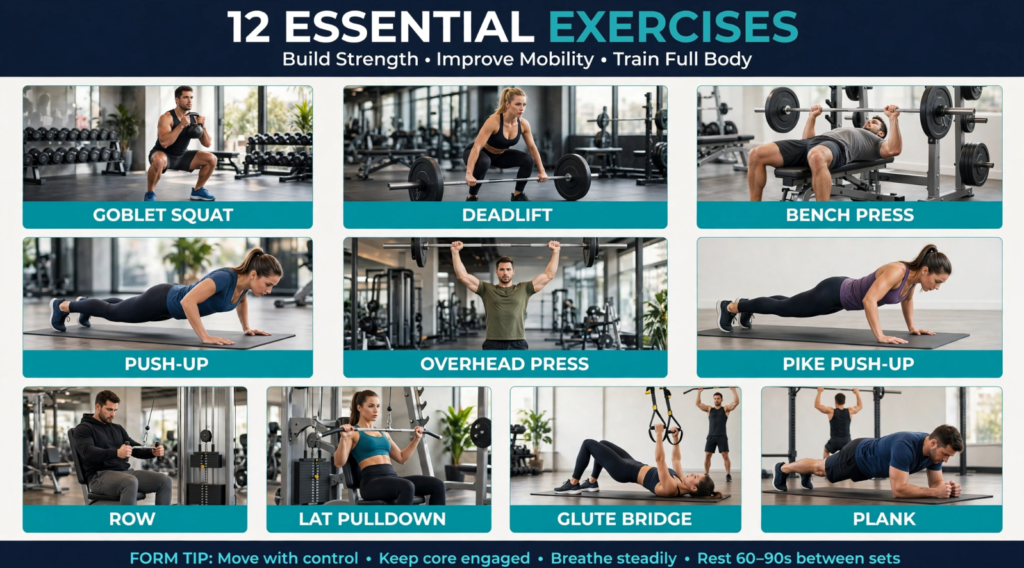
| Squats (or Goblet Squats) | 3 | 8–12 | 60 sec | 5 min |
| Bench Press (or Dumbbell) | 3 | 8–12 | 60 sec | 5 min |
| Bent-Over Rows | 3 | 8–12 | 60 sec | 5 min |
| Superset: Overhead Press + Pull-ups | 3 | 8–12 each | 60 sec | 6 min |
| Plank | 3 | 45–60 sec | 45 sec | 4 min |
| Total | — | — | — | ~30 min |
Workout B: 45-Minute Upper/Lower (4 Days/Week)
Upper Body Day (45 min):
| Exercise | Sets | Reps | Rest | Time |
|---|---|---|---|---|
| Bench Press | 4 | 8–10 | 60 sec | 6 min |
| Bent-Over Rows | 4 | 8–10 | 60 sec | 6 min |
| Superset: OHP + Lateral Raises | 3 | 10–12 each | 45 sec | 5 min |
| Superset: Pull-ups + Face Pulls | 3 | 8–10 each | 45 sec | 5 min |
| Superset: Bicep Curls + Tricep Extensions | 3 | 12–15 each | 45 sec | 5 min |
| Total | — | — | — | ~27 min |
Lower Body Day (45 min):
| Exercise | Sets | Reps | Rest | Time |
|---|---|---|---|---|
| Squats | 4 | 8–10 | 60 sec | 6 min |
| Romanian Deadlifts | 4 | 10–12 | 60 sec | 6 min |
| Superset: Lunges + Leg Curls | 3 | 10–12 each | 45 sec | 5 min |
| Superset: Calf Raises + Hanging Leg Raises | 3 | 12–15 each | 45 sec | 5 min |
| Total | — | — | — | ~22 min |
Workout C: The Minimalist 20-Minute Workout
Perfect for: Days when you’re extremely short on time.
| Exercise | Sets | Reps | Rest | Time |
|---|---|---|---|---|
| Squats | 3 | 10–15 | 45 sec | 4 min |
| Push-ups | 3 | 10–15 | 45 sec | 4 min |
| Rows (or Pull-ups) | 3 | 10–15 | 45 sec | 4 min |
| Plank | 3 | 45–60 sec | 30 sec | 3 min |
| Total | — | — | — | ~15–20 min |
Section 3: The Time-Saving Workout Schedule
Option 1: 3-Day Full Body (Perfect for Busy Professionals)
| Day | Workout | Duration |
|---|---|---|
| Monday | Full Body A | 30–40 min |
| Tuesday | Rest or Active Recovery | — |
| Wednesday | Full Body B | 30–40 min |
| Thursday | Rest or Active Recovery | — |
| Friday | Full Body C | 30–40 min |
| Saturday | Optional: Light Cardio | 20–30 min |
| Sunday | Complete Rest | — |
Option 2: 4-Day Upper/Lower (Moderate Time Commitment)
| Day | Workout | Duration |
|---|---|---|
| Monday | Upper Body A | 40–45 min |
| Tuesday | Lower Body A | 40–45 min |
| Wednesday | Rest or Active Recovery | — |
| Thursday | Upper Body B | 40–45 min |
| Friday | Lower Body B | 40–45 min |
| Saturday | Active Recovery | 20–30 min |
| Sunday | Complete Rest | — |
Option 3: 5-Day Minimalist Split (Advanced)
| Day | Workout | Duration |
|---|---|---|
| Monday | Push | 30–35 min |
| Tuesday | Pull | 30–35 min |
| Wednesday | Legs | 30–35 min |
| Thursday | Push | 30–35 min |
| Friday | Pull | 30–35 min |
| Saturday | Rest or Active Recovery | — |
| Sunday | Complete Rest | — |
Section 4: Morning vs. Evening Workouts
Morning Workouts
| Pros | Cons |
|---|---|
| Consistency (less likely to skip) | Need to wake up earlier |
| Sets the tone for the day | May take time to “wake up” |
| No excuses later | May need to adjust sleep schedule |
| Convenient before work | May need to eat/workout timing |
Tips for Morning Workouts:
- Prepare everything the night before (clothes, bag, breakfast)
- Wake up 15–30 minutes earlier to allow for warm-up
- Eat a small pre-workout snack (banana, toast)
- Hydrate well
Evening Workouts
| Pros | Cons |
|---|---|
| More energy (body is warmed up) | More excuses (tired, busy) |
| Can relieve daily stress | Interferes with evening plans |
| May sleep better | May have difficulty falling asleep (if too late) |
Tips for Evening Workouts:
- Train before dinner (not after)
- Finish 2–3 hours before bed
- Keep lights low after training
- Use caffeine earlier in the day (not late afternoon)
When to Workout (Based on Schedule)
| Schedule | Best Time | Why |
|---|---|---|
| 9–5 Office Job | Morning (before work) | Consistency, no excuses |
| 6–2 Early Shift | Afternoon (post-work) | Energy, less rushed |
| 2–10 Late Shift | Morning or early afternoon | Energy, before work |
| Variable Schedule | Morning (always) | Consistency regardless of day |
| Parent of Young Children | Early morning or lunch break | Sacrifice sleep or lunch |
Section 5: Nutrition for Busy People
Meal Prep: The Time-Saving Strategy
Why Meal Prep Works:
| Benefit | How It Saves Time |
|---|---|
| Convenience | Food is ready, no preparation needed |
| Control | You know exactly what you’re eating |
| Consistency | Easy to stick to your nutrition plan |
| Cost-Effective | Reduces eating out and impulse purchases |
Sample Meal Prep Schedule:
| Day | Activity | Time |
|---|---|---|
| Sunday | Grocery shopping, meal prep (2–3 hours) | 2–3 hours |
| Monday–Friday | Reheat and eat | 5–10 min/meal |
Quick Meal Prep Ideas
Breakfast (5-Minute Prep):
| Meal | Prep |
|---|---|
| Overnight Oats | Combine oats, milk, protein powder, berries (5 min, refrigerate) |
| Egg Muffins | Bake eggs, vegetables, cheese in muffin tins (30 min, reheats) |
| Greek Yogurt Bowl | Greek yogurt + fruit + nuts (2 min) |
Lunch (10-Minute Prep):
| Meal | Prep |
|---|---|
| Chicken and Rice Bowl | 6 oz chicken + 1 cup rice + vegetables (prepped Sunday) |
| Salmon and Sweet Potato | 6 oz salmon + sweet potato + vegetables (prepped Sunday) |
| Turkey Wrap | Turkey, vegetables, hummus in whole wheat wrap (5 min) |
Dinner (15-Minute Prep):
| Meal | Prep |
|---|---|
| Stir-Fry | Pre-cut vegetables + chicken + sauce (15 min) |
| Sheet Pan Meal | Salmon + vegetables + potatoes (30 min, minimal clean-up) |
| Burger Bowl | Lean burger + vegetables + sauce (15 min) |
Convenient Protein Sources
| Food | Protein | Prep Time |
|---|---|---|
| Canned Tuna | 25g per can | 0 min |
| Greek Yogurt | 20–25g per cup | 0 min |
| Protein Powder | 20–30g per scoop | 1 min |
| Rotisserie Chicken | 30g per 6 oz | 0 min |
| Pre-Cooked Chicken Strips | 25g per 6 oz | 2 min |
| Hard-Boiled Eggs | 6g per egg | 0 min (prepped) |
Hydration on the Go
| Strategy | How to Do It |
|---|---|
| Carry a Water Bottle | Keep it with you throughout the day |
| Set Reminders | Use phone alarms or apps |
| Use a Large Bottle | 32+ oz, refill less often |
| Add Flavor | Lemon, cucumber, or sugar-free flavoring |
Section 6: Working Out When Traveling
Hotel Room Workout (No Equipment)
| Exercise | Sets | Reps | Rest |
|---|---|---|---|
| Bodyweight Squats | 3 | 15–20 | 45 sec |
| Push-ups (on bed) | 3 | 10–15 | 45 sec |
| Glute Bridges | 3 | 15–20 | 45 sec |
| Plank | 3 | 45–60 sec | 30 sec |
| Lunges | 3 | 10–12 per leg | 45 sec |
Minimal Equipment Travel Workout
Pack:
| Equipment | Space | Cost |
|---|---|---|
| Resistance Bands | Small | $10–30 |
| Jump Rope | Small | $10–20 |
| Pull-up Bar (doorway) | Small | $20–40 |
Travel Workout:
| Exercise | Sets | Reps | Rest |
|---|---|---|---|
| Band Squats | 3 | 12–15 | 45 sec |
| Band Rows | 3 | 12–15 | 45 sec |
| Band Presses | 3 | 12–15 | 45 sec |
| Jump Rope | 3 | 60 sec | 45 sec |
| Plank | 3 | 45–60 sec | 30 sec |
Quick Hotel Gym Workout
20 Minutes:
| Exercise | Sets | Reps | Rest |
|---|---|---|---|
| Dumbbell Squats | 3 | 10–12 | 45 sec |
| Dumbbell Press | 3 | 10–12 | 45 sec |
| Dumbbell Rows | 3 | 10–12 | 45 sec |
| Dumbbell Overhead Press | 3 | 10–12 | 45 sec |
Section 7: Recovery with a Busy Schedule
Sleep: The Non-Negotiable
| Factor | Recommendation |
|---|---|
| Duration | 7–9 hours per night |
| Consistency | Same bedtime and wake time |
| Environment | Cool (65–68°F), dark, quiet |
| Pre-Bed | No screens 60 min before bed |
Stress Management
| Strategy | How to Do It (5–10 min/day) |
|---|---|
| Deep Breathing | 5 minutes of 4-7-8 breathing |
| Meditation | 5–10 minutes of mindfulness |
| Journaling | Write down thoughts, worries |
| Walking | 10–15 minute walk during lunch |
Active Recovery
| Activity | Duration | Frequency |
|---|---|---|
| Walking | 15–30 min | 2–3 days/week |
| Light Stretching | 10–15 min | 2–3 days/week |
| Foam Rolling | 10–15 min | 2–3 days/week |
Section 8: Common Mistakes of Busy Lifters
Mistake 1: Skipping Workouts
The Problem: “I’m too busy today, I’ll workout tomorrow.” Tomorrow never comes.
The Fix: Schedule your workouts like any other appointment. Prioritize them. Even a 20-minute workout is better than nothing.
Mistake 2: Not Having a Plan
The Problem: Wasting time deciding what to do.
The Fix: Plan your workouts in advance. Write them down. Know exactly what you’ll do before you step foot in the gym.
Mistake 3: Making Workouts Too Long
The Problem: Trying to do a 90-minute workout when you only have 30 minutes.
The Fix: Use efficient workouts. Focus on compounds, use supersets, minimize rest. A 30-minute efficient workout is more effective than a 60-minute random workout.
Mistake 4: Poor Nutrition
The Problem: Grabbing quick, unhealthy food.
The Fix: Meal prep. Have healthy food ready. Carry snacks (protein bars, nuts, fruit). Don’t let busyness ruin your nutrition.
Mistake 5: Not Tracking Progress
The Problem: Not knowing if you’re making progress.
The Fix: Track your workouts. Even a simple log (weight, sets, reps) helps you see progress and stay motivated.
Mistake 6: Neglecting Recovery
The Problem: Training hard but not recovering.
The Fix: Prioritize sleep and stress management. Recovery is not optional—it’s essential.
Section 9: The 30-Minute Workout Template
Here’s a template you can adapt to any workout:
Template: 30-Minute Efficient Workout
| Time | Activity |
|---|---|
| 0–5 min | Warm-up (light cardio, dynamic stretches) |
| 5–10 min | Compound Exercise 1 (3 sets, 60 sec rest) |
| 10–15 min | Compound Exercise 2 (3 sets, 60 sec rest) |
| 15–20 min | Superset: Exercise 3 + 4 (3 sets, 45 sec rest) |
| 20–25 min | Superset: Exercise 5 + 6 (3 sets, 45 sec rest) |
| 25–30 min | Core Finisher (3 sets, 30 sec rest) |
Example: Full Body Workout
| Time | Exercise | Sets | Reps | Rest |
|---|---|---|---|---|
| 0–5 | Warm-up | — | — | — |
| 5–10 | Goblet Squats | 3 | 10–12 | 60 sec |
| 10–15 | Dumbbell Bench Press | 3 | 10–12 | 60 sec |
| 15–20 | Superset: Rows + Overhead Press | 3 | 10–12 each | 45 sec |
| 20–25 | Superset: Bicep Curls + Tricep Extensions | 3 | 12–15 each | 45 sec |
| 25–30 | Plank | 3 | 45–60 sec | 30 sec |
Section 10: FAQ—Your Top Busy Lifter Questions
Q: Can I build muscle with just 30-minute workouts?
A: Yes. Thirty-minute workouts can build significant muscle if they’re efficient—compound exercises, supersets, minimal rest. The key is intensity and consistency, not duration.
Q: What if I can only train 2 days per week?
A: Two days per week can maintain muscle and build some strength. Focus on full-body workouts with compound exercises. You may gain slowly, but you’ll still make progress.
Q: Should I train early morning or late at night?
A: Whatever works best for your schedule. Morning workouts are consistent and set the tone for the day. Evening workouts can relieve stress. The best time is the time you’ll actually do.
Q: How do I fit in cardio with a busy schedule?
A: Options:
- Combine with strength training (superset or finish)
- HIIT (15–20 minutes, 2–3 times/week)
- Active recovery (walking during breaks)
- Commuting (bike or walk)
Q: What’s the best pre-workout meal for a morning workout?
A: A small, easily digestible meal 30–60 minutes before training:
- Banana + peanut butter
- Toast + honey
- Protein shake + banana
- Greek yogurt + berries
Q: How do I stay motivated when I’m busy?
A: Remember your “why.” Focus on consistency, not perfection. Celebrate small wins. Track progress. Remind yourself: “A 20-minute workout is better than no workout.”
Q: Can I build muscle without ever going to the gym?
A: Yes. Bodyweight exercises, resistance bands, and a pull-up bar can build significant muscle. You can train at home, in a hotel room, or anywhere with a small space.
Q: Is it possible to overtrain with short workouts?
A: Overtraining is more about intensity and recovery than duration. If you’re training hard 4–5 days/week with short sessions, still prioritize sleep, nutrition, and rest days.
The VigorForty Take
Building muscle and strength with a busy schedule is not about having more time—it’s about making the most of the time you have.
The principles:
- Prioritize compounds — exercises that work multiple muscles
- Use supersets — save time, increase intensity
- Minimize rest — 45–90 seconds between sets
- Plan your workouts — know exactly what you’ll do
- Be consistent — short, regular workouts beat occasional long ones
- Prep your nutrition — have healthy food ready
- Recover well — sleep and stress management are essential
The results:
- Significant muscle and strength gains
- Better body composition
- Improved health and function
- Sustainable long-term progress
Busy doesn’t mean impossible. It means intentional.
This article was reviewed by the Vigor Forty Editorial Review Board on July 20, 2026.
🔗 Related Articles
- Beyond Crunches: The Best Exercises for True Core Stability
- Core Stability for Lifters: How a Strong Core Protects Your Lower Back
- The Connection Between Core Strength and Better Posture
- Top 5 Strength Training Myths Debunked
- “I’m Too Old to Start Lifting”: Why Strength Training is for Everyone
- “I Don’t Want to Get Bulky”: The Truth About Weightlifting and Muscle Growth
- Can You Build Muscle with Just Bodyweight Exercises?
- The Role of Nutrition in Strength Training: Fueling Your Gains
- The Importance of Rest and Recovery for Building Muscle
- Supplements 101: What Actually Works for Strength Athletes?
- Sleep and Strength: How Better Sleep Can Improve Your Lifts
- 5-Minute Daily Core Routine for Busy Americans
- The Science of Hypertrophy: How to Build Muscle Effectively
- Periodization: How to Plan Your Training for Long-Term Success
- Drop Sets, Supersets, and AMRAPs: Advanced Training Techniques Explained
- Strength Training for Fat Loss: A Comprehensive Guide
- How to Build Muscle and Strength with a Busy Schedule
- The Ultimate Guide to Kettlebell Training for Strength and Conditioning
- Resistance Band Workout: A Full-Body Strength Routine
- Dumbbell Only Workout: Build Muscle Anywhere
- Hybrid Training: Combining Calisthenics and Powerlifting
- The Importance of Mobility for Strength Athletes
- 5 Dynamic Warm-Up Exercises to Do Before Every Workout
- The Best of Both Worlds: Why You Should Combine Calisthenics and Weights
- Your 2027 Strength Training Roadmap: Setting Goals and Staying Consistent
- Strength Training for Life: Building a Sustainable Fitness Habit
- The 12 Best Strength Training Exercises for Americans
Affiliate Disclosure: Some links in this article may be affiliate links. If you make a purchase through these links, Vigor Forty may earn a small commission at no extra cost to you. We only recommend products we trust.