
Author: Vigor Forty Editorial Team
Medically Reviewed By: Editorial Review Board
Disclaimer: This article is for informational purposes only and is not a substitute for professional medical advice. Read our full Medical Disclaimer.
📌 Key Takeaways
- Crunches are not enough: Traditional crunches primarily work the rectus abdominis (the “six-pack” muscle) in a limited range of motion. They don’t build the functional core stability that protects your spine and supports your lifts.
- True core stability requires training all core muscles: Your core is a 360-degree system—front, sides, back, top (diaphragm), and bottom (pelvic floor). All must work together for optimal stability.
- The best core exercises are anti-movement exercises: Planks (anti-extension), Pallof presses (anti-rotation), and bird dogs (anti-extension) teach your core to resist unwanted movement—the key to spinal protection.
- Core stability transfers directly to lifting performance: A stable core allows you to transmit force from your lower body to your upper body safely and efficiently. Without it, you leak power and risk injury.
- Train core stability like any other muscle group: Apply progressive overload—increase time, add movement, or add weight to continue making gains.
Introduction: The Core Revolution
For decades, the standard approach to core training was simple: do crunches until your abs burn. The more crunches you could do, the stronger your core must be, right?
Wrong.
The truth is, crunches are one of the least effective exercises for building the kind of core stability that matters—the kind that protects your lower back, improves your lifts, and supports your daily activities.
The problem with crunches:
- They primarily work one muscle (rectus abdominis) in a limited range of motion
- They don’t train core stability (the ability to resist movement)
- They can stress your neck and lower back if done incorrectly
- They don’t translate well to functional movement or lifting
The solution? Exercises that train your core to resist movement—anti-extension, anti-rotation, and anti-lateral flexion. These exercises build the kind of stability that protects your spine during heavy lifts and everyday activities.
This guide will introduce you to the best exercises for true core stability. You’ll learn why these exercises work, how to perform them correctly, and how to integrate them into your training for maximum benefit.
Section 1: Understanding Core Stability
Core Stability vs. Core Strength
Let’s revisit this critical distinction:
Core Strength: The ability of your core muscles to generate force. This is what you train when you do crunches, leg raises, or any exercise where your core is actively shortening (concentric contraction) to produce movement.
Core Stability: The ability of your core muscles to control and maintain the position of your spine during movement—especially when external forces are applied. This is what you train when you do planks, Pallof presses, and bird dogs. Your core is working isometrically to resist unwanted movement.
Why stability matters more for lifting:
| Scenario | Core Strength | Core Stability |
|---|---|---|
| Squatting | Your legs generate the force; your core transmits it | Your core must stabilize your spine against the load |
| Deadlifting | Your hips and back generate the force; your core transmits it | Your core must brace to protect your spine from shear forces |
| Overhead Press | Your shoulders generate the force; your core transmits it | Your core must prevent hyperextension of your lower back |
| Everyday lifting | Your legs and back generate the force; your core transmits it | Your core must protect your spine when lifting groceries, children, etc. |
Key Insight: In almost every lifting scenario, your core’s primary job is stability, not movement. It must brace, resist, and transmit force—not curl your torso.
The Core System: A 360-Degree View
| Direction | Muscles | Function |
|---|---|---|
| Front | Rectus Abdominis, Transverse Abdominis | Prevents hyperextension; creates intra-abdominal pressure |
| Sides | Internal and External Obliques | Resists rotation and lateral flexion |
| Back | Erector Spinae, Multifidus, Quadratus Lumborum | Maintains spinal extension; prevents excessive flexion |
| Top | Diaphragm | Controls breathing and intra-abdominal pressure |
| Bottom | Pelvic Floor | Supports pelvic organs; contributes to intra-abdominal pressure |
The Three Anti-Movements
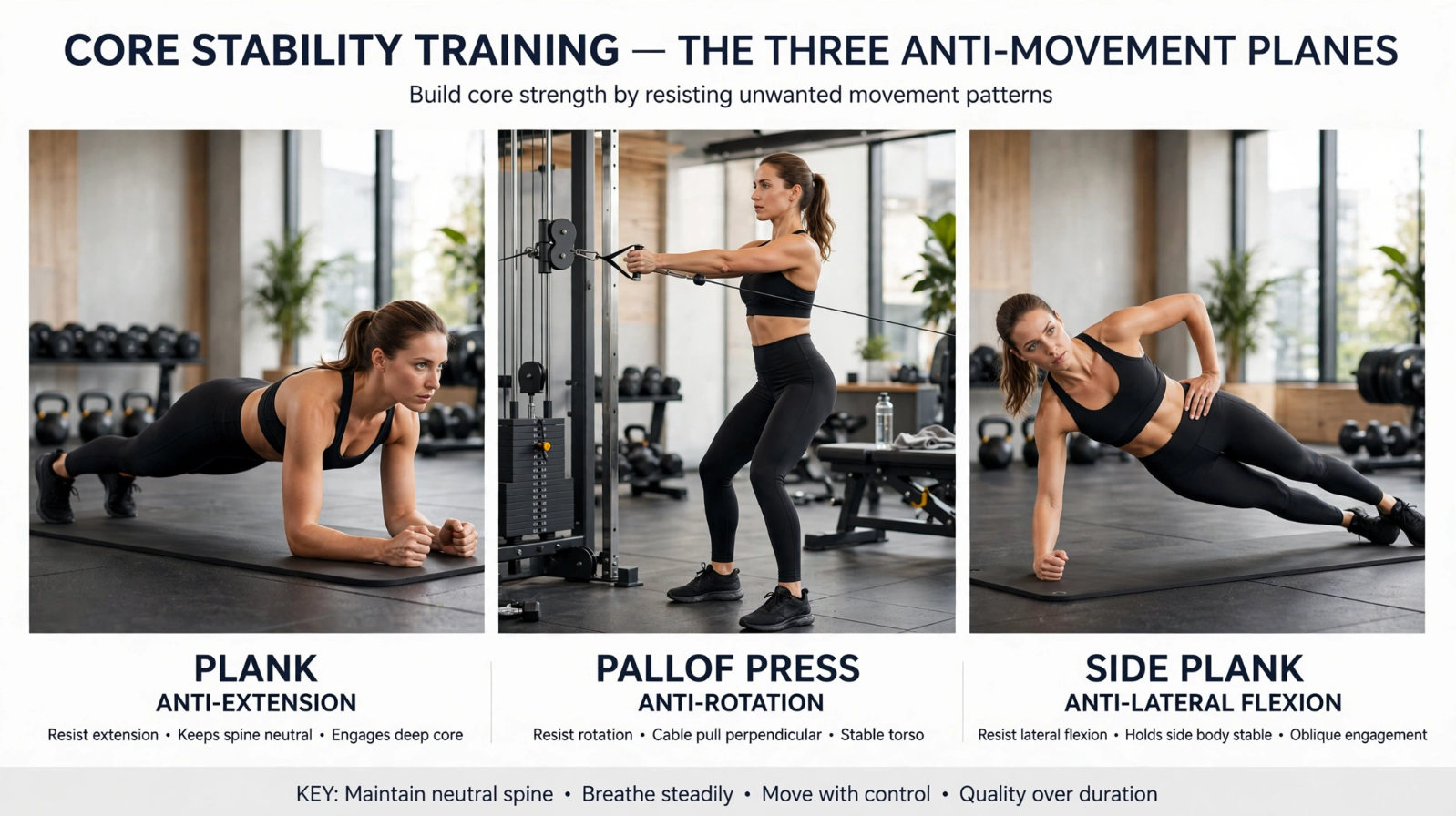
Effective core stability training focuses on three types of anti-movement:
| Anti-Movement | Description | Example Exercises |
|---|---|---|
| Anti-Extension | Resisting the tendency of your spine to hyperextend (arch backward) | Planks, Dead Bugs, Hollow Body Holds |
| Anti-Rotation | Resisting forces that try to rotate your spine | Pallof Press, Suitcase Carries, Bird Dogs |
| Anti-Lateral Flexion | Resisting forces that try to bend your spine sideways | Side Planks, Farmer’s Carries (single-sided), Suitcase Carries |
Section 2: The Best Anti-Extension Exercises
Anti-extension exercises train your core to resist the tendency of your spine to hyperextend (arch backward). This is critical for protecting your lower back during overhead pressing, squatting, and deadlifting.
Exercise 1: The Plank
Why It’s Essential: The plank is the foundational anti-extension exercise. It teaches your entire core to brace against gravity, which wants to pull your hips toward the floor.
Form:
- Forearms on the floor, elbows directly under shoulders
- Body forms a straight line from head to heels
- Squeeze your glutes and engage your core
- Hold, breathing steadily
- Hold Time: 30–60 seconds
Progressions:
| Variation | Difficulty | How To |
|---|---|---|
| Knee Plank | Beginner | Knees on the floor |
| Full Plank | Intermediate | Feet on the floor |
| Weighted Plank | Advanced | Weight plate on back |
| RKC Plank | Advanced | Maximum tension, shorter holds |
Exercise 2: The Dead Bug
Why It’s Essential: The dead bug teaches you to maintain core stability while moving your limbs. This is highly functional—it mimics the demands of many daily activities and lifting movements.
Form:
- Lie on your back with arms extended toward the ceiling
- Lift your legs to a tabletop position (knees at 90 degrees)
- Press your lower back firmly into the floor
- Slowly extend your right arm and left leg toward the floor
- Return to start and repeat on the opposite side
- Reps: 8–12 per side
Key Point: If your lower back lifts off the floor, you’ve gone too far. Maintain back contact throughout.
Progressions:
| Variation | Difficulty | How To |
|---|---|---|
| Dead Bug (no weight) | Beginner | Bodyweight only |
| Dead Bug with Hold | Intermediate | Pause at extension for 2–3 seconds |
| Weighted Dead Bug | Advanced | Hold light dumbbells in hands |
Exercise 3: The Hollow Body Hold
Why It’s Essential: The hollow body hold is a gymnastics staple that builds incredible core tension and body control.
Form:
- Lie on your back with arms extended overhead (by your ears)
- Press your lower back into the floor
- Lift your shoulders and legs off the floor
- Only your lower back and glutes contact the floor
- Your body forms a “hollow” shape (like a banana)
- Hold, breathing steadily
- Hold Time: 20–45 seconds
Progressions:
| Variation | Difficulty | How To |
|---|---|---|
| Hollow Body Hold (knees bent) | Beginner | Knees bent at 90 degrees |
| Hollow Body Hold (legs straight) | Intermediate | Legs extended, lifted |
| Hollow Body Rocks | Advanced | Rock forward and back in the hollow position |
Section 3: The Best Anti-Rotation Exercises
Anti-rotation exercises train your core to resist forces that try to rotate your spine. This is critical for sports, everyday activities, and maintaining balance during unilateral lifts (single-arm or single-leg movements).
Exercise 1: The Pallof Press
Why It’s Essential: The Pallof press is the gold standard for anti-rotation training. It forces your core to resist the rotational pull of a cable or band.
Form (with cable or band):
- Stand perpendicular to a cable machine or band anchor
- Grasp the handle with both hands at chest height
- Step away from the anchor to create tension
- Press the handle directly forward (away from your chest)
- Hold for 2–3 seconds, resisting the rotational pull
- Return slowly to your chest
- Reps: 10–12 per side
Key Point: Your hips should remain square—don’t rotate or twist. Your core does the work.
Progressions:
| Variation | Difficulty | How To |
|---|---|---|
| Pallof Press (standing) | Beginner | Standard standing position |
| Pallof Press (kneeling) | Intermediate | Kneel on one or both knees |
| Pallof Press (half-kneeling) | Intermediate | One knee down, one foot up |
| Pallof Press (staggered stance) | Advanced | Feet staggered for instability |
Home Modification: Use a resistance band anchored to a door frame or sturdy object. The resistance should be challenging but allow you to maintain form.
Exercise 2: The Bird Dog
Why It’s Essential: The bird dog trains anti-rotation while also challenging balance and coordination. It’s particularly effective for building the deep core stabilizers (multifidus, transverse abdominis).
Form:
- Start on all fours, hands under shoulders, knees under hips
- Keep your back flat and core engaged
- Extend your right arm forward and left leg back simultaneously
- Hold for 2–3 seconds, maintaining a flat back and level hips
- Return to start and repeat on the opposite side
- Reps: 8–12 per side
Key Point: If your hips rotate or your lower back arches, you’re going too far. Your core should control the movement.
Progressions:
| Variation | Difficulty | How To |
|---|---|---|
| Bird Dog | Beginner | Standard movement |
| Bird Dog with Hold | Intermediate | Hold extended position for 3–5 seconds |
| Bird Dog with Weight | Advanced | Hold light weights in hands or ankle weights |
Exercise 3: The Suitcase Carry
Why It’s Essential: The suitcase carry mimics real-life activities (carrying groceries, luggage, children) and builds anti-rotation stability under load.
Form:
- Hold a dumbbell, kettlebell, or heavy object in one hand
- Stand tall with shoulders back and core braced
- Walk forward with steady, controlled steps
- Maintain an upright posture—don’t lean to the heavy side
- Walk Time: 30–60 seconds per side
Key Point: Your core must work to keep you upright. If you’re leaning, the weight is too heavy or you need to focus on bracing.
Progressions:
| Variation | Difficulty | How To |
|---|---|---|
| Suitcase Carry (light) | Beginner | Short distance, light weight |
| Suitcase Carry (moderate) | Intermediate | Longer distance, moderate weight |
| Suitcase Carry (heavy) | Advanced | Heavy weight, farmer’s walk style |
Section 4: The Best Anti-Lateral Flexion Exercises
Anti-lateral flexion exercises train your core to resist forces that try to bend your spine sideways. This is critical for maintaining posture and protecting your lower back during asymmetrical loading.
Exercise 1: The Side Plank
Why It’s Essential: The side plank is the foundational anti-lateral flexion exercise. It builds stability in your obliques and quadratus lumborum—muscles that are often neglected.
Form:
- Lie on your side, one forearm on the floor, elbow under shoulder
- Stack your feet (one on top of the other)
- Lift your hips, forming a straight line from head to heels
- Hold, breathing steadily
- Hold Time: 30–45 seconds per side
Key Point: Your hips should be lifted, not sagging toward the floor. Your body should form a straight line.
Progressions:
| Variation | Difficulty | How To |
|---|---|---|
| Knee Side Plank | Beginner | Knees on the floor |
| Full Side Plank | Intermediate | Feet stacked, hips lifted |
| Side Plank with Leg Lift | Advanced | Lift the top leg |
| Side Plank with Reach | Advanced | Reach top arm under body |
Exercise 2: The Farmer’s Carry (Single-Sided)
Why It’s Essential: A single-sided farmer’s carry challenges your core to resist lateral flexion—the tendency of your spine to bend toward the heavy side.
Form:
- Hold a heavy dumbbell or kettlebell in one hand
- Stand tall, shoulders back, core braced
- Walk forward with steady, controlled steps
- Maintain upright posture—don’t lean toward the weight
- Walk Time: 30–60 seconds per side
Key Point: This exercise is excellent for building core stability and grip strength simultaneously. It also improves postural awareness.
Progressions:
| Variation | Difficulty | How To |
|---|---|---|
| Farmer’s Carry (light) | Beginner | Short distance, light weight |
| Farmer’s Carry (moderate) | Intermediate | Longer distance, moderate weight |
| Farmer’s Carry (heavy) | Advanced | Heavy weight, longer distance |
Section 5: The Best Exercises for the Deep Core
The deep core muscles—transverse abdominis, pelvic floor, multifidus—are the true stabilizers of your spine. They’re not visible, but they’re essential.
Exercise 1: Dead Bug (Already Covered)
The dead bug is excellent for the transverse abdominis.
Focus on: Pressing your lower back into the floor. This activates the transverse abdominis and pelvic floor.
Exercise 2: Bird Dog (Already Covered)
The bird dog is excellent for the multifidus and transverse abdominis.
Focus on: Maintaining a flat back and level hips. This activates the deep spinal stabilizers.
Exercise 3: Diaphragmatic Breathing
Why It’s Essential: Your diaphragm is the top of your core. Proper breathing patterns activate your deep core and create intra-abdominal pressure.
Form:
- Lie on your back with knees bent
- Place one hand on your chest and one on your belly
- Breathe in slowly through your nose—your belly should rise (not your chest)
- Breathe out slowly through your mouth—your belly should fall
- Practice: 5–10 minutes daily
Key Point: Most people breathe with their chest, not their diaphragm. Diaphragmatic breathing activates the core and promotes relaxation.
Section 6: Sample Core Stability Workouts
Workout A: Beginner Core Stability (15 Minutes)
| Exercise | Sets | Duration/Reps | Rest |
|---|---|---|---|
| Dead Bugs | 3 | 10 per side | 45 sec |
| Bird Dogs | 3 | 10 per side | 45 sec |
| Knee Planks | 3 | 30 sec | 45 sec |
| Glute Bridges | 3 | 15 reps | 45 sec |
Focus: Master form and build foundational endurance
Workout B: Intermediate Core Stability (20 Minutes)
| Exercise | Sets | Duration/Reps | Rest |
|---|---|---|---|
| Full Planks | 3 | 45 sec | 45 sec |
| Pallof Press (band) | 3 | 12 per side | 45 sec |
| Side Planks | 3 | 30 sec per side | 45 sec |
| Hollow Body Holds | 3 | 30 sec | 45 sec |
Focus: Build stability in all three anti-movement planes
Workout C: Advanced Core Stability (25 Minutes)
| Exercise | Sets | Duration/Reps | Rest |
|---|---|---|---|
| Weighted Planks | 3 | 45 sec | 45 sec |
| Pallof Press (heavy) | 3 | 10 per side | 45 sec |
| Weighted Side Planks | 3 | 30 sec per side | 45 sec |
| Suitcase Carries | 3 | 45 sec per side | 45 sec |
| Hollow Body Rocks | 3 | 15 rocks | 45 sec |
Focus: Apply progressive overload to all movements
Workout D: Quick Core Finisher (10 Minutes)
Perform these after your main workout:
| Exercise | Duration/Reps |
|---|---|
| Plank | 45 sec |
| Side Plank (left) | 30 sec |
| Side Plank (right) | 30 sec |
| Dead Bugs | 12 per side |
| Bird Dogs | 12 per side |
Repeat: 2 rounds with minimal rest
Section 7: Integrating Core Stability into Your Lifts
The most effective way to train core stability is to integrate it into your main lifts.
Before Your Lifts (Core Activation)
Perform these exercises as part of your warm-up to “turn on” your core:
- Dead Bugs: 10 per side (slow and controlled)
- Bird Dogs: 10 per side (hold for 2 seconds at extension)
- Glute Bridges: 15 reps (squeeze at the top)
During Your Lifts (Bracing Practice)
Practice proper bracing during every rep:
- Take a deep breath into your belly (not your chest)
- Brace your core as if someone is about to punch you
- Maintain the brace throughout the entire lift
- Exhale at the top of the lift or as you pass the sticking point
After Your Lifts (Core Finisher)
Perform core stability exercises as a finisher:
- Plank: 3 sets of 45–60 seconds
- Side Plank: 3 sets of 30–45 seconds per side
- Pallof Press: 3 sets of 10–12 per side
Section 8: Common Mistakes in Core Training
Mistake 1: Doing Too Many Crunches
The Problem: Overemphasizing crunches at the expense of stability exercises.
The Fix: Replace 80% of your crunch volume with stability exercises (planks, dead bugs, pallof presses). If you do crunches, do them with controlled form and don’t make them your primary core work.
Mistake 2: Sacrificing Form for Time
The Problem: Holding a plank for 2 minutes with sagging hips.
The Fix: Quality over quantity. A 30-second perfect plank builds more stability than a 2-minute sloppy plank. If your form breaks, stop.
Mistake 3: Forgetting to Breathe
The Problem: Holding your breath during core exercises.
The Fix: Breathe steadily throughout. Inhale and exhale while maintaining core tension. Practice diaphragmatic breathing.
Mistake 4: Ignoring the Obliques
The Problem: Only training the front of your core.
The Fix: Include anti-rotation (Pallof press) and anti-lateral flexion (side planks) exercises. Your core is 360 degrees—train it that way.
Mistake 5: Not Progressing
The Problem: Doing the same core exercises with the same duration week after week.
The Fix: Apply progressive overload. Increase time, add movement, or add weight. Your core adapts like any other muscle.
Mistake 6: Holding Your Breath
The Problem: You hold your breath throughout the entire exercise, building up dangerous blood pressure levels.
The Fix: Exhale on exertion, inhale on the easier phase. Maintain steady breathing.
Section 9: FAQ—Your Top Core Stability Questions
Q: How many times per week should I train core stability?
A: 3–4 times per week is ideal. You can do core work after your main lifts or on separate days. Consistency matters more than volume.
Q: Should I do core exercises before or after my main lifts?
A: It depends on your goals:
- Before: If you want to activate your core for better bracing during lifts (do core activation, not a full workout)
- After: If you want to build core strength without fatiguing your core before heavy lifts
Q: Are crunches completely useless?
A: Not useless—but overrated. Crunches train the rectus abdominis in a limited range of motion. They have their place, but they shouldn’t be your primary core exercise. Focus on stability exercises for spinal health and functional strength.
Q: Can I build a six-pack with stability exercises?
A: Yes—but with a caveat. Stability exercises build the deep core muscles that give your core a tight, strong appearance. However, visible abs depend on body fat percentage. You can have the strongest core in the world, but if it’s covered by a layer of fat, your six-pack won’t be visible. Nutrition is key for visible abs.
Q: Why do I feel core exercises in my lower back?
A: This is often a sign that your core is not engaging properly. Your lower back is compensating for weak core stability. Focus on bracing your core and maintaining a neutral spine. If the pain persists, consult a physical therapist or qualified trainer.
Q: How do I progress core stability exercises?
A: Options include:
- Increase hold time (planks)
- Add movement (plank with leg lifts, shoulder taps)
- Add weight (weighted planks, weighted carries)
- Progress to harder variations (knee plank → full plank → side plank)
- Reduce stability (use an unstable surface like a Bosu ball)
Q: Can I do core stability exercises every day?
A: You can, but it’s not necessary. 3–4 times per week is sufficient. Your core muscles need recovery too. If you do daily core work, vary the intensity and volume.
The VigorForty Take
The crunches of the world have had their day. For decades, we were told that endless crunches were the path to a strong core. The research and the results tell a different story.
True core stability is built through:
- Anti-extension: Planks, dead bugs, hollow body holds
- Anti-rotation: Pallof presses, bird dogs, suitcase carries
- Anti-lateral flexion: Side planks, farmer’s carries
These exercises build the kind of stability that:
- Protects your lower back during heavy lifts
- Transfers force efficiently between your upper and lower body
- Reduces injury risk in daily activities
- Improves posture and reduces back pain
- Enhances performance in every lift you perform
The principles are simple:
- Train all planes of movement (anti-extension, anti-rotation, anti-lateral flexion)
- Prioritize stability over movement
- Apply progressive overload
- Integrate core work into your main lifts
- Be consistent
Your core is the foundation of your strength. Build it with intention.
This article was reviewed by the Vigor Forty Editorial Review Board on July 19, 2026.
🔗 Related Articles
- Beyond Crunches: The Best Exercises for True Core Stability
- Core Stability for Lifters: How a Strong Core Protects Your Lower Back
- The Connection Between Core Strength and Better Posture
- Top 5 Strength Training Myths Debunked
- “I’m Too Old to Start Lifting”: Why Strength Training is for Everyone
- “I Don’t Want to Get Bulky”: The Truth About Weightlifting and Muscle Growth
- Can You Build Muscle with Just Bodyweight Exercises?
- The Role of Nutrition in Strength Training: Fueling Your Gains
- The Importance of Rest and Recovery for Building Muscle
- Supplements 101: What Actually Works for Strength Athletes?
- Sleep and Strength: How Better Sleep Can Improve Your Lifts
- 5-Minute Daily Core Routine for Busy Americans
- The Science of Hypertrophy: How to Build Muscle Effectively
- Periodization: How to Plan Your Training for Long-Term Success
- Drop Sets, Supersets, and AMRAPs: Advanced Training Techniques Explained
- Strength Training for Fat Loss: A Comprehensive Guide
- How to Build Muscle and Strength with a Busy Schedule
- The Ultimate Guide to Kettlebell Training for Strength and Conditioning
- Resistance Band Workout: A Full-Body Strength Routine
- Dumbbell Only Workout: Build Muscle Anywhere
- Hybrid Training: Combining Calisthenics and Powerlifting
- The Importance of Mobility for Strength Athletes
- 5 Dynamic Warm-Up Exercises to Do Before Every Workout
- The Best of Both Worlds: Why You Should Combine Calisthenics and Weights
- Your 2027 Strength Training Roadmap: Setting Goals and Staying Consistent
- Strength Training for Life: Building a Sustainable Fitness Habit
- The 12 Best Strength Training Exercises for Americans
Affiliate Disclosure: Some links in this article may be affiliate links. If you make a purchase through these links, Vigor Forty may earn a small commission at no extra cost to you. We only recommend products we trust.