

Author: Vigor Forty Editorial Team
Medically Reviewed By: Editorial Review Board
Disclaimer: This article is for informational purposes only and is not a substitute for professional legal advice or official TSA guidance. Read our full Medical Disclaimer.
📌 Key Takeaways
- Pills and Capsules Are the Easiest: Solid supplement forms (tablets, capsules, softgels) have no quantity restrictions in carry-on luggage. They do not need to be in their original bottles, though keeping them labeled can prevent delays.
- Powders Over 12 Ounces Require Separate Screening: The TSA treats powders like liquids for carry-ons. Any powder container over 12 ounces (350 ml) must be placed in a separate bin for X-ray screening. If it cannot clear screening, you may be asked to check it. Pre-portion powders into smaller containers or single-serve packets.
- Liquids Follow the 3-1-1 Rule: Liquid supplements (fish oil, vitamin D drops, liquid magnesium, tinctures) must be in containers of 3.4 ounces (100 ml) or less, all fitting in a single quart-sized, clear zip-top bag. Medically necessary liquids can exceed this limit but must be declared at the checkpoint.
- International Travel Requires Extra Caution: Many countries have stricter rules than the US. Some ban certain ingredients (like melatonin in the UK without a prescription). Always check the destination country’s embassy or health authority website.
- Time-Zone Dosing Keeps You Consistent: Crossing multiple time zones disrupts your supplement schedule. A simple, gradual adjustment strategy during travel and upon arrival preserves your body’s rhythm and protocol adherence.
Introduction: Don’t Let a TSA Bin Derail Your Health Protocol
You’ve spent months dialing in your Vigor Five. Your morning D3+K2 and omega-3 softgels, your 5 grams of creatine, your evening magnesium glycinate, and your protein powder for post-workout recovery are non-negotiable parts of your day. Then comes the business trip or the long-awaited vacation. You pack your bags, head to the airport, and suddenly you’re staring at your supplement stash wondering: Can I bring this? Will they confiscate it? Am I going to look like a suspicious person with bags of white powder?
The Transportation Security Administration (TSA) has clear rules, but they’re buried in government language and often misunderstood. This guide translates those rules into plain English, gives you step-by-step packing strategies, and covers everything from domestic flights to international travel, time-zone dosing, and even what to do if an agent pulls your bag for secondary inspection. You’ve worked too hard on your health to leave your protocol at home.
Section 1: The TSA’s Core Supplement Categories—Solid, Powder, and Liquid
The TSA categorizes supplements by their physical form. Understanding these three buckets eliminates 95% of airport anxiety.
1. Solid Supplements (Pills, Capsules, Tablets, Softgels)
- Rule: No quantity limits in either carry-on or checked luggage.
- Screening: These pass through the X-ray with no special handling.
- Original Packaging: Not required. You can put them in a daily pill organizer, a ziplock bag, or a small travel container. However, TSA officers may ask you to identify loose pills, and having them in their original labeled containers or a clearly marked organizer significantly speeds up any secondary check.
- VigorForty Tip: For short trips (3–7 days), pre-fill a compact AM/PM pill organizer. For longer trips, keep supplements in their original bottles or in a small, labeled travel kit. If you are pulled aside, calmly stating “These are my daily vitamins and supplements” while pointing to a labeled container usually resolves the question instantly.
2. Powder Supplements (Creatine, Protein Powder, Glycine, Inositol, Collagen, Electrolytes)
- Rule (Carry-On): Powder containers over 12 ounces (approximately 350 milliliters) must be removed from your carry-on bag and placed in a separate bin for X-ray screening, just like a laptop or liquids. Containers under 12 ounces can remain in your bag but may still be subject to additional screening if the officer cannot identify the contents.
- Rule (Checked Luggage): No quantity restrictions. Powders can go in checked bags in any amount, though TSA recommends packing them in sealed, leak-proof containers.
- Why This Rule Exists: After the 2017 thwarted terrorist plot involving powdered explosives, the TSA increased scrutiny on powders in the cabin. They are looking for suspicious organic and inorganic compounds, not your creatine—but your creatine can look ambiguous on the X-ray.
- VigorForty Strategy:
- Pre-portion into single-serve packets or small containers. Buy a set of small, travel-sized screw-top jars (2–4 oz each) and fill them with exactly the number of servings you need for the trip plus a couple of extras for delays. Label each with the supplement name.
- Use commercial single-serve stick packs. Many brands now sell creatine, protein, and collagen in travel-friendly individual sachets. These are explicitly designed to pass through security without issue.
- If you must bring a full-size tub (over 12 oz): Place it in a separate bin at the security checkpoint, just like a laptop. It will go through the X-ray. If the officer cannot identify it, they may swab it for explosive residue. This is routine and quick.
- Checked bag is the hassle-free option for large quantities. If you’re checking a bag, put the full tub of protein or large bag of creatine there. Keep a small carry-on supply for the flight and the first day at your destination.
3. Liquid Supplements (Fish Oil, Vitamin D3 Liquid Drops, Herbal Tinctures, Liquid Electrolytes, Magnesium Citrate Liquid, Aloe Vera Juice)
- Rule (Carry-On): Must follow the 3-1-1 liquids rule. Each liquid container must be 3.4 ounces (100 milliliters) or smaller. All liquid containers must fit together in a single, clear, quart-sized plastic zip-top bag. One bag per passenger.
- Medically Necessary Liquids (Exemption): Larger volumes of medically necessary liquids are permitted in carry-on bags but must be declared to a TSA officer at the checkpoint. “Medically necessary” includes prescription medications, liquid nutrition for disabilities or medical conditions, and over-the-counter medical supplies. TSA does not define dietary supplements as automatically medically necessary, but if your physician has documented a specific medical need for a liquid supplement (e.g., liquid iron for severe anemia, liquid magnesium for documented deficiency causing muscle spasms), bring a doctor’s note. Be prepared for additional screening, which may include opening the container.
- VigorForty Strategy: Transfer liquid supplements into small, leak-proof, TSA-compliant travel bottles (3.4 oz or less) and place them in your quart-sized bag. Solid softgels (fish oil, D3) avoid the liquids rule entirely; choose softgels over liquid oil whenever possible for travel.
Section 2: Exactly How to Pack Your Supplements for Smooth TSA Screening
The VigorForty Travel Packing System:
Carry-On Bag (for the flight and immediate needs):
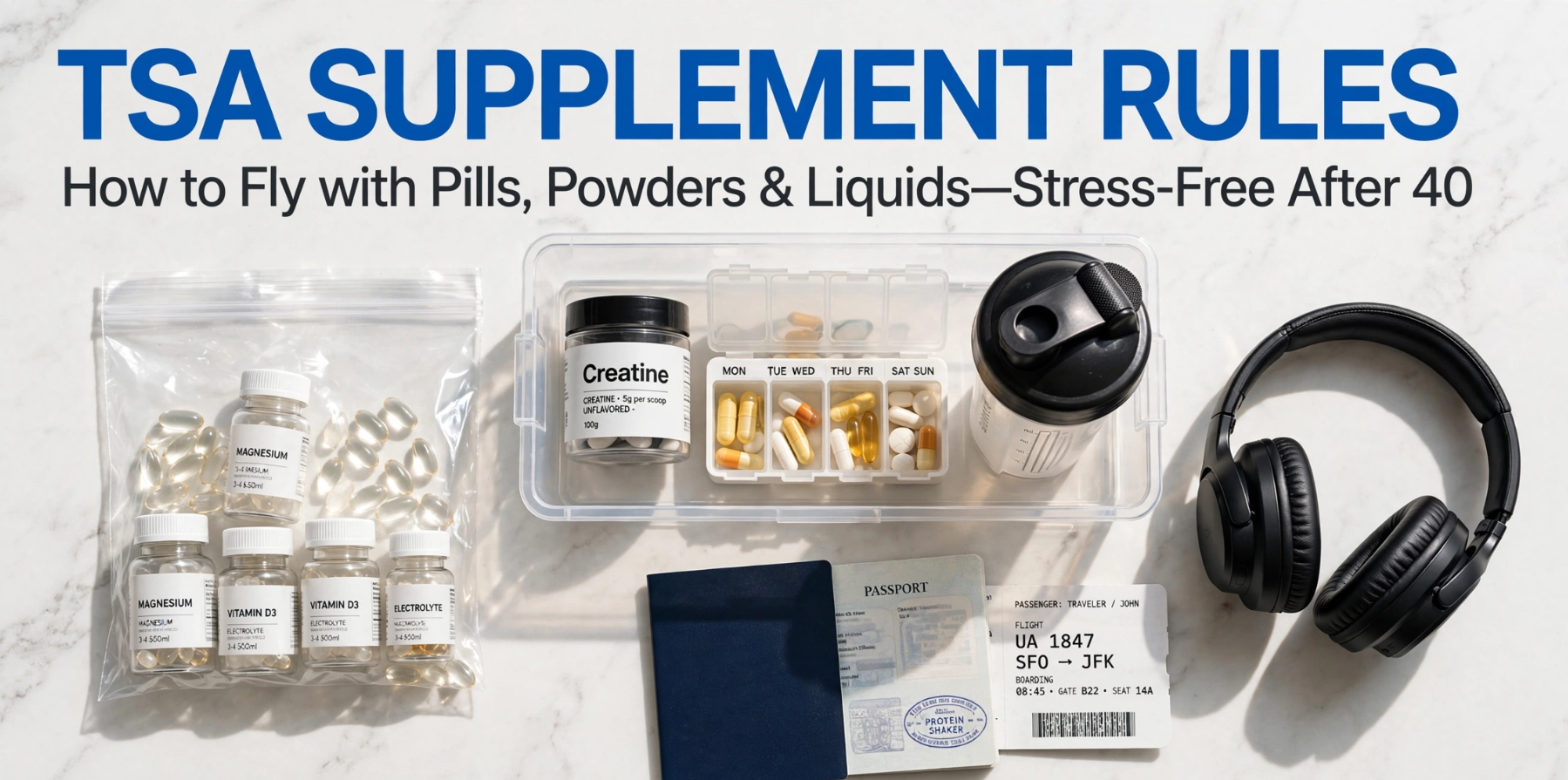
- Quart-sized clear bag: Contains any liquid softgels (placed here if you want to be safe; solid softgels technically don’t have to be here but keeping them with your liquids can streamline things), liquid tinctures in 3.4 oz bottles, and any other liquids.
- Daily pill organizer: In an easily accessible outer pocket. If TSA wants to look at it, you can produce it in two seconds.
- Powders: Pre-portioned into labeled, 4 oz travel jars or single-serve packets, in a separate zip-top bag (to contain any spills).
- Protein/Meal replacement shakes: Pre-made protein shakes are treated as liquids and must follow 3-1-1. Better to pack the dry powder and a shaker bottle, then buy water or milk after security.
Checked Luggage (bulk supply for the trip):
- Full-size protein tub, large creatine bag, extra bottles of pills.
- Pack in sealed plastic bags to prevent spills from pressure changes.
- Keep a copy of your supplement list and, if relevant, a doctor’s note in the checked bag as well.
The “Supplements Passport” (Highly Recommended):
Create a small, printed index card or a note on your phone with:
- List of every supplement you’re carrying, with both common and scientific names.
- Your doctor’s contact information (if you have one managing your protocol).
- A brief statement: “These dietary supplements are for my personal health maintenance. None contain prohibited or illegal substances.”
If questioned, hand this over. It demonstrates organization and transparency, dramatically de-escalating any inquiry.
Section 3: International Travel—When the Rules Change Dramatically
The TSA gets you out of the US. Customs and border protection in your destination country controls what comes in. Rules vary enormously.
Countries with Strict Supplement Bans or Restrictions:
- Japan: Many common US supplements, including those containing pseudoephedrine, some stimulants, and even certain forms of melatonin, are strictly controlled. Check the Japanese Ministry of Health, Labour and Welfare before packing.
- United Kingdom: Melatonin is classified as a prescription medicine. Bringing it in without a prescription could lead to confiscation. Most standard vitamins and minerals are fine.
- Australia and New Zealand: Extremely strict biosecurity laws. All supplements, including vitamins and protein powders, must be declared on arrival. Unlabeled or open powders are highly likely to be confiscated and destroyed. Pack supplements in their original, sealed, commercially labeled containers.
- Middle Eastern Countries (UAE, Saudi Arabia, Qatar): Some herbal supplements and even certain over-the-counter medications (like codeine, which is banned) can be confused with narcotics. Check the country’s controlled substances list. A doctor’s note and original pharmacy packaging are essential.
- Singapore: Many common supplements and even chewing gum are strictly regulated. Always check ahead.
VigorForty Pre-Travel International Checklist:
- Visit the embassy website of your destination country. Search for “customs medication supplements” or “traveling with medication.”
- Use the International Narcotics Control Board (INCB) website for general guidance on controlled substances.
- Pack all supplements in their original, sealed, labeled containers. Do not transfer to unmarked bags.
- Carry a signed, dated doctor’s letter stating that the supplements are for your personal health, listing each one.
- Declare supplements on the customs form if required. Never assume they are exempt.
Section 4: Time-Zone Dosing—Keeping Your Protocol on Track
Flying from New York to London? Your 8 AM morning stack is suddenly due at 1 PM local time. Flying from Los Angeles to Tokyo? Your 10 PM magnesium routine lands at 3 PM the next day. Jet lag disrupts more than sleep; it disrupts your supplement timing. Abrupt shifts can cause you to miss doses or double up.
The VigorForty Time-Zone Adjustment Protocol:
Short Trips (1–3 Days):
- Stick to your home time zone as closely as practical. If you take magnesium at 10 PM Eastern, take it at 10 PM Pacific regardless of local bedtime. This minimizes disruption upon return and prevents confusing your body’s circadian clock further.
Long Trips (4+ Days):
- Day of Travel: Take your morning supplements at your usual home time. During the flight, avoid stimulant-containing supplements (e.g., rhodiola, B-complex) close to the destination’s nighttime. Hydrate with electrolytes but skip melatonin until the destination’s local bedtime.
- Day 1 at Destination: Begin transitioning. Set your watch to local time. Take morning supplements with the destination’s breakfast, regardless of how your body feels. Magnesium glycinate is taken 30–60 minutes before the destination’s local bedtime. You may experience some grogginess or alertness mismatch; this is normal.
- Day 2–3 and Beyond: Full local-time dosing. Your circadian clock adjusts faster when you rigidly expose yourself to local meal times, light, and supplement timing. Consistent magnesium at the new local bedtime helps retrain the sleep-wake cycle.
Melatonin for Jet Lag (Bonus):
If you use melatonin to hasten jet lag recovery, take 0.5–3 mg at the destination’s local bedtime for the first 3–4 nights. Do not take it during the flight if it conflicts with the destination’s night; timing matters above all.
Section 5: What to Do If You’re Stopped by TSA or Customs
Even with perfect preparation, you might be flagged. Stay calm. Agents are following protocols, not persecuting you.
The VigorForty De-Escalation Script:
- “Good morning/afternoon. These containers hold my dietary supplements and vitamins. I have a list of everything with me.”
- Hand them your “Supplements Passport” card or show them on your phone.
- “The powders are creatine monohydrate and protein powder for my daily nutrition. The capsules are magnesium, vitamin D, and fish oil. None are illegal or prohibited.”
- If they wish to test a powder: “Of course. Please go ahead.” They will swab the outside of the container (or a small sample) and run it through a machine. This takes 1–2 minutes. Do not argue. Do not make jokes about it looking like drugs.
- If they ask to open a container, allow it. TSA officers are permitted to open sealed containers for testing.
- If they confiscate something (rare for domestic travel with compliant items): Politely ask for the exact regulation being cited and the officer’s name or badge number. You can file a complaint later, but do not escalate at the checkpoint. You can buy replacements at your destination.
TSA PreCheck and Global Entry:
If you travel frequently, invest in TSA PreCheck ($85 for 5 years). PreCheck passengers typically do not need to remove shoes, laptops, liquids, belts, or light jackets. While powders still need to be separated if over 12 oz, the overall screening is faster and less intrusive. Global Entry ($100 for 5 years) expedites customs when returning to the US and includes TSA PreCheck. For the busy professional on the go, this is a health investment—less stress, less time in line, more consistency with your routine.
Section 6: FAQ — Your Top Travel Supplement Questions
Q: Can I bring my pre-measured white powder (creatine) in a clear baggie?
A: Yes, but it will almost certainly be flagged for additional screening. The more you can keep powders in their original labeled containers or in clearly labeled travel jars with a printed supplement list, the smoother the process. Avoid anonymous-looking plastic baggies for powders; use containers with “Creatine” written on them.
Q: What about bringing supplements for my spouse or teenager?
A: You can bring supplements for family members. All standard rules apply. For a minor, carry a note from a parent/guardian if the supplements seem unusual. For your spouse, clearly labeling “Jane’s Vitamin D3” helps differentiate.
Q: Can I put my daily pill organizer in my checked bag?
A: Yes. There are no restrictions on solid pills in checked luggage. However, checked bags can be lost or delayed. Always carry a few days’ worth of essential supplements in your carry-on—enough to bridge the gap until your bag is recovered.
Q: I use a greens powder that’s green. Will that cause issues?
A: Unusual colors can attract curiosity. The same powder rules apply: keep it in its original container or a clearly labeled travel container, and if it’s over 12 oz, pull it out for separate screening. The color alone is not prohibited.
Q: Can I bring gummy vitamins?
A: Yes, gummies are treated as solids (or semi-solids) and are not subject to the 3-1-1 liquids rule. They go in the bin with your bag like any food item. They are an excellent, hassle-free travel option, though often contain added sugar.
The VigorForty Take
Your supplement protocol supports your health so you can perform at your best—whether in the boardroom, on the hiking trail, or exploring a new city. Don’t let arbitrary security rules derail it. Pre-portion your powders, label everything clearly, keep liquids small, and carry a supplements list. When in doubt, check the TSA website (tsa.gov) and the destination country’s customs page before you fly. A few minutes of preparation ensures your VigorForty protocol travels seamlessly beside you, wherever life takes you.
Read Realated Articles
- The Complete Guide to Heart Health: Beyond Omega-3s—CoQ10, Magnesium, Potassium, and Nitric Oxide Support After 40
- The Complete Guide to Eye Health: Lutein, Zeaxanthin, Astaxanthin, and Omega-3s for Protecting Your Vision After 40
- The Complete Guide to Anti-Aging Skin, Hair, and Nails: Collagen, Biotin, Silica, and Antioxidants for a Vibrant Appearance After 40
- The Busy Parent’s Supplement Guide: Staying Energized, Resilient, and Healthy While Raising Kids After 40
- Supplements for Brain Fog and Mental Clarity: Phosphatidylserine, Bacopa Monnieri, and Lion’s Mane—What Actually Works After 40
- The Complete Guide to Digestive Health: Probiotics, Prebiotics, Digestive Enzymes, and Gut-Healing Nutrients After 40
- Supplements for Osteoarthritis: A Natural Pain Management Protocol That Protects Your Joints After 40
- The Sleep-Supplement Connection: Magnesium, Glycine, L-Theanine, and Melatonin—A Complete Protocol for Restorative Rest After 40
- The Ultimate Guide to Healthy Aging: How to Build Your Personalized Supplement Plan at 40, 50, and 60
- Menopause Beyond the Basics: Mood, Bone, Brain, and Sleep Support for the American Woman Over 40
- Selenium, Zinc, and Iodine: The Trace Minerals That Support Thyroid, Immunity, and Longevity After 40
- TSA Rules for Supplements: Traveling with Pills, Powders, and Liquids as an American Over 40
- CoQ10 After 40: Ubiquinone vs. Ubiquinol, Statin Depletion, and Mitochondrial Support
- The VigorForty Guide to Third-Party Testing: USP, NSF, ConsumerLab, and How to Verify Your Supplements Are Safe
- The VigorForty Yearly Blood Work Blueprint: Exactly What to Test and When for Optimal Health After 40
- Metabolic Health Supplements: Berberine, Inositol, and Chromium for Blood Sugar Control After 40
- The Complete Guide to Electrolytes for the Active American Over 40: Sodium, Potassium, Magnesium, and Hydration Science
- Supplement-Drug Interactions Every American Over 40 Must Know: Blood Thinners, Antidepressants, BP Meds, and Statins
- The Busy Professional’s Core 5 Supplements: No Clutter, No Hype, Just What Actually Moves the Needle After 40
- Glycine + NAC: The Under-the-Radar Longevity Stack for Glutathione, Detoxification, and Deep Sleep After 40
- Adaptogens Worth Your Money: Ashwagandha, Rhodiola, and Holy Basil—Evidence and Safe Use for the Stressed 40+ American
- Best Supplements for Joint Health After 40: Curcumin, Collagen, MSM, and Glucosamine—Ranked by Evidence
- NAD+ Precursors (NMN & NR) in 2026: Current Evidence, US Legal Status, and What’s Worth Your Money
- Budget-Friendly Blood Tests to Check Your Actual Micronutrient Gaps (And Skip the Guesswork)
- The Perimenopause Supplement Protocol: Bone, Brain, and Sleep Support for American Women Over 40
- How to Read a Supplement Facts Panel Like a Dietitian: The 5-Step Method for Over-40 Americans
- Protein Powder After 40: Whey, Plant, Collagen, and the Anabolic Threshold You Must Know
- Omega-3s Decoded: EPA, DHA, and How to Read a Fish Oil Label for the Over-40 American
- Creatine After 40: Not Just for Bodybuilders—Brain, Muscle, and Longevity Science
- 5 Magnesium Myths Busted: Glycinate, Citrate, Oxide, and Which One You Actually Need
- Vitamin D3 + K2: The Over-40 American’s Protocol for Bones, Arteries, and Immunity
- The ‘Vigor Five’: Core Daily Supplements for Energy and Longevity After 40
- How Much Protein Do You Actually Need? (The Definite Guide for Satiety and Muscle Retention)
- The Ultimate Guide to Nutrient Density: How to Eat Real Food in America