

Author: Vigor Forty Editorial Team
Medically Reviewed By: Editorial Review Board
Disclaimer: This article is for informational purposes only and is not a substitute for professional medical advice. Read our full Medical Disclaimer.
📌 Key Takeaways
- The Front of the Bottle Is Marketing—Ignore It. Bold claims like “Supports Brain Health” or “Clinically Studied” are not FDA-approved. The only truth lives on the Supplement Facts panel on the back.
- Total Milligrams Aren’t What You Think: A capsule may say “500 mg Magnesium” but the actual elemental magnesium could be as low as 50 mg. You must identify the active nutrient weight.
- Proprietary Blends Hide Weak Doses: When a label lists a “Proprietary Blend” with a total weight but no individual breakdown, the manufacturer is legally hiding how much of each ingredient you’re actually getting.
- Third-Party Seals Are Your Shortcut: In the loosely regulated US market, seals from USP, NSF for Sport, or ConsumerLab are your only guarantee that the product is pure, potent, and free of contaminants.
- You Don’t Need to Memorize Every Ingredient—Just the Red Flags. Artificial dyes, hydrogenated oils, “proprietary blend,” and missing third-party seals are instant walk-away signals.
Introduction: The $50 Billion Industry That Leaves You Guessing
The US supplement industry is massive—and massively confusing. Unlike prescription drugs, dietary supplements do not require FDA approval before hitting the market. The 1994 Dietary Supplement Health and Education Act (DSHEA) places the burden of safety and labeling accuracy squarely on the manufacturer. The FDA can step in only after a product is proven unsafe or mislabeled. This means that as a consumer, you are your own last line of defense.
For Americans over 40, the stakes are higher. You’re likely taking one or more prescription medications with potential interactions. You’re more vulnerable to contaminants like heavy metals in herbal products. You have less margin for wasting money on ineffective doses. Yet most shoppers spend less than 10 seconds glancing at a supplement label before tossing it in the cart—ten seconds that determine whether you’re buying a therapeutic dose of a nutrient or an expensive placebo.
This article teaches you the 5-step method a clinical dietitian uses to read any supplement label in under a minute. Master this, and you’ll never be fooled by shiny marketing again.
Step 1: Ignore the Front Label (Yes, Entirely)
The front of the bottle is designed for one purpose only: to get you to buy it. Phrases like “Supports Heart Health,” “Boosts Energy,” or “Clinically Proven” are structure-function claims, not FDA-evaluated health claims. The FDA requires a disclaimer to the effect of: “This statement has not been evaluated by the Food and Drug Administration. This product is not intended to diagnose, treat, cure, or prevent any disease.” That disclaimer is your signal that the front-label promises are unverified.
Common Front-Label Traps:
- “Made with Real Ingredients” — So is soda. This means nothing about potency or purity.
- “Doctor Formulated” — No legal definition. Any individual with a doctorate can claim this, even if the degree is in an unrelated field.
- “Premium Quality” — Marketing fluff. There is no regulated grading system.
What to Do Instead: Turn the bottle over immediately. The Supplement Facts panel and the ingredient list are the legally regulated sections. They may not be exciting, but they’re true.
Step 2: Find the Actual Active Ingredient Amount (Not the Total Compound Weight)
This is the most common mistake supplement buyers make. You see “Magnesium 500 mg” and assume you’re getting 500 mg of magnesium. But if the label reads “Magnesium Oxide 500 mg,” you’re getting only about 60% of that as actual elemental magnesium—roughly 300 mg. For some forms like magnesium glycinate, the elemental content is even lower per gram, because the glycine carrier adds weight.
How to Read It:
Look for parentheses that specify the exact elemental amount. A high-quality supplement will state: “Magnesium (as magnesium glycinate) 200 mg.” That means 200 mg of pure magnesium, regardless of how much glycinate compound was used. If the label only lists the compound name without clarifying elemental weight, you’re guessing.
The Rule of Thumb: If the active nutrient is a mineral (magnesium, zinc, calcium, iron), always locate the elemental amount. For amino acids and herbs, the compound weight is usually the metric that matters, but standardization to active compounds (e.g., “standardized to 95% curcuminoids”) is the gold standard.
Step 3: Decode the “Other Ingredients” and Spot the Hidden Junk
The “Other Ingredients” list is where binders, fillers, flow agents, preservatives, and artificial colors live. While many of these are harmless, some are red flags for a low-quality product.
Generally Safe and Acceptable:
- Magnesium stearate, silica, rice flour, cellulose capsule (vegetarian capsule), gelatin. These aid in manufacturing and are benign at the tiny amounts used.
Red Flags Worth Avoiding:
- Hydrogenated oils (trans fats): Should never be in a supplement; avoid.
- Artificial colors (FD&C Red No. 40, Yellow No. 5, etc.): Unnecessary chemical colorants that some individuals react to.
- Titanium dioxide: A whitening agent under scrutiny for potential health risks; some manufacturers are moving away from it.
- Phthalates, parabens: Rare but occasionally appear in liquid supplements as preservatives; avoid.
For the 40+ American concerned about liver and kidney load, the fewer inert ingredients, the better. A protein powder with 20 ingredients, half of which are gums and emulsifiers, is inferior to one with three: protein, sunflower lecithin, and vanilla.
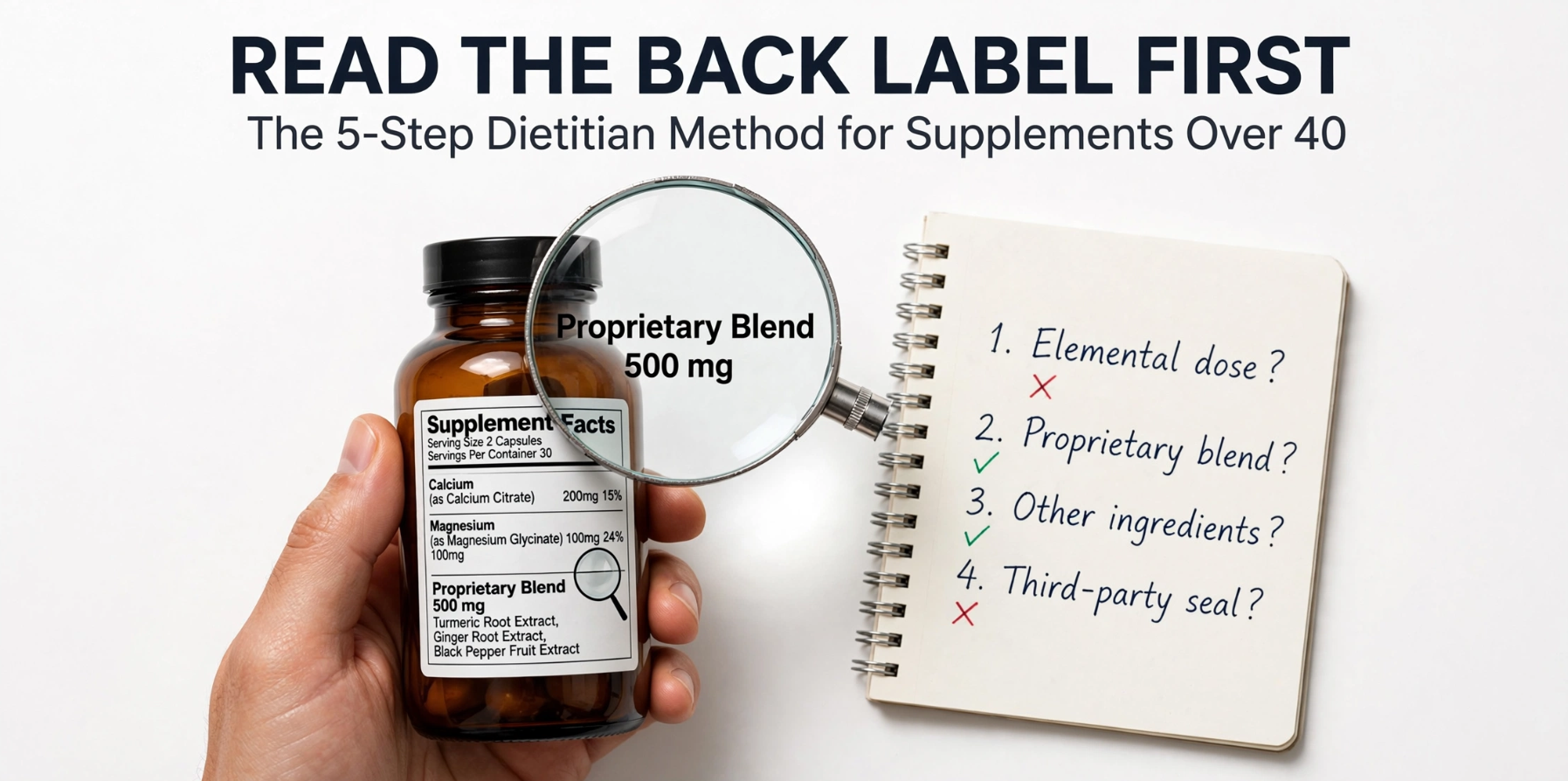
Step 4: Proprietary Blends — The Legal Loophole That Hides Weak Formulas
A proprietary blend is a group of ingredients listed under a single total weight, without individual amounts. For example: “Proprietary Recovery Blend 1,200 mg: (Creatine, Beta-Alanine, L-Glutamine).” You have no idea how much creatine is in there. It could be 100 mg (ineffective) and 1,000 mg of glutamine. Manufacturers love this because it prevents competitors from copying their formula—but it also prevents you from knowing if the active ingredients are dosed at clinically effective levels.
How to Spot It: If you see the word “Proprietary Blend,” “Matrix,” or “Complex” followed by a list of ingredients in parentheses with only a total weight, you are being kept in the dark. Unless the brand fully discloses the individual amounts (some transparent brands do), it’s a hard pass.
Exception: If the proprietary blend is a trademarked, clinically studied ingredient with published dosing (e.g., “Curcumin C3 Complex® 500 mg”), and the research used that exact complex at that dose, it’s acceptable. The key is traceable dosing, not secret formulas.
Step 5: Look for the Third-Party Certification Seal — Your Only True Guarantee
Because the FDA does not routinely test supplements, voluntary third-party certification is the only way to know that what’s on the label is in the bottle—and nothing else. These independent organizations test for identity, potency, purity, and dissolution.
The Big Three Seals to Look For:
| Seal | What It Verifies | Best For |
|---|---|---|
| USP (United States Pharmacopeia) | Ingredient identity, potency, purity, disintegration, and absence of harmful contaminants. | General multivitamins, minerals, fish oils. |
| NSF for Sport (or NSF Certified) | Potency, purity, and absence of over 270 banned athletic substances. | Athletes, anyone seeking rigorous purity testing. |
| ConsumerLab.com | Purity, potency, and label accuracy; publishes detailed reviews. | Broad range; their seal appears on products they’ve approved. |
Other reputable certifiers: Informed Sport, Informed Choice, BSCG (Banned Substances Control Group), and IFOS (International Fish Oil Standards) specifically for fish oil.
What If There’s No Seal? It doesn’t automatically mean the product is bad, but you are trusting the manufacturer’s word. For high-risk categories like herbal supplements, fish oils, and protein powders, buying an unverified product is a gamble. The VigorForty recommendation is simple: if a product category matters to your health, pay a few dollars more for the certified option.
Section: The 60-Second Label Scan — A Practical Walkthrough
Let’s apply the 5-step method to a real-world bottle. Imagine you’re holding a “Calm Sleep Formula” that claims “Supports Deep, Restful Sleep” on the front. You flip it over:
- Supplement Facts: The serving size is 2 capsules. The active ingredients list: “Proprietary Sleep Blend 1,000 mg: (Magnesium Glycinate, Valerian Root Extract, Melatonin).” Red flag immediately—proprietary blend.
- Active Nutrient Amount: You see “Melatonin” but no milligram amount. It could be 1 mg or 10 mg. You have no idea.
- Other Ingredients: Titanium dioxide, FD&C Blue No. 1. Unnecessary colorants.
- Third-Party Seal: None.
Conclusion: You put the bottle back. You instead find a separate magnesium glycinate with “Magnesium (as magnesium glycinate) 200 mg” listed clearly, a USP seal, and “vegetable cellulose capsule” as the only other ingredient. You buy that and control your own melatonin separately if needed.
Section: Special Considerations for Americans Over 40
Drug Interactions: You must check the label for active ingredients that could interact with common 40+ medications. For example, St. John’s Wort (in mood supplements) interferes with statins, antidepressants, and birth control. High-dose vitamin K (in bone formulas) destabilizes warfarin. If the label lacks full disclosure, you can’t do this safety check.
Heavy Metal Risk: Plant-based proteins, greens powders, and herbal supplements sourced from contaminated soil (common in certain regions) can accumulate lead, arsenic, and cadmium. Third-party certification is non-negotiable here. The Clean Label Project has documented alarming levels in some top-selling plant proteins.
Polypharmacy: The average American over 45 takes at least one prescription drug. Before adding any supplement, you must show the label to your doctor or pharmacist. A transparent, fully disclosed label makes that conversation possible.
FAQ: Your Top Label-Reading Questions
Q: What does “standardized” mean on a herbal supplement?
A: It means the manufacturer guarantees a specific percentage of the active compound. For example, “standardized to 95% curcuminoids” ensures potency. Without standardization, the herb could vary wildly from batch to batch.
Q: Is “natural flavor” something to avoid?
A: Generally safe, but it’s a proprietary blend of flavor compounds derived from natural sources. If you have specific allergies, you might prefer unflavored versions to avoid hidden allergens.
Q: Do expiration dates matter?
A: Yes. Supplements lose potency after their expiration date, and oils (fish, flax) can oxidize and become harmful. Never use a supplement past its expiration. Store in a cool, dry place; avoid the bathroom cabinet where humidity degrades capsules.
Q: Are gummy supplements as effective as capsules?
A: Gummies are notoriously less reliable in potency and often loaded with sugar or sugar alcohols. They degrade faster and often fail third-party testing for label accuracy. Stick to capsules, softgels, or powders whenever possible.
The VigorForty Take
Supplement shopping in America shouldn’t require a chemistry degree, but it does require skepticism. The front of the bottle is a billboard. The back is a legal document. Train your eyes to jump straight to the Supplement Facts panel, isolate the elemental dose, reject proprietary blends, scan for junk fillers, and look for a third-party seal. Do this, and in 60 seconds you’ll know whether the product deserves your money—or belongs back on the shelf.
The Vigor Five articles have told you what to take. This skill ensures you take it in the cleanest, most effective form possible. You now hold the filter. Use it every single time.
Read Realated Articles
- The Complete Guide to Heart Health: Beyond Omega-3s—CoQ10, Magnesium, Potassium, and Nitric Oxide Support After 40
- The Complete Guide to Eye Health: Lutein, Zeaxanthin, Astaxanthin, and Omega-3s for Protecting Your Vision After 40
- The Complete Guide to Anti-Aging Skin, Hair, and Nails: Collagen, Biotin, Silica, and Antioxidants for a Vibrant Appearance After 40
- The Busy Parent’s Supplement Guide: Staying Energized, Resilient, and Healthy While Raising Kids After 40
- Supplements for Brain Fog and Mental Clarity: Phosphatidylserine, Bacopa Monnieri, and Lion’s Mane—What Actually Works After 40
- The Complete Guide to Digestive Health: Probiotics, Prebiotics, Digestive Enzymes, and Gut-Healing Nutrients After 40
- Supplements for Osteoarthritis: A Natural Pain Management Protocol That Protects Your Joints After 40
- The Sleep-Supplement Connection: Magnesium, Glycine, L-Theanine, and Melatonin—A Complete Protocol for Restorative Rest After 40
- The Ultimate Guide to Healthy Aging: How to Build Your Personalized Supplement Plan at 40, 50, and 60
- Menopause Beyond the Basics: Mood, Bone, Brain, and Sleep Support for the American Woman Over 40
- Selenium, Zinc, and Iodine: The Trace Minerals That Support Thyroid, Immunity, and Longevity After 40
- TSA Rules for Supplements: Traveling with Pills, Powders, and Liquids as an American Over 40
- CoQ10 After 40: Ubiquinone vs. Ubiquinol, Statin Depletion, and Mitochondrial Support
- The VigorForty Guide to Third-Party Testing: USP, NSF, ConsumerLab, and How to Verify Your Supplements Are Safe
- The VigorForty Yearly Blood Work Blueprint: Exactly What to Test and When for Optimal Health After 40
- Metabolic Health Supplements: Berberine, Inositol, and Chromium for Blood Sugar Control After 40
- The Complete Guide to Electrolytes for the Active American Over 40: Sodium, Potassium, Magnesium, and Hydration Science
- Supplement-Drug Interactions Every American Over 40 Must Know: Blood Thinners, Antidepressants, BP Meds, and Statins
- The Busy Professional’s Core 5 Supplements: No Clutter, No Hype, Just What Actually Moves the Needle After 40
- Glycine + NAC: The Under-the-Radar Longevity Stack for Glutathione, Detoxification, and Deep Sleep After 40
- Adaptogens Worth Your Money: Ashwagandha, Rhodiola, and Holy Basil—Evidence and Safe Use for the Stressed 40+ American
- Best Supplements for Joint Health After 40: Curcumin, Collagen, MSM, and Glucosamine—Ranked by Evidence
- NAD+ Precursors (NMN & NR) in 2026: Current Evidence, US Legal Status, and What’s Worth Your Money
- Budget-Friendly Blood Tests to Check Your Actual Micronutrient Gaps (And Skip the Guesswork)
- The Perimenopause Supplement Protocol: Bone, Brain, and Sleep Support for American Women Over 40
- How to Read a Supplement Facts Panel Like a Dietitian: The 5-Step Method for Over-40 Americans
- Protein Powder After 40: Whey, Plant, Collagen, and the Anabolic Threshold You Must Know
- Omega-3s Decoded: EPA, DHA, and How to Read a Fish Oil Label for the Over-40 American
- Creatine After 40: Not Just for Bodybuilders—Brain, Muscle, and Longevity Science
- 5 Magnesium Myths Busted: Glycinate, Citrate, Oxide, and Which One You Actually Need
- Vitamin D3 + K2: The Over-40 American’s Protocol for Bones, Arteries, and Immunity
- The ‘Vigor Five’: Core Daily Supplements for Energy and Longevity After 40
- How Much Protein Do You Actually Need? (The Definite Guide for Satiety and Muscle Retention)
- The Ultimate Guide to Nutrient Density: How to Eat Real Food in America