

Author: Vigor Forty Editorial Team
Medically Reviewed By: Editorial Review Board
Disclaimer: This article is for informational purposes only and is not a substitute for professional medical advice. Read our full Medical Disclaimer.
📌 Key Takeaways
- The FDA Does Not Approve Supplements Before They Hit Shelves: Unlike prescription drugs, dietary supplements are regulated post-market. The manufacturer is responsible for safety and labeling accuracy, but enforcement only occurs after problems arise. Third-party certification fills this regulatory gap.
- USP, NSF, and ConsumerLab Are the Three Pillars of Supplement Verification: Each has a slightly different focus, but all test for identity (is this ingredient actually in the bottle?), potency (is the dose accurate?), purity (are there heavy metals, microbes, pesticides?), and dissolution (will the pill break down properly in your body?).
- A Seal on the Bottle Is Your Shortcut to Safety: If a supplement carries the USP Verified Mark, NSF Certified for Sport, or ConsumerLab Approved Quality seal, you can be confident it contains what it claims without harmful contaminants. No seal doesn’t guarantee a bad product, but it means you’re relying on the manufacturer’s word alone.
- Third-Party Testing Is Especially Critical for High-Risk Categories: Fish oils (rancidity, PCBs), plant proteins (heavy metals), herbal supplements (pesticides, adulteration), and imported products (lax regulation) demand the highest scrutiny. Spending a few extra dollars for a certified product in these categories is not optional—it’s essential.
- You Can Verify Claims Yourself: Don’t just trust the seal. Cross-check the product on the certifier’s official website. Counterfeit supplements with fake seals exist, and a 60-second verification protects you.
Introduction: The Regulatory Gap That Puts Your Health at Risk
Imagine buying a prescription drug from a pharmacy with no guarantee that the pill contains the right dose, or that it isn’t contaminated with lead, arsenic, or bacteria. You wouldn’t tolerate that for a moment. Yet that’s precisely the situation millions of Americans face every day in the supplement aisle.
The Dietary Supplement Health and Education Act of 1994 (DSHEA) fundamentally shaped the US supplement industry. Under DSHEA, dietary supplements are regulated as a category of food, not drugs. Manufacturers do not need to prove safety or efficacy to the FDA before putting a product on the market. The FDA can only step in after a product is on shelves and proven to be adulterated, misbranded, or dangerous—a reactive, not proactive, system.
In 2015, the New York Attorney General’s office tested popular store-brand herbal supplements from major retailers including Walmart, Target, GNC, and Walgreens. They found that roughly 80% contained none of the herbs listed on the label—just cheap fillers like rice powder, wheat, and houseplants. More recently, a 2023 investigation by ConsumerLab found that several popular turmeric supplements contained lead levels exceeding safe daily limits. These aren’t fringe products from obscure websites; they’re mainstream brands sold in national chains.
Third-party certification is the only independent, voluntary system that fills this regulatory void. This article gives you a complete, actionable guide to the three organizations that matter most, how to read their seals, and how to use their databases to protect yourself and your family.
Section 1: Why the FDA Doesn’t Have Your Back on Supplements
Understanding DSHEA is crucial because it explains the entire verification landscape.
Under DSHEA, supplement manufacturers are required to follow Good Manufacturing Practices (GMPs), which cover facility cleanliness, record-keeping, and quality control procedures. However, GMPs do not mandate specific tests for every batch of every ingredient. They require that manufacturers establish specifications for identity, purity, and potency—but the manufacturer sets those specifications themselves. The FDA audits a tiny fraction of facilities each year, and even when violations are found, enforcement is often slow and limited.
This means that a supplement company can:
- Source raw ingredients from the cheapest global supplier with minimal verification.
- Use “proprietary blends” to hide exact ingredient amounts.
- Add fillers, flow agents, and even pharmaceutical drugs (as seen in some “weight loss” and “performance” supplements) without pre-market detection.
- Make structure-function claims (“supports brain health”) that sound like drug indications but are not evaluated by the FDA.
The disclaimer you see on every bottle—”This statement has not been evaluated by the Food and Drug Administration. This product is not intended to diagnose, treat, cure, or prevent any disease”—is the direct consequence of DSHEA. Third-party certification is the consumer’s countermeasure.
Section 2: The Big Three Certifiers—Who They Are and What They Test
1. USP (United States Pharmacopeia)
USP is a non-profit, scientific organization that sets public standards for the identity, strength, quality, and purity of medicines, food ingredients, and dietary supplements. Its standards are enforceable by the FDA for drugs, and voluntarily adopted for supplements.
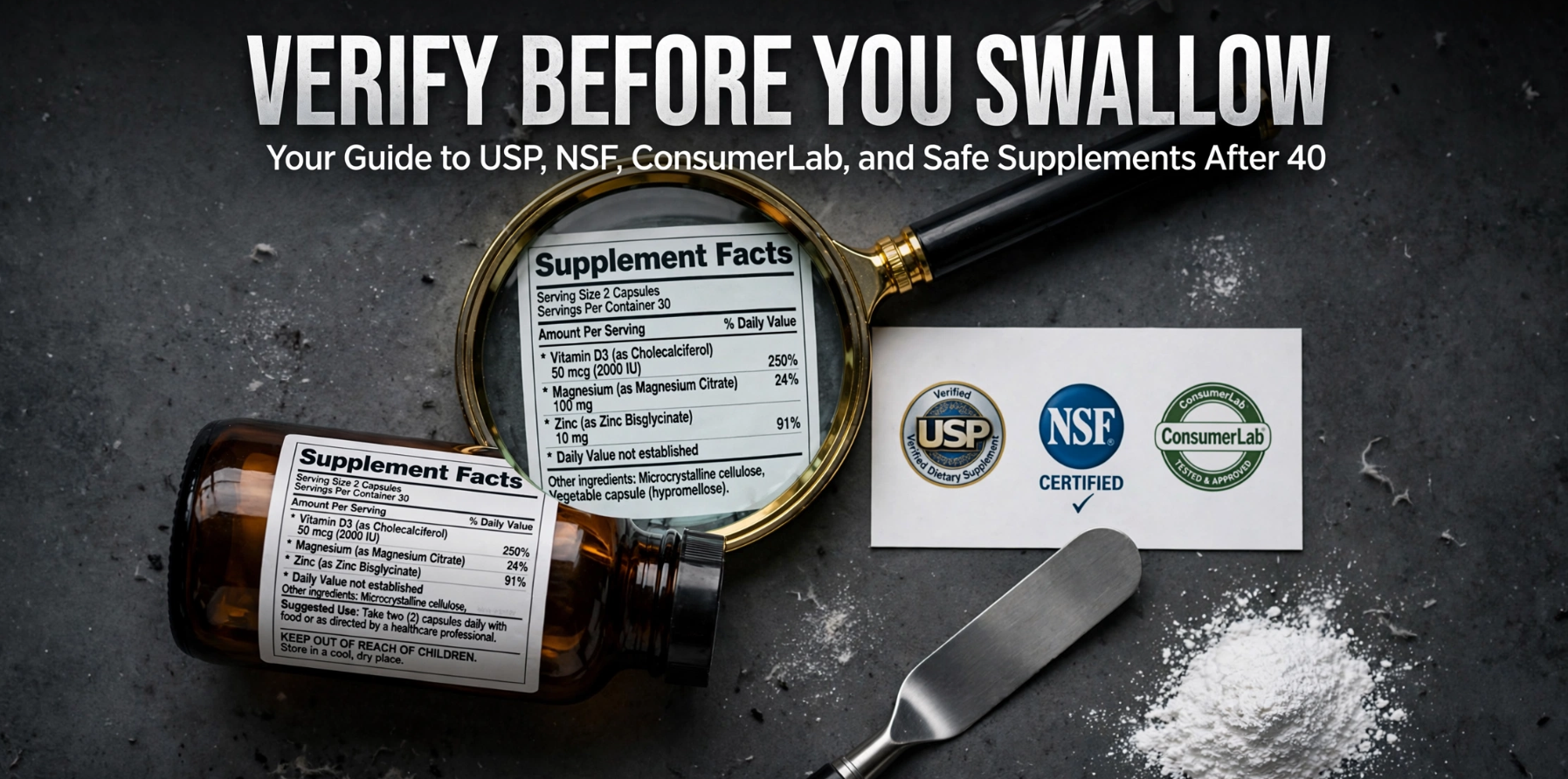
- USP Verified Mark: A product bearing this gold-and-black seal has been independently tested and confirmed to:
- Contain the ingredients listed on the label, in the declared potency and amounts.
- Not contain harmful levels of specified contaminants (heavy metals, microbes, pesticides).
- Break down and release nutrients in the body within a specified time (dissolution).
- Be manufactured in a facility that is audited by USP to ensure GMP compliance.
USP verification is rigorous and costly. Brands that pursue it—such as Nature Made, Kirkland Signature, and some formulas from Garden of Life and MegaFood—are signaling a significant investment in quality. You can verify any USP seal at the USP website’s verified products directory.
2. NSF International (and NSF Certified for Sport)
NSF International is an independent, accredited organization that tests and certifies products for public health and safety. While NSF certifies a wide range of consumer goods, its supplement programs are especially important.
- NSF/ANSI 173 Certification (Dietary Supplements): Confirms label accuracy, contaminant screening, and GMP compliance.
- NSF Certified for Sport: This is the gold standard for anyone concerned about athletic banned substances. Every batch of a Certified for Sport product is tested for over 270 substances banned by the NFL, MLB, NCAA, and WADA, including stimulants, anabolic agents, diuretics, and masking agents. Certified for Sport also verifies label potency and purity.
If you’re an athlete subject to drug testing, a member of the military, or simply someone who wants the highest possible assurance that your protein powder or pre-workout isn’t spiked with hidden stimulants, NSF Certified for Sport is the seal to demand. Trusted brands include Klean Athlete, Thorne, NOW Sports, and some Garden of Life Sport formulas.
ConsumerLab is a for-profit, independent testing company that purchases products off retail shelves and anonymously tests them in its own laboratories. Unlike USP and NSF, which test products at the manufacturer’s request, ConsumerLab selects products based on market popularity and consumer requests. It then publishes detailed, comparative reviews.
- ConsumerLab Approved Quality Seal: Products that pass ConsumerLab’s rigorous testing can license the CL seal for their packaging. The testing covers identity, potency, purity, and dissolution. ConsumerLab also re-tests products periodically to ensure ongoing compliance.
ConsumerLab’s real value lies in its publicly accessible reports. For an annual subscription (approximately $50), you can read head-to-head comparisons of dozens of popular supplements, seeing exactly which brands passed, which failed, and why. A failed test might reveal that a fish oil was rancid, a probiotic had only 10% of the listed CFU count, or a green tea extract contained dangerous levels of lead. This transparency allows you to choose wisely, even among products without a visible seal.
Section 3: How to Read and Verify a Certification Seal
A seal on a bottle is a strong trust signal, but you must verify it. Counterfeit seals and misleading marketing are real problems.
The VigorForty Verification Protocol:
- Look for the official logo. A generic “Lab Tested” badge with no certifying body name is marketing, not certification. The real seals have distinctive, registered designs—USP’s black-and-gold circle, NSF’s blue-and-white globe, ConsumerLab’s diamond.
- Note the exact product name and lot number. Certification applies to a specific product in a specific size and formulation, not an entire brand.
- Visit the certifier’s website and search their directory. USP, NSF, and ConsumerLab all maintain free, searchable online databases of certified products. Type in the product name or company. If it appears, the seal is legitimate. If it doesn’t, contact the certifier.
- Check the date. Certifications lapse. A product might have been tested years ago but is no longer actively certified. The directory will indicate current status.
Example: You pick up a protein powder with an NSF Certified for Sport seal. You visit nsfsport.com, enter the product name, and confirm it’s listed with a current certification date. Only then do you trust the seal. This takes 60 seconds.
Section 4: Which Supplement Categories Demand Certification the Most?
While it’s ideal for all supplements to be third-party tested, budget and availability mean you must prioritize. The following categories carry the highest risk of contamination, adulteration, or mislabeling, making certification effectively mandatory.
| High-Risk Category | Primary Concern | Specific Tests That Matter |
|---|---|---|
| Fish Oil / Omega-3s | Rancidity (oxidation), PCBs, dioxins, mercury, and incorrect EPA/DHA content | IFOS (International Fish Oil Standards), NSF, USP, or ConsumerLab for purity and potency; TOTOX value for freshness (<26). |
| Plant-Based Protein Powders | Heavy metals (lead, cadmium, arsenic) from contaminated soil, pesticide residues | NSF, USP, or Clean Label Project certification specifically for heavy metals. |
| Herbal Supplements (Turmeric, Ashwagandha, etc.) | Adulteration with cheap fillers, pesticide contamination, heavy metals from soil, incorrect standardization | USP, NSF, ConsumerLab; also look for a transparent Certificate of Analysis from the manufacturer if no seal is present. |
| Imported Supplements (especially from China, India) | Lax manufacturing oversight, heavy metals, pharmaceutical adulteration | NSF, USP, or ConsumerLab. Avoid uncertified imported products sold on third-party Amazon/eBay. |
| Multi-Ingredient Pre-Workouts / Fat Burners | Hidden stimulants, pharmaceutical analogues, inaccurate dosing | NSF Certified for Sport (to rule out banned substances). |
For lower-risk categories (single-ingredient amino acids, creatine monohydrate from reputable Western manufacturers, basic vitamin C), a GMP-certified facility and a transparent label might be sufficient, but a third-party seal adds meaningful peace of mind.
Section 5: What “GMP Certified” Actually Means (and Doesn’t)
Many supplement labels carry the phrase “Manufactured in a GMP-Certified Facility.” This is not the same as third-party product testing.
GMP certification means the facility has been audited and meets standards for cleanliness, equipment maintenance, record-keeping, and quality control processes. However, it does not guarantee that any specific batch of any specific product was tested for purity, potency, or identity. A GMP-certified facility can still produce a contaminated product if the raw ingredients were compromised and in-house testing was inadequate.
Think of it this way: GMP certification means the kitchen is clean and the cooks follow recipes. Third-party product certification means an independent inspector tasted the soup and confirmed it’s exactly what’s on the menu, with no hidden nasties. You want both.
Section 6: Beyond the Big Three—Other Certifications Worth Knowing
- IFOS (International Fish Oil Standards): The gold standard specifically for fish oils. IFOS assigns a star rating (1–5) based on the product’s compliance with GOED purity standards, potency relative to the label, and freshness (oxidation). Products like Nordic Naturals, Carlson, and Viva Naturals often publish current IFOS reports.
- Clean Label Project: A non-profit that tests for industrial and environmental contaminants (heavy metals, plasticizers, pesticide residues) and publishes star ratings. It’s particularly useful for plant proteins, baby products, and pet foods.
- Informed Sport / Informed Choice: Similar to NSF Certified for Sport, these programs test every batch for banned substances. Widely used in Europe and gaining traction in the US.
- BSCG (Banned Substances Control Group): Founded by anti-doping pioneer Don Catlin, BSCG offers rigorous testing for athletic supplements, including a “Gold” certification for products free of drugs and contaminants.
Section 7: How to Apply This When Shopping Online (Amazon, iHerb, Brand Sites)
Shopping for supplements online requires extra vigilance. Counterfeit products, fake reviews, and sellers of diverted or expired stock are rampant on large marketplaces.
The VigorForty Online Shopping Rules:
- Buy from the brand’s official store on Amazon, or directly from the brand’s website. Avoid third-party sellers with names like “Deals4U123.”
- On Amazon, look for the “Transparency” code. Some premium brands participate in Amazon’s Transparency program, which assigns a unique QR-like code to each unit that can be scanned to verify authenticity.
- On iHerb, check for the “iTested” badge. iHerb conducts its own third-party testing on select products and publishes results online.
- Cross-reference any seal you see with the certifier’s online directory. Do this before adding to cart. If a product claims “third-party tested” but doesn’t name the organization, it’s a red flag.
Section 8: FAQ — Your Most-Asked Certification Questions
Q: Is a supplement without a seal automatically bad?
A: No. Many small, reputable brands cannot afford the high cost of USP or NSF certification. Some conduct equally rigorous in-house testing and publish Certificates of Analysis (CoAs) for each batch. If a brand transparently provides up-to-date CoAs from an ISO-accredited lab, that’s a strong trust signal in the absence of a seal. If they hide their testing data, consider that a red flag.
Q: Do third-party certifications test for all possible contaminants?
A: No. They test for a defined panel of common, known contaminants relevant to the ingredient. A seal doesn’t guarantee “100% free of everything.” It does guarantee that the product meets the certifier’s specific, published standards, which are far more rigorous than the industry baseline.
Q: Can I trust the “Lab Verified” logo on a brand’s website?
A: Only if it links to the actual lab report from a named, accredited laboratory, with the specific lot number of your product visible. A generic “Lab Verified” badge created by the brand’s marketing team means nothing.
Q: What’s the difference between USP and NSF?
A: USP is the world’s most recognized pharmacopeial standard-setter and focuses heavily on ingredient identity, potency, and dissolution. NSF places additional emphasis on public health and safety, and its Certified for Sport program is the benchmark for athletic banned substance testing. Both are excellent. Choose based on your specific concern—general quality assurance (USP) or sports safety (NSF Certified for Sport).
The VigorForty Take
You’ve learned what supplements to take, how to dose them, when to test your blood, and how to stack them for your specific goals. The final, non-negotiable layer is quality assurance. In a market where the FDA is largely absent from pre-market oversight, the USP, NSF, and ConsumerLab seals are your independent quality control department. They take the guesswork out of purity and potency.
From this point forward, let every supplement you purchase pass a simple test: flip the bottle, look for a named third-party seal, and verify it online. A product that meets this standard earns a place in your VigorForty protocol. One that doesn’t stays on the shelf. Your health deserves nothing less than verified quality.
Read Realated Articles
- The Complete Guide to Heart Health: Beyond Omega-3s—CoQ10, Magnesium, Potassium, and Nitric Oxide Support After 40
- The Complete Guide to Eye Health: Lutein, Zeaxanthin, Astaxanthin, and Omega-3s for Protecting Your Vision After 40
- The Complete Guide to Anti-Aging Skin, Hair, and Nails: Collagen, Biotin, Silica, and Antioxidants for a Vibrant Appearance After 40
- The Busy Parent’s Supplement Guide: Staying Energized, Resilient, and Healthy While Raising Kids After 40
- Supplements for Brain Fog and Mental Clarity: Phosphatidylserine, Bacopa Monnieri, and Lion’s Mane—What Actually Works After 40
- The Complete Guide to Digestive Health: Probiotics, Prebiotics, Digestive Enzymes, and Gut-Healing Nutrients After 40
- Supplements for Osteoarthritis: A Natural Pain Management Protocol That Protects Your Joints After 40
- The Sleep-Supplement Connection: Magnesium, Glycine, L-Theanine, and Melatonin—A Complete Protocol for Restorative Rest After 40
- The Ultimate Guide to Healthy Aging: How to Build Your Personalized Supplement Plan at 40, 50, and 60
- Menopause Beyond the Basics: Mood, Bone, Brain, and Sleep Support for the American Woman Over 40
- Selenium, Zinc, and Iodine: The Trace Minerals That Support Thyroid, Immunity, and Longevity After 40
- TSA Rules for Supplements: Traveling with Pills, Powders, and Liquids as an American Over 40
- CoQ10 After 40: Ubiquinone vs. Ubiquinol, Statin Depletion, and Mitochondrial Support
- The VigorForty Guide to Third-Party Testing: USP, NSF, ConsumerLab, and How to Verify Your Supplements Are Safe
- The VigorForty Yearly Blood Work Blueprint: Exactly What to Test and When for Optimal Health After 40
- Metabolic Health Supplements: Berberine, Inositol, and Chromium for Blood Sugar Control After 40
- The Complete Guide to Electrolytes for the Active American Over 40: Sodium, Potassium, Magnesium, and Hydration Science
- Supplement-Drug Interactions Every American Over 40 Must Know: Blood Thinners, Antidepressants, BP Meds, and Statins
- The Busy Professional’s Core 5 Supplements: No Clutter, No Hype, Just What Actually Moves the Needle After 40
- Glycine + NAC: The Under-the-Radar Longevity Stack for Glutathione, Detoxification, and Deep Sleep After 40
- Adaptogens Worth Your Money: Ashwagandha, Rhodiola, and Holy Basil—Evidence and Safe Use for the Stressed 40+ American
- Best Supplements for Joint Health After 40: Curcumin, Collagen, MSM, and Glucosamine—Ranked by Evidence
- NAD+ Precursors (NMN & NR) in 2026: Current Evidence, US Legal Status, and What’s Worth Your Money
- Budget-Friendly Blood Tests to Check Your Actual Micronutrient Gaps (And Skip the Guesswork)
- The Perimenopause Supplement Protocol: Bone, Brain, and Sleep Support for American Women Over 40
- How to Read a Supplement Facts Panel Like a Dietitian: The 5-Step Method for Over-40 Americans
- Protein Powder After 40: Whey, Plant, Collagen, and the Anabolic Threshold You Must Know
- Omega-3s Decoded: EPA, DHA, and How to Read a Fish Oil Label for the Over-40 American
- Creatine After 40: Not Just for Bodybuilders—Brain, Muscle, and Longevity Science
- 5 Magnesium Myths Busted: Glycinate, Citrate, Oxide, and Which One You Actually Need
- Vitamin D3 + K2: The Over-40 American’s Protocol for Bones, Arteries, and Immunity
- The ‘Vigor Five’: Core Daily Supplements for Energy and Longevity After 40
- How Much Protein Do You Actually Need? (The Definite Guide for Satiety and Muscle Retention)
- The Ultimate Guide to Nutrient Density: How to Eat Real Food in America