
Author: Vigor Forty Editorial Team
Medically Reviewed By: Editorial Review Board
Disclaimer: This article is for informational purposes only and is not a substitute for professional medical advice. Read our full Medical Disclaimer.
📌 Key Takeaways
- Strength training is essential for everyone, especially after 40: It combats age-related muscle loss (sarcopenia), improves bone density, boosts metabolism, and lowers the risk of chronic diseases like cardiovascular disease, type 2 diabetes, and osteoporosis.
- There are three powerful approaches to strength training: Weightlifting (using external resistance like dumbbells and barbells), calisthenics (using your own body weight), and core stability training (building the foundation for all movement). Each has unique benefits, and together they create a complete program.
- You don’t need to choose just one approach: The most effective strategy for long-term health and functional strength combines all three disciplines. This hybrid approach gives you the strength-building power of weights, the functional movement of bodyweight training, and the injury-prevention benefits of core work.
- Proper form and progressive overload are the keys to success: Start with lighter weights or easier variations, master the movement patterns, and gradually increase the challenge over time. Quality always beats quantity.
- Consistency beats intensity: Two to three strength training sessions per week, performed consistently, will deliver significant results. It’s better to train moderately for years than intensely for weeks and then quit.
Introduction: Why Strength Training Matters Now More Than Ever
If you’re over 40, you’ve probably noticed some changes. Maybe everyday tasks feel a little heavier. Perhaps your joints ache more than they used to. Or maybe you’ve simply realized that the body you had in your twenties isn’t coming back on its own.
Here’s the good news: strength training is the closest thing we have to a fountain of youth.
After age 30, adults begin losing 3–5% of their muscle mass per decade—a condition called sarcopenia. This loss accelerates after 40, affecting not just how you look, but how you feel, move, and function. By age 60, the average American has lost approximately 10–15% of their muscle mass. By age 80, that number can reach 30–50%.
But here’s what most people don’t realize: this decline is not inevitable. It’s reversible. And it starts with picking up something heavy—whether that’s a dumbbell, a barbell, or just your own body weight.
The Science of Strength Training
When you strength train, you create microscopic damage in your muscle fibers. Your body responds by repairing these fibers and making them stronger and slightly larger than before. This process—called muscle protein synthesis—is triggered by resistance training and supported by adequate protein intake and rest.
The benefits extend far beyond muscle:
| Benefit | How It Works |
|---|---|
| Increased Bone Density | Resistance training stimulates bone-forming cells, reducing the risk of osteoporosis and fractures. |
| Boosted Metabolism | Muscle tissue burns more calories at rest than fat tissue, supporting healthy weight management. |
| Improved Glucose Metabolism | Muscle tissue is a primary site of glucose uptake, reducing the risk of type 2 diabetes. |
| Joint Protection | Stronger muscles stabilize and support joints, reducing pain and injury risk. |
| Enhanced Mental Health | Strength training reduces anxiety and depression, improves mood, and enhances sleep quality. |
| Better Balance and Coordination | Stronger muscles and improved proprioception reduce fall risk—a critical factor as we age. |
| Increased Functional Capacity | Everyday activities—carrying groceries, climbing stairs, playing with grandchildren—become easier. |
The American Context
The standard American lifestyle—sedentary work, processed food, limited physical activity—accelerates muscle loss and chronic disease risk. According to the CDC, only 23% of American adults meet the recommended guidelines for aerobic and muscle-strengthening activity. The consequences are staggering: obesity rates over 40%, diabetes affecting 1 in 10 Americans, and cardiovascular disease remaining the leading cause of death.
The good news? You can change your trajectory. Strength training is one of the most powerful interventions available. It’s never too late to start—and the benefits begin immediately.
Section 1: The Three Pillars of Strength Training
Think of these three approaches as complementary tools in your fitness toolbox. Each has unique strengths, and together they create a complete, balanced program.
Pillar 1: Weightlifting (External Resistance Training)
Weightlifting involves using external weights—dumbbells, barbells, kettlebells, or machines—to provide resistance against your muscles.
What It’s Good For:
- Building maximal strength and muscle mass (hypertrophy)
- Targeting specific muscle groups with precision
- Progressive overload is easy to measure and control (just add more weight)
- Developing bone density through heavy loading
- Creating measurable, trackable progress
Key Exercises for Beginners:
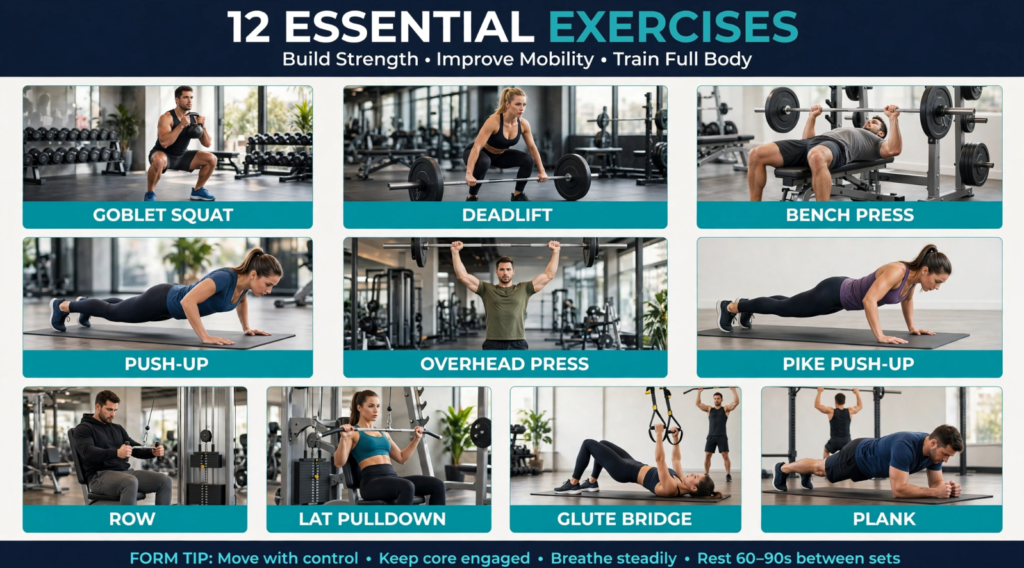
The foundation of any weightlifting program rests on compound movements—exercises that work multiple muscle groups at once.
| Exercise | Primary Muscles Worked | Why It Matters |
|---|---|---|
| Squat | Quads, Glutes, Hamstrings, Core | Builds foundational lower body strength and mobility |
| Deadlift | Full Posterior Chain (Back, Glutes, Hamstrings) | Develops full-body strength and functional lifting capacity |
| Bench Press | Chest, Shoulders, Triceps | Builds upper body pushing strength |
| Overhead Press | Shoulders, Triceps, Upper Chest | Develops shoulder strength and stability |
| Bent-Over Row | Back, Biceps, Rear Deltoids | Builds pulling strength and improves posture |
For beginners, start with lighter weights to ensure correct posture and movement mechanics, especially during complex lifts like the squat and deadlift. Consider working with a qualified trainer initially to learn proper form.
Pillar 2: Calisthenics (Bodyweight Training)
Calisthenics is strength training that uses your own body weight as resistance. No gym membership required—just you, gravity, and the willingness to move.
What It’s Good For:
- Building functional, practical strength that translates to daily life
- Improving joint stability, coordination, and balance
- Training anywhere, anytime—no equipment needed
- Developing core endurance and body awareness
- Building relative strength (strength relative to body weight)
Key Exercises for Beginners:
| Exercise | Primary Muscles Worked | Why It Matters |
|---|---|---|
| Push-ups (or Knee Push-ups) | Chest, Shoulders, Triceps, Core | Builds upper body pushing strength and core stability |
| Bodyweight Squats | Quads, Glutes, Hamstrings | Develops lower body strength and mobility |
| Planks | Core, Shoulders, Glutes | Builds core stability and endurance |
| Glute Bridges | Glutes, Hamstrings, Lower Back | Strengthens posterior chain and supports lower back health |
| Bird Dogs | Core, Glutes, Shoulders | Improves core stability, balance, and coordination |
The Beauty of Scalability:
The beauty of calisthenics is its scalability. Can’t do a full push-up? Start with wall push-ups or knee push-ups. Can’t do a pull-up? Start with scapular pull-ups or bodyweight rows. There’s always a variation that matches your current level.
| Exercise | Beginner | Intermediate | Advanced |
|---|---|---|---|
| Push-up | Wall → Incline → Knee | Full Push-up | Diamond → Decline → Archer |
| Squat | Box Squat | Full Squat | Deep Squat → Bulgarian Split Squat → Pistol |
| Plank | Knee Plank | Full Plank | Side Plank → Weighted Plank |
Pillar 3: Core Stability
Your core is far more than your “six-pack” muscles. It’s the command center for all movement—a complex system of muscles that stabilizes your spine, transfers force between your upper and lower body, and protects your lower back.
The Core System:
| Muscle | Location | Function |
|---|---|---|
| Transverse Abdominis | Deepest abdominal layer | Acts like a corset, compressing and stabilizing the spine |
| Rectus Abdominis | Front of the abdomen (the “six-pack”) | Flexes the spine |
| Internal and External Obliques | Sides of the abdomen | Rotate and laterally flex the spine |
| Erector Spinae | Along the spine in the back | Extends and stabilizes the spine |
| Multifidus | Deep along the spine | Provides segmental spinal stability |
| Pelvic Floor | Base of the core | Supports pelvic organs and contributes to intra-abdominal pressure |
| Diaphragm | Top of the core | Primary breathing muscle; critical for core bracing |
Key Distinction: Core Strength vs. Core Stability
- Core Strength: The ability of your core muscles to generate force (e.g., crunches)
- Core Stability: The ability of your core muscles to control and maintain the position of your spine during movement (e.g., planks, dead bugs)
For lifting and daily life, stability is more important than strength. When you squat or deadlift, your core doesn’t generate the force that moves the barbell—your legs and hips do. Your core’s job is to transmit that force while keeping your spine safe.
Key Exercises for Beginners:
| Exercise | Why It Works |
|---|---|
| Dead Bug | Teaches core control and coordination while stabilizing the spine |
| Bird Dog | Builds core stability and balance while strengthening the posterior chain |
| Plank (Forearm or Hands) | Develops endurance in the entire core system |
| Glute Bridge | Activates the posterior chain and supports the lower back |
| Hollow Body Hold | Builds foundational core tension and body control |
Section 2: The Hybrid Approach—Why Combining All Three Works
The debate between weightlifting and calisthenics is over. The answer is: both. And core stability is the foundation that supports everything.
The Synergy
| Approach | Primary Benefit | How It Complements the Others |
|---|---|---|
| Weightlifting | Maximal strength and muscle mass | Provides the heavy loading needed for bone density and maximal strength |
| Calisthenics | Functional strength and body control | Builds joint stability, balance, and movement quality |
| Core Stability | Spinal protection and force transfer | Protects your back during heavy lifts and improves all other movements |
The Hybrid Advantage
When you combine all three, you get:
- Strength + Function: Maximal strength from weights + functional movement from calisthenics
- Muscle + Control: Hypertrophy from weights + body control from calisthenics
- Joint Protection: Calisthenics strengthens stabilizers and connective tissues, protecting joints during heavy lifting
- Injury Prevention: Core stability protects your spine during all movements
- Variety + Sustainability: Mixing modalities keeps training interesting and reduces burnout
- Accessibility: You can train anywhere with calisthenics while also benefiting from weights when you have access
Section 3: Getting Started—Your Action Plan
Step 1: Master the Five Foundational Movement Patterns
All effective strength training—whether with weights or bodyweight—revolves around five fundamental movement patterns:
| Movement Pattern | Weightlifting Example | Calisthenics Example | Why It Matters |
|---|---|---|---|
| Push | Bench Press, Overhead Press | Push-ups, Dips | Builds upper body pushing strength |
| Pull | Bent-Over Row, Pull-downs | Pull-ups, Bodyweight Rows | Develops back strength and posture |
| Hinge | Deadlift, Romanian Deadlift | Glute Bridges, Single-leg Deadlifts | Builds posterior chain power and protects the lower back |
| Squat | Barbell Squat, Goblet Squat | Bodyweight Squats, Lunges | Develops foundational lower body strength |
| Core Stabilization | Plank with Weight, Pallof Press | Planks, Dead Bugs, Bird Dogs | Protects the spine and transfers force |
Building strength in all five patterns ensures balanced development, prevents muscle imbalances, and reduces injury risk.
Step 2: Choose Your Starting Point
Option A: Gym-Based (Weightlifting Focus)
- Ideal if you have access to a gym or home equipment
- Start with two to three full-body sessions per week
- Focus on mastering form with light weights before adding load
- Progress by adding 2.5–5 lbs to main lifts each week
Option B: Home-Based (Calisthenics Focus)
- Perfect if you prefer training at home or have limited equipment
- Start with three sessions per week on non-consecutive days
- Progress by increasing reps, sets, or trying harder variations
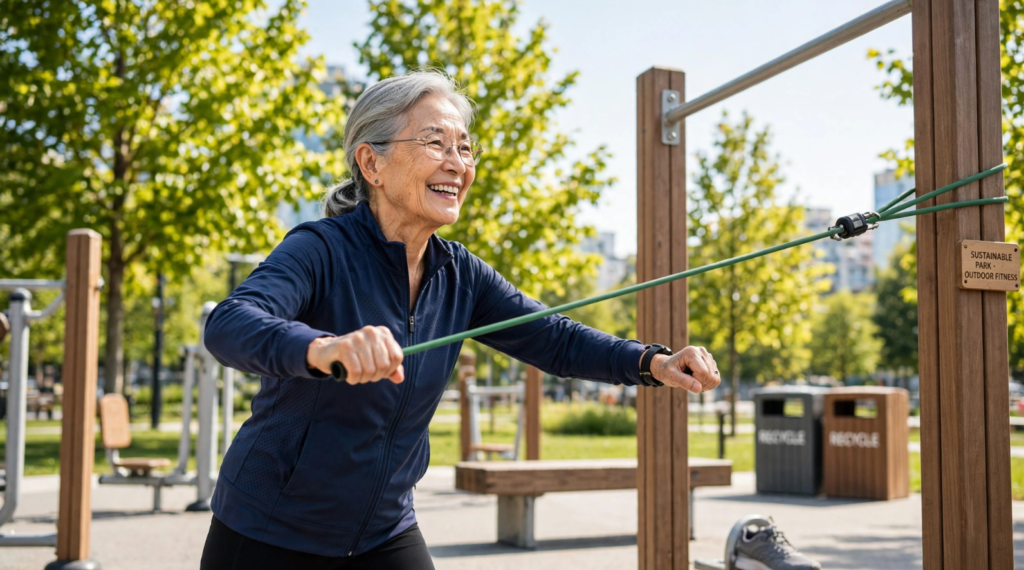
- Add a pull-up bar and resistance bands as you progress
Option C: Hybrid Approach (Recommended)
- Combine weightlifting for maximal strength with calisthenics for functional movement and core work
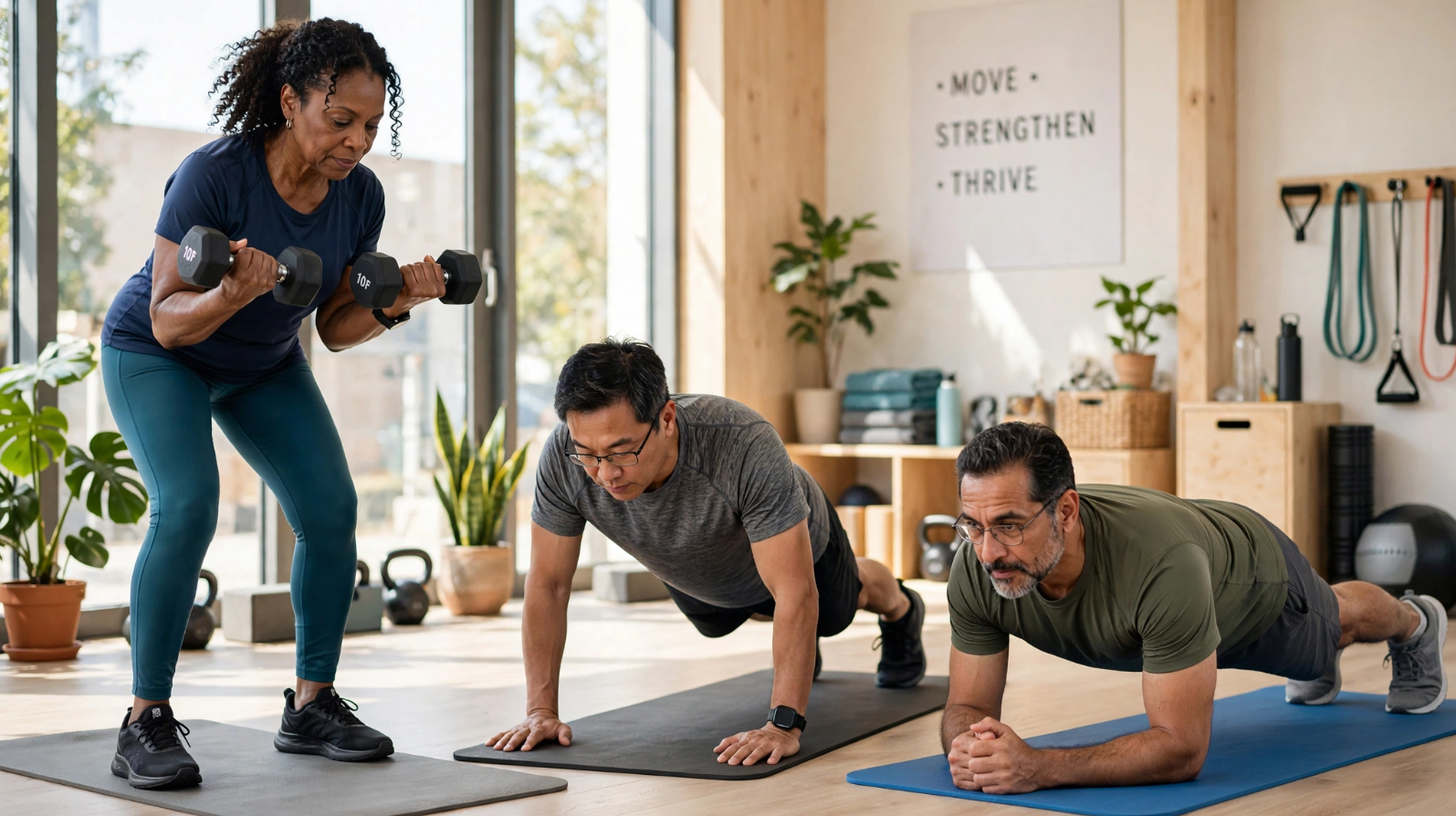
- Example: Two days of weightlifting + one day of calisthenics and core per week
- This is the most complete approach for long-term health and performance
Step 3: Sample Beginner Weekly Schedule (Hybrid Approach)
Here’s a practical, beginner-friendly weekly plan that combines all three approaches:
| Day | Focus | Sample Exercises |
|---|---|---|
| Monday | Full Body (Weights) | Goblet Squats, Dumbbell Bench Press, Bent-Over Rows, Plank |
| Tuesday | Rest or Active Recovery | Light walking, stretching, mobility work |
| Wednesday | Calisthenics & Core | Push-ups (or knee), Bodyweight Squats, Glute Bridges, Bird Dogs, Dead Bugs |
| Thursday | Rest or Active Recovery | Light walking, stretching, mobility work |
| Friday | Full Body (Weights) | Dumbbell Deadlifts, Overhead Press, Lunges, Side Plank |
| Saturday | Optional Light Activity | Walking, cycling, yoga, or light mobility |
| Sunday | Complete Rest | Full recovery day |
This schedule follows the CDC recommendation of two strength training sessions per week to hit all major muscle groups—with an additional calisthenics day for variety and core focus.
Step 4: Understand Progressive Overload
Progressive overload is the most important principle in strength training. It simply means gradually increasing the challenge to your muscles over time.
Why It Matters:
Your body adapts to stress. If you lift the same weight for the same reps week after week, your muscles have no reason to grow stronger. You’re maintaining, not building.
Five Ways to Apply Progressive Overload:
- Increase weight: Add 2.5–5 lbs when you can complete all reps with good form
- Increase reps: Add one or two more reps per set
- Increase sets: Add an additional set of an exercise
- Improve execution: Deepen your squat, slow down the tempo, or increase range of motion
- Decrease rest: Shorten rest periods between sets (advanced)
For Beginners: Start with a weight that allows you to perform 8–12 reps with good form, but with some difficulty—leaving about 2–3 reps “in the tank.” Each week, try to add a little more weight or one more rep.
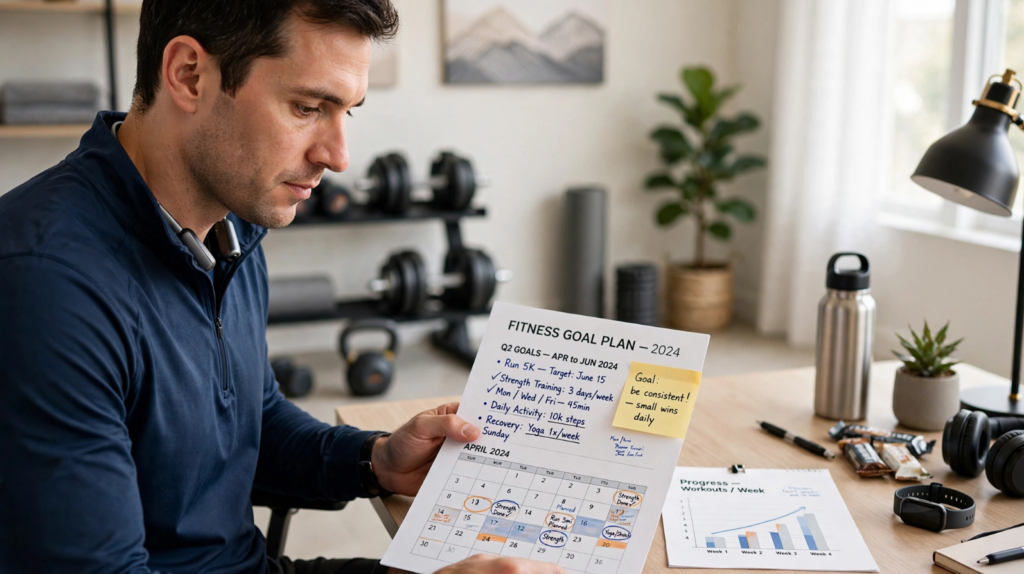
Step 5: Track Your Progress
What to Track:
| Data Point | Why Track It |
|---|---|
| Exercise | Know exactly what you did |
| Weight Used | Track strength gains |
| Sets and Reps | Track volume and capacity |
| Perceived Effort (RPE 1–10) | Track how hard each set felt |
| Notes | Track form issues, how you felt, energy levels |
Sample Training Log Entry:
| Date: 7/20/2026 | Day: Monday | Workout: Full Body A | |
|---|---|---|---|
| Exercise | Weight | Sets x Reps | RPE |
| Goblet Squats | 45 lbs | 3 x 10, 10, 9 | 7/10 |
| Push-ups | Bodyweight | 3 x 12, 10, 9 | 8/10 |
| Dumbbell Rows | 35 lbs | 3 x 12, 12, 11 | 7/10 |
| Plank | Bodyweight | 3 x 45s, 45s, 40s | 7/10 |
Section 4: Form Fundamentals—Do These Right
The Squat
- Feet shoulder-width apart, toes slightly turned out
- Keep your chest up and back straight
- Lower your hips back and down as if sitting in a chair
- Aim for at least parallel (thighs parallel to the floor)
- Drive through your heels to return to standing
- Common Mistake: Knees caving inward—push them out to track over your toes
The Push-up
- Hands slightly wider than shoulder-width
- Body forms a straight line from head to heels
- Lower your chest toward the floor, elbows at about 45 degrees
- Push back up without sagging your hips or arching your back
- Common Mistake: Sagging hips—engage your glutes and core
The Plank
- Forearms on the floor, elbows directly under shoulders
- Body forms a straight line from head to heels
- Engage your core by pulling your belly button toward your spine
- Hold without letting your hips sag or pike up
- Common Mistake: Sagging or piking hips—maintain a straight line
The Deadlift (Dumbbell or Barbell)
- Stand with feet hip-width apart, weight over mid-foot
- Hinge at your hips, keeping your back straight
- Lower the weight while maintaining a neutral spine
- Drive through your heels to stand up, squeezing your glutes at the top
- Never round your lower back—this is the #1 danger in the deadlift
The Bird Dog
- Start on all fours, hands under shoulders, knees under hips
- Keep your back flat and core engaged
- Extend your right arm forward and left leg back simultaneously
- Hold for 2 seconds, then return to start
- Repeat on the opposite side
- Common Mistake: Rotating your hips—keep them level throughout
Section 5: Avoiding Common Beginner Mistakes
Mistake 1: Using Too Much Weight Too Soon
The Problem: Using more weight than you can handle with good form.
The Fix: Prioritize form over weight. It’s better to lift light with perfect technique than heavy with poor form. Master the movement pattern first; the weight will come.
Mistake 2: Skipping the Warm-Up
The Problem: Jumping straight into working sets without preparing your body.
The Fix: Spend 5–10 minutes on dynamic warm-up—light cardio (jumping jacks, arm circles, leg swings) and movement preparation. This increases blood flow to working muscles and lowers injury risk.
Mistake 3: Neglecting Core Work
The Problem: Focusing only on “mirror muscles” (chest, arms) and ignoring the core.
The Fix: Include core stability exercises in every workout, not just on “ab day.” A strong core protects your lower back and improves performance in every other exercise.
Mistake 4: Not Tracking Progress
The Problem: Guessing what you did last week instead of knowing.
The Fix: Keep a simple workout log. Record the exercises, weight, sets, and reps you perform. This allows you to see progress and apply progressive overload systematically.
Mistake 5: Inconsistent Training
The Problem: Training intensely for a few weeks, then stopping.
The Fix: Schedule your workouts like any other important appointment. Two to three sessions per week, consistently, will produce far better results than sporadic bursts of intense training.
Mistake 6: Holding Your Breath
The Problem: Forgetting to breathe during heavy lifts.
The Fix: Exhale during the exertion phase (the hardest part) and inhale during the easier phase. For example, breathe out as you push up from a push-up, and in as you lower down.
Section 6: Sample Beginner Workouts
Workout A: Full Body (Weightlifting Focus)
| Exercise | Sets | Reps | Rest |
|---|---|---|---|
| Goblet Squat | 3 | 10–12 | 60–90 sec |
| Dumbbell Bench Press | 3 | 10–12 | 60–90 sec |
| Bent-Over Dumbbell Row | 3 | 10–12 | 60–90 sec |
| Plank | 3 | 30–45 sec | 45–60 sec |
Progression: Add 2.5–5 lbs to each exercise when you can complete all reps with good form.
Workout B: Calisthenics & Core
| Exercise | Sets | Reps/Duration | Rest |
|---|---|---|---|
| Knee Push-ups (or full) | 3 | 8–12 | 60 sec |
| Bodyweight Squats | 3 | 15–20 | 60 sec |
| Glute Bridges | 3 | 12–15 | 60 sec |
| Bird Dogs | 3 | 10 each side | 45 sec |
| Dead Bugs | 3 | 10 each side | 45 sec |
Progression: Increase reps by 1–2 per set each week. When you can do 3 sets of 15 with good form, progress to a harder variation.
Workout C: Full Body (Weightlifting Focus)
| Exercise | Sets | Reps | Rest |
|---|---|---|---|
| Dumbbell Deadlift | 3 | 10–12 | 60–90 sec |
| Overhead Press | 3 | 10–12 | 60–90 sec |
| Dumbbell Lunges | 3 | 10 each side | 60–90 sec |
| Side Plank | 3 | 20–30 sec each side | 45 sec |
Progression: Add 2.5–5 lbs to each exercise when you can complete all reps with good form.
Section 7: Nutrition and Recovery—The Missing Pieces
Protein: The Building Block of Muscle
Muscle protein synthesis is triggered by resistance training and supported by adequate protein intake.
Recommended Protein Intake:
- Minimum: 0.8 grams per pound of body weight
- Optimal: 1.0–1.2 grams per pound of body weight
Example: A 180-pound person should aim for 144–216 grams of protein per day.
Best Protein Sources:
- Lean meats (chicken, turkey, lean beef)
- Fish (salmon, tuna, cod)
- Eggs and egg whites
- Greek yogurt and cottage cheese
- Legumes (beans, lentils)
- Plant-based options (tofu, tempeh, edamame)
- Protein supplements (whey, casein, plant-based protein powders)
Sleep: When the Magic Happens
Muscles don’t grow in the gym—they grow during recovery. Sleep is when your body releases growth hormone and repairs damaged tissue.
Sleep Guidelines:
- Aim for 7–9 hours per night
- Consistent sleep schedule: Go to bed and wake up at the same time
- Sleep environment: Cool, dark, quiet room
- Limit screen time 60–90 minutes before bed
Hydration
Even mild dehydration impairs performance and recovery.
Hydration Guidelines:
- Drink water consistently throughout the day
- Aim for 8–10 cups (64–80 oz) minimum
- More if you’re sweating heavily
- Signs of dehydration: Dark urine, fatigue, headache, dizziness
Section 8: FAQ—Your Top Beginner Questions
Q: How many times per week should I strength train?
A: For beginners, two to three sessions per week is ideal. This provides enough stimulus for progress while allowing adequate recovery. Always have at least one rest day between strength sessions.
Q: Do I need to join a gym?
A: Not necessarily. Calisthenics can be done anywhere with no equipment. If you want to include weightlifting, a pair of adjustable dumbbells at home can cover most exercises. A gym membership offers more variety but isn’t required to get started.
Q: What if I can’t do a single push-up or pull-up?
A: That’s completely normal! Start with easier variations:
- Push-ups: Start with wall push-ups, then incline push-ups, then knee push-ups, then full push-ups
- Pull-ups: Start with scapular pull-ups, then bodyweight rows, then assisted pull-ups (with bands or a chair)
Q: Will lifting weights make me bulky?
A: This is one of the most common myths. Building significant muscle mass requires years of dedicated training, specific nutrition, and often favorable genetics. For most people, strength training results in a toned, lean, and functional physique—not “bulky.”
Q: Is strength training safe for people over 40 with joint issues?
A: Yes, when done correctly. In fact, strength training strengthens the muscles and connective tissues around joints, which can reduce pain and improve function. Start with light resistance, prioritize proper form, and consider working with a qualified trainer initially. Always consult your doctor before starting any new exercise program.
Q: How long before I see results?
A: Many beginners notice improved energy and confidence within 2–4 weeks. Visible changes in muscle tone typically appear in 6–12 weeks with consistent training and proper nutrition. Remember: this is a marathon, not a sprint.
Q: Should I stretch before or after my workout?
A: Before: Perform dynamic stretching (movement-based stretching like leg swings, arm circles, torso twists). After: Perform static stretching (holding stretches for 15–30 seconds). Dynamic stretching prepares your body for movement; static stretching helps with recovery and flexibility.
Q: What should I eat before and after a workout?
A: Before (1–2 hours): A light meal with carbohydrates and protein (e.g., banana with peanut butter, Greek yogurt with fruit). After (30–60 minutes): A meal with protein and carbohydrates to support recovery (e.g., chicken with rice, protein shake with fruit).
The VigorForty Take
Strength training is not about vanity. It’s about capability—the ability to live your life fully, independently, and without pain. It’s about carrying your own groceries, playing with your grandchildren, hiking that trail you’ve always wanted to explore, and simply feeling strong and capable in your own body.
You don’t need to be an athlete. You don’t need to lift heavy weights on day one. You don’t need a perfect gym or expensive equipment. You just need to start.
The hybrid approach—combining weightlifting, calisthenics, and core stability—is the most complete path to lifelong strength and health. It gives you the muscle-building power of weights, the functional movement of bodyweight training, and the injury-prevention benefits of core work.
Start with one workout this week. Then another. Then another. Focus on form, be patient with yourself, and trust the process. Your body is remarkably responsive—it will meet you where you are and take you further than you think possible.
The best time to start strength training was ten years ago. The second best time is today.
Your stronger, healthier future starts now.
This article was reviewed by the Vigor Forty Editorial Review Board on July 19, 2026.
🔗 Related Articles
- Weightlifting 101: A Simple Guide for Beginners
- Calisthenics for Beginners: Your First Bodyweight Workout Plan
- What is Core Stability and Why Does It Matter for Every Lift?
- How to Perform a Perfect Squat: Form Tips for Weightlifting and Bodyweight
- 5 Foundational Movement Patterns for a Stronger Body
Affiliate Disclosure: Some links in this article may be affiliate links. If you make a purchase through these links, Vigor Forty may earn a small commission at no extra cost to you. We only recommend products we trust.
Related Articles
- The Ultimate Beginner’s Guide to Strength Training (Weightlifting, Calisthenics, and Core)
- Weightlifting 101: A Simple Guide for Beginners
- Calisthenics for Beginners: Your First Bodyweight Workout Plan
- What is Core Stability and Why Does It Matter for Every Lift?
- 5 Foundational Movement Patterns for a Stronger Body
- Perfect Your Push-Up: A Step-by-Step Guide to Building Upper Body Strength
- How to Perform a Perfect Squat: Form Tips for Weightlifting and Bodyweight
- The Plank: More Than Just an Ab Exercise
- How to Combine Calisthenics and Weight Training for Maximum Results
- Sample Weekly Workout Plan: Combining Weights, Bodyweight, and Core
- The Importance of Progressive Overload in Strength Training
- How to Progress Calisthenics Exercises When Bodyweight Gets Easy
- Home Gym vs. Gym Membership: Which is Right for You?
- The Minimalist’s Guide to Strength Training: No Equipment Needed
- Top 5 Pieces of Equipment for a Home Strength Training Setup
- How to Choose the Right Weight for Your Workouts