
Author: Vigor Forty Editorial Team
Medically Reviewed By: Editorial Review Board
Disclaimer: This article is for informational purposes only and is not a substitute for professional medical advice. Read our full Medical Disclaimer.
📌 Key Takeaways
- Your core is far more than your “six-pack”: It’s a complex system of muscles—including the transverse abdominis, obliques, pelvic floor, diaphragm, and spinal stabilizers—that work together to stabilize your spine and transfer force between your upper and lower body.
- Core stability is different from core strength: Stability is the ability to maintain control of your spine during movement; strength is the ability to generate force. Both matter, but stability is the foundation for everything else.
- A stable core protects your lower back: Weak core stability is one of the leading causes of low back pain—a condition that affects approximately 80% of Americans at some point in their lives.
- Every lift depends on a stable core: Whether you’re squatting, deadlifting, pressing, or doing a push-up, your core must brace to transmit force and protect your spine. Without core stability, your strength is limited and your injury risk is elevated.
- Core stability is trainable: Exercises like planks, dead bugs, bird dogs, and Pallof presses build the kind of stability that transfers directly to lifting performance and daily life.
Introduction: The Foundation You Didn’t Know You Were Missing
Imagine building a house on sand. No matter how beautiful the architecture, how strong the materials, or how skilled the craftsmen, the structure will eventually crack, shift, or collapse. The foundation simply can’t support what’s built on top of it.
Your core is the foundation of your body.
Every movement you make—from picking up a grocery bag to performing a heavy deadlift—originates in and is transmitted through your core. If your core is weak or unstable, you’re building your strength on sand. Your lifts will be limited, your joints will compensate, and eventually, something will give.
The most common site of failure? The lower back.
Low back pain is the leading cause of disability worldwide, and approximately 80% of Americans will experience it at some point in their lives. In many cases, the root cause is not a “weak back” but a core that fails to stabilize the spine during movement. When your core checks out, your lower back bears the load—and it wasn’t designed for that.
This guide will explain what core stability really means, why it’s critical for every lift and every movement, and how to build the kind of core stability that will protect your spine and unlock your full strength potential.
Section 1: Your Core—More Than Just Abs
The Anatomy of the Core
The core is a complex system of muscles, not just the visible rectus abdominis (the “six-pack”). It’s often described as a cylinder of muscle that surrounds your spine and abdominal cavity.
The Key Core Muscles:
| Muscle | Location | Function |
|---|---|---|
| Transverse Abdominis | Deepest abdominal layer | Acts like a corset, compressing and stabilizing the spine |
| Rectus Abdominis | Front of the abdomen (the “six-pack”) | Flexes the spine (e.g., crunches) |
| Internal and External Obliques | Sides of the abdomen | Rotate and laterally flex the spine |
| Erector Spinae | Along the spine in the back | Extends and stabilizes the spine |
| Multifidus | Deep along the spine | Provides segmental spinal stability |
| Quadratus Lumborum | Deep in the lower back | Stabilizes the pelvis and spine |
| Pelvic Floor | Base of the core | Supports pelvic organs and contributes to intra-abdominal pressure |
| Diaphragm | Top of the core | Primary breathing muscle; critical for core bracing |
Key Insight: Your core is a 360-degree system. It’s not just the muscles in the front—it’s the front, sides, back, top, and bottom. A truly stable core requires balanced development across all these muscles.
Core Strength vs. Core Stability
These terms are often used interchangeably, but they mean different things—and understanding the distinction is crucial.
- Core Strength: The ability of your core muscles to generate force. This is what you’re training when you do crunches or leg raises.
- Core Stability: The ability of your core muscles to control and maintain the position of your spine during movement—especially when external forces (like a heavy barbell) are applied.
Think of it this way: core strength is about how much force you can produce; core stability is about how well you can control your spine while producing that force.
Why stability matters more for lifting: When you squat or deadlift, you don’t need your core to generate the force that moves the barbell. Your legs and hips do that. Your core’s job is to transmit that force while keeping your spine safe. If your core can’t stabilize, the force leaks, and your spine—particularly your lumbar spine—absorbs the stress it wasn’t built to handle.
Section 2: Why Core Stability Matters for Every Lift
The Core as a Force Transmitter
Think of your body as a chain. Your legs generate force against the ground, and that force travels up through your hips, your spine, and your shoulders to the barbell. Your core is the link between your lower and upper body.
If your core is stable:
- Force transfers efficiently from your legs to the barbell
- Your spine maintains a neutral, protected position
- Your lifts feel strong and controlled
- Your injury risk is minimized
If your core is unstable:
- Force leaks—you’ll be unable to lift as much weight
- Your spine is exposed to shear and compressive forces
- Your lower back overworks to compensate
- Your injury risk skyrockets
Core Stability in Specific Lifts
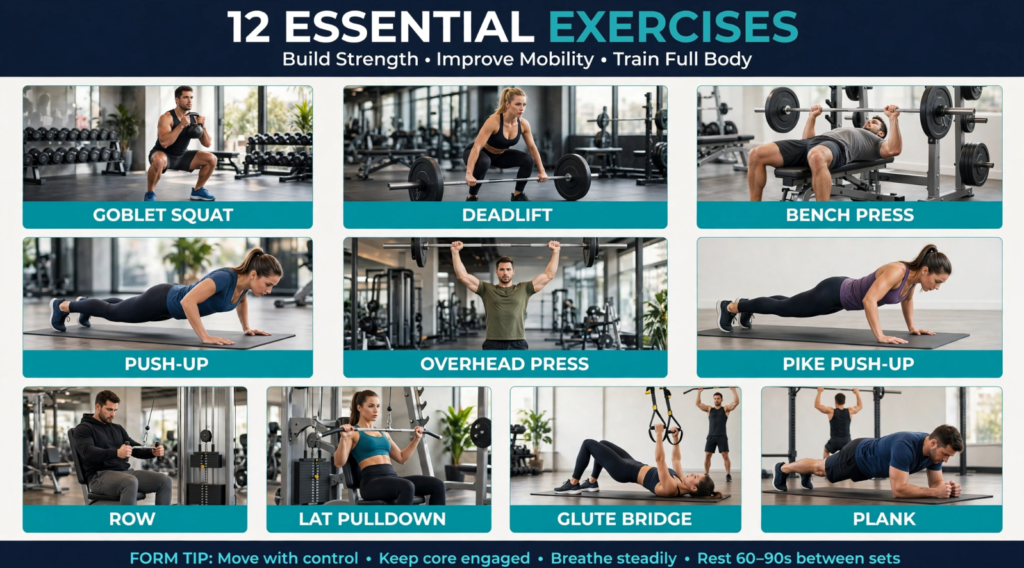
The Squat: As you descend into a squat, the barbell loads your spine. Your core must brace to maintain a neutral spine position, preventing your chest from collapsing forward or your lower back from rounding. Without core stability, the weight pulls you forward—and your back pays the price.
The Deadlift: The deadlift demands maximum core stability. As you pull the weight from the floor, your core must create massive intra-abdominal pressure to stabilize your lumbar spine. This “bracing” protects your back from the immense forces of the lift.
The Overhead Press: Pressing a barbell overhead demands core stability to prevent your spine from hyperextending or shifting sideways. Your core braces to create a stable platform for the pressing movement.
The Push-up: Even in a push-up, your core must engage to maintain a straight line from head to heels. If your core isn’t stable, your hips sag or pike up—reducing the effectiveness of the exercise and stressing your lower back.
Practical Takeaway: Every lift is a core exercise. You cannot safely or effectively perform any significant strength movement without core stability.
The Back Pain Connection
Low back pain is among the most common reasons Americans visit their doctors. While the causes are multifactorial, core instability is often a contributing factor.
Here’s what happens: when your core fails to stabilize your spine, the paraspinal muscles (the muscles along your spine) and the spinal ligaments take on extra load. Over time, this leads to:
- Muscle strain and fatigue
- Ligament sprains
- Disc compression and degeneration
- Joint dysfunction and pain
The solution isn’t to “rest your back.” It’s to strengthen the system that protects it. Many studies have demonstrated that core stabilization training is among the most effective interventions for low back pain—often more effective than general exercise or medical management alone.
Section 3: The Science of Bracing—How Your Core Protects Your Spine
Intra-Abdominal Pressure
One of the core’s most important functions is generating intra-abdominal pressure (IAP) .
When you take a deep breath into your belly (not your chest) and then brace your core, you increase the pressure inside your abdominal cavity. This pressure acts like an internal “airbag” that supports your spine from the inside, reducing the load on your vertebral discs and ligaments.
Here’s how to brace properly:
- Take a deep breath into your belly—your diaphragm moves down, pushing your abdomen out
- Contract your core muscles—imagine someone is about to punch you in the stomach
- Create 360-degree tension—you should feel pressure in your front, sides, and back
- Maintain the brace throughout the entire lift
Key Insight: This is not the same as “sucking in” your stomach. Sucking in draws your navel toward your spine, which reduces stability. Bracing is about creating outward pressure—imagine you’re wearing a tight weightlifting belt (even without one).
Neutral Spine Position
Core stability isn’t about freezing your spine in a rigid position. It’s about maintaining a neutral spine during movement—the natural “S” curve of your back that optimally distributes load.
During a squat or deadlift, your spine should be in a neutral position: slightly arched in the lower back, neither excessively rounded nor hyperextended. Core stability allows you to maintain this position even under heavy load.
Why neutral matters:
- Discs are strongest and most resilient in a neutral position
- Ligaments are not stressed beyond their normal range
- Muscles can optimally generate and transmit force
Section 4: The Best Core Stability Exercises
Forget crunches. Forget sit-ups. Here are the exercises that actually build the kind of core stability that protects your spine and supports your lifts.
Exercise 1: The Dead Bug
The dead bug is arguably the single best core stability exercise for beginners and advanced lifters alike.
Why it works:
- It teaches you to stabilize your spine while moving your limbs
- It strengthens the deep core muscles (transverse abdominis, pelvic floor)
- It’s low-risk—no spinal loading
Form:
- Lie on your back with arms extended toward the ceiling and legs lifted with knees at 90 degrees (tabletop position)
- Press your lower back firmly into the floor—there should be no space
- Maintain this back position while slowly extending your right arm and left leg toward the floor
- Pause, then return to the starting position
- Repeat on the opposite side
Sets & Reps: 3 sets of 8–12 reps per side
Progression:
- Extend your limbs further toward the floor for greater challenge
- Hold a light weight in your hands
Exercise 2: The Bird Dog
The bird dog builds core stability while challenging your balance and coordination.
Why it works:
- It forces your core to stabilize your spine while you move your limbs
- It strengthens the posterior core (spinal extensors, glutes, hamstrings)
- It improves balance and proprioception
Form:
- Start on all fours, hands under shoulders, knees under hips
- Keep your back flat, core engaged
- Extend your right arm forward and left leg back simultaneously—maintaining a flat back and level hips
- Hold for 2–3 seconds, squeezing your glutes and engaging your core
- Return to start, then repeat on the opposite side
Sets & Reps: 3 sets of 10–12 reps per side
Progression:
- Hold the extended position for 5 seconds
- Use ankle weights or resistance bands
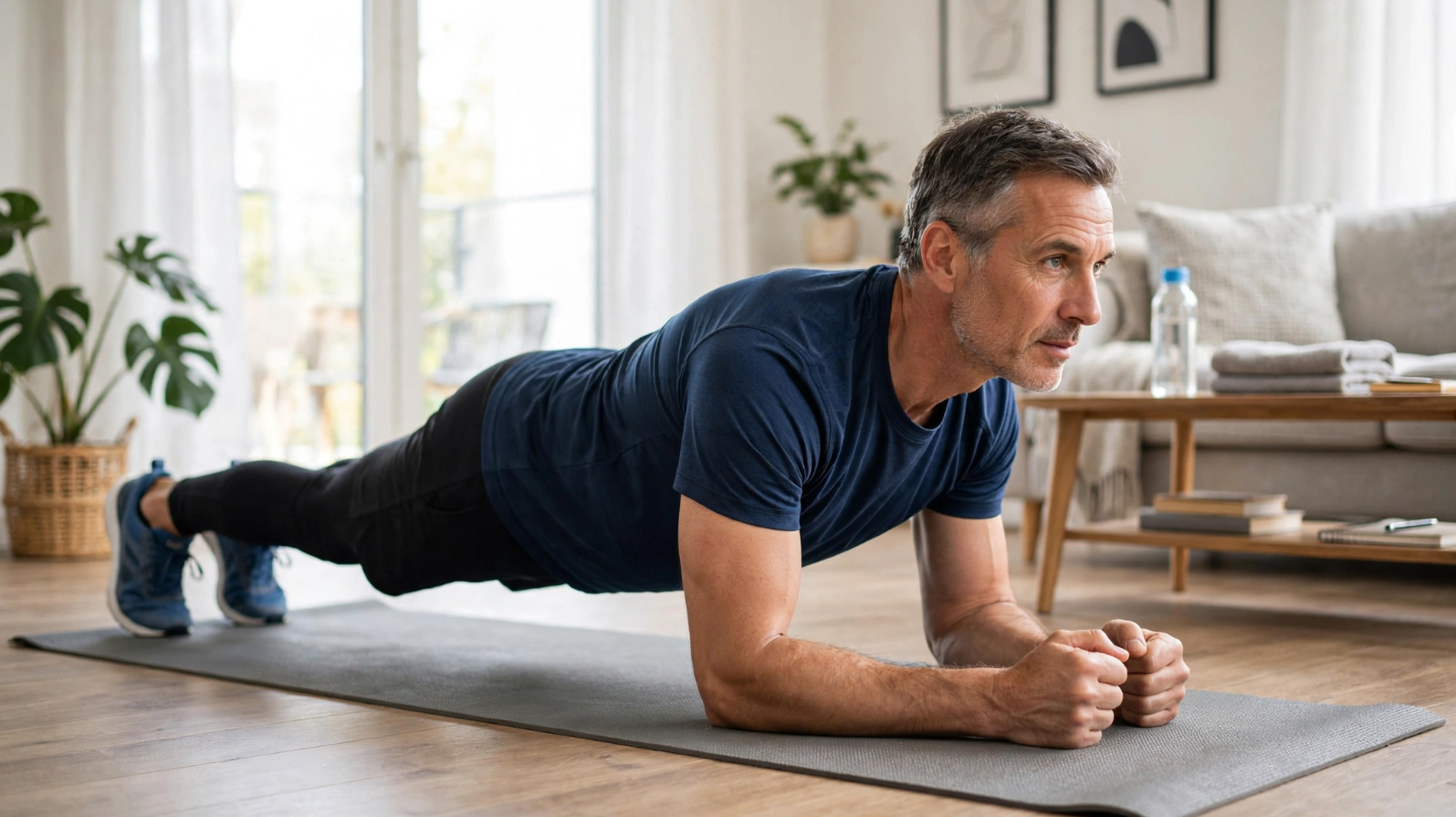
Exercise 3: The Plank (Forearm and Hands)
The plank is the classic core stability exercise—and for good reason.
Why it works:
- It’s a full-core activation exercise
- It builds endurance in the core muscles
- It’s scalable for all levels
Form:
- Forearms on the floor, elbows directly under shoulders
- Body forms a straight line from head to heels
- Squeeze your glutes and engage your core—imagine pulling your belly button toward your spine
- Hold the position without letting your hips sag or pike up
Sets & Hold Times: 3 sets of 30–60 seconds
Progression:
- Increase hold time
- Progress to high plank (hands on floor)
- Add side planks
- Add plank with shoulder taps
Exercise 4: The Pallof Press
The Pallof press is an anti-rotation exercise—it forces your core to resist rotation.
Why it works:
- It trains rotational stability, often neglected in core training
- It builds strength in the obliques and transverse abdominis
- It’s highly functional for sports and daily life
Form (requires a cable machine or resistance band):
- Stand perpendicular to a cable machine or anchor point
- Grasp the handle with both hands at chest height
- Step away from the anchor to create tension
- Press the handle directly forward, resisting the rotational pull
- Hold for 2–3 seconds, then return slowly
Sets & Reps: 3 sets of 10–12 reps per side
Progression:
- Increase the resistance
- Use a staggered stance for more challenge
Exercise 5: The Farmer’s Carry
The farmer’s carry builds core stability under load—it’s one of the most functional exercises you can do.
Why it works:
- It forces your core to stabilize your spine against lateral forces
- It builds grip strength and endurance
- It translates directly to carrying groceries, luggage, and children
Form:
- Hold a heavy dumbbell or kettlebell in each hand
- Stand tall with shoulders back, core braced
- Walk with steady, controlled steps
- Maintain an upright posture—don’t lean to one side
Sets & Hold Times: 3 sets of 30–60 seconds walking
Progression:
- Increase weight
- Carry a single heavy weight on one side (anti-lateral flexion)
Section 5: Your Core Stability Workout Plan
Here’s a complete core stability workout to perform 2–3 times per week after your main lifting session or on dedicated core days.
Core Stability Workout
| Exercise | Sets | Reps/Duration | Rest |
|---|---|---|---|
| Dead Bugs | 3 | 10 per side | 45 sec |
| Bird Dogs | 3 | 10 per side | 45 sec |
| Plank (Forearm) | 3 | 30–60 seconds | 45 sec |
| Side Plank | 3 | 20–40 seconds per side | 45 sec |
| Glute Bridge | 3 | 15 reps | 45 sec |
Integration with Your Lifts
Many lifters make the mistake of doing core work only on “ab days.” Instead, integrate core stability training directly into your lifting sessions:
- Before your main lift: Perform dead bugs or bird dogs to activate your core
- Between sets: Perform plank holds or glute bridges
- After your workout: Complete the core stability workout above
Key Insight: This approach reinforces core stability when you need it most—during your heavy lifts.
Section 6: Core Stability in Daily Life
Core stability isn’t just for the gym. It’s for your life.
In the Kitchen
- Bracing to lift a heavy pot: Apply the same bracing technique you use for a deadlift
- Standing at the counter: Maintain a neutral spine, not a slumped posture
In the Garden
- Lifting bags of soil: Squat, brace your core, lift with your legs
- Raking or shoveling: Engage your core to protect your back during twisting movements
At the Office
- Sitting at your desk: Maintain core engagement to support your lower back
- Lifting boxes: Apply proper lifting mechanics—braced core, neutral spine, legs driving
With Your Family
- Playing with your kids: Core stability helps you get down to the floor and back up comfortably
- Carrying a tired child: Maintain an upright posture, not a swayback
The ultimate goal: Core stability isn’t something you do for 15 minutes in the gym and forget. It’s a skill you carry with you throughout your day to protect your back and move with confidence.
Section 7: FAQ—Your Top Core Stability Questions
Q: Is it better to do core exercises before or after my main lifts?
A: This depends on your goals. If you’re a beginner, doing core activation exercises (like dead bugs and bird dogs) before your main lifts can improve your bracing during those lifts. However, doing a full core stability workout before heavy squats or deadlifts can pre-fatigue your core and compromise your lifting technique. Most experts recommend performing core exercises after your main lifts or on separate days.
Q: How many times per week should I train core stability?
A: 2–3 times per week is ideal for most people. More than that may not provide additional benefit, especially if you’re already doing compound lifts that engage the core. Quality over quantity.
Q: Are crunches and sit-ups bad for you?
A: Not necessarily bad, but they’re often overemphasized. Crunches and sit-ups primarily train the rectus abdominis in a limited range of motion. For core stability, exercises like planks, dead bugs, and bird dogs are more functional and less stressful on the lower back. If you choose to include crunches, do them with controlled form and don’t make them your only core work.
Q: Why does my lower back hurt during planks?
A: This is usually a sign that you’re not engaging your core properly. If your hips sag toward the floor, your lower back takes the load. Try to tuck your pelvis slightly and squeeze your glutes—this should help maintain a neutral spine and take strain off your lower back. If the pain persists, try knee planks or reduce the hold time.
Q: Can core stability help my lower back pain?
A: Yes. Research shows that core stabilization exercises can be among the most effective interventions for non-specific low back pain. Many low back pain cases involve core instability, and strengthening the muscles that stabilize your spine can significantly reduce pain and prevent recurrence.
Q: Can I train core stability without any equipment?
A: Yes. All the exercises in this guide (except the Pallof press) require no equipment. You can train core stability anywhere with just your body weight. This is one of the great benefits of core stability training—it’s accessible and can be incorporated into daily life.
The VigorForty Take
Your core is the foundation of every movement you make. It protects your spine, transmits force between your upper and lower body, and allows you to lift, carry, push, and pull with strength and safety. Neglecting core stability isn’t just a missed opportunity—it’s a risk.
Start with the basics: dead bugs, bird dogs, planks, and glute bridges. Perform them with perfect form. Build the habit of bracing your core before every lift and every daily heavy movement. Integrate core stability training into your routine 2–3 times per week.
Here’s what you’ll gain:
- A stronger, safer squat and deadlift: Force transfers efficiently, and your spine stays protected
- Better posture and reduced back pain: Your core supports your spine throughout the day
- Improved performance in daily life: Getting up from the floor, carrying heavy items, playing with your kids—all become easier
- Injury prevention: A stable core is one of the best defenses against back injuries that can sideline you for weeks or months
Core stability isn’t glamorous. It doesn’t show up in the mirror the way a six-pack does. But it is one of the highest-return investments you can make in your health, strength, and longevity.
Build your foundation. Protect your spine. Unlock your strength.
This article was reviewed by the Vigor Forty Editorial Review Board on July 19, 2026.
🔗 Related Articles
- The Ultimate Beginner’s Guide to Strength Training
- Weightlifting 101: A Simple Guide for Beginners
- Calisthenics for Beginners: Your First Bodyweight Workout Plan
- How to Perform a Perfect Squat: Form Tips for Weightlifting and Bodyweight
Affiliate Disclosure: Some links in this article may be affiliate links. If you make a purchase through these links, Vigor Forty may earn a small commission at no extra cost to you. We only recommend products we trust.
Related Articles
- The Ultimate Beginner’s Guide to Strength Training (Weightlifting, Calisthenics, and Core)
- Weightlifting 101: A Simple Guide for Beginners
- Calisthenics for Beginners: Your First Bodyweight Workout Plan
- What is Core Stability and Why Does It Matter for Every Lift?
- 5 Foundational Movement Patterns for a Stronger Body
- Perfect Your Push-Up: A Step-by-Step Guide to Building Upper Body Strength
- How to Perform a Perfect Squat: Form Tips for Weightlifting and Bodyweight
- The Plank: More Than Just an Ab Exercise
- How to Combine Calisthenics and Weight Training for Maximum Results
- Sample Weekly Workout Plan: Combining Weights, Bodyweight, and Core
- The Importance of Progressive Overload in Strength Training
- How to Progress Calisthenics Exercises When Bodyweight Gets Easy
- Home Gym vs. Gym Membership: Which is Right for You?
- The Minimalist’s Guide to Strength Training: No Equipment Needed
- Top 5 Pieces of Equipment for a Home Strength Training Setup
- How to Choose the Right Weight for Your Workouts