
Author: Vigor Forty Editorial Team
Medically Reviewed By: Editorial Review Board
Disclaimer: This article is for informational purposes only and is not a substitute for professional medical advice. Read our full Medical Disclaimer.
📌 Key Takeaways
- You don’t need any equipment to build strength: Your body weight is a powerful resistance tool. With the right exercises and progression, you can build significant strength, muscle, and fitness—anywhere, anytime.
- Bodyweight training is highly effective: Push-ups, squats, planks, and their variations work every major muscle group. These exercises build functional strength that translates directly to daily life.
- Progressive overload applies to bodyweight training too: You can make exercises harder by changing leverage, tempo, range of motion, or adding reps—no weights required.
- Consistency matters more than equipment: A simple bodyweight routine performed 3 times per week will deliver better results than an elaborate gym routine you rarely do.
- This approach is ideal for travel, small spaces, and busy schedules: You can train in hotel rooms, offices, parks, or your living room. No excuses, no barriers.
Introduction: The Gym You Always Carry With You
What if I told you that you already have everything you need to build strength?
No dumbbells. No barbells. No machines. No resistance bands. No pull-up bar. Just you, your body, and gravity.
This isn’t a compromise. It’s not “better than nothing.” Bodyweight training—when done with intention and progression—is a complete strength training system. It builds muscle, develops functional strength, improves mobility, and challenges your cardiovascular system.
The minimalist approach to strength training is about removing barriers. No gym membership. No expensive equipment. No commute. No excuses. Just you and the workout.
This guide will show you exactly how to build a complete no-equipment strength training program. You’ll learn the most effective bodyweight exercises, how to progress them, sample workouts for every level, and how to train in small spaces, hotel rooms, or while traveling.
Your body is your gym. Start using it.
Section 1: Why Bodyweight Training Works
The Science of Bodyweight Training
Your body doesn’t know the difference between lifting a dumbbell and lifting your own weight. It only knows resistance. When you perform a push-up, your chest, shoulders, and triceps are working against approximately 60–70% of your body weight. For a 180-pound person, that’s 108–126 pounds of resistance.
With progressive overload—making exercises harder over time—you can continue building strength with bodyweight exercises indefinitely. The key is to constantly challenge your muscles with new demands.
Benefits Beyond Strength
Functional Strength:
Bodyweight exercises use natural movement patterns that translate directly to daily activities. Squats help you get out of chairs. Push-ups help you get up from the floor. Planks protect your back when you lift heavy objects.
Joint Health:
Bodyweight exercises are generally joint-friendly. They use natural ranges of motion and don’t place excessive compressive forces on your spine or joints.
Body Awareness:
Training without equipment forces you to develop proprioception—awareness of your body in space. This improves coordination, balance, and movement quality.
Accessibility:
No equipment means no barriers. You can train anywhere, anytime. This consistency is what drives long-term results.
Core Engagement:
Almost every bodyweight exercise requires core stability. This builds functional core strength that supports all your movements.
Section 2: The Big Six—Your No-Equipment Exercise Arsenal
You don’t need dozens of exercises. Master these six fundamental movements, and you have a complete bodyweight program.
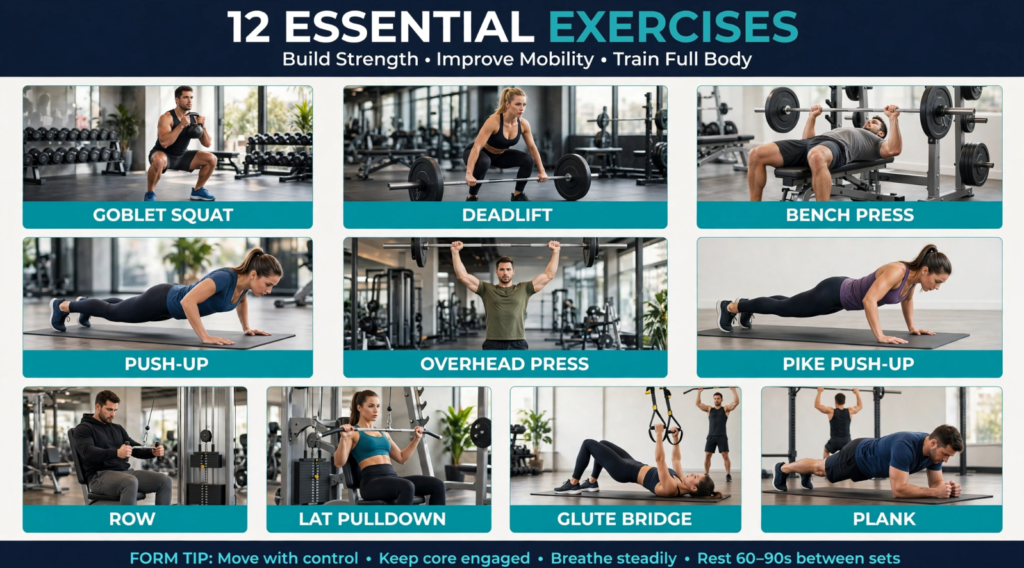
1. Squats (Lower Body)
Muscles Worked: Quads, glutes, hamstrings, core
Standard Squat:
- Feet shoulder-width apart, toes slightly turned out
- Lower hips back and down as if sitting in a chair
- Aim for at least parallel (thighs parallel to floor)
- Drive through heels to return to standing
Progressions:
- Beginner: Box Squats (squat to a chair)
- Intermediate: Deep Squats (ass-to-grass)
- Advanced: Bulgarian Split Squats (one foot behind on a chair)
- Expert: Pistol Squats (one leg)
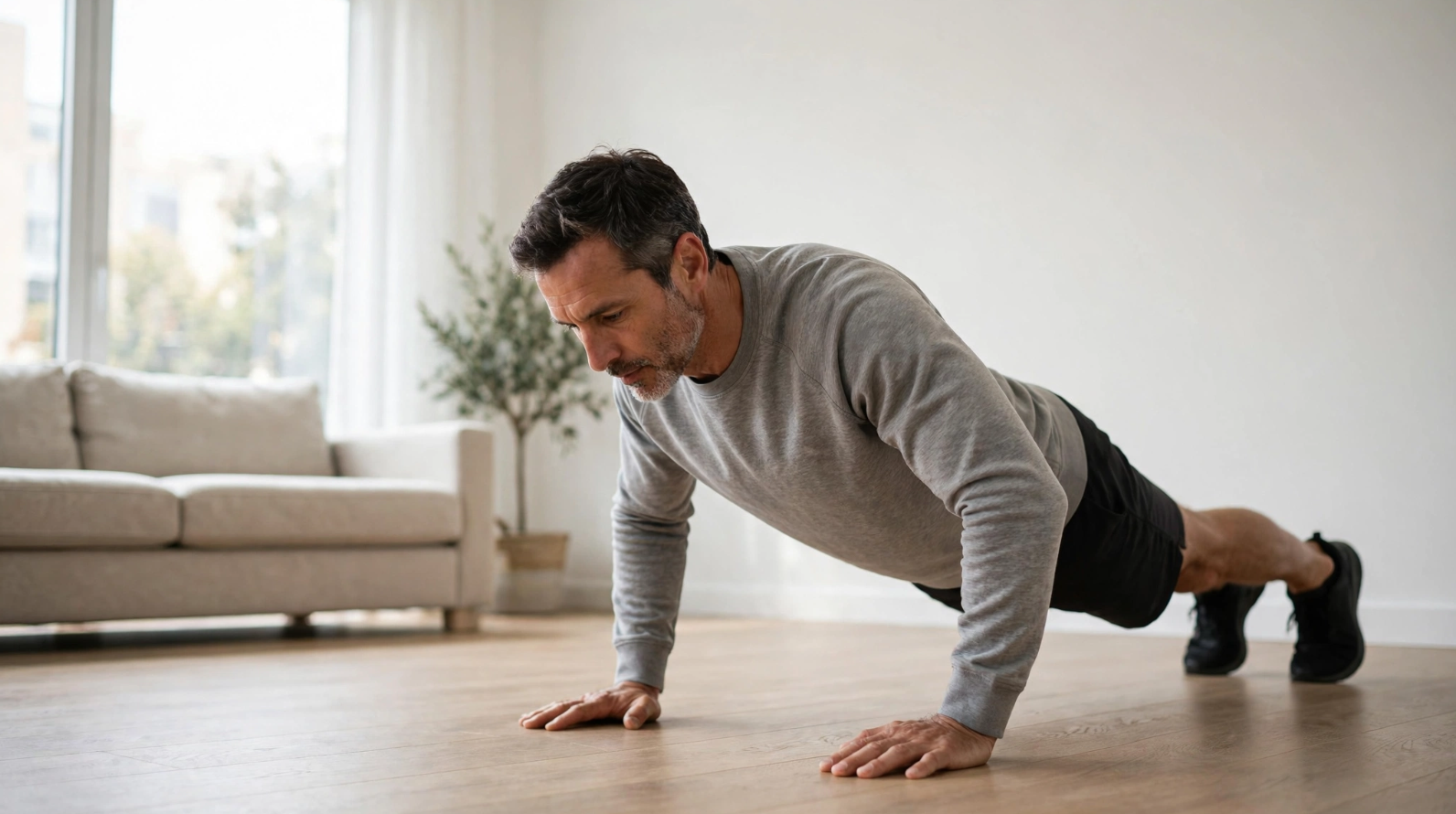
2. Push-ups (Upper Body Push)
Muscles Worked: Chest, shoulders, triceps, core
Standard Push-up:
- Hands under shoulders, body straight from head to heels
- Lower chest to within an inch of the floor
- Push back up
Progressions:
- Beginner: Wall Push-ups → Incline Push-ups → Knee Push-ups
- Intermediate: Full Push-ups
- Advanced: Diamond Push-ups → Decline Push-ups
- Expert: Archer Push-ups → One-Arm Push-ups
3. Bodyweight Rows (Upper Body Pull)
Muscles Worked: Back (lats, rhomboids), biceps, core
Under-Table Rows:
- Lie under a sturdy table, desk, or bar
- Grip the edge and pull your chest toward it
- Lower with control
Door Frame Rows:
- Stand facing a door frame, grip the sides
- Lean back and pull yourself upright
Progressions:
- Beginner: Bent-over Rows (without table)
- Intermediate: Inverted Rows (feet on floor, body at angle)
- Advanced: Inverted Rows (feet elevated)
- Expert: Pull-ups (using a tree branch, playground bar, or sturdy beam)
4. Glute Bridges (Hinge Pattern)
Muscles Worked: Glutes, hamstrings, lower back, core
Standard Glute Bridge:
- Lie on your back, knees bent, feet flat
- Press through heels to lift hips toward ceiling
- Squeeze glutes at the top
- Lower with control
Progressions:
- Beginner: Glute Bridges
- Intermediate: Single-Leg Glute Bridges
- Advanced: Elevated Glute Bridges (feet on chair)
- Expert: Single-Leg Elevated Glute Bridges
5. Planks (Core Stability)
Muscles Worked: Core, shoulders, glutes, quads
Standard Plank:
- Forearms on floor, elbows under shoulders
- Body straight from head to heels
- Hold, breathing steadily
Progressions:
- Beginner: Knee Planks
- Intermediate: Full Plank
- Advanced: Side Planks → Plank with Leg Lifts
- Expert: Plank with Shoulder Taps → Walking Planks
6. Lunges (Lower Body/Unilateral)
Muscles Worked: Quads, glutes, hamstrings, core, balance
Standard Lunge:
- Step forward with one leg
- Lower until both knees are at 90 degrees
- Push through front heel to return to start
Progressions:
- Beginner: Stationary Lunges
- Intermediate: Walking Lunges
- Advanced: Reverse Lunges
- Expert: Bulgarian Split Squats → Jumping Lunges
Section 3: Sample No-Equipment Workouts
Workout A: Full Body Beginner (30 Minutes)
| Exercise | Sets | Reps/Duration | Rest |
|---|---|---|---|
| Bodyweight Squats | 3 | 12–15 | 60 sec |
| Wall Push-ups (or Incline) | 3 | 10–12 | 60 sec |
| Glute Bridges | 3 | 15–20 | 60 sec |
| Knee Planks | 3 | 30–45 sec | 45 sec |
| Bird Dogs | 3 | 10 per side | 45 sec |
Notes: Focus on form. If an exercise is too easy, progress to a harder variation. If it’s too hard, regress to an easier variation.
Workout B: Full Body Intermediate (30–40 Minutes)
| Exercise | Sets | Reps/Duration | Rest |
|---|---|---|---|
| Deep Squats (ass-to-grass) | 3 | 12–15 | 60 sec |
| Full Push-ups | 3 | 8–12 | 60 sec |
| Bodyweight Rows (under table) | 3 | 10–12 | 60 sec |
| Single-Leg Glute Bridges | 3 | 10 per leg | 60 sec |
| Side Planks | 3 | 30–45 sec per side | 45 sec |
Workout C: Full Body Advanced (40–45 Minutes)
| Exercise | Sets | Reps/Duration | Rest |
|---|---|---|---|
| Bulgarian Split Squats | 3 | 8–10 per leg | 60 sec |
| Diamond Push-ups | 3 | 8–12 | 60 sec |
| Pull-ups (or hardest row variation) | 3 | 5–8 | 60 sec |
| Single-Leg Glute Bridges (elevated) | 3 | 8–10 per leg | 60 sec |
| Plank with Shoulder Taps | 3 | 20 taps | 45 sec |
Workout D: The Hotel Room Workout (20 Minutes)
Perfect for: Travel, tight spaces, limited time
Circuit Format (Perform exercises back-to-back, rest 60 seconds between rounds):
| Exercise | Reps/Duration |
|---|---|
| Bodyweight Squats | 15 reps |
| Incline Push-ups (on bed or chair) | 12 reps |
| Glute Bridges | 15 reps |
| Plank | 45 seconds |
| Reverse Lunges | 10 per leg |
Repeat: 3–4 rounds
Workout E: The Office Break Workout (10 Minutes)
Perfect for: During work breaks, no sweat
| Exercise | Reps/Duration |
|---|---|
| Wall Push-ups | 15 reps |
| Chair Squats | 15 reps |
| Desk Planks | 30 seconds |
| Standing Calf Raises | 20 reps |
| Glute Squeezes | 20 reps |
Repeat: 2–3 rounds
Section 4: Training in Small Spaces
Strategies for Tight Quarters
For Hotel Rooms:
- Use the bed for incline push-ups or glute bridges
- Use the desk for bodyweight rows
- Use the wall for wall sits and wall push-ups
- Use a chair for tricep dips and Bulgarian split squats
- Open the doorway for door frame rows
For Small Apartments:
- Clear a 6×6 foot space for movement
- Use a yoga mat or towel for floor exercises
- Use sturdy furniture for supported exercises
- Open a window for fresh air during intense work
For Office Spaces:
- Use a private office or empty conference room
- Bathroom stalls (clean) for quick sets
- Stairwells for step-ups and incline push-ups
- Desk for plank and incline push-ups
Sample Small Space Workout
| Exercise | Instructions |
|---|---|
| Deep Squats | 15 reps |
| Door Frame Rows | 10 reps |
| Knee Push-ups | 12 reps |
| Glute Bridges | 15 reps |
| Wall Sits | 45 seconds |
| Plank | 45 seconds |
| Bird Dogs | 10 per side |
Repeat: 3 rounds
Section 5: Progression Strategies Without Equipment
Since you can’t just “add weight,” you need to be creative. Here are the most effective ways to progress bodyweight exercises.
1. Leverage Progression
Change your body position to make the exercise harder.
Push-up Progression:
Wall → Incline → Knee → Full → Diamond → Decline → Archer → One-Arm
Squat Progression:
Wall Squats → Parallel Squats → Deep Squats → Bulgarian Split Squats → Pistol Squats
Row Progression:
Bent-over Rows → Bodyweight Rows (horizontal) → Bodyweight Rows (feet elevated) → Pull-ups
2. Tempo Progression
Slow down the movement to increase time under tension.
Example:
- Standard Squat: 1 second down, 1 second up
- Slow Squat: 3 seconds down, 3 seconds up
- Pause Squat: 2 seconds down, 2-second pause at bottom, 2 seconds up
3. Rep Progression
Add reps when the current rep range becomes easy.
Example:
- Week 1: 3 sets of 10 push-ups
- Week 2: 3 sets of 12 push-ups
- Week 3: 3 sets of 15 push-ups
- Week 4: Progress to a harder variation (diamond push-ups)
4. Volume Progression
Add sets or total volume.
Example:
- Week 1: 3 sets of 10 push-ups (30 total)
- Week 2: 4 sets of 10 push-ups (40 total)
- Week 3: 5 sets of 10 push-ups (50 total)
- Week 4: Progress to harder variation
5. Isometric Holds
Pause at the hardest part of the movement.
Example:
- Pause at the bottom of a squat for 2–5 seconds
- Pause at the bottom of a push-up for 2–5 seconds
- Pause in the hollow body position for 10–30 seconds
6. Reduced Rest
Decrease rest between sets to increase metabolic stress.
Example:
- Week 1: 60 seconds rest
- Week 2: 45 seconds rest
- Week 3: 30 seconds rest
- Week 4: Increase reps or difficulty
Section 6: Sample 8-Week Progression Plan
This plan will take you from a complete beginner to a solid intermediate—all without equipment.
Phase 1: Building Foundation (Weeks 1–3)
3 sessions per week
| Exercise | Sets x Reps |
|---|---|
| Incline Push-ups | 3 x 10–12 |
| Bodyweight Squats | 3 x 12–15 |
| Glute Bridges | 3 x 15–20 |
| Knee Planks | 3 x 30 seconds |
| Bird Dogs | 3 x 10 per side |
Goal: Master form, build work capacity
Phase 2: Increasing Intensity (Weeks 4–6)
3 sessions per week
| Exercise | Sets x Reps |
|---|---|
| Full Push-ups | 3 x 8–10 |
| Deep Squats | 3 x 12–15 |
| Bodyweight Rows (under table) | 3 x 8–10 |
| Single-Leg Glute Bridges | 3 x 10 per leg |
| Side Planks | 3 x 30 seconds per side |
Goal: Build strength, progress variations
Phase 3: Advanced Moves (Weeks 7–8)
3 sessions per week
| Exercise | Sets x Reps |
|---|---|
| Diamond Push-ups | 3 x 8–10 |
| Bulgarian Split Squats | 3 x 8–10 per leg |
| Bodyweight Rows (feet elevated) | 3 x 8–10 |
| Single-Leg Glute Bridges (elevated) | 3 x 8–10 per leg |
| Plank with Leg Lifts | 3 x 10 per side |
Goal: Push limits, build advanced strength
Section 7: The 30-Day No-Equipment Challenge
Goal: Build strength, consistency, and confidence
Structure: 5 days of training per week, 2 rest days
Week 1: Building the Habit
| Day | Workout |
|---|---|
| Monday | Beginner Workout A |
| Tuesday | Beginner Workout A |
| Wednesday | Rest |
| Thursday | Beginner Workout A |
| Friday | Beginner Workout A |
| Saturday | Light stretching or walking |
| Sunday | Rest |
Week 2: Adding Volume
- Increase reps by 2–3 per set
- Add 1 set to each exercise
- Keep the same workout schedule
Week 3: Tempo Changes
- Slow down the eccentric (lowering) phase to 3 seconds
- Pause at the bottom of each rep for 1 second
- Keep all other variables the same
Week 4: Harder Variations
- Move to the next progression level for each exercise
- Example: Full Push-ups → Diamond Push-ups
- Example: Bodyweight Squats → Deep Squats
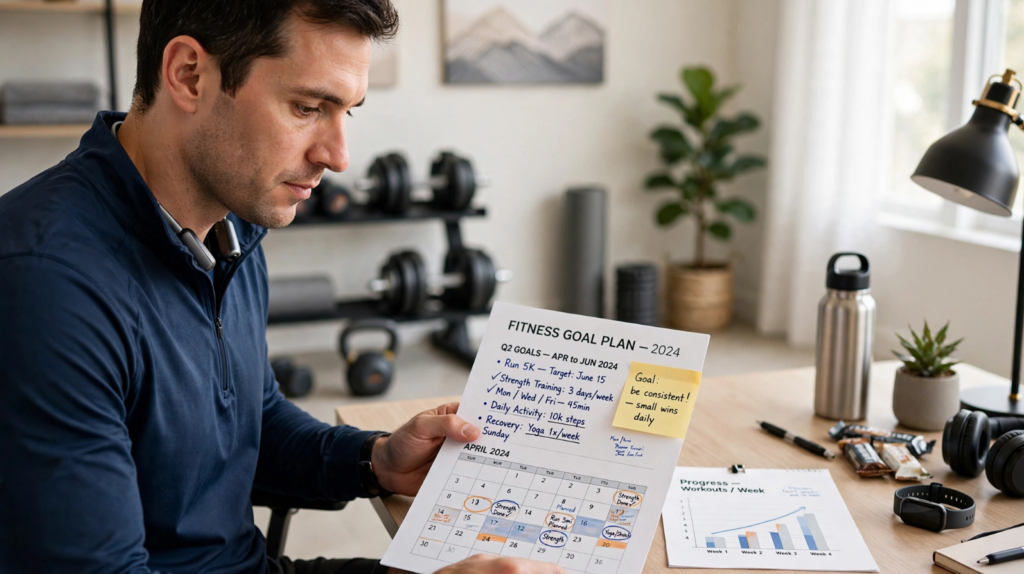
Tracking: Record your sets, reps, and how each workout felt. Celebrate small wins.
Section 8: Training While Traveling
The Traveler’s Workout
No Equipment Needed, No Excuses
Pre-Flight Preparation:
- If you’ll be in one place for several days, identify a park with pull-up bars
- Use resistance bands as backup (they pack small)
- Scope out the hotel gym if available
The Hotel Room Workout:
- 3 rounds of:
- Squats: 20 reps
- Push-ups (on bed): 15 reps
- Glute Bridges: 20 reps
- Plank: 45 seconds
- Reverse Lunges: 10 per leg
- Bird Dogs: 10 per side
The Park Workout:
- Use park benches for incline push-ups and step-ups
- Use playground bars for pull-ups and rows
- Use grassy areas for floor work
Airport Workout:
- Walk (gate to gate is often good exercise)
- Standing calf raises (while waiting)
- Wall sits (against a pillar or wall)
- Glute squeezes (sitting in the waiting area)
- Deep breathing exercises (for stress and recovery)
Section 9: Common Mistakes in No-Equipment Training
Mistake 1: Not Progressing
The Problem: Doing the same workout with the same reps week after week.
The Fix: Apply progressive overload. Add reps, change tempo, progress to harder variations, or reduce rest.
Mistake 2: Sacrificing Form for Reps
The Problem: Doing 15 sloppy push-ups instead of 10 perfect ones.
The Fix: Quality over quantity. A perfect push-up is more effective and safer. If your form breaks, stop.
Mistake 3: Not Using Full Range of Motion
The Problem: Partial push-ups, half-squats, and shortened movements.
The Fix: Go as deep as your mobility allows while maintaining form. Full range of motion builds more strength and improves mobility.
Mistake 4: Ignoring Rest and Recovery
The Problem: Training every day without rest.
The Fix: Your body builds strength during recovery, not during training. Take 1–2 rest days per week. Get 7–9 hours of sleep.
Mistake 5: Only Doing Upper Body
The Problem: Neglecting lower body and core exercises.
The Fix: Include squats, lunges, and glute bridges. A balanced body is a strong body.
Mistake 6: Not Tracking Progress
The Problem: You don’t know what you did last week, so you can’t tell if you’re improving.
The Fix: Track your workouts—sets, reps, variations, and how you felt.
Section 10: Frequently Asked Questions
Q: Can I build muscle with no equipment?
A: Yes. Bodyweight exercises can build significant muscle—especially for beginners and intermediates. With progressive overload (harder variations, more reps, slower tempo), you can continue building muscle indefinitely. However, advanced trainees may eventually need additional resistance for maximal hypertrophy.
Q: How do I train my back without a pull-up bar?
A: Use bodyweight rows:
- Under a sturdy table (lie under it, pull yourself up)
- In a doorway (grip the frame, lean back, pull upright)
- With a towel over a door (grip the towel, lean back, pull up)
- On a park bench (lie under it, use the bench edge)
Q: How many times per week should I train with bodyweight?
A: 3–4 times per week is ideal. This allows each muscle group to be trained 2–3 times per week while allowing adequate recovery. If you’re a beginner, 3 times per week is perfect.
Q: How long should each workout be?
A: Beginners: 20–30 minutes. Intermediates: 30–45 minutes. Advanced: 45–60 minutes. Focus on quality and progression, not just duration.
Q: Is bodyweight training enough for weight loss?
A: Yes. Bodyweight training builds muscle, which boosts your metabolism. It also burns calories during the workout. Combine it with a healthy diet and you can lose weight effectively.
Q: Can I train every day with no equipment?
A: You can, but it’s not necessary and may lead to overuse injuries. 3–4 sessions per week is ideal. If you want to move daily, alternate between strength workouts and light movement (walking, stretching, yoga).
Q: What if I have limited mobility?
A: Start with the easiest variations:
- Wall push-ups instead of floor push-ups
- Box squats instead of full squats
- Knee planks instead of full planks
- Focus on form and range of motion
- Work on mobility daily (dynamic stretching, deep squats with holds)
Q: Is no-equipment training suitable for older adults?
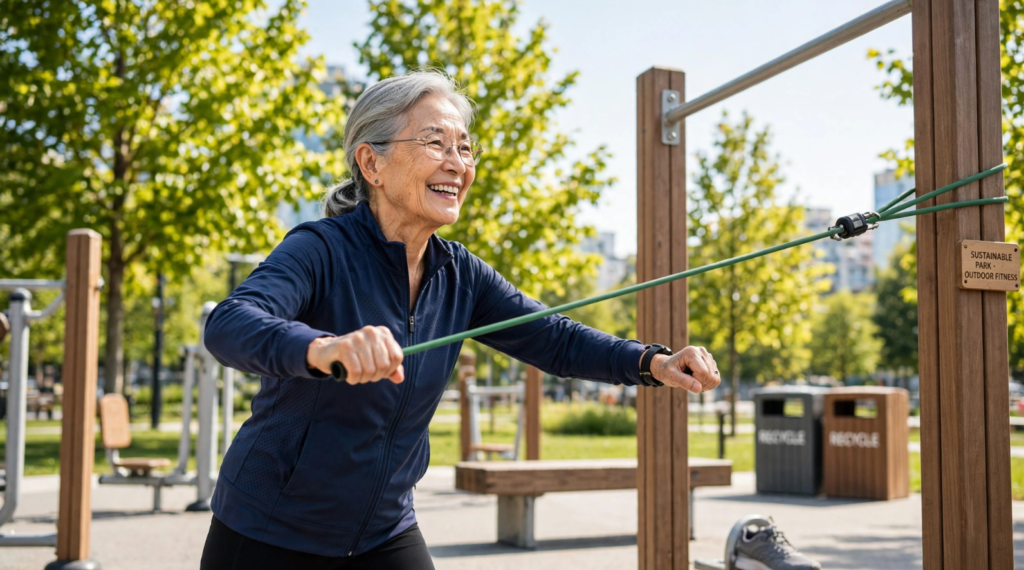
A: Absolutely. Bodyweight training is gentle on joints and can be scaled to any level. It’s particularly beneficial for building functional strength that supports daily activities and maintaining independence.
The VigorForty Take
The minimalist approach to strength training is liberating. No equipment. No gym. No excuses. Just you and your body, working together to build strength, health, and resilience.
The key principles are simple:
- Master the basics: Squats, push-ups, rows, glute bridges, planks, and lunges
- Progress consistently: Harder variations, more reps, slower tempo
- Train regularly: 3–4 times per week
- Track your progress: Write it down
- Listen to your body: Rest when needed
What you’ll gain:
- Functional strength that serves you in daily life
- Better body awareness and control
- Improved mobility and joint health
- Confidence in your body’s capabilities
- The freedom to train anywhere, anytime
You don’t need a gym to get stronger. You don’t need equipment to build muscle. You just need to start.
Your body is the most sophisticated piece of fitness equipment ever created. It’s always with you. It’s always ready. And it’s capable of far more than you think.
No equipment. No excuses. Just results.
This article was reviewed by the Vigor Forty Editorial Review Board on July 19, 2026.
🔗 Related Articles
- The Ultimate Beginner’s Guide to Strength Training
- Calisthenics for Beginners: Your First Bodyweight Workout Plan
- How to Progress Calisthenics Exercises When Bodyweight Gets Easy
- Sample Weekly Workout Plan: Combining Weights, Bodyweight, and Core
Affiliate Disclosure: Some links in this article may be affiliate links. If you make a purchase through these links, Vigor Forty may earn a small commission at no extra cost to you. We only recommend products we trust.
Related Articles
- The Ultimate Beginner’s Guide to Strength Training (Weightlifting, Calisthenics, and Core)
- Weightlifting 101: A Simple Guide for Beginners
- Calisthenics for Beginners: Your First Bodyweight Workout Plan
- What is Core Stability and Why Does It Matter for Every Lift?
- 5 Foundational Movement Patterns for a Stronger Body
- Perfect Your Push-Up: A Step-by-Step Guide to Building Upper Body Strength
- How to Perform a Perfect Squat: Form Tips for Weightlifting and Bodyweight
- The Plank: More Than Just an Ab Exercise
- How to Combine Calisthenics and Weight Training for Maximum Results
- Sample Weekly Workout Plan: Combining Weights, Bodyweight, and Core
- The Importance of Progressive Overload in Strength Training
- How to Progress Calisthenics Exercises When Bodyweight Gets Easy
- Home Gym vs. Gym Membership: Which is Right for You?
- The Minimalist’s Guide to Strength Training: No Equipment Needed
- Top 5 Pieces of Equipment for a Home Strength Training Setup
- How to Choose the Right Weight for Your Workouts