Author: Vigor Forty Editorial Team
Medically Reviewed By: Editorial Review Board
Disclaimer: This article is for informational purposes only and is not a substitute for professional medical advice. Read our full Medical Disclaimer.
📌 Key Takeaways
- All human movement boils down to five fundamental patterns: Push, Pull, Hinge, Squat, and Core Stabilization. Mastering these patterns builds balanced, functional strength that translates directly to daily life.
- Each pattern serves a distinct purpose: Pushing builds upper body strength; pulling develops the back and posture; hinging powers explosive lower body movements; squatting builds foundational leg strength; core stabilization protects your spine and transfers force.
- Imbalances lead to injury: Neglecting any one pattern creates muscle imbalances that increase injury risk and limit performance. A balanced program includes all five.
- You can train each pattern with weights or bodyweight: The movement pattern matters more than the equipment. Whether you use a barbell, dumbbells, or just your body weight, the fundamental mechanics remain the same.
- Master the patterns before adding load: Perfecting movement quality with light or no resistance builds the foundation for safe, effective strength training at any age.
Introduction: The Blueprint for Human Movement
Every physical activity you perform—from picking up a grandchild to deadlifting 300 pounds—is built on a small set of fundamental movement patterns.
Think of these patterns as the alphabet of human movement. Just as 26 letters combine to form every word in the English language, these five patterns combine to create every movement your body performs.
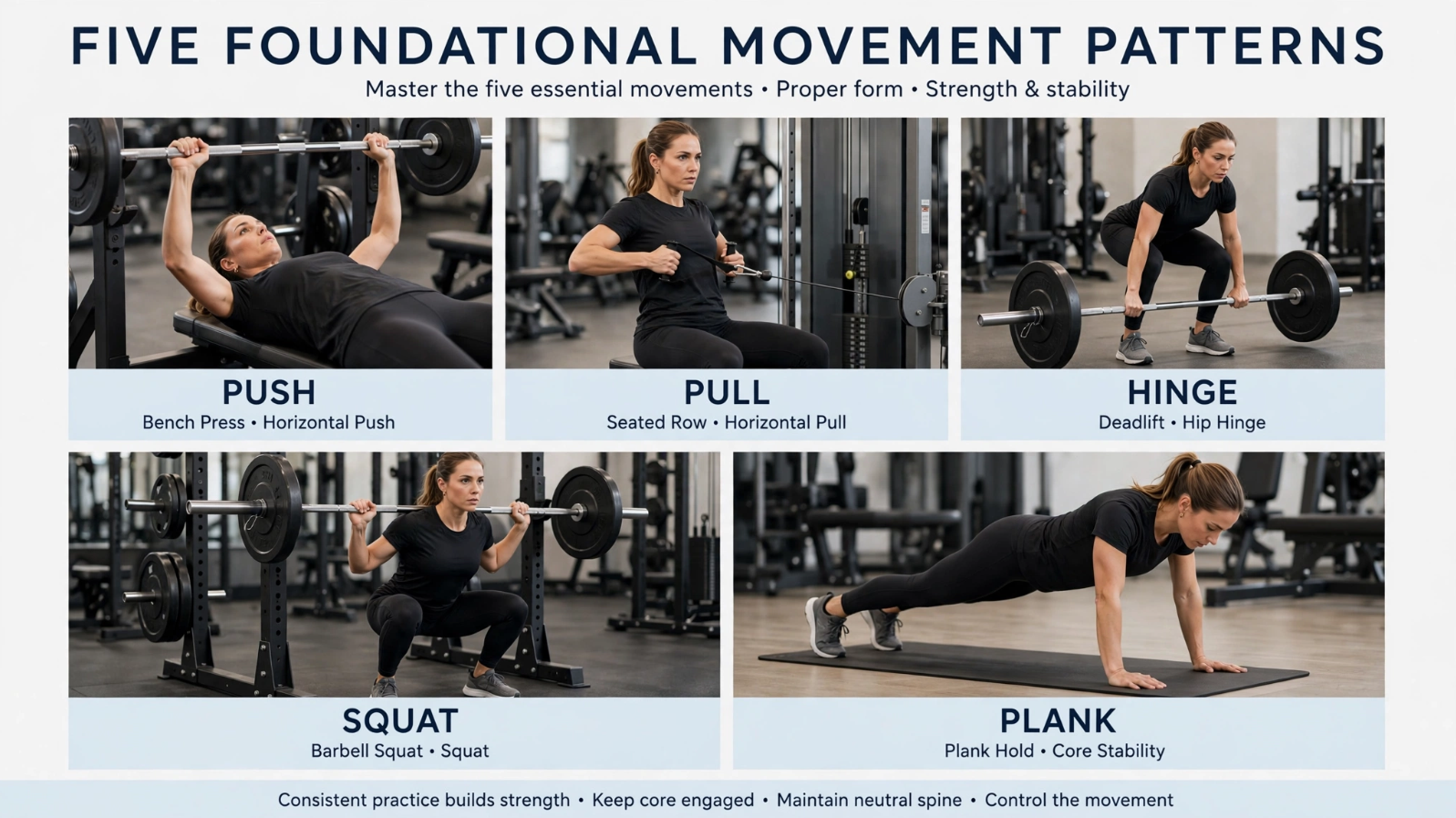
The Five Foundational Movement Patterns:
- Push (horizontal and vertical)
- Pull (horizontal and vertical)
- Hinge
- Squat
- Core Stabilization
These aren’t exercises—they’re categories of movement. Within each category, there are dozens of exercises you can perform with different equipment, at different skill levels, and with different training goals.
Understanding these patterns transforms how you approach strength training. Instead of randomly picking exercises, you can build a balanced program that develops every major muscle group, corrects imbalances, and builds functional strength that serves you in the real world.
Section 1: The Push Pattern
What It Is
The push pattern involves any movement where you push resistance away from your body. This includes pushing forward (horizontal push) and pushing upward (vertical push).
Muscles Worked
- Primary: Chest (pectoralis major), shoulders (deltoids), triceps
- Secondary: Core (for stability), upper back (for scapular control)
Why It Matters
Pushing strength is essential for everyday activities like:
- Pushing open heavy doors
- Getting up from the floor (pushing through your hands)
- Moving furniture
- Pushing a shopping cart
- Playing with children or grandchildren
Common Exercises by Equipment
Bodyweight:
- Push-ups (and variations)
- Dips (using a bench or parallel bars)
- Handstand push-ups (advanced)
Dumbbells/Barbells:
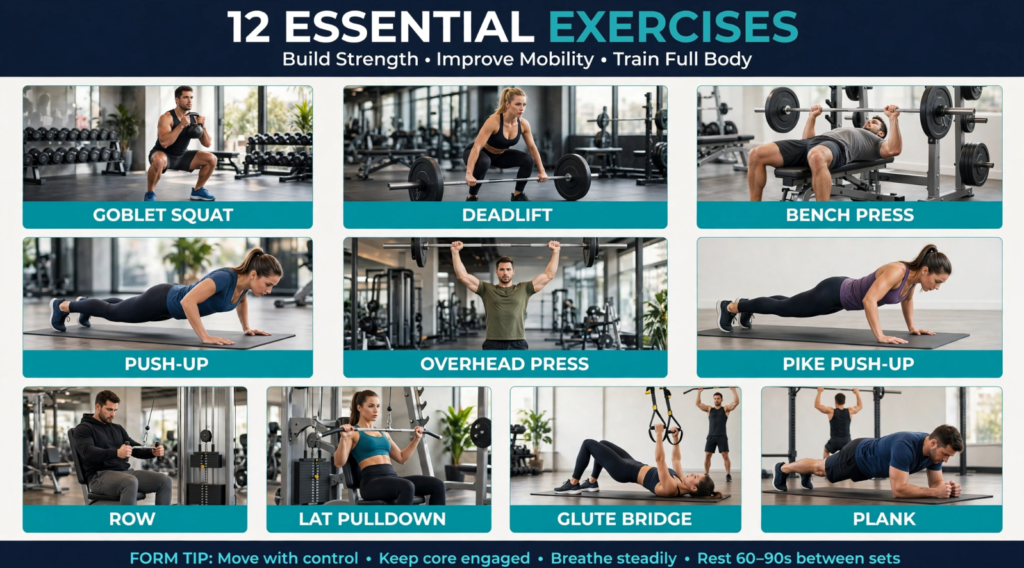
- Bench Press (horizontal push)
- Overhead Press (vertical push)
- Incline Press (angled push)
- Dumbbell Flyes
Cables/Machines:
- Chest Press Machine
- Shoulder Press Machine
- Cable Crossovers
Form Fundamentals
Bench Press:
- Lie flat on a bench with feet planted on the floor
- Grip the bar slightly wider than shoulder-width
- Retract your shoulder blades and keep them pinned to the bench
- Lower the bar to your mid-chest, elbows at 45 degrees
- Press the bar back up, maintaining tension throughout
Overhead Press:
- Stand with feet shoulder-width apart, core braced
- Hold the bar at shoulder height, elbows slightly forward
- Press the bar straight up, keeping it close to your face
- Lock out at the top, then lower with control
Beginner’s Push Workout
| Exercise | Sets | Reps |
|---|---|---|
| Knee Push-ups (or incline) | 3 | 10–15 |
| Dumbbell Overhead Press | 3 | 10–12 |
| Tricep Dips (bench) | 3 | 10–12 |
Section 2: The Pull Pattern
What It Is
The pull pattern involves any movement where you pull resistance toward your body. This includes pulling from in front (horizontal pull) and pulling from above (vertical pull).
Muscles Worked
- Primary: Back (lats, rhomboids, traps), biceps, rear deltoids
- Secondary: Core (for stability), forearms (grip strength)
Why It Matters
Pulling strength is critical for:
- Carrying groceries and luggage
- Opening heavy doors
- Pulling yourself up (literally or figuratively)
- Maintaining good posture (counteracting forward shoulders)
- Preventing shoulder injuries
Common Exercises by Equipment
Bodyweight:
- Pull-ups (and variations)
- Bodyweight Rows (inverted rows)
- Scapular Pull-ups (for beginners)
Dumbbells/Barbells:
- Bent-Over Rows
- Single-Arm Dumbbell Rows
- Barbell Rows
- Deadlifts (also involves the hinge pattern)
Cables/Machines:
- Lat Pulldowns
- Seated Cable Rows
- Pull-up Assist Machine
Form Fundamentals
Bent-Over Row:
- Stand with feet shoulder-width apart, knees slightly bent
- Hinge at your hips until your torso is nearly parallel to the floor
- Keep your back flat, core braced
- Pull the bar or dumbbells toward your lower chest
- Squeeze your shoulder blades together at the top
- Lower with control
Pull-up (or assisted):
- Grip the bar slightly wider than shoulder-width
- Hang with arms fully extended, core braced
- Pull yourself up until your chin clears the bar
- Lower with control to full extension
Beginner’s Pull Workout
| Exercise | Sets | Reps |
|---|---|---|
| Bodyweight Rows (or Lat Pulldowns) | 3 | 10–15 |
| Dumbbell Bent-Over Rows | 3 | 10–12 |
| Face Pulls (for shoulder health) | 3 | 12–15 |
Section 3: The Hinge Pattern
What It Is
The hinge pattern involves bending at your hips while maintaining a straight spine. It’s the movement of pushing your hips backward while keeping your chest up and back flat.
Muscles Worked
- Primary: Glutes, hamstrings, lower back (erector spinae)
- Secondary: Core, lats (for stabilization), grip
Why It Matters
The hinge is arguably the most important movement pattern for functional strength and injury prevention:
- Lifting heavy objects from the floor (the proper way)
- Picking up children or pets
- Gardening and yard work
- Standing up from a seated position
- Protecting your lower back during daily activities
Common Exercises by Equipment
Bodyweight:
- Glute Bridges
- Single-Leg Glute Bridges
- Hip Thrusts
Dumbbells/Barbells:
- Deadlifts (conventional, sumo, Romanian)
- Good Mornings
- Kettlebell Swings
- Dumbbell Romanian Deadlifts
Cables/Machines:
- Cable Pull-Throughs
- Hyperextensions (back extension machine)
Form Fundamentals
Deadlift:
- Stand with feet hip-width apart, bar over the middle of your feet
- Hinge at your hips, keeping your back straight
- Grip the bar with hands just outside your knees
- Brace your core, keep your chest up
- Drive through your heels to stand up, extending your hips and knees simultaneously
- Squeeze your glutes at the top, then lower with control
Glute Bridge:
- Lie on your back, knees bent, feet flat on the floor
- Press through your heels to lift your hips toward the ceiling
- Squeeze your glutes at the top, hold for 2 seconds
- Lower with control
Beginner’s Hinge Workout
| Exercise | Sets | Reps |
|---|---|---|
| Glute Bridges | 3 | 15–20 |
| Dumbbell Romanian Deadlifts | 3 | 10–12 |
| Kettlebell Swings (light) | 3 | 15–20 |
Section 4: The Squat Pattern
What It Is
The squat pattern involves bending your knees and hips to lower your body, then returning to standing. It’s the foundation of lower body strength.
Muscles Worked
- Primary: Quads, glutes, hamstrings, core
- Secondary: Calves, hip adductors, spinal erectors
Why It Matters
Squatting is a fundamental human movement that directly impacts your ability to:
- Get up from a chair or toilet independently
- Pick things up from the floor
- Climb stairs
- Play with children or grandchildren
- Maintain mobility and independence as you age
Common Exercises by Equipment
Bodyweight:
- Bodyweight Squats
- Split Squats
- Lunges (forward, reverse, lateral)
Dumbbells/Barbells:
- Barbell Squats (back or front)
- Goblet Squats (dumbbell held at chest)
- Dumbbell Lunges
- Bulgarian Split Squats
Cables/Machines:
- Leg Press Machine
- Hack Squat Machine
- Smith Machine Squats
Form Fundamentals
Bodyweight Squat:
- Stand with feet shoulder-width apart, toes slightly turned out
- Keep your chest up, back straight, core braced
- Lower your hips back and down as if sitting in a chair
- Go as low as your mobility allows (aim for at least parallel)
- Drive through your heels to return to standing
Goblet Squat:
- Hold a dumbbell or kettlebell against your chest
- Feet shoulder-width apart, toes slightly out
- Squat down, keeping your chest up and core braced
- Drive through your heels to return to standing
Beginner’s Squat Workout
| Exercise | Sets | Reps |
|---|---|---|
| Bodyweight Squats | 3 | 15–20 |
| Goblet Squats (light dumbbell) | 3 | 10–12 |
| Reverse Lunges | 3 | 10 per leg |
Section 5: Core Stabilization
What It Is
Core stabilization involves maintaining control of your spine and pelvis during movement. It’s not about generating force (like a crunch) but about resisting force and maintaining position.
Muscles Worked
- Primary: Transverse abdominis, pelvic floor, multifidus, diaphragm
- Secondary: Rectus abdominis, obliques, spinal erectors, glutes
Why It Matters
Core stabilization is the foundation of all movement:
- Protects your lower back during lifting
- Transfers force between upper and lower body
- Improves posture and reduces back pain
- Enhances balance and coordination
- Prevents injuries in daily life and sports
Common Exercises by Equipment
Bodyweight:
- Planks (forearm, high, side)
- Dead Bugs
- Bird Dogs
- Hollow Body Holds
Dumbbells/Barbells:
- Farmer’s Carries
- Suitcase Carries
- Pallof Press (with resistance band or cable)
Cables/Machines:
- Pallof Press (with cable machine)
- Ab Wheel Rollouts
Form Fundamentals
Plank:
- Forearms on the floor, elbows directly under shoulders
- Body forms a straight line from head to heels
- Squeeze your glutes, engage your core
- Hold, breathing steadily, without letting your hips sag
Dead Bug:
- Lie on your back, arms extended up, legs in tabletop position
- Press your lower back into the floor
- Extend your right arm and left leg toward the floor
- Maintain back contact with the floor
- Return to start, repeat on opposite side
Beginner’s Core Workout
| Exercise | Sets | Reps/Duration |
|---|---|---|
| Plank | 3 | 30–45 seconds |
| Dead Bugs | 3 | 10 per side |
| Bird Dogs | 3 | 10 per side |
| Glute Bridges | 3 | 15 reps |
Section 6: Building a Balanced Program
The Weekly Template
Here’s a sample weekly program that incorporates all five movement patterns:
| Day | Focus | Exercises |
|---|---|---|
| Monday | Full Body A | Squat (Goblet or Barbell), Push (Bench Press), Pull (Rows), Core (Plank) |
| Wednesday | Full Body B | Hinge (Deadlift or RDL), Push (Overhead Press), Pull (Lat Pulldowns), Core (Dead Bugs) |
| Friday | Full Body C | Squat (Lunges or Split Squats), Push (Push-ups), Pull (Bodyweight Rows), Core (Bird Dogs) |
Why Balance Matters
Focusing on only one pattern creates imbalances that lead to injury and dysfunction.
Example Imbalances:
- Too much push, not enough pull: Rounded shoulders, poor posture, increased risk of shoulder impingement
- Too much squat, not enough hinge: Overdeveloped quads, weak glutes, increased knee stress
- Too much hinge, not enough core: Inability to stabilize the spine during heavy lifts, increased back pain risk
A balanced program ensures that all your muscles are developed in proportion, reducing injury risk and improving overall function.
Section 7: Assessing Your Movement Quality
The Functional Movement Screen (Simplified)
Before adding weight, assess your ability to perform each pattern correctly.
Squat Assessment:
- Stand and squat without weights
- Can you keep your chest up?
- Can you maintain a flat back?
- Can you reach at least parallel?
Hinge Assessment:
- Stand and bend at your hips (like a deadlift)
- Can you keep your back straight?
- Can you feel tension in your hamstrings?
- Can you maintain a neutral spine?
Push Assessment:
- Perform a push-up (or modified version)
- Can you keep your body straight?
- Can you lower your chest close to the floor?
- Are your elbows at a safe angle (45 degrees)?
Pull Assessment:
- Hang from a bar or perform bodyweight rows
- Can you engage your shoulder blades?
- Can you maintain core stability?
Core Assessment:
- Perform a plank or dead bug
- Can you maintain a neutral spine?
- Can you breathe while maintaining the position?
When to Add Load
Add weight only when you can perform the movement pattern with perfect form for 10–15 reps. Adding load to poor movement patterns reinforces bad habits and increases injury risk.
Section 8: FAQ—Your Top Questions on Movement Patterns
Q: Which movement pattern is the most important?
A: They’re all important. However, the hinge and squat patterns are foundational for daily life and overall strength. The hinge pattern (deadlift) is arguably the most important for back health and functional strength. But no single pattern should be neglected.
Q: Can I train all five patterns in one workout?
A: Yes, a “full body” workout typically includes all five patterns. However, you may choose to emphasize different patterns on different days. For example, Monday might focus more on squat and push, Wednesday on hinge and pull, and Friday on all patterns with lighter weight.
Q: I have low back pain. Which patterns should I focus on?
A: The hinge and core stabilization patterns are crucial. Strengthening your glutes and core with exercises like glute bridges, bird dogs, and dead bugs can significantly reduce back pain. However, avoid heavy hinge exercises (like deadlifts) until your form is perfect and your pain is managed. Consult a physical therapist or qualified trainer.
Q: How do I know if I have an imbalance?
A: Common signs include:
- Rounded shoulders (too much push, not enough pull)
- Weak glutes (too much squat, not enough hinge)
- Low back pain (weak core or improper hinge mechanics)
- Difficulty getting up from the floor (weak squat pattern)
A qualified trainer can assess your movement patterns and identify imbalances.
Q: Can I train movement patterns with bodyweight only?
A: Absolutely. Bodyweight exercises for each pattern:
- Push: Push-ups, dips
- Pull: Bodyweight rows, pull-ups (or assisted)
- Hinge: Glute bridges, single-leg glute bridges
- Squat: Bodyweight squats, lunges, split squats
- Core: Planks, dead bugs, bird dogs
Bodyweight training is a complete approach to developing all five patterns.
The VigorForty Take
The five foundational movement patterns—push, pull, hinge, squat, and core stabilization—are the blueprint for a strong, functional, resilient body.
Here’s the truth: You don’t need to do dozens of exercises. You don’t need to follow the latest fitness trends. You don’t need to spend hours in the gym. What you need is a program that develops all five patterns with consistency and progressive overload.
Start by mastering the patterns themselves—with bodyweight or very light weight. Perfect your form. Build a foundation of movement quality. Then progressively add load over weeks and months.
A balanced program that develops all five patterns will:
- Build strength in every major muscle group
- Correct muscle imbalances
- Reduce injury risk in the gym and in daily life
- Improve your ability to perform everyday activities with ease
- Set you up for a lifetime of healthy, pain-free movement
Your body is capable of incredible things. Build it on a foundation that lasts.
This article was reviewed by the Vigor Forty Editorial Review Board on July 19, 2026.
🔗 Related Articles
- The Ultimate Beginner’s Guide to Strength Training
- Weightlifting 101: A Simple Guide for Beginners
- Calisthenics for Beginners: Your First Bodyweight Workout Plan
- What is Core Stability and Why Does It Matter for Every Lift?
Affiliate Disclosure: Some links in this article may be affiliate links. If you make a purchase through these links, Vigor Forty may earn a small commission at no extra cost to you. We only recommend products we trust.
Related Articles
- The Ultimate Beginner’s Guide to Strength Training (Weightlifting, Calisthenics, and Core)
- Weightlifting 101: A Simple Guide for Beginners
- Calisthenics for Beginners: Your First Bodyweight Workout Plan
- What is Core Stability and Why Does It Matter for Every Lift?
- 5 Foundational Movement Patterns for a Stronger Body
- Perfect Your Push-Up: A Step-by-Step Guide to Building Upper Body Strength
- How to Perform a Perfect Squat: Form Tips for Weightlifting and Bodyweight
- The Plank: More Than Just an Ab Exercise
- How to Combine Calisthenics and Weight Training for Maximum Results
- Sample Weekly Workout Plan: Combining Weights, Bodyweight, and Core
- The Importance of Progressive Overload in Strength Training
- How to Progress Calisthenics Exercises When Bodyweight Gets Easy
- Home Gym vs. Gym Membership: Which is Right for You?
- The Minimalist’s Guide to Strength Training: No Equipment Needed
- Top 5 Pieces of Equipment for a Home Strength Training Setup
- How to Choose the Right Weight for Your Workouts