
Author: Vigor Forty Editorial Team
Medically Reviewed By: Editorial Review Board
Disclaimer: This article is for informational purposes only and is not a substitute for professional medical advice. Read our full Medical Disclaimer.
📌 Key Takeaways
- You don’t need a full commercial gym to build strength at home: With just 5 key pieces of equipment, you can perform hundreds of exercises that target every muscle group.
- Invest in quality over quantity: A few well-chosen, durable pieces of equipment will serve you better than a collection of cheap, poorly made items.
- Start with the essentials and build over time: You don’t need to buy everything at once. Begin with the most versatile equipment and add more as your needs and budget allow.
- Adjustable equipment saves space and money: Adjustable dumbbells, benches, and resistance bands replace multiple fixed-weight items, making them ideal for home gyms.
- The right equipment makes consistency easier: When you have what you need at home, you eliminate excuses and make it easier to stick to your routine.
Introduction: Building Your Home Gym—One Piece at a Time
You’ve decided to train at home. The convenience, privacy, and long-term savings are compelling. But now comes the question: what equipment do you actually need?
Walking into a fitness store or browsing online can be overwhelming. Racks of dumbbells. Rows of machines. Bands, balls, benches, bars, and countless gadgets. It’s easy to overspend on equipment you don’t need or under-buy on equipment that matters most.
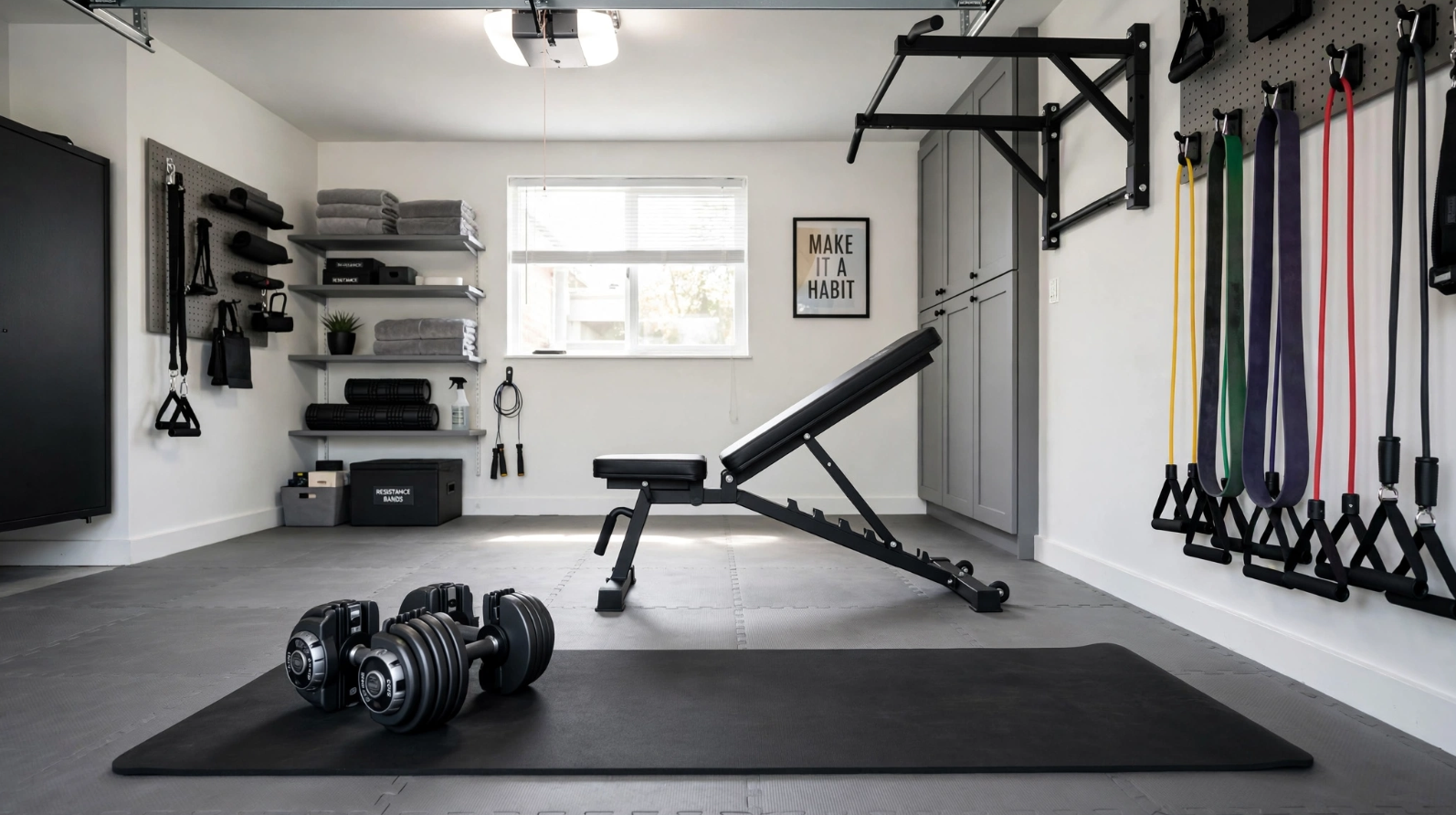
The truth is, you don’t need a lot. With just five carefully chosen pieces of equipment, you can build a home gym that supports a complete strength training program. This equipment will allow you to perform exercises for every muscle group, scale from beginner to advanced, and fit within almost any budget and space.
This guide will walk you through the top 5 pieces of equipment for a home strength training setup. You’ll learn what to buy, what to look for, how much to spend, and how to use each piece for maximum benefit.
Section 1: Why These 5 Pieces?
Before we dive into the list, let’s look at how these pieces were selected.
The Selection Criteria:
- Versatility: Can it be used for multiple exercises and muscle groups?
- Space Efficiency: Does it fit in a small space?
- Cost-Effectiveness: Does it provide good value for the price?
- Durability: Will it last for years of regular use?
- Scalability: Can it grow with you as you get stronger?
- Accessibility: Is it easy to find and purchase?
The Winner’s Circle:
- Adjustable Dumbbells — The most versatile strength training tool
- Adjustable Bench — Essential for pressing, rows, and more
- Resistance Bands — Lightweight, portable, and incredibly versatile
- Pull-Up Bar — The gateway to upper body pulling strength
- Exercise Mat — The foundation for comfort and safety
Section 2: Equipment #1 — Adjustable Dumbbells
Why They’re #1
Adjustable dumbbells are the single most versatile piece of equipment for a home gym. With one set, you can replace an entire rack of fixed dumbbells, saving space and money. You can perform hundreds of exercises targeting every major muscle group.
What They Do
Adjustable dumbbells allow you to change the weight by adding or removing plates, or by turning a dial that adjusts the weight. This means you can use light weights for shoulder exercises, moderate weights for upper body, and heavier weights for lower body—all with one set.
Key Exercises
| Muscle Group | Exercises |
|---|---|
| Chest | Dumbbell Bench Press, Dumbbell Flyes, Incline Press |
| Shoulders | Overhead Press, Lateral Raises, Front Raises |
| Back | Bent-Over Rows, Single-Arm Rows, Pullovers |
| Biceps | Bicep Curls, Hammer Curls, Concentration Curls |
| Triceps | Tricep Extensions, Skull Crushers, Kickbacks |
| Legs | Goblet Squats, Dumbbell Lunges, Romanian Deadlifts |
| Core | Weighted Planks, Russian Twists, Dumbbell Side Bends |
What to Look For
Adjustable Dumbbell Buying Guide:
| Feature | What to Consider |
|---|---|
| Weight Range | Look for 5–50 lbs per dumbbell (or more). 5–50 lbs covers 90% of exercises for most people. |
| Adjustment Mechanism | Dial system (quick and convenient) vs. plate system (more affordable, but slower to change). |
| Build Quality | Metal construction is more durable than plastic. Look for solid, well-made components. |
| Weight Increments | Smaller increments (2.5–5 lbs) allow for gradual progression. |
| Handle Comfort | Contoured, knurled handles are more comfortable and secure. |
| Space Requirement | A single set of adjustable dumbbells takes up minimal space (about the size of a small suitcase). |
Price Range
| Type | Price Range |
|---|---|
| Basic Plate-Loaded | $100–$200 per pair |
| Mid-Range Dial System | $250–$400 per pair |
| Premium Dial System | $500–$800 per pair |
Our Recommendation
Best Budget Option: CAP Barbell Adjustable Dumbbells ($100–150) — Plate-loaded, durable, and gets the job done.
Best Value Option: Bowflex SelectTech 552 ($350–400) — Dial system, 5–52.5 lbs, quick to adjust, reliable.
Best Premium Option: PowerBlock Elite ($400–600) — Expandable, extremely durable, professional quality.
Section 3: Equipment #2 — Adjustable Bench
Why You Need It
An adjustable bench transforms a basic dumbbell setup into a complete gym. It allows you to perform pressing exercises (bench press, incline press), rowing exercises (dumbbell rows), and a variety of other movements safely and effectively.
What It Does
A bench provides support and stability for a wide range of exercises. An adjustable bench—one that can be set at different angles—adds even more versatility, allowing you to target muscles from different angles.
Key Exercises
| Exercise | Muscle Group | Bench Position |
|---|---|---|
| Dumbbell Bench Press | Chest | Flat (0°) |
| Incline Dumbbell Press | Upper Chest | Incline (30–45°) |
| Decline Dumbbell Press | Lower Chest | Decline (—15°) |
| Dumbbell Rows | Back | Flat (0°) |
| Dumbbell Pullovers | Chest/Back | Flat (0°) |
| Seated Shoulder Press | Shoulders | Upright (90°) |
| Dumbbell Bicep Curls | Biceps | Seated (90°) |
| Tricep Dips | Triceps | Flat (0°) |
| Bulgarian Split Squats | Legs | Flat (with foot on bench) |
| Hip Thrusts | Glutes | Flat (with back on bench) |
What to Look For
Adjustable Bench Buying Guide:
| Feature | What to Consider |
|---|---|
| Adjustability | At minimum, flat, incline, and decline positions. More angles = more versatility. |
| Weight Capacity | Look for at least 500 lbs capacity (to handle your body weight plus weights). |
| Stability | A wide base and rubber feet prevent wobbling. |
| Padding | Firm, dense foam that doesn’t compress too much. Thickness matters for comfort. |
| Frame Material | Steel construction is essential for durability. |
| Folding/Collapsibility | If space is tight, look for a bench that folds flat for storage. |
| Wheel System | A bench with wheels is easier to move around. |
Price Range
| Type | Price Range |
|---|---|
| Basic Flat Bench | $60–$150 |
| Mid-Range Adjustable | $150–$350 |
| Premium Adjustable (FID) | $350–$700+ |
Our Recommendation
Best Budget Option: AmazonBasics Adjustable Bench ($100–150) — Basic but functional, supports up to 300 lbs.
Best Value Option: Flybird Adjustable Bench ($150–200) — Flat/Incline/Decline, heavy-duty steel, folds flat.
Best Premium Option: Rep Fitness AB-3000 ($350–450) — FID (Flat/Incline/Decline), 1000 lb capacity, commercial quality.
Section 4: Equipment #3 — Resistance Bands
Why You Need Them
Resistance bands are the most underrated piece of fitness equipment. They’re incredibly versatile, take up almost no space, and can add significant resistance to your workouts. They’re also a great alternative to weights for travel, rehabilitation, and warming up.
What They Do
Resistance bands provide variable resistance—they get harder as you stretch them. This challenges your muscles through the entire range of motion. They can be used for strength training, mobility work, rehabilitation, and assistance exercises.
Types of Resistance Bands
| Type | Description | Best For |
|---|---|---|
| Tube Bands (with Handles) | Bands with handles on each end | Traditional strength exercises, bicep curls, rows |
| Loop Bands (Flat) | Flat bands in a loop (no handles) | Hip thrusts, glute exercises, pull-up assistance |
| Therapy Bands | Thin, flat strips | Rehabilitation, mobility, warm-ups |
| Monster/Thick Bands | Very heavy-duty, thick bands | Pull-up assistance, heavy resistance training |
Key Exercises
| Exercise | Muscle Group |
|---|---|
| Band Rows | Back |
| Band Presses | Chest |
| Band Overhead Press | Shoulders |
| Band Bicep Curls | Biceps |
| Band Tricep Extensions | Triceps |
| Band Squats | Legs |
| Band Romanian Deadlifts | Hamstrings/Glutes |
| Band Hip Thrusts | Glutes |
| Band Lateral Walks | Glute Medius |
| Band Pull-Aparts | Shoulder Health |
| Band Assisted Pull-Ups | Back |
What to Look For
Resistance Band Buying Guide:
| Feature | What to Consider |
|---|---|
| Resistance Level | Look for a set with multiple levels (light, medium, heavy, x-heavy). |
| Material | Natural rubber or latex provides the best resistance and durability. If allergic, look for latex-free options. |
| Durability | High-quality bands should last 1–2 years of regular use before losing elasticity. |
| Accessories | Some sets include handles, door anchors, and ankle straps for more exercise options. |
| Storage | They take up minimal space—a small bag or container is plenty. |
Price Range
| Type | Price Range |
|---|---|
| Basic Set (5 bands) | $20–$40 |
| Mid-Range Set with Accessories | $40–$70 |
| Professional Set (with handles, anchors) | $70–$120 |
Our Recommendation
Best Budget Option: Fit Simplify Resistance Band Set ($25–30) — 5 bands, good for beginners.
Best Value Option: WODFitters Resistance Bands ($40–60) — 5 bands, heavy-duty, great for pull-up assistance and strength training.
Best Premium Option: Rogue Monster Bands ($60–100) — Commercial quality, extremely durable, used by professional athletes.
Section 5: Equipment #4 — Pull-Up Bar
Why You Need It
Pull-ups are one of the best upper body exercises you can do. They build a strong, wide back, improve posture, and develop grip strength. A pull-up bar brings this essential exercise into your home.
What It Does
A pull-up bar provides a stable point to pull yourself up. It can be mounted in a doorway, on a wall, or as part of a larger power rack. It also allows for hanging core exercises like knee raises and leg raises.
Types of Pull-Up Bars
| Type | Description | Pros | Cons |
|---|---|---|---|
| Doorway Mount | Fits into a standard door frame | Affordable, no permanent installation | May damage door frame, limited to doorways |
| Wall Mount | Bolted to a wall | Stable, durable, multiple grip options | Requires permanent installation |
| Freestanding | Stand-alone structure | Movable, no installation needed | Takes up more space, more expensive |
| Power Rack Integrated | Built into a power rack | Extremely stable, supports heavy weight | Requires a power rack (expensive, space-consuming) |
Key Exercises
| Exercise | Muscle Group |
|---|---|
| Pull-Ups | Lats, biceps, upper back |
| Chin-Ups | Lats, biceps (more bicep emphasis) |
| Wide Grip Pull-Ups | Outer lats |
| Close Grip Pull-Ups | Lower lats, biceps |
| Hanging Leg Raises | Core (lower abs) |
| Hanging Knee Raises | Core |
| Scapular Pull-Ups | Shoulder health, scapular control |
| Dead Hangs | Spinal decompression, grip strength |
What to Look For
Pull-Up Bar Buying Guide:
| Feature | What to Consider |
|---|---|
| Weight Capacity | Look for at least 300 lbs (your body weight plus any added weight). |
| Grip Options | Multiple grip positions (wide, medium, neutral) provide variety. |
| Padding | Grip padding improves comfort and prevents slipping. |
| Installation Ease | Doorway bars should be easy to install and remove. |
| Doorway Compatibility | Check your door frame width and depth before purchasing. |
| Build Quality | Steel construction is essential for durability and safety. |
Price Range
| Type | Price Range |
|---|---|
| Doorway Mount | $25–$60 |
| Wall Mount | $60–$150 |
| Freestanding | $100–$300 |
| Power Rack Integrated | $300–$800+ (part of rack cost) |
Our Recommendation
Best Budget Option: Iron Gym Total Upper Body Workout Bar ($30–40) — Doorway mount, multiple grip positions, supports 300 lbs.
Best Value Option: Perfect Fitness Multi-Gym Doorway Pull-Up Bar ($50–60) — Secure, padded grips, multi-position.
Best Premium Option: Rogue P-4 Pull-Up Bar ($150–200) — Wall mount, extremely durable, commercial quality.
Section 6: Equipment #5 — Exercise Mat
Why You Need It
An exercise mat is the foundation of your home gym. It provides cushioning for floor exercises, protects your floors, and creates a dedicated workout space that signals “it’s time to train.”
What It Does
A mat provides a comfortable, non-slip surface for floor exercises. It also protects your flooring from sweat, weights, and wear. The right mat can make the difference between a comfortable workout and one that’s hard on your joints.
Key Uses
| Use | Exercises |
|---|---|
| Core Work | Planks, crunches, dead bugs, bird dogs |
| Floor Work | Push-ups, glute bridges, hip thrusts |
| Stretching | All stretches, warm-ups, cool-downs |
| Yoga/Pilates | Yoga poses, Pilates exercises |
| Protection | Protects flooring from weights and movement |
Types of Exercise Mats
| Type | Description | Best For |
|---|---|---|
| Yoga Mat | Thin, lightweight, textured | Yoga, stretching, light floor work |
| Exercise Mat | Thicker than yoga mat, more cushioning | Planks, push-ups, core work |
| Interlocking Mats | Puzzle-style mats that connect | Home gym flooring, protects floors |
| High-Density Mat | Very thick, dense foam | Heavy floor work, joint protection |
What to Look For
Exercise Mat Buying Guide:
| Feature | What to Consider |
|---|---|
| Thickness | 1/4 inch (6mm) for general use, 1/2 inch (12mm) for joint protection |
| Material | PVC, EVA foam, or rubber. Rubber is most durable. |
| Texture | Non-slip texture prevents slipping during workouts. |
| Size | Standard (72″ x 24″) for most people. Larger if you want more space. |
| Durability | Dense foam holds up better over time. |
| Easy to Clean | Smooth surfaces are easier to wipe down. |
Price Range
| Type | Price Range |
|---|---|
| Basic Yoga Mat | $15–$30 |
| High-Quality Exercise Mat | $30–$60 |
| Interlocking Floor Mats (4-pack) | $30–$60 |
| Premium Rubber Mat | $50–$100+ |
Our Recommendation
Best Budget Option: BalanceFrom GoYoga Mat ($15–20) — 1/2 inch thick, non-slip, great value.
Best Value Option: Manduka PROlite ($50–70) — Dense, durable, long-lasting, professional quality.
Best Premium Option: Lululemon The Mat ($70–90) — Premium quality, excellent grip, durable.
Section 7: Complete Home Gym Setups by Budget
Budget Setup ($150–$250)
| Equipment | Price |
|---|---|
| Basic Adjustable Dumbbells (2x 40 lbs) | $100–150 |
| Exercise Mat | $20–30 |
| Resistance Bands (set of 5) | $20–30 |
| Pull-Up Bar (doorway) | $30–40 |
| Total | $170–$250 |
What You Can Do: Full body strength training, all major muscle groups
Mid-Range Setup ($400–$700)
| Equipment | Price |
|---|---|
| Bowflex SelectTech 552 Dumbbells | $350–400 |
| Flybird Adjustable Bench | $150–200 |
| Exercise Mat | $30–50 |
| Resistance Bands (set) | $30–50 |
| Pull-Up Bar (doorway) | $40–60 |
| Total | $600–$760 |
What You Can Do: Full body strength training, all major muscle groups, incline/decline variations
Premium Setup ($1,000–$2,000+)
| Equipment | Price |
|---|---|
| PowerBlock Elite Dumbbells (5–90 lbs) | $600–800 |
| Rep Fitness AB-3000 Bench | $350–450 |
| Rogue Monster Bands (set) | $60–100 |
| Rogue P-4 Pull-Up Bar (wall mount) | $150–200 |
| Premium Rubber Mat or Flooring | $50–150 |
| Total | $1,210–$1,700 |
What You Can Do: Everything—maximal strength, full range of motion, professional-grade training
Section 8: Beyond the Top 5 — Optional Additions
Once you have the essentials, you may want to add these optional items:
| Equipment | Price | Best For |
|---|---|---|
| Kettlebells | $50–200 each | Swings, Turkish get-ups, conditioning |
| Barbell and Plates | $300–800 | Heavy squats, deadlifts, bench press |
| Squat Rack | $300–800 | Safe heavy squats and bench press |
| Foam Roller | $20–40 | Recovery, myofascial release |
| Jump Rope | $10–20 | Cardio, conditioning |
| Medicine Ball | $30–60 | Throws, core work, wall balls |
| Ab Wheel | $15–30 | Advanced core work |
Section 9: Equipment Maintenance Tips
Dumbbells
- Wipe down handles after each use (prevents rust and corrosion)
- Store in a dry place (away from moisture)
- Tighten screws/bolts periodically
- Keep plates organized
Bench
- Wipe down after each use (especially after sweaty workouts)
- Check bolts and screws for tightness monthly
- Avoid leaving heavy weights on the bench when not in use
- Store in a dry area to prevent rust
Resistance Bands
- Store in a cool, dark place (direct sunlight degrades rubber)
- Avoid contact with sharp objects
- Wash occasionally with mild soap and water
- Inspect for tears or wear before each use
Pull-Up Bar
- Check all bolts and screws regularly
- Ensure the bar is securely mounted
- Wipe down grip surfaces after use
- Test the bar before each session
Exercise Mat
- Wipe down after each use
- Roll up when not in use (prevents creasing)
- Clean with mild soap and water occasionally
- Keep away from direct sunlight
Section 10: FAQ—Your Top Home Equipment Questions
Q: Can I build significant muscle with just these 5 pieces?
A: Yes. With adjustable dumbbells, a bench, resistance bands, a pull-up bar, and a mat, you can perform hundreds of exercises covering every muscle group. Progressive overload is still possible through increasing weight, reps, and difficulty. Many people have built impressive physiques with this exact setup.
Q: What’s the most important piece of equipment?
A: Adjustable dumbbells are the most versatile. They allow you to perform exercises for every muscle group and can be scaled from beginner to advanced. If you only buy one thing, buy adjustable dumbbells.
Q: What’s the most cost-effective addition?
A: Resistance bands. They’re inexpensive, incredibly versatile, and take up almost no space. They also add variety and can be used for assistance exercises and mobility work.
Q: Do I really need a bench?
A: A bench greatly expands your exercise options. It allows for safe pressing exercises, various rowing variations, and many other movements. While you can train without one, it’s a worthwhile investment.
Q: Can I use resistance bands instead of dumbbells?
A: Bands and dumbbells have different benefits. Dumbbells provide more precise, consistent resistance and are better for maximal strength development. Bands provide variable resistance and are excellent for certain movements, warm-ups, and travel. Use both.
Q: How much should I spend on a home gym?
A: Start with $150–$250 for a basic setup. As your needs grow, you can add more equipment. Many people spend $500–$1,000 over time, which is still less than 1–2 years of a gym membership.
Q: Will these 5 pieces fit in a small space?
A: Yes. Adjustable dumbbells take up about the space of a small suitcase. A bench can fold or be stored upright. Resistance bands and a mat take up minimal space. A doorway pull-up bar uses no floor space at all.
The VigorForty Take
Building a home gym doesn’t have to be complicated or expensive. You don’t need a room full of machines or thousands of dollars in equipment. You just need the right tools.
The five pieces in this guide—adjustable dumbbells, an adjustable bench, resistance bands, a pull-up bar, and an exercise mat—give you everything you need for a complete strength training program.
They’re:
- Versatile: Hundreds of exercises, every muscle group
- Space-Efficient: Fit in a closet, corner, or small room
- Cost-Effective: Pay for themselves in 1–2 years compared to a gym membership
- Scalable: Grow with you as you get stronger
- Durable: Last for years with proper care
Start with what you can afford. A basic set of adjustable dumbbells, a mat, and some bands will take you a long way. Add a bench when you can. Add a pull-up bar when you’re ready. Build your gym over time, as your needs and budget allow.
The best gym in the world is the one you use. These five pieces make it easy to use yours—every day.
This article was reviewed by the Vigor Forty Editorial Review Board on July 19, 2026.
🔗 Related Articles
- Home Gym vs. Gym Membership: Which is Right for You?
- The Minimalist’s Guide to Strength Training: No Equipment Needed
- How to Choose the Right Weight for Your Workouts
- Weightlifting 101: A Simple Guide for Beginners
Affiliate Disclosure: Some links in this article may be affiliate links. If you make a purchase through these links, Vigor Forty may earn a small commission at no extra cost to you. We only recommend products we trust.
Related Articles
- The Ultimate Beginner’s Guide to Strength Training (Weightlifting, Calisthenics, and Core)
- Weightlifting 101: A Simple Guide for Beginners
- Calisthenics for Beginners: Your First Bodyweight Workout Plan
- What is Core Stability and Why Does It Matter for Every Lift?
- 5 Foundational Movement Patterns for a Stronger Body
- Perfect Your Push-Up: A Step-by-Step Guide to Building Upper Body Strength
- How to Perform a Perfect Squat: Form Tips for Weightlifting and Bodyweight
- The Plank: More Than Just an Ab Exercise
- How to Combine Calisthenics and Weight Training for Maximum Results
- Sample Weekly Workout Plan: Combining Weights, Bodyweight, and Core
- The Importance of Progressive Overload in Strength Training
- How to Progress Calisthenics Exercises When Bodyweight Gets Easy
- Home Gym vs. Gym Membership: Which is Right for You?
- The Minimalist’s Guide to Strength Training: No Equipment Needed
- Top 5 Pieces of Equipment for a Home Strength Training Setup
- How to Choose the Right Weight for Your Workouts