
Author: Vigor Forty Editorial Team
Medically Reviewed By: Editorial Review Board
Disclaimer: This article is for informational purposes only and is not a substitute for professional medical advice. Read our full Medical Disclaimer.
📌 Key Takeaways
- Balance Declines Faster Than Strength After 40: Proprioception (your body’s sense of position), vestibular function (inner ear), and neuromuscular coordination all degrade with age. This decline begins subtly in your 40s but accelerates significantly after 60—and it is a primary predictor of falls and fractures.
- Falls Are the Leading Cause of Injury Death in Older Adults: One in four Americans over 65 falls each year. The cascade—fall → fracture → immobilization → muscle loss → further falls—is devastating. Preventing falls starts in your 40s with proactive balance training.
- Balance Is Trainable at Any Age: The vestibular system, proprioceptors, and neuromuscular pathways respond to targeted training. You do not need to be a gymnast—simple daily exercises can dramatically improve stability and reaction time.
- The 3 Pillars of Balance: Vestibular (inner ear), Proprioceptive (sensory feedback from joints and muscles), and Muscular (strength and reaction time). Effective training addresses all three.
- The 3-Exercise Balance Protocol: Single-Leg Stand (proprioception), Tandem Stance (vestibular), and Dynamic Reaches (neuromuscular control). Perform these daily for 5 minutes to bulletproof your stability.
Introduction: The Skill You Don’t Know You’re Losing
You can squat 225 pounds. You can run a 5K. You can touch your toes. But can you stand on one leg with your eyes closed for 30 seconds?
If you are over 40, the answer is probably “no”—and that is a problem. Balance is the most neglected component of fitness in the American male. We focus on strength, cardio, and flexibility, but we ignore the neurological foundation that keeps us upright, stable, and safe.
Here is the uncomfortable truth: balance declines faster than strength after 40. The decline is gradual—so gradual that you do not notice it until you stumble on uneven ground, wobble when putting on your pants, or lose your footing on a slippery sidewalk. By the time you notice the problem, the neuromuscular pathways have already atrophied significantly.
The stakes are high. Falls are the leading cause of injury-related death in adults over 65. The cascade is brutal: a fall leads to a hip fracture, which leads to immobilization, which leads to muscle atrophy, which leads to more falls. Breaking this cycle requires proactive training—starting now.
But here is the good news: balance is highly trainable. The vestibular system (inner ear), proprioceptors (sensory nerves in your joints and muscles), and neuromuscular pathways all respond to targeted stimulation. You do not need expensive equipment, a gym membership, or 60 minutes a day. You need 5 minutes of intentional practice, performed daily.
This article provides a comprehensive guide to balance training for the over-40 male. We will cover the science of balance, the three pillars of stability, a simple 5-minute daily protocol, and how to integrate balance work into your existing fitness routine. By the end, you will have the tools to bulletproof your stability and protect yourself against the #1 threat to your independence.
Section 1: The Three Pillars of Balance
Balance is not a single skill—it is a complex interplay of three physiological systems.
Pillar 1: The Vestibular System (Inner Ear)
The vestibular system, located in the inner ear, detects head position and movement. It tells your brain whether you are upright, tilting, or accelerating. As we age, the vestibular hair cells degenerate, reducing the sensitivity of this system. This is why older adults often feel dizzy or unsteady when standing up quickly or turning their heads rapidly.
Pillar 2: Proprioception (Sensory Feedback)
Proprioceptors are sensory nerves located in your muscles, tendons, and joints. They send constant feedback to your brain about the position of your body in space. After 40, the density and sensitivity of these receptors decline, reducing your ability to “feel” where your limbs are without looking at them. This is why you may find yourself looking down at your feet when walking on uneven terrain—you have lost the automatic feedback.
Pillar 3: Muscular Strength and Reaction Time
Even with perfect vestibular and proprioceptive input, you need muscular strength to correct a wobble. The ankle, knee, hip, and core muscles must fire rapidly to stabilize you. After 40, muscle atrophy (sarcopenia) and slowed neural conduction reduce your reaction time—making it harder to catch yourself before you fall.
The Synergy:
When you stumble, the sequence is: vestibular system detects the tilt → proprioceptors sense the joint angle → brain sends a corrective signal → muscles fire to stabilize. If any link in this chain is weak, you fall.
Section 2: The “One-Leg Test”—A Simple Diagnostic
Before you start training, assess your baseline. This test is simple, free, and highly predictive of fall risk.
How to Perform the “One-Leg Stand” Test:
- Stand barefoot or in thin socks on a flat, non-slippery surface.
- Lift one foot off the floor, bending your knee to about 45 degrees.
- Keep your arms at your sides or crossed over your chest (do not use them for balance).
- Start a timer. Stop when:
- Your lifted foot touches the floor.
- Your arms uncross.
- You hop on your standing foot.
- Your standing foot shifts position.
- Repeat on the other leg.
The Norms (Age 40–60):
| Age | Eyes Open (Seconds) | Eyes Closed (Seconds) |
|---|---|---|
| 40–49 | 25–30+ | 8–12 |
| 50–59 | 20–25 | 5–8 |
| 60–69 | 15–20 | 3–5 |
Interpretation:
- If you can hold for less than 10 seconds with eyes open, you are at significantly elevated fall risk.
- If you can hold for less than 5 seconds with eyes closed, your vestibular and proprioceptive systems are impaired.
Do not be discouraged if your numbers are low. This is a baseline—not a verdict. The goal is to improve them over time.
Section 3: The 3-Exercise Balance Protocol
This is your daily 5-minute protocol. It addresses all three pillars of balance and requires no equipment (beyond a chair for safety).
Exercise #1: Single-Leg Stand (Proprioception Focus)
- How:
- Stand with a chair or wall within arm’s reach for safety.
- Lift your left foot off the floor, bending your knee to 45 degrees.
- Focus your gaze on a fixed point on the wall at eye level.
- Hold for 30 seconds (or as long as you can maintain good form).
- Switch legs. Repeat 3 times per leg.
- Progression:
- Week 1–2: Hold for 15–20 seconds.
- Week 3–4: Hold for 30 seconds.
- Week 5–6: Hold for 45 seconds.
- Advanced: Perform with eyes closed or while looking up/down.
- Why It Works: This challenges the proprioceptors in your ankle, knee, and hip, training them to send accurate position feedback to your brain.
Exercise #2: Tandem Stance (Vestibular Focus)
- How:
- Stand with your feet in a straight line, heel-to-toe (as if you are on a tightrope).
- Your right foot should be in front, left foot behind.
- Keep your arms at your sides.
- Hold for 30 seconds. Switch feet (left foot in front). Repeat 3 times per side.
- Progression:
- Week 1–2: Hold for 15 seconds, use a wall for balance if needed.
- Week 3–4: Hold for 30 seconds without support.
- Advanced: Perform with eyes closed or with head turns (slowly look left and right).
- Why It Works: The narrow base of support challenges the vestibular system, which must constantly adjust to maintain upright posture.
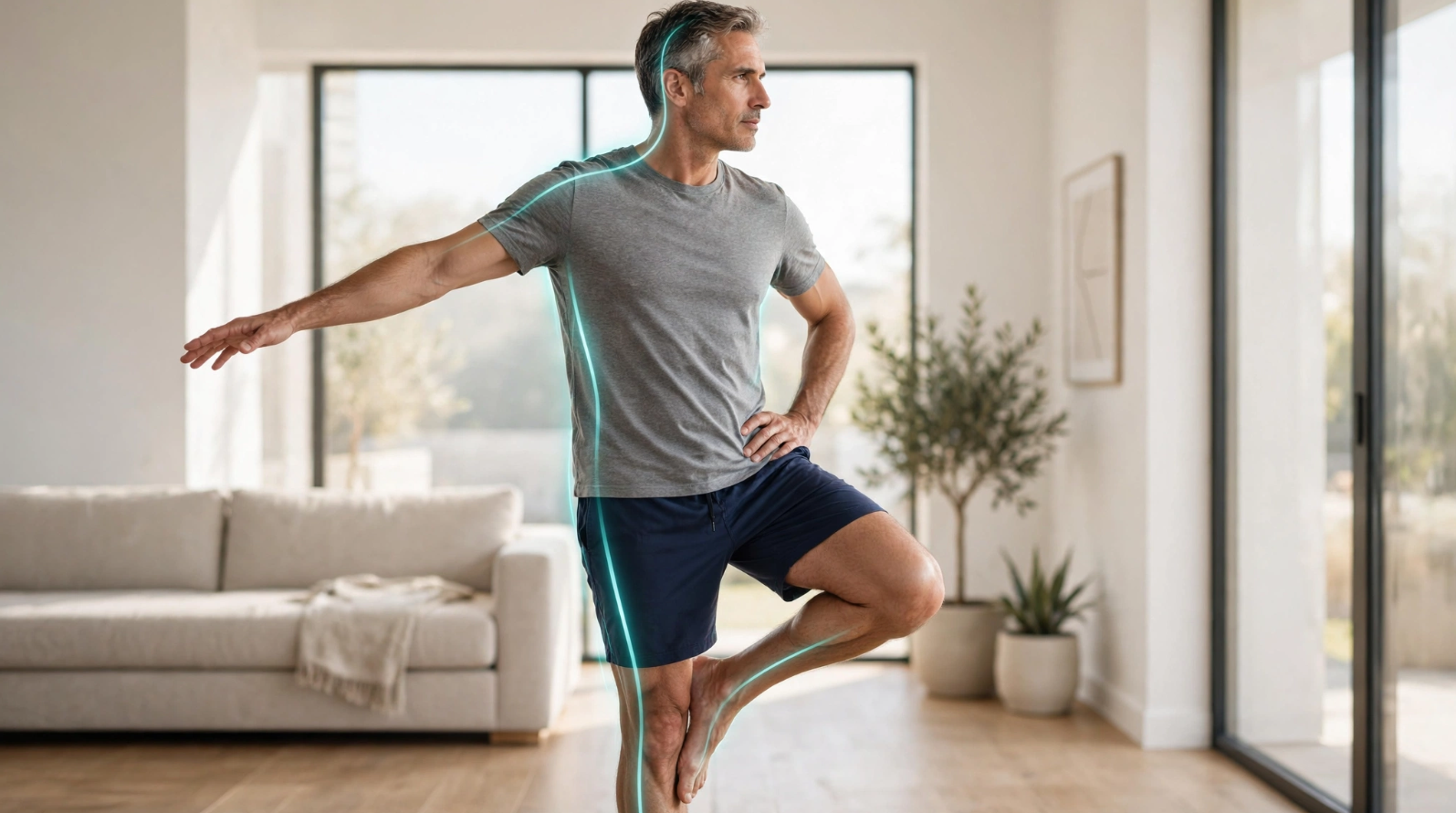
Exercise #3: Dynamic Reaches (Neuromuscular Control)
- How:
- Stand on your right leg, left knee bent to 45 degrees.
- Slowly reach your left arm forward and to the left, as if reaching for an object.
- Return to center.
- Reach your left arm backward and to the left.
- Return to center.
- Perform 5 reaches in each direction (forward, side, backward). Switch legs.
- Progression:
- Week 1–2: Perform reaches with a chair nearby for safety.
- Week 3–4: Perform reaches with a light weight (2–3 lbs) in the reaching hand.
- Advanced: Reach while balancing on a soft surface (pillow or foam pad).
- Why It Works: This challenges your neuromuscular system to maintain stability while your center of mass shifts. It trains the rapid corrective responses needed to prevent falls.
Section 4: The 5-Minute Daily Schedule
| Order | Exercise | Duration/Reps | Pillar Targeted |
|---|---|---|---|
| 1 | Single-Leg Stand | 3 x 30 seconds (each leg) | Proprioception |
| 2 | Tandem Stance | 3 x 30 seconds (each side) | Vestibular |
| 3 | Dynamic Reaches | 5 reaches (each direction), each leg | Neuromuscular Control |
| TOTAL | ~5 minutes | Full Balance System |
When to Perform:
- Morning: As part of your morning mobility routine (Article #6). Perform it before your coffee.
- Evening: As a “cool-down” after your workout or before bed.
- Throughout the Day: Use the Single-Leg Stand while brushing your teeth—it is a simple 2-minute habit that adds up.
Safety First:
- Always perform balance exercises on a non-slip surface.
- Keep a chair or wall within arm’s reach for the first 2 weeks.
- If you feel dizzy or lightheaded, sit down immediately.
Section 5: Integrating Balance into Your Workouts
Balance training does not need to be separate from your strength or cardio work. You can integrate it seamlessly.
Strength Training Integration:
- Perform single-leg Romanian deadlifts (RDLs) instead of bilateral RDLs (Article #2).
- Perform single-leg glute bridges instead of bilateral bridges (Article #6).
- Perform step-ups onto an unstable surface (a folded yoga mat or a balance pad).
Cardio Integration:
- Walk on uneven terrain (grass, trail, sand) to challenge proprioception.
- Use a balance board while watching TV (10–15 minutes daily).
- Perform side-stepping and carioca (grapevine) as a warm-up.
The “Incidental” Approach:
- Stand on one leg while waiting for your coffee to brew.
- Stand on one leg while brushing your teeth (alternate legs daily).
- Walk heel-to-toe (tandem walking) down your hallway.
These small, cumulative efforts add up to significant improvements in balance over time.
Section 6: The Role of Strength in Balance
Balance is not just about the nervous system—it is also about strength. Weak ankles, knees, hips, and core cannot correct a wobble.
Key Muscle Groups for Balance:
| Muscle Group | Function in Balance | Exercise |
|---|---|---|
| Ankle stabilizers | Fine-tune balance, adjust for uneven surfaces | Single-leg calf raises, ankle circles |
| Quadriceps | Provide explosive strength to correct wobbles | Step-ups, box squats |
| Hamstrings | Decelerate forward motion, prevent falls | RDLs, reverse lunges |
| Glute medius | Prevent lateral instability, knee valgus | Lateral band walks, single-leg bridges |
| Core (transversus abdominis) | Brace the spine, transfer force | Dead bugs, planks, bird-dogs |
The “Balance-First” Workout:
- Warm-up: 5 minutes on a balance board or foam pad.
- Strength: Perform the knee-friendly protocol (Article #10) with an emphasis on single-leg variations.
- Cool-down: 3 minutes of tandem stance and dynamic reaches.
Section 7: FAQ—Your Top Balance Questions
Q: I feel dizzy when I stand up quickly. Is that a balance problem?
A: That is orthostatic hypotension—a drop in blood pressure when standing. It is common after 40 and related to cardiovascular and autonomic function, not balance per se. To manage it:
- Stand up slowly (30 seconds to transition from lying to sitting to standing).
- Stay hydrated.
- Avoid heavy meals before standing.
- If it persists, see your physician to rule out anemia or cardiovascular issues.
Q: Can balance exercises help with vertigo?
A: It depends on the cause. If your vertigo is due to Benign Paroxysmal Positional Vertigo (BPPV) —crystals in the inner ear—balance exercises may not help. BPPV requires specific maneuvers (like the Epley maneuver) performed by a physical therapist. If your vertigo is due to vestibular hypofunction (reduced inner ear sensitivity), the balance exercises in this article (especially tandem stance with head turns) can help stimulate the remaining vestibular function.
Q: How long does it take to see improvement in balance?
A: You will notice improvements in 2–4 weeks with daily practice. The nervous system adapts quickly to new demands. However, to maintain these gains, you must continue regular practice. Balance is a “use it or lose it” skill.
Q: I have an ankle injury. Should I still do balance exercises?
A: Yes, but modify them. If you cannot bear weight, perform seated balance exercises (seated trunk rotations, seated reaches). Once you can bear weight, start with two-legged balance (stand with feet together) before progressing to single-leg stands. Always consult your physical therapist.
Q: Is yoga effective for balance?
A: Yes. Yoga improves proprioception, ankle stability, and core strength—all of which support balance. Specific poses like Tree Pose, Warrior III, and Eagle Pose are excellent. However, yoga classes are often 60–90 minutes. The 5-minute protocol in this article provides the same balance stimulus in a fraction of the time, making it easier to maintain consistently.
Q: Can poor vision affect balance?
A: Absolutely. Vision is a major input to the balance system. If your prescription is outdated, or if you have cataracts or macular degeneration, your balance will suffer. Get an annual eye exam, and consider prescription glasses for activities like walking or driving.
The VigorForty Take
Balance is the invisible foundation of all physical activity. Without it, your strength, cardio, and flexibility are irrelevant—because you cannot safely apply them in the real world. The uneven sidewalk, the slippery floor, the sudden turn on the pickleball court—these are the moments that separate the stable from the unstable.
The 5-minute balance protocol in this article is your insurance policy against falls, fractures, and the cascade of decline that follows. It takes less time than scrolling through social media. It requires no equipment. And it pays dividends in the form of confidence, safety, and independence.
Your 30-Day Challenge:
- Perform the One-Leg Stand Test today. Write down your baseline times for both legs (eyes open and eyes closed).
- Perform the 5-minute balance protocol daily for 30 days.
- After 30 days, repeat the One-Leg Stand Test.
We predict you will see significant improvements—10–15 seconds on eyes open, and 5–10 seconds on eyes closed. More importantly, you will feel more stable on your feet, more confident on uneven terrain, and more capable of catching yourself before you fall.
Your balance is your anchor in the world. Strengthen it now, and it will serve you for decades to come.
Read All Realated Articles
- The Complete Guide to Heart Health: Beyond Omega-3s—CoQ10, Magnesium, Potassium, and Nitric Oxide Support After 40
- Why Your Hamstrings Are Tight (And Stretching Them Won’t Fix It)—The Real Causes & 4 Fixes for Men Over 40
- The 3 Worst Stretches for the Over-40 Lower Back (And What to Do Instead)
- Pickleball and Your Knees: 4 Preventative Exercises to Bulletproof Your Joints (For Men Over 40)
- The Desk Chair Evaluation: How to Setup Your Home Office to Protect Your Neck, Shoulders, and Upper Back (For Men Over 40)
- The 5-Minute Morning Mobility Routine for Americans Over 40—Start Your Day Pain-Free
- Is Your Pillow Causing Your Neck Pain? The Over-40 Guide to Sleep Posture, Pillow Selection, and Morning Relief
- Collagen vs. Glucosamine vs. Omega-3s: The 3 Best Supplements for Joint Pain (2026 Update for Men Over 40)
- Sciatica vs. Piriformis Syndrome: How to Tell the Difference and Find the Right Treatment (For Men Over 40)
- The 3 Worst Exercises for Bad Knees (And What to Do Instead)—A 40+ Gym Survival Guide
- How to Improve Your Balance After 40—The Underrated Longevity Skill Every Man Needs