
Author: Vigor Forty Editorial Team
Medically Reviewed By: Editorial Review Board
Disclaimer: This article is for informational purposes only and is not a substitute for professional medical advice. Read our full Medical Disclaimer.
📌 Key Takeaways
- Calisthenics uses your own body weight as resistance: No gym membership, expensive equipment, or heavy weights required. Just you, gravity, and the willingness to move.
- It builds functional, practical strength: Bodyweight training develops strength that translates directly to everyday activities—carrying groceries, playing with kids, climbing stairs, and maintaining independence as you age.
- There’s always a variation for your current level: Can’t do a push-up? Start with wall push-ups. Can’t do a pull-up? Start with bodyweight rows or scapular pull-ups. Progressions make calisthenics accessible to everyone.
- Consistency matters more than complexity: Three sessions per week of basic exercises—push-ups, squats, planks, and glute bridges—will deliver significant results.
- Calisthenics pairs perfectly with weightlifting: Many of the world’s strongest and most functional athletes combine both approaches for complete development.
Introduction: The Power of Your Own Body
Imagine having a gym that’s always with you—one that costs nothing, requires no commute, and adapts to your current fitness level instantly. That’s calisthenics.
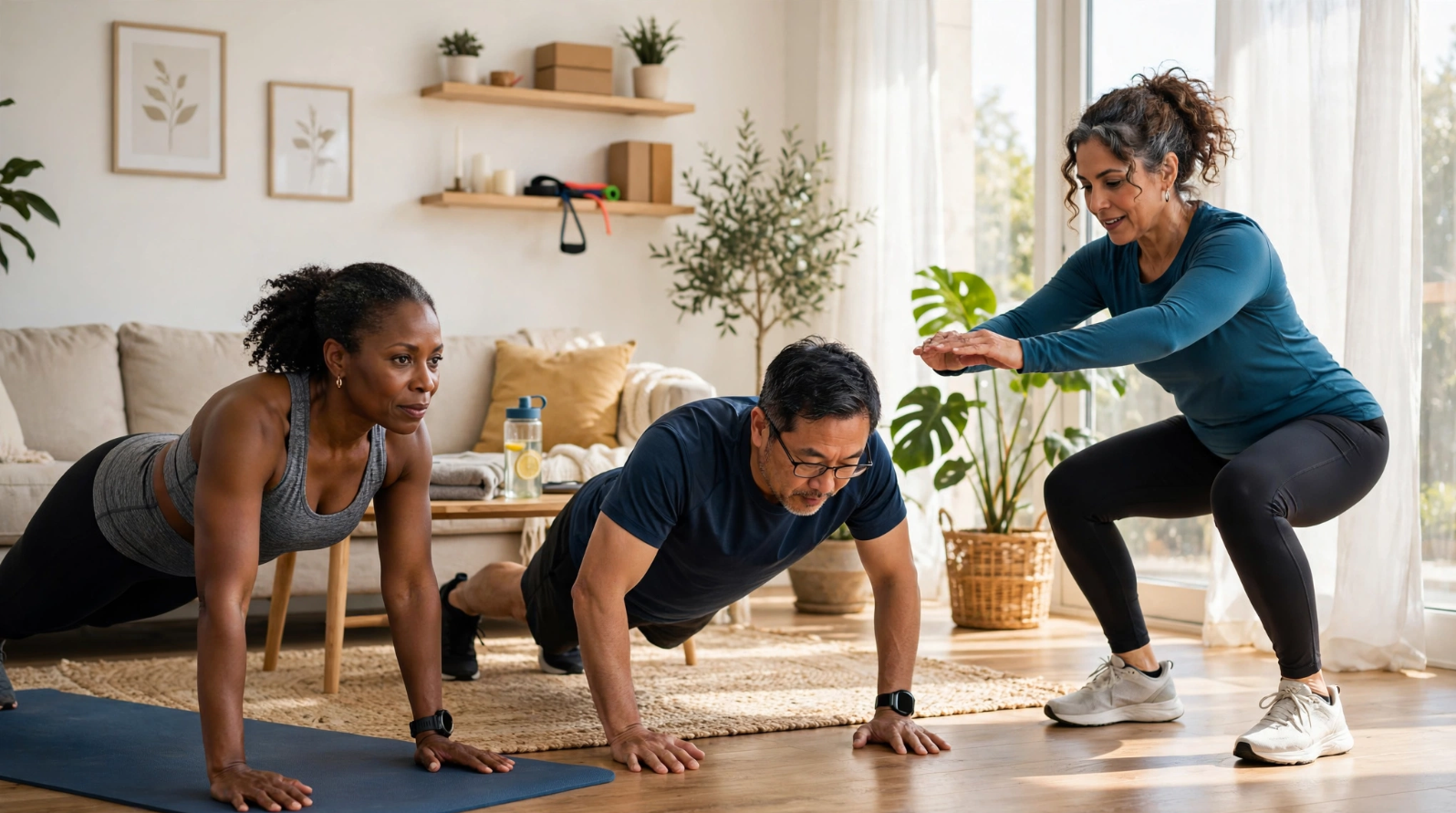
Calisthenics is strength training that uses your own body weight as resistance. Push-ups, squats, planks, lunges, pull-ups—these are the tools of bodyweight training. And while they may seem simple, they’re incredibly effective for building strength, improving mobility, and developing functional fitness that translates directly to real life.
If you’re over 40, calisthenics offers something particularly valuable: sustainable, joint-friendly strength. Without the compressive forces of heavy barbells on your spine and joints, bodyweight training allows you to build muscle and strength with minimal risk of injury. It’s strength training that can last a lifetime.
Calisthenics does more than build muscle. It:
- Develops body awareness and proprioception—knowing where your body is in space
- Improves joint stability and mobility through full range-of-motion movements
- Builds muscular endurance—the ability to sustain effort over time
- Supports bone health through weight-bearing exercises
- Enhances balance and coordination—critical for fall prevention as you age
- Can be done anywhere, anytime—no excuses
The best part? You can start today. No equipment. No gym membership. No waiting.
Section 1: Why Calisthenics? Benefits After 40
Joint-Friendly Strength
As we age, our joints become more susceptible to wear and tear. Heavy barbell training, while effective, can place significant stress on the spine, knees, and shoulders—especially if form isn’t perfect. Calisthenics offers a gentler path to building strength without the same degree of joint compression.
The key is progression: You start with easier variations that are joint-friendly and gradually advance to more challenging ones as your strength improves.
Functional, Real-World Strength
Calisthenics builds strength that directly translates to everyday activities. Pushing open a heavy door, standing up from a low chair, lifting a suitcase into an overhead compartment—these are all bodyweight movements in disguise.
When you train with your body weight, you’re training movement patterns, not just isolated muscles. This functional approach builds strength that serves you in daily life.
No Excuses, No Barriers
The most effective workout plan is the one you actually do. Calisthenics removes every barrier to consistency:
- No equipment? No problem.
- Can’t get to the gym? Your living room works perfectly.
- Travelling? Bodyweight exercises travel with you.
Scalable for Every Level
Calisthenics is infinitely scalable. Here’s how one exercise—the push-up—scales from beginner to advanced:
| Level | Variation | Difficulty |
|---|---|---|
| Beginner | Wall Push-ups | Very Easy |
| Novice | Incline Push-ups (hands on bench) | Easy |
| Intermediate | Knee Push-ups | Moderate |
| Advanced | Full Push-ups | Challenging |
| Elite | Diamond Push-ups, Archer Push-ups | Very Challenging |
| Master | One-Arm Push-ups | Extremely Challenging |
There’s always a variation that matches your current level—and always a harder variation to work toward.
Section 2: The Essential Calisthenics Exercises for Beginners
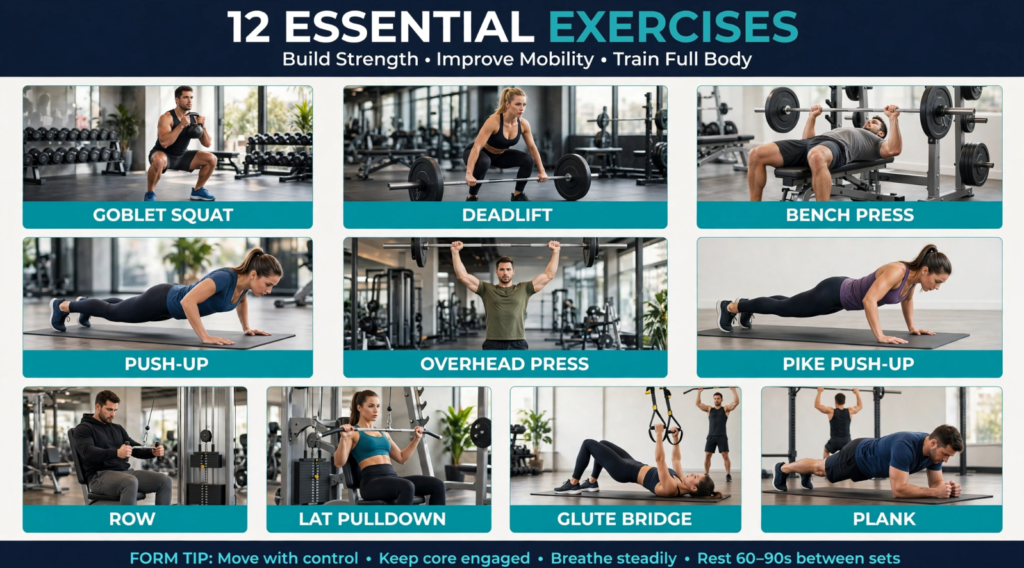
You don’t need a long list of exercises. Master these six fundamental movements, and you’ve got a complete bodyweight workout program.
Exercise 1: Push-ups (and Variations)
The push-up is the king of upper-body bodyweight exercises. It builds strength in your chest, shoulders, triceps, and core.
Wall Push-up (Beginner):
- Stand arm’s length from a wall, hands placed shoulder-width apart on the wall
- Lean forward and lower your chest toward the wall
- Push back to the starting position
Incline Push-up (Beginner-Intermediate):
- Place your hands on a bench, table, or stairs (higher = easier)
- Lower your chest toward the surface with a straight body
- Push back up
Knee Push-up (Intermediate):
- Start on all fours, knees on the floor, hands under shoulders
- Lower your chest toward the floor, keeping a straight line from head to knees
- Push back up
Full Push-up (Advanced):
- Start in a high plank position, hands under shoulders, body straight
- Lower your chest to the floor, elbows at 45 degrees
- Push back up to the starting position
Sets & Reps: 3 sets of 5–20 reps (choose a variation that challenges you within this range)
Exercise 2: Bodyweight Squats
The bodyweight squat is the foundation of lower-body strength and mobility.
Form:
- Stand with feet shoulder-width apart, toes slightly turned out
- Keep your chest up and back straight
- Lower your hips back and down as if sitting in a chair
- Aim for at least parallel (thighs parallel to the floor)
- Drive through your heels to return to standing
Variations:
- Box Squat: Squat to a chair or box for support and confidence
- Split Squat: One foot forward, one back—great for balance and unilateral strength
- Squat with Heel Lift: Place a small book under your heels if ankle mobility is limited
Sets & Reps: 3 sets of 10–20 reps
Exercise 3: Planks (Core Stability)
The plank is the gold standard for building core stability and endurance.
Forearm Plank:
- Forearms on the floor, elbows directly under shoulders
- Body forms a straight line from head to heels
- Engage your core by pulling your belly button toward your spine
- Hold without letting your hips sag or pike up
Hands Plank (High Plank):
- Hands under shoulders, arms straight
- Body forms a straight line from head to heels
- Hold the position
Side Plank (Advanced):
- One forearm on the floor, body turned to the side
- Stack your feet and hips, forming a straight line
- Hold, then repeat on the other side
Sets & Hold Times: 3 sets of 20–60 seconds (start with what you can manage and build up)
Exercise 4: Glute Bridges
The glute bridge activates and strengthens your glutes, hamstrings, and lower back—critical for posture, lower back health, and hip stability.
Form:
- Lie on your back with knees bent, feet flat on the floor, hip-width apart
- Arms flat on the floor, palms down
- Press through your heels to lift your hips toward the ceiling
- Squeeze your glutes at the top, hold for 1–2 seconds
- Lower back down with control
Variations:
- Single-Leg Glute Bridge: Lift one foot off the floor and press through the other heel
- Elevated Glute Bridge: Place your feet on a bench or chair for greater range of motion
Sets & Reps: 3 sets of 12–20 reps
Exercise 5: Bird Dog
The bird dog builds core stability, balance, and coordination—all of which decline with age and are critical for fall prevention.
Form:
- Start on all fours, hands under shoulders, knees under hips
- Keep your back flat and core engaged
- Extend your right arm forward and left leg back simultaneously, keeping your hips level
- Hold for 2–3 seconds, squeezing your glutes and engaging your core
- Return to start and repeat on the opposite side
Sets & Reps: 3 sets of 8–12 reps per side
Exercise 6: Dead Bug
The dead bug teaches core control, coordination, and spinal stability—without putting pressure on your lower back.
Form:
- Lie on your back with arms extended toward the ceiling and legs lifted with knees bent at 90 degrees (tabletop position)
- Keep your lower back pressed firmly into the floor
- Slowly extend your right arm and left leg toward the floor, keeping your back flat
- Return to the starting position and repeat on the opposite side
Sets & Reps: 3 sets of 8–12 reps per side
Section 3: Your First Bodyweight Workout Plan
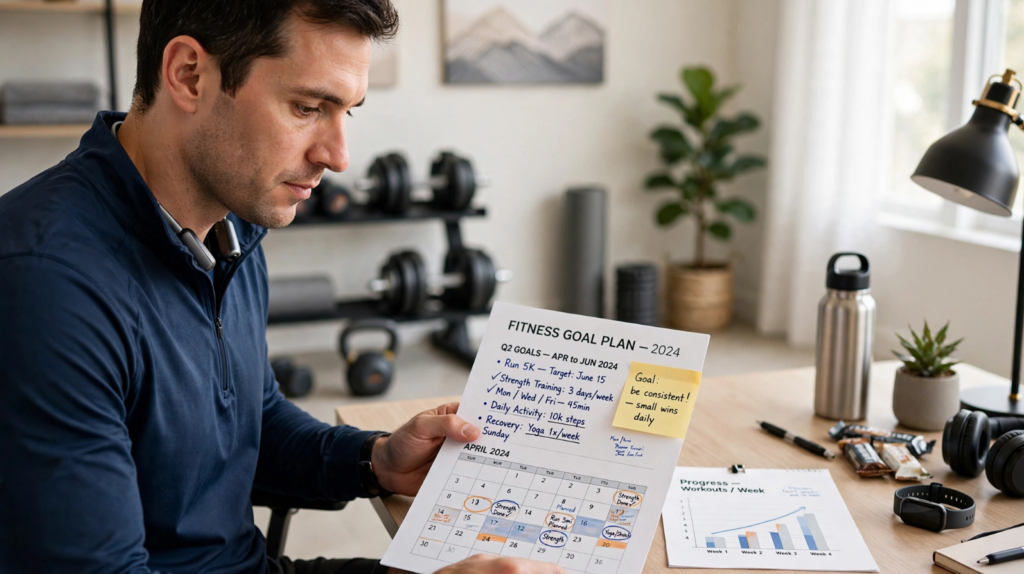
Here’s a complete beginner-friendly calisthenics program you can do anywhere, three times per week.
The Basic Workout
Perform this workout on non-consecutive days (e.g., Monday, Wednesday, Friday).
| Exercise | Sets | Reps/Duration | Rest |
|---|---|---|---|
| Bodyweight Squats | 3 | 12–15 | 60 sec |
| Push-ups (your variation) | 3 | 8–12 | 60 sec |
| Glute Bridges | 3 | 12–15 | 60 sec |
| Bird Dogs | 3 | 10 per side | 45 sec |
| Plank | 3 | 20–45 sec | 45 sec |
| Dead Bugs | 3 | 10 per side | 45 sec |
Warm-Up (5 Minutes)
Before each workout, complete this dynamic warm-up:
- Arm Circles: 30 seconds forward, 30 seconds backward
- Leg Swings: 10 swings forward, 10 side-to-side per leg
- Torso Twists: 10 rotations each side
- Bodyweight Squats (Light): 10 reps
- Cat-Cow Stretch: 10 repetitions
Cool-Down (5 Minutes)
After each workout, perform these static stretches:
- Quad Stretch: 30 seconds per side
- Hamstring Stretch: 30 seconds per side
- Chest Stretch: 30 seconds per side
- Child’s Pose: 60 seconds
Section 4: Progression—How to Make Bodyweight Exercises Harder
Once an exercise becomes easy (you can comfortably complete all reps with good form), it’s time to progress. Here’s how:
Progressing Push-ups
- Wall Push-ups → Incline Push-ups → Knee Push-ups → Full Push-ups → Diamond Push-ups (hands together) → Archer Push-ups → One-Arm Push-ups
Progressing Squats
- Box Squats → Bodyweight Squats → Jump Squats → Pistol Squats (one-legged)
Progressing Planks
- Knee Planks → Forearm Planks → High Planks → Side Planks → Plank with Leg Lifts → Plank with Shoulder Taps
Progressing Glute Bridges
- Glute Bridges → Single-Leg Glute Bridges → Elevated Glute Bridges → Weighted Glute Bridges (hold a household item)
Simple Progression Rule: If you can perform 3 sets of 15 reps with perfect form, advance to a harder variation or increase your rep count.
Section 5: Adding Variety—The “No Equipment” Full Body Workout
Here’s an alternative full-body workout that requires no equipment at all—perfect for when you’re traveling or just want some variety.
Circuit Style (Perform exercises back-to-back, rest 1–2 minutes between rounds)
5 Rounds:
- Bodyweight Squats: 15 reps
- Push-ups (your variation): 10 reps
- Walking Lunges: 10 reps per leg
- Plank: 30 seconds
- Glute Bridges: 15 reps
- Bird Dogs: 10 reps per side
This circuit builds muscle, cardiovascular endurance, and mental toughness. Start with 3 rounds if 5 is too challenging.
Section 6: Advanced Beginner Moves—Once You’re Ready
After a few months of consistent training, you can add these more challenging variations:
Diamond Push-ups
- Place hands close together in a diamond shape under your chest
- Targets the triceps and inner chest more intensely
Bulgarian Split Squats
- Place one foot behind you on a chair or bench
- Lower into a deep lunge with your front leg
- Builds leg strength, balance, and knee stability
Hanging Knee Raises
- Hang from a pull-up bar or sturdy ledge
- Raise your knees toward your chest, engaging your core
- The first step toward full hanging leg raises and ultimately, pull-ups
L-Sit Holds
- Sit on the floor with legs extended
- Press through your palms to lift your hips off the floor
- Hold the position, keeping legs straight
- Builds incredible core strength and hip flexor endurance
Section 7: Common Beginner Mistakes
Mistake 1: Sacrificing Form for Reps
The Fix: Quality over quantity. Perform 5 perfect push-ups rather than 15 sloppy ones. Good form is the foundation of progress and injury prevention.
Mistake 2: Forgetting to Breathe
The Fix: Exhale during the exertion phase (the hardest part) and inhale during the easier phase. For example, breathe out as you push up from a push-up, and in as you lower down.
Mistake 3: Doing the Same Routine Forever
The Fix: Your body adapts quickly. If you can do 3 sets of 15 reps of an exercise with no difficulty, it’s time to progress to a harder variation.
Mistake 4: Not Engaging Your Core
The Fix: In almost every calisthenics exercise, your core should be engaged to protect your spine and transfer force. Think about pulling your belly button toward your spine during each movement.
Mistake 5: Neglecting Warm-Up and Cool-Down
The Fix: Never skip the warm-up (5 minutes) or cool-down (5 minutes). They’re not optional—they’re part of the workout and essential for longevity.
Section 8: FAQ—Your Top Calisthenics Questions
Q: Can I build muscle with just bodyweight exercises?
A: Absolutely. Bodyweight exercises build significant muscle—especially when you use progressive overload (making exercises harder over time). Many calisthenics athletes have physiques comparable to those who use weights.
Q: What if I can’t do a single push-up?
A: That’s completely normal! Start with wall push-ups. When you can do 3 sets of 20, progress to incline push-ups (hands on a bench). When you can do 3 sets of 15, progress to knee push-ups. Eventually, you’ll be doing full push-ups. This process might take a few months—and that’s perfectly fine.
Q: How many days per week should I do calisthenics?
A: For beginners, three days per week (e.g., Monday, Wednesday, Friday) is ideal. This gives your muscles time to recover between sessions. If you only have time for two sessions, that still works—consistency matters more than frequency.
Q: Do I need any equipment?
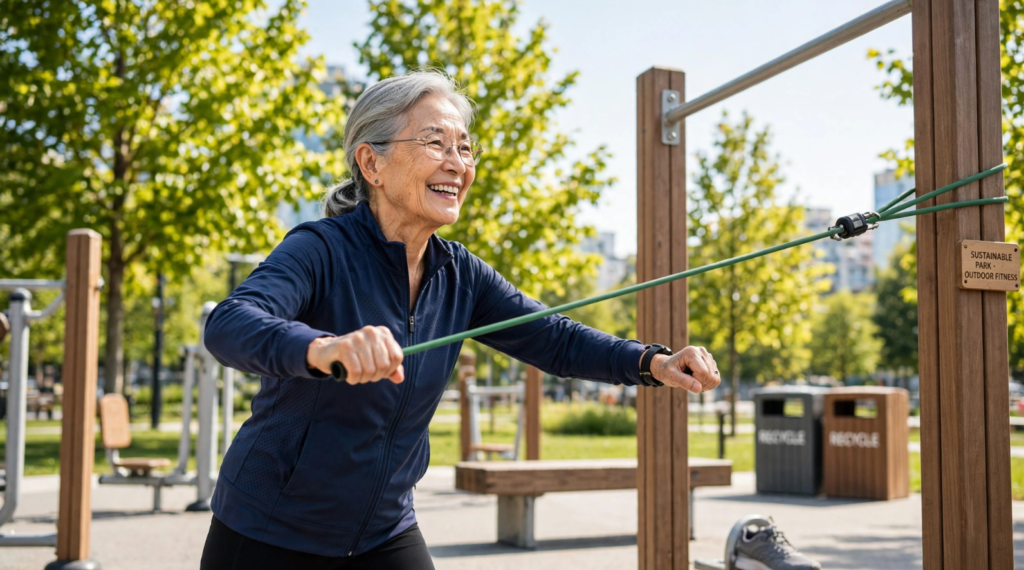
A: No equipment is required to start. However, a pull-up bar and resistance bands can open up many more exercises as you progress. But for the first few months, your body weight is all you need.
Q: Is calisthenics safe for people with joint issues?
A: In many cases, yes—it can even be therapeutic. Bodyweight exercises place less compressive stress on joints than heavy weightlifting. However, always start with the gentlest variations, move through full ranges of motion slowly, and stop if you feel joint pain (as opposed to muscle burn). Consult your healthcare provider before starting any exercise program.
Q: How long before I see results?
A: Most beginners notice improved energy, better body awareness, and increased confidence within 2–4 weeks. Visible changes in muscle definition typically appear in 6–12 weeks with consistent training and proper nutrition.
The VigorForty Take
Calisthenics is the most accessible form of strength training on the planet. You don’t need a gym. You don’t need expensive equipment. You don’t need a spotter. All you need is your body, a bit of space, and the willingness to start.
The exercises in this guide—push-ups, squats, planks, glute bridges, bird dogs, and dead bugs—form a complete foundation for building strength, stability, and functional fitness. They’ll help you:
- Get up off the floor with ease
- Carry heavy bags without straining your back
- Play with your kids or grandchildren without exhaustion
- Maintain your independence as you age
- Feel strong, capable, and confident in your body
Start with the beginner variations. Do three sessions per week. Be consistent. Be patient. Progress will come.
And here’s the secret: calisthenics is the gateway. Once you build a solid foundation of bodyweight strength, you’ll be ready to add weightlifting if you choose—or continue your bodyweight journey toward more advanced movements. Either path leads to a stronger, healthier you.
Your body is your gym. Start using it today.
This article was reviewed by the Vigor Forty Editorial Review Board on July 19, 2026.
🔗 Related Articles
- The Ultimate Beginner’s Guide to Strength Training
- Weightlifting 101: A Simple Guide for Beginners
- What is Core Stability and Why Does It Matter for Every Lift?
- How to Perform a Perfect Squat: Form Tips for Weightlifting and Bodyweight
Affiliate Disclosure: Some links in this article may be affiliate links. If you make a purchase through these links, Vigor Forty may earn a small commission at no extra cost to you. We only recommend products we trust.
Related Articles
- The Ultimate Beginner’s Guide to Strength Training (Weightlifting, Calisthenics, and Core)
- Weightlifting 101: A Simple Guide for Beginners
- Calisthenics for Beginners: Your First Bodyweight Workout Plan
- What is Core Stability and Why Does It Matter for Every Lift?
- 5 Foundational Movement Patterns for a Stronger Body
- Perfect Your Push-Up: A Step-by-Step Guide to Building Upper Body Strength
- How to Perform a Perfect Squat: Form Tips for Weightlifting and Bodyweight
- The Plank: More Than Just an Ab Exercise
- How to Combine Calisthenics and Weight Training for Maximum Results
- Sample Weekly Workout Plan: Combining Weights, Bodyweight, and Core
- The Importance of Progressive Overload in Strength Training
- How to Progress Calisthenics Exercises When Bodyweight Gets Easy
- Home Gym vs. Gym Membership: Which is Right for You?
- The Minimalist’s Guide to Strength Training: No Equipment Needed
- Top 5 Pieces of Equipment for a Home Strength Training Setup
- How to Choose the Right Weight for Your Workouts