
Author: Vigor Forty Editorial Team
Medically Reviewed By: Editorial Review Board
Disclaimer: This article is for informational purposes only and is not a substitute for professional medical advice. Read our full Medical Disclaimer.
📌 Key Takeaways
- CoQ10 Is the Spark Plug of Your Cells: Coenzyme Q10 shuttles electrons in the mitochondrial electron transport chain, enabling ATP production. Without it, cellular energy grinds to a halt. Organs with the highest energy demands—heart, brain, muscles, liver—are most vulnerable to deficiency.
- Statin Drugs Systematically Deplete CoQ10: Statins block the same mevalonate pathway that produces cholesterol and CoQ10. This depletion is a leading hypothesis for statin-related muscle pain, fatigue, and exercise intolerance. Supplementation does not interfere with the cholesterol-lowering effect.
- After 40, Natural Production Declines: The body’s ability to synthesize CoQ10 drops significantly with age, starting as early as the mid-30s. Mitochondrial efficiency fades in parallel, contributing to the energy slump many feel in midlife.
- Ubiquinol Is the Superior Form for Absorption—But Not Always Necessary: Ubiquinol (the reduced, active form) is better absorbed than ubiquinone (the oxidized form), especially in older adults. However, for general maintenance, high-quality ubiquinone taken with a fatty meal is effective and more affordable.
- Dosing and Pairing Matter: 100–200 mg daily is the evidence-backed range for general health and statin support. Absorption requires dietary fat. Pairing CoQ10 with your morning D3+K2 and omega-3s is a practical, synergistic ritual.
Introduction: The Cellular Battery That Slowly Drains
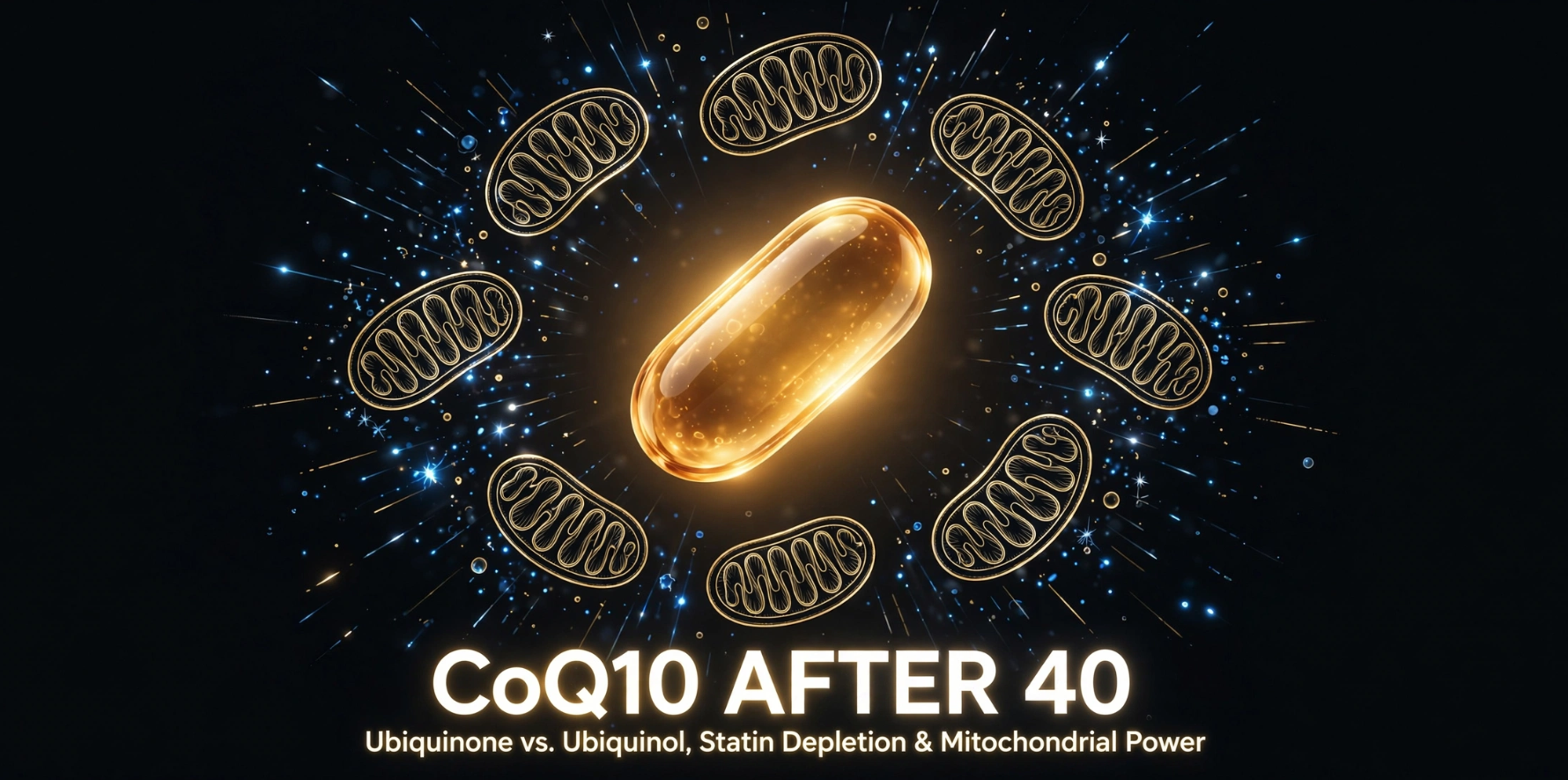
Every heartbeat, every thought, every muscle contraction depends on a molecule most people have never heard of. Coenzyme Q10, or CoQ10, is a fat-soluble, vitamin-like compound embedded in the inner membrane of your mitochondria—the power plants inside each of your trillions of cells. It’s the final electron acceptor in the chain that converts food into ATP, the usable energy currency of life. Without adequate CoQ10, your mitochondria sputter. Energy output drops. Tissues with the highest metabolic demand—your heart, your skeletal muscles, your brain—suffer first.
After 40, two forces conspire to drain your CoQ10 reserves: the natural decline of biosynthesis with age, and the widespread prescription of statin medications, which inhibit the same biochemical pathway that produces both cholesterol and CoQ10. The result? The very drug protecting your arteries may be quietly sapping your muscles of energy. This article gives you the complete picture: the science of CoQ10, the critical difference between ubiquinone and ubiquinol, exactly who needs to supplement, and how to do it correctly.
Section 1: What CoQ10 Does—Beyond the Buzzwords
CoQ10 lives in the inner mitochondrial membrane, where it performs two essential jobs:
1. ATP Production (Electron Transport Chain):
CoQ10 accepts electrons from Complex I and Complex II and passes them to Complex III. This shuttling creates the proton gradient that drives ATP synthase. It’s a non-negotiable step. If CoQ10 is deficient, the entire energy assembly line backs up, and less ATP is produced per unit of oxygen consumed.
2. Membrane Antioxidant:
In its reduced form (ubiquinol), CoQ10 is one of the most potent lipid-soluble antioxidants in the body. It protects mitochondrial membranes and circulating LDL cholesterol from oxidative damage. Oxidized LDL is the form that lodges in arterial walls, so CoQ10’s antioxidant role is directly cardioprotective.
Organs with the highest mitochondrial density—heart, skeletal muscle, liver, kidneys, and brain—contain the most CoQ10 and are the first to suffer when levels fall. Fatigue, muscle weakness, brain fog, and reduced exercise tolerance are the predictable symptoms.
Section 2: The Statin Problem—How Your Cholesterol Pill Creates a CoQ10 Deficit
Statins (atorvastatin, rosuvastatin, simvastatin, etc.) work by inhibiting HMG-CoA reductase, the rate-limiting enzyme in the mevalonate pathway. This pathway produces cholesterol—but it also produces CoQ10, heme A, dolichols, and other essential molecules. Blocking it reduces both cholesterol synthesis and CoQ10 synthesis simultaneously.
Clinical studies have consistently shown that statin therapy lowers serum CoQ10 levels by 20–40%, with effects appearing within weeks and persisting for the duration of treatment. Muscle tissue CoQ10 levels also drop, and the magnitude of depletion correlates with the severity of myalgia (muscle pain) in some, though not all, studies.
What the Evidence Says About Supplementing CoQ10 with Statins:
- A 2018 meta-analysis of 12 randomized controlled trials published in the Journal of the American Heart Association concluded that CoQ10 supplementation significantly reduced statin-associated muscle pain compared to placebo, with a number needed to treat of 6.
- A 2022 systematic review in Mayo Clinic Proceedings confirmed that CoQ10 (100–200 mg/day) improved statin tolerance and reduced myalgia severity, especially in those with confirmed low CoQ10 levels.
- CoQ10 supplementation does not reduce the lipid-lowering efficacy of statins. It replenishes what the drug depletes without interfering with HMG-CoA reductase in a clinically meaningful way.
Who Should Consider CoQ10 with Statins:
- Anyone starting a statin who experiences new-onset muscle aches, weakness, or exercise intolerance.
- Anyone on high-dose statins (atorvastatin 40–80 mg, rosuvastatin 20–40 mg) as a preventive measure.
- Anyone with a personal history of statin intolerance who wants to attempt a rechallenge with CoQ10 support.
Section 3: Ubiquinone vs. Ubiquinol—Which Form, and Why It Matters
CoQ10 exists in two forms in the body: ubiquinone (the oxidized form) and ubiquinol (the reduced, active antioxidant form). Your body interconverts them as needed, but this conversion becomes less efficient with age.
Ubiquinone (Standard CoQ10):
- The more common, less expensive form in supplements.
- Must be reduced to ubiquinol in the body to function as an antioxidant.
- Absorption is moderate and heavily dependent on taking it with a fat-containing meal.
- Effective for raising serum CoQ10 levels in younger adults and for general maintenance.
Ubiquinol (Reduced CoQ10):
- The active antioxidant form, directly usable by the body.
- Superior absorption, especially in individuals over 40 and those with compromised digestion or fat malabsorption.
- Typically costs 50–100% more than ubiquinone.
- Ideal for older adults, those with significant statin-induced muscle symptoms, or those with known absorption issues (IBS, celiac, post-gastric bypass).
The VigorForty Recommendation:
- For general health and mild statin support under age 55: 100–200 mg of high-quality ubiquinone (with standardized purity, from a reputable GMP facility, taken with a fat-containing meal) is sufficient and cost-effective.
- For significant statin-related muscle symptoms, age 55+, or known malabsorption: 100–200 mg of ubiquinol (Kaneka-sourced, the patented yeast-fermented form) provides superior bioavailability and is worth the higher cost.
- Switching tip: If you’ve been taking ubiquinone without noticeable benefit, try ubiquinol for 4–6 weeks. Some individuals absorb one dramatically better than the other.
Section 4: CoQ10 for Non-Statin Users—Heart, Brain, and Fertility
Even if you’ve never taken a statin, CoQ10 status matters.
Heart Failure and Cardiovascular Disease:
The landmark Q-SYMBIO trial (2014) showed that 300 mg of CoQ10 daily for 2 years reduced all-cause mortality by 43% and cardiovascular mortality by 43% in patients with moderate-to-severe heart failure when added to standard therapy. A 2021 meta-analysis confirmed CoQ10’s benefit in improving ejection fraction and functional capacity in heart failure patients. While not every 40-something needs heart failure-level dosing, it underscores CoQ10’s profound cardiometabolic importance.
Migraine Prevention:
Multiple randomized trials have found that CoQ10 (100–300 mg/day) reduces migraine frequency by roughly 30–50%, comparable to some prescription preventives. The effect is likely due to improved mitochondrial energy metabolism in neurons. The American Academy of Neurology and the Canadian Headache Society both list CoQ10 as a Level C (possibly effective) preventive therapy.
Exercise Performance and Recovery:
CoQ10 reduces exercise-induced oxidative stress and may improve time to exhaustion in trained athletes. Effects are modest, but for the 40+ adult who notices slower recovery, CoQ10 can be a useful adjunct alongside creatine and protein.
Fertility (Both Sexes):
Sperm and egg cells are mitochondrially dense. CoQ10 levels decline in both with age. Supplementation (200–600 mg/day) has been shown to improve sperm motility and, in women, egg quality markers. This is an advanced topic for readers navigating fertility in their late 30s and 40s.
Section 5: Dosing, Timing, and Absorption—The Practical Protocol
Dose:
- General health, 40+: 100 mg daily.
- Statin support, muscle symptoms: 100–200 mg daily. Start at 100 mg and increase to 200 mg if symptoms persist after 4–6 weeks.
- Heart failure or migraine (under medical supervision): 200–300 mg daily, divided into two doses.
Timing:
Take CoQ10 with your largest fat-containing meal of the day—breakfast with eggs and avocado, or dinner with salmon and olive oil. Absorption is negligible on an empty stomach. Pair it with your D3+K2 and omega-3s in the morning, creating a single, efficient fat-soluble supplement ritual.
Duration:
CoQ10 is not an instant-effect supplement. Tissue saturation takes 2–4 weeks. Muscle symptoms from statins may begin to improve within 4–8 weeks. For migraine prevention, allow a 12-week trial.
What to Look For on the Label:
- Ubiquinone: Derived from yeast fermentation (not synthetic). Reputable brands include Kaneka-sourced ubiquinone. Softgels with an oil base (olive, MCT, soybean) enhance absorption.
- Ubiquinol: Look for “Kaneka Ubiquinol™” on the label. This patented form is the gold standard, used in most clinical trials.
- Third-party certification: USP, NSF, or ConsumerLab seal, particularly for heart health applications.
Section 6: Safety, Side Effects, and Drug Interactions
CoQ10 has an excellent safety profile. Clinical trials using doses up to 3,000 mg/day for months have reported no serious adverse effects.
- Mild Side Effects: Insomnia (if taken too late in the day—take with breakfast or lunch), mild GI upset, headache. These are uncommon and often resolve by lowering the dose.
- Blood Pressure: CoQ10 can modestly lower blood pressure. If you’re on antihypertensives, monitor for dizziness and inform your doctor. This effect is usually beneficial, not dangerous.
- Blood Thinners: There is a theoretical, though clinically rare, concern that CoQ10 could reduce the efficacy of warfarin because CoQ10 is structurally similar to vitamin K. A 2018 review found no definitive evidence of a clinically significant interaction. Still, if you take warfarin, inform your prescribing physician and monitor INR more frequently when starting or changing CoQ10 dose. DOACs (Eliquis, Xarelto) do not share this concern.
- Thyroid Medications: CoQ10 may slightly reduce the absorption of levothyroxine. Separate doses by 4 hours.
Section 7: FAQ — Your Top CoQ10 Questions
Q: Can I just eat more CoQ10-rich foods instead of supplementing?
A: Dietary CoQ10 sources—beef heart, pork, chicken, fatty fish, organ meats—provide only 3–6 mg per serving. Supplementation at 100–200 mg is impossible to replicate through diet alone. Food is supportive but not therapeutic.
Q: Does CoQ10 work for fatigue unrelated to statins?
A: Possibly. In conditions like chronic fatigue syndrome and fibromyalgia, some (but not all) trials show modest benefit. If you have unexplained fatigue and are over 40, a 3-month trial of 100–200 mg ubiquinol is low-risk and may help. It is not a stimulant; it supports cellular energy production.
Q: Can I take CoQ10 with my other supplements in the Vigor Five?
A: Yes, seamlessly. Take it with the D3+K2 and omega-3 softgels in the morning, all requiring fat for absorption. It does not interact with magnesium, creatine, or protein.
Q: Is CoQ10 the same as CoQ10 with PQQ?
A: No. PQQ (pyrroloquinoline quinone) is a separate compound that promotes mitochondrial biogenesis (the creation of new mitochondria). Some formulations combine CoQ10 with PQQ. While promising, PQQ has less robust human evidence than CoQ10. It’s an optional add-on, not a replacement.
The VigorForty Take
CoQ10 is not a flashy nootropic or an exotic anti-aging peptide. It’s a foundational molecule that your body has relied on since the first heartbeat. After 40, and especially if you take a statin, your natural production can no longer keep pace with the energy demands of your heart, muscles, and brain. Replenishing it with a well-absorbed supplement—ubiquinone for most, ubiquinol for those with symptoms or over 55—is one of the simplest, most evidence-backed steps you can take to support cellular energy, exercise tolerance, and cardiovascular resilience.
Pair it with your morning fat-soluble ritual. Give it 4–6 weeks. Notice whether your muscles feel less achy, your energy feels steadier, and your workouts feel less draining. Then decide if it earns a permanent place in your personalized VigorForty protocol.
Read Realated Articles
- The Complete Guide to Heart Health: Beyond Omega-3s—CoQ10, Magnesium, Potassium, and Nitric Oxide Support After 40
- The Complete Guide to Eye Health: Lutein, Zeaxanthin, Astaxanthin, and Omega-3s for Protecting Your Vision After 40
- The Complete Guide to Anti-Aging Skin, Hair, and Nails: Collagen, Biotin, Silica, and Antioxidants for a Vibrant Appearance After 40
- The Busy Parent’s Supplement Guide: Staying Energized, Resilient, and Healthy While Raising Kids After 40
- Supplements for Brain Fog and Mental Clarity: Phosphatidylserine, Bacopa Monnieri, and Lion’s Mane—What Actually Works After 40
- The Complete Guide to Digestive Health: Probiotics, Prebiotics, Digestive Enzymes, and Gut-Healing Nutrients After 40
- Supplements for Osteoarthritis: A Natural Pain Management Protocol That Protects Your Joints After 40
- The Sleep-Supplement Connection: Magnesium, Glycine, L-Theanine, and Melatonin—A Complete Protocol for Restorative Rest After 40
- The Ultimate Guide to Healthy Aging: How to Build Your Personalized Supplement Plan at 40, 50, and 60
- Menopause Beyond the Basics: Mood, Bone, Brain, and Sleep Support for the American Woman Over 40
- Selenium, Zinc, and Iodine: The Trace Minerals That Support Thyroid, Immunity, and Longevity After 40
- TSA Rules for Supplements: Traveling with Pills, Powders, and Liquids as an American Over 40
- CoQ10 After 40: Ubiquinone vs. Ubiquinol, Statin Depletion, and Mitochondrial Support
- The VigorForty Guide to Third-Party Testing: USP, NSF, ConsumerLab, and How to Verify Your Supplements Are Safe
- The VigorForty Yearly Blood Work Blueprint: Exactly What to Test and When for Optimal Health After 40
- Metabolic Health Supplements: Berberine, Inositol, and Chromium for Blood Sugar Control After 40
- The Complete Guide to Electrolytes for the Active American Over 40: Sodium, Potassium, Magnesium, and Hydration Science
- Supplement-Drug Interactions Every American Over 40 Must Know: Blood Thinners, Antidepressants, BP Meds, and Statins
- The Busy Professional’s Core 5 Supplements: No Clutter, No Hype, Just What Actually Moves the Needle After 40
- Glycine + NAC: The Under-the-Radar Longevity Stack for Glutathione, Detoxification, and Deep Sleep After 40
- Adaptogens Worth Your Money: Ashwagandha, Rhodiola, and Holy Basil—Evidence and Safe Use for the Stressed 40+ American
- Best Supplements for Joint Health After 40: Curcumin, Collagen, MSM, and Glucosamine—Ranked by Evidence
- NAD+ Precursors (NMN & NR) in 2026: Current Evidence, US Legal Status, and What’s Worth Your Money
- Budget-Friendly Blood Tests to Check Your Actual Micronutrient Gaps (And Skip the Guesswork)
- The Perimenopause Supplement Protocol: Bone, Brain, and Sleep Support for American Women Over 40
- How to Read a Supplement Facts Panel Like a Dietitian: The 5-Step Method for Over-40 Americans
- Protein Powder After 40: Whey, Plant, Collagen, and the Anabolic Threshold You Must Know
- Omega-3s Decoded: EPA, DHA, and How to Read a Fish Oil Label for the Over-40 American
- Creatine After 40: Not Just for Bodybuilders—Brain, Muscle, and Longevity Science
- 5 Magnesium Myths Busted: Glycinate, Citrate, Oxide, and Which One You Actually Need
- Vitamin D3 + K2: The Over-40 American’s Protocol for Bones, Arteries, and Immunity
- The ‘Vigor Five’: Core Daily Supplements for Energy and Longevity After 40
- How Much Protein Do You Actually Need? (The Definite Guide for Satiety and Muscle Retention)
- The Ultimate Guide to Nutrient Density: How to Eat Real Food in America