

Author: Vigor Forty Editorial Team
Medically Reviewed By: Editorial Review Board
Disclaimer: This article is for informational purposes only and is not a substitute for professional medical advice. Read our full Medical Disclaimer.
📌 Key Takeaways
- Widespread Deficiency: Over 40% of American adults are vitamin D deficient, with rates climbing higher in northern latitudes, darker skin tones, and those who work indoors. After 40, the skin’s ability to synthesize D3 declines significantly.
- The K2 Partnership Is Non-Negotiable: Without vitamin K2 (as MK-7), vitamin D’s calcium-absorbing boost can lead to arterial calcification instead of stronger bones. K2 activates proteins that direct calcium into the skeleton and teeth.
- Dosing Matters: The optimal daily intake for most 40+ Americans is 2,000–4,000 IU of D3 paired with 100–200 mcg of K2 MK-7, taken with a fat-containing meal. This is far above the outdated RDA of 600–800 IU.
- Immune, Mood, and Metabolic Support: Beyond bone health, D3 modulates immune function, influences serotonin pathways, and supports insulin sensitivity—all of which become more critical with age.
- Label Literacy Saves Your Arteries: Most drugstore vitamin D lacks K2. Choosing a combined D3 + K2 formula with third-party testing (USP, NSF) and an oil-based delivery system is the VigorForty standard.
Introduction: The Silent Deficiency Sabotaging American Health After 40
You can eat clean, train hard, and prioritize sleep, but if your vitamin D status is suboptimal, you’re leaving a gaping hole in your health defense. Vitamin D isn’t a vitamin in the classic sense; it’s a pro-hormone that influences the expression of over 1,000 genes. It modulates your immune system, supports your mood, regulates calcium metabolism, and helps maintain muscle strength. Yet, despite living in a country with abundant food and sunshine, vitamin D insufficiency is a near-epidemic among American adults—and it gets worse with every passing decade after 40.
The reason is threefold. First, our increasingly indoor, screen-based lifestyle blocks the UVB rays required for natural synthesis. Second, as skin ages, its concentration of 7-dehydrocholesterol (the precursor that UVB converts to vitamin D3) plummets. Third, the official Recommended Dietary Allowance of 600–800 IU is widely criticized by researchers as being adequate only to prevent rickets, not to support the pleiotropic benefits that middle-aged adults need.
But here’s the critical twist that mainstream advice often misses: taking high-dose vitamin D in isolation, without its partner vitamin K2, risks quietly calcifying your arteries while you think you’re protecting your bones. This article gives you the complete, science-backed protocol for pairing D3 with K2 to safely unlock the full benefits—no marketing fluff, only what the peer-reviewed data says.
Section 1: Vitamin D After 40 — Why Your Age Makes You Vulnerable
Vitamin D3 (cholecalciferol) is produced in the skin when UVB radiation converts 7-dehydrocholesterol into pre-vitamin D3, which then isomerizes into D3. This D3 travels to the liver, where it becomes 25-hydroxyvitamin D [25(OH)D], the storage form measured in blood tests. Finally, the kidneys (and many other tissues) convert it into the active hormonal form, 1,25-dihydroxyvitamin D.
What changes at 40+:
- Decreased Cutaneous Synthesis: A 70-year-old produces roughly 25% of the vitamin D a 20-year-old does from the same sun exposure. The decline is gradual, beginning as early as the mid-30s and accelerating.
- Increased Time Indoors: Careers at desks, commuting in cars, and fatigue that reduces outdoor leisure time slash UVB exposure.
- Higher Body Fat Percentage: Vitamin D is fat-soluble and can become sequestered in adipose tissue, making it less bioavailable. This is especially relevant for Americans with rising BMIs.
- Kidney Function Shifts: The conversion of 25(OH)D to the active form relies on kidney function, which can decline subtly with age.
Blood Level Targets:
The Endocrine Society and many functional medicine practitioners recommend a serum 25(OH)D level of 40–60 ng/mL for optimal immune, bone, and metabolic health. By contrast, the Institute of Medicine considers 20 ng/mL sufficient for bone health—but that lower threshold ignores extraskeletal benefits. Given that many Americans test below 30 ng/mL, supplementation becomes a rational default.
Section 2: Vitamin K2 — The “Calcium Traffic Controller”
Vitamin K is a family of fat-soluble vitamins. K1 (phylloquinone) is abundant in leafy greens and primarily supports blood clotting. K2 (menaquinone) comes in several forms, the most important for humans being MK-7 (long half-life) and MK-4 (shorter half-life, tissue-specific). K2’s job is to activate proteins that regulate calcium deposition:
- Osteocalcin: Binds calcium and incorporates it into the bone matrix. Without sufficient K2, osteocalcin remains undercarboxylated (inactive), and bone mineralization suffers.
- Matrix Gla Protein (MGP): The most potent inhibitor of vascular calcification known. MGP prevents calcium from depositing in the smooth muscle of arteries. Warfarin, a common blood thinner, blocks vitamin K recycling, leading to rapid arterial calcification—a stark demonstration of K2’s importance.
The D3-K2 Synergy: Vitamin D increases the synthesis of both osteocalcin and MGP. Without K2, these proteins remain inactive, and the increased calcium absorption driven by D3 can end up in artery walls instead of bones. This is not a theoretical risk. Several population studies show that low vitamin K2 intake correlates with increased arterial stiffness and cardiovascular events, independent of other factors.
For the American over 40, who is already navigating rising cardiovascular risk, the D3+K2 combination is a protective, not optional, pairing.
Section 3: Optimal Dosing and Forms — The VigorForty Protocol
D3 Dosage:
- Maintenance Dose: 2,000–4,000 IU daily. This range reliably achieves a 25(OH)D level between 40–60 ng/mL in most average-weight adults. Doses above 4,000 IU should be guided by blood testing and a physician.
- Loading Dose (if known deficient): Sometimes 5,000–10,000 IU daily for 8 weeks, followed by a maintenance dose. Do not self-prescribe high-dose loading without lab work.
- Form: Always choose cholecalciferol (D3), not ergocalciferol (D2). D3 is roughly 87% more effective at raising and maintaining 25(OH)D levels. Look for D3 dissolved in olive oil, coconut oil, or MCT oil for superior absorption.
K2 Dosage:
- Maintenance Dose: 100–200 mcg of MK-7. MK-7 has a biological half-life of 3 days, vs. MK-4’s 1–2 hours, meaning once-daily dosing achieves steady levels. MK-4 is rapidly cleared and requires multiple daily doses, making MK-7 the practical choice for a combined supplement.
- Form: MK-7 (menaquinone-7), typically derived from natto (fermented soy) or a synthetic trans-MK-7 that is bioidentical. Avoid products that list only “vitamin K” or “K2” without specifying MK-7 or MK-4.
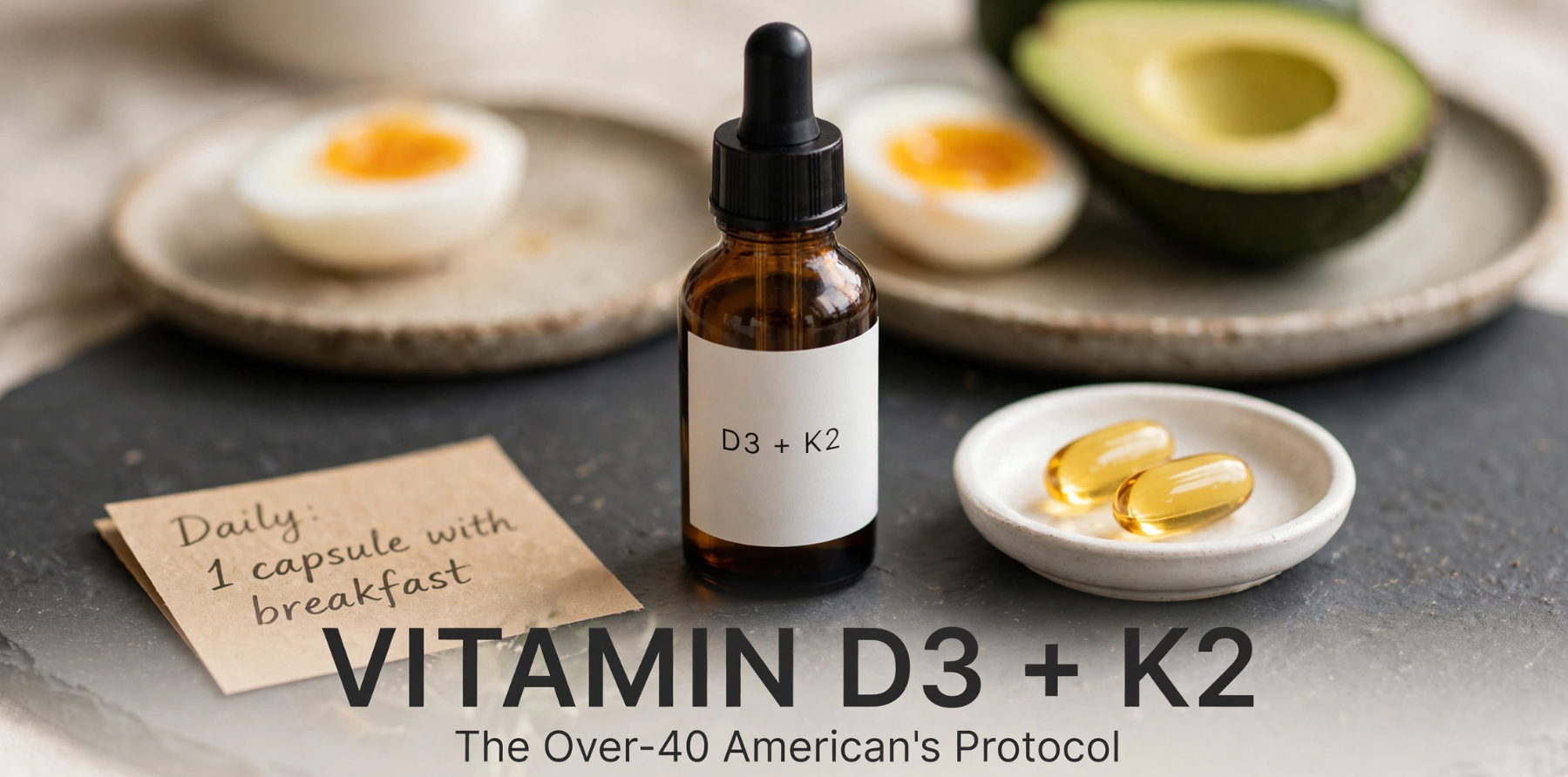
Taking the Capsule: Consume with a meal that contains fat—eggs, avocado, olive oil, or nuts. A fat-free breakfast (like a plain bagel or cereal) will significantly reduce absorption of both D3 and K2.
Section 4: Beyond Bones — The Full-Body Benefits for the 40+ American
While calcium metabolism gets the headlines, vitamin D3 and K2 influence systems that matter urgently to middle-aged adults.
Immune Competence: Vitamin D upregulates cathelicidin and defensins, antimicrobial peptides that act as the body’s first-line defense. Low D status is associated with higher incidence and severity of respiratory infections. For an American navigating crowded airports, open-plan offices, and seasonal flu, maintaining robust D levels is a practical immune shield.
Mood and Cognitive Function: Vitamin D receptors are densely distributed in the brain, including regions associated with depression. Supplementation trials have shown that correcting insufficiency improves mood scores, particularly in those with seasonal affective disorder. Additionally, K2 is being studied for its role in brain cell mitochondrial health and the inhibition of neuroinflammation.
Muscle Strength and Fall Prevention: Vitamin D improves muscle protein synthesis and neuromuscular coordination. Clinical trials show that supplementation reduces fall risk in older adults, but the muscle-strengthening effects are relevant even in the 40s for those who want to maintain power and resilience.
Metabolic Health: Adequate vitamin D status correlates with better insulin sensitivity and pancreatic beta-cell function. Combined with magnesium (which activates vitamin D), this duo forms a metabolic support axis that complements diet and exercise.
Section 5: Safety, Contraindications, and Drug Interactions
Vitamin D toxicity (hypercalcemia) is rare and requires months of daily doses exceeding 10,000–15,000 IU. The greater concern for the 40+ American is not toxicity but a silent mismatch: taking D3 without K2. However, specific cautions apply:
- Blood Thinners (Warfarin/Coumadin): K2 can interfere with warfarin’s mechanism, which relies on blocking vitamin K recycling. Even small consistent doses of K2 can destabilize INR. Patients on warfarin should not take K2 without close medical supervision. Newer anticoagulants (DOACs like apixaban, rivaroxaban) do not target the vitamin K pathway, so K2 supplementation is generally considered safer, but you must still consult your cardiologist.
- Sarcoidosis and Granulomatous Diseases: These conditions can cause excessive conversion of 25(OH)D to active D, leading to hypercalcemia. Supplementation should only occur with physician monitoring.
- Kidney Stones (Hypercalciuric): High-dose D without K2 and magnesium can increase calcium excretion and theoretically stone risk. Adequate hydration, K2, and magnesium mitigate this.
Section 6: How to Read a D3 + K2 Label Like a VigorForty Editor
Flip the bottle over and scan for these non-negotiables:
- Form of D: Cholecalciferol (D3).
- Form of K2: Menaquinone-7 (MK-7), with dosage between 100–200 mcg.
- Oil Carrier: The softgel or liquid should contain olive oil, MCT oil, or another fat source. Dry tablet D3 is poorly absorbed.
- No Proprietary Blends: Every active ingredient must list its exact amount.
- Third-Party Seal: USP, NSF for Sport, or ConsumerLab certification. This confirms potency, purity, and the absence of heavy metals.
- Avoid: Formulas that tout “Vitamin K complex” without disclosing exact K2 MK-7 levels, or that pair D3 with calcium. We recommend getting calcium from food (yogurt, sardines, leafy greens), not a pill.
Section 7: The VigorForty Take
Vitamin D3 paired with K2 isn’t trendy. It’s the biological bedrock that almost every American over 40 needs to address. Start with a simple, oil-based D3 + MK-7 softgel, taken with breakfast every day. Test your blood levels after 3–4 months to fine-tune. Your bones, arteries, immune system, and mood will all operate better when this nutrient gap is closed.
This one decision—taking a daily D3+K2 softgel with food—will likely do more for your long-term health than half the exotic supplements in your shopping cart. Master the basics first.
Read Realated Articles
- The Complete Guide to Heart Health: Beyond Omega-3s—CoQ10, Magnesium, Potassium, and Nitric Oxide Support After 40
- The Complete Guide to Eye Health: Lutein, Zeaxanthin, Astaxanthin, and Omega-3s for Protecting Your Vision After 40
- The Complete Guide to Anti-Aging Skin, Hair, and Nails: Collagen, Biotin, Silica, and Antioxidants for a Vibrant Appearance After 40
- The Busy Parent’s Supplement Guide: Staying Energized, Resilient, and Healthy While Raising Kids After 40
- Supplements for Brain Fog and Mental Clarity: Phosphatidylserine, Bacopa Monnieri, and Lion’s Mane—What Actually Works After 40
- The Complete Guide to Digestive Health: Probiotics, Prebiotics, Digestive Enzymes, and Gut-Healing Nutrients After 40
- Supplements for Osteoarthritis: A Natural Pain Management Protocol That Protects Your Joints After 40
- The Sleep-Supplement Connection: Magnesium, Glycine, L-Theanine, and Melatonin—A Complete Protocol for Restorative Rest After 40
- The Ultimate Guide to Healthy Aging: How to Build Your Personalized Supplement Plan at 40, 50, and 60
- Menopause Beyond the Basics: Mood, Bone, Brain, and Sleep Support for the American Woman Over 40
- Selenium, Zinc, and Iodine: The Trace Minerals That Support Thyroid, Immunity, and Longevity After 40
- TSA Rules for Supplements: Traveling with Pills, Powders, and Liquids as an American Over 40
- CoQ10 After 40: Ubiquinone vs. Ubiquinol, Statin Depletion, and Mitochondrial Support
- The VigorForty Guide to Third-Party Testing: USP, NSF, ConsumerLab, and How to Verify Your Supplements Are Safe
- The VigorForty Yearly Blood Work Blueprint: Exactly What to Test and When for Optimal Health After 40
- Metabolic Health Supplements: Berberine, Inositol, and Chromium for Blood Sugar Control After 40
- The Complete Guide to Electrolytes for the Active American Over 40: Sodium, Potassium, Magnesium, and Hydration Science
- Supplement-Drug Interactions Every American Over 40 Must Know: Blood Thinners, Antidepressants, BP Meds, and Statins
- The Busy Professional’s Core 5 Supplements: No Clutter, No Hype, Just What Actually Moves the Needle After 40
- Glycine + NAC: The Under-the-Radar Longevity Stack for Glutathione, Detoxification, and Deep Sleep After 40
- Adaptogens Worth Your Money: Ashwagandha, Rhodiola, and Holy Basil—Evidence and Safe Use for the Stressed 40+ American
- Best Supplements for Joint Health After 40: Curcumin, Collagen, MSM, and Glucosamine—Ranked by Evidence
- NAD+ Precursors (NMN & NR) in 2026: Current Evidence, US Legal Status, and What’s Worth Your Money
- Budget-Friendly Blood Tests to Check Your Actual Micronutrient Gaps (And Skip the Guesswork)
- The Perimenopause Supplement Protocol: Bone, Brain, and Sleep Support for American Women Over 40
- How to Read a Supplement Facts Panel Like a Dietitian: The 5-Step Method for Over-40 Americans
- Protein Powder After 40: Whey, Plant, Collagen, and the Anabolic Threshold You Must Know
- Omega-3s Decoded: EPA, DHA, and How to Read a Fish Oil Label for the Over-40 American
- Creatine After 40: Not Just for Bodybuilders—Brain, Muscle, and Longevity Science
- 5 Magnesium Myths Busted: Glycinate, Citrate, Oxide, and Which One You Actually Need
- Vitamin D3 + K2: The Over-40 American’s Protocol for Bones, Arteries, and Immunity
- The ‘Vigor Five’: Core Daily Supplements for Energy and Longevity After 40
- How Much Protein Do You Actually Need? (The Definite Guide for Satiety and Muscle Retention)
- The Ultimate Guide to Nutrient Density: How to Eat Real Food in America