
Author: Vigor Forty Editorial Team
Medically Reviewed By: Editorial Review Board
Disclaimer: This article is for informational purposes only and is not a substitute for professional medical advice. Read our full Medical Disclaimer.
📌 Key Takeaways
- Both home gyms and commercial gyms have distinct advantages: Your choice depends on your budget, schedule, goals, and personal preferences—not on what’s “best” in absolute terms.
- Home gyms offer convenience, privacy, and long-term cost savings: You can train anytime, in your own space, with no commute. The upfront investment can pay for itself within 1–2 years compared to a monthly membership.
- Commercial gyms provide variety, equipment, and community: Access to specialized machines, heavy weights, classes, and trainers—plus the motivation of training around others.
- The hybrid approach works for many: A basic home setup for daily workouts plus a gym membership for heavy lifting or variety can be the best of both worlds.
- Your needs will evolve: What works for you today may change as your goals, schedule, and budget shift over time.
Introduction: The Great Fitness Debate
You’ve decided to get stronger. You’re committed to building muscle, improving your health, and feeling more capable in your body. Now comes the question: where should you train?
The debate between home gyms and commercial gyms is one of the most common questions in fitness. And like most debates, there’s no single right answer. What works for your neighbor, your coworker, or your favorite fitness influencer may not work for you.
Your choice depends on a range of factors:
- How much space do you have?
- What’s your budget?
- What’s your schedule like?
- What are your fitness goals?
- What motivates you?
- Do you prefer training alone or with others?
This guide will help you answer these questions. We’ll compare home gyms and commercial gyms across key factors—cost, convenience, equipment, motivation, and more. By the end, you’ll have a clear understanding of which option fits your life.
Section 1: The Home Gym
The Appeal
Imagine this: You wake up, have coffee, walk into your garage or spare room, and start your workout. No commute. No waiting for equipment. No one watching you. No monthly bill. This is the promise of the home gym.
The Home Gym Advantage:
- Convenience: Train whenever you want, day or night. No driving, no parking, no checking in. This is huge for busy Americans with packed schedules.
- Privacy: No one watching you struggle with a new exercise or lift lighter weights than you’d like. You can focus completely on your form and effort without self-consciousness.
- Flexibility: Work out in your underwear if you want. Play whatever music you like. Take breaks to check on the kids or answer a work email. It’s your space.
- Cost-Effective Long-Term: While the upfront investment can be significant, a home gym pays for itself over time compared to monthly gym dues.
- Hygiene: You know who’s using your equipment. No shared sweat, no questionable hygiene practices.
- Family-Friendly: Your spouse, partner, or children can use the equipment too. It becomes a family resource.
The Challenges
The Home Gym Challenges:
- Upfront Investment: Quality equipment costs money. A good home gym setup can run from a few hundred dollars to several thousand. You need to be prepared for that initial outlay.
- Space Requirements: Not everyone has a spare room, garage, or basement. You need enough space to move and store equipment.
- Limited Equipment: Unless you have a large space and significant budget, you won’t have the variety of a commercial gym. No leg press, no cable machines, no specialized equipment.
- Lack of Motivation: It’s easier to skip a workout when the gym is just down the hall. Some people need the external accountability of going to a gym.
- No Professional Guidance: Unless you hire a personal trainer to come to your home, you’re on your own for form checks and programming advice.
- Maintenance: You’re responsible for equipment maintenance, repairs, and replacements.
- Distractions: Laundry, dishes, kids, work—your home is full of distractions that can derail a workout.
Section 2: The Commercial Gym
The Appeal
There’s something about walking into a gym filled with equipment, energy, and people working toward their goals. The commercial gym experience is about more than just lifting weights—it’s about immersion in a fitness environment.
The Commercial Gym Advantage:
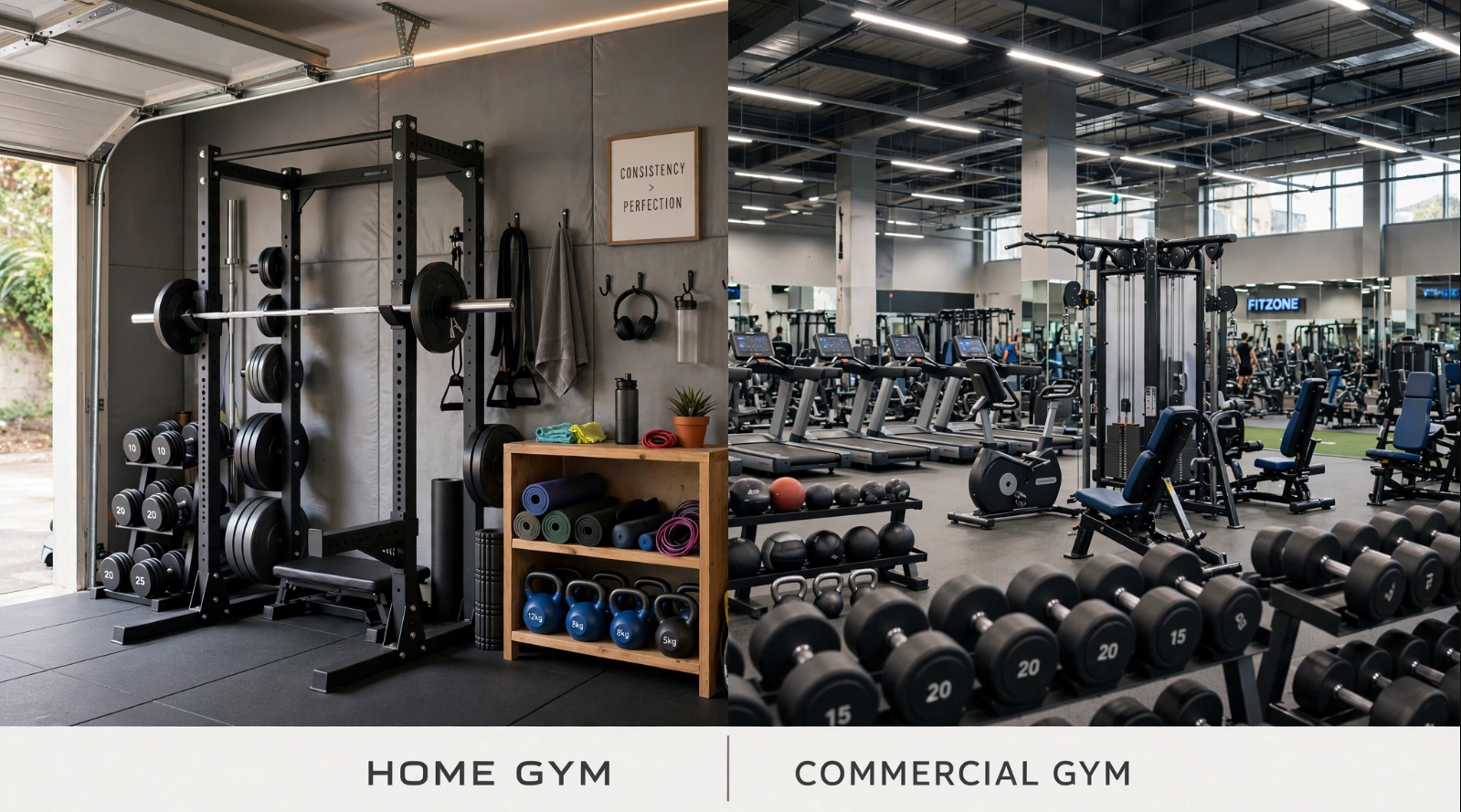
- Equipment Variety: Commercial gyms have everything—barbells, dumbbells, kettlebells, machines, cables, cardio equipment, and specialty gear. You never run out of options.
- Specialized Equipment: Leg press machines, cable crossovers, Smith machines, hack squats, pec decks, and more. Some exercises are much easier or safer with specialized equipment.
- Heavy Weights: If you’re lifting heavy, commercial gyms have the weights you need. No need to invest in expensive heavy plates.
- Community and Motivation: Training around others can be motivating. You see people working hard, and it pushes you to work harder. Some people thrive on this energy.
- Professional Guidance: Most gyms have trainers available for form checks, programming advice, and personal training sessions.
- Classes and Variety: Group fitness classes, yoga, spin, and other offerings add variety to your training.
- No Maintenance: Equipment breaks? Not your problem. Need new equipment? Not your problem. The gym handles everything.
- Social Connection: Gym friendships are real. Training with a partner or meeting regulars can make fitness more enjoyable.
The Challenges
The Commercial Gym Challenges:
- Monthly Cost: Gym memberships add up. $30–$100 per month, year after year, is a significant expense over time.
- Travel Time: Driving to and from the gym takes time—sometimes 15–30 minutes each way. That’s time you might not have.
- Busy Hours: At peak times, you may wait for equipment. The squat rack is occupied. All the benches are taken. You adapt your workout or wait.
- Hygiene: Shared equipment. Sweat. Improperly wiped-down machines. It’s not always pleasant.
- Lack of Privacy: If you’re self-conscious, the gym can be intimidating. People watch. People judge. (Though in reality, most people are focused on themselves.)
- Closing Hours: Many gyms aren’t open 24/7. If you prefer late-night or early-morning workouts, check the hours.
- Membership Contracts: Many gyms have contracts with cancellation fees. Read the fine print.
- Commute Time: That 15–30 minutes each way adds up—an hour or more per week spent just getting to and from your workout.
Section 3: Cost Comparison
The Numbers: Home Gym vs. Gym Membership
Let’s do the math.
Commercial Gym Membership (Typical Costs):
| Expense | Monthly | Yearly | 5 Years | 10 Years |
|---|---|---|---|---|
| Gym Membership ($50/month) | $50 | $600 | $3,000 | $6,000 |
| Annual Fee (some gyms) | — | $50 | $250 | $500 |
| Total | $50 | $650 | $3,250 | $6,500 |
Home Gym (Typical Costs):
| Equipment | Cost |
|---|---|
| Adjustable Dumbbells | $200–$500 |
| Adjustable Bench | $100–$300 |
| Barbell and Plates (200 lbs) | $300–$600 |
| Squat Rack | $300–$800 |
| Pull-up Bar | $30–$100 |
| Resistance Bands | $20–$50 |
| Flooring/Mat | $50–$150 |
| Total | $1,000–$2,500 |
The Break-Even Point:
| Scenario | Gym Cost (5 Years) | Home Gym Cost | Savings |
|---|---|---|---|
| Minimal Home Gym ($1,000) | $3,250 | $1,000 | $2,250 saved |
| Mid-Range Home Gym ($1,500) | $3,250 | $1,500 | $1,750 saved |
| Premium Home Gym ($2,500) | $3,250 | $2,500 | $750 saved |
Key Point: A home gym typically pays for itself within 1–2 years compared to a gym membership. Over 5–10 years, the savings are significant.
Additional Costs to Consider
Home Gym Hidden Costs:
- Maintenance and repairs
- Replacing worn equipment
- Flooring and space preparation
- Climate control (heating/cooling your workout space)
Gym Membership Hidden Costs:
- Parking (in some locations)
- Lockers
- Towel service
- Personal training (optional but expensive)
- Cancellation fees
Section 4: Space Considerations
Home Gym Space Requirements
Minimum Space for a Basic Setup:
- Bodyweight Only: 6 ft x 6 ft (enough for push-ups, squats, planks)
- Dumbbell Setup: 8 ft x 8 ft (bench, dumbbells, mat)
- Full Setup: 10 ft x 12 ft (rack, barbell, bench, dumbbells, mats)
Room Options:
- Garage (most common)
- Basement
- Spare bedroom
- Corner of a living room
- Outdoor patio (weather permitting)
Tips for Small Spaces:
- Use collapsible or foldable equipment (folding squat rack, foldable bench)
- Wall-mounted storage for plates and bars
- Resistance bands take almost no space
- Use a doorway pull-up bar (no floor space needed)
- Use a yoga mat on carpet or hard floor
Commercial Gym Space
The gym has unlimited space—or at least enough space for all the equipment you could need. No need to worry about where to put things or how much room you have. The trade-off? You have to share that space with others.
Section 5: Equipment Comparison
What You Need vs. What You Want
The Home Gym Essentials:
| Equipment | Use | Cost |
|---|---|---|
| Adjustable Dumbbells | Most exercises | $200–500 |
| Adjustable Bench | Presses, rows, step-ups | $100–300 |
| Resistance Bands | Pull-ups, rows, warm-ups | $20–50 |
| Pull-up Bar | Pull-ups, hanging leg raises | $30–100 |
| Mat/Yoga Mat | Core, stretching, flooring | $20–50 |
The Home Gym Upgrades:
| Equipment | Use | Cost |
|---|---|---|
| Barbell and Plates | Squats, deadlifts, bench | $300–600 |
| Squat Rack | Safety for squats and bench | $300–800 |
| Kettlebells | Swings, Turkish get-ups | $50–200 each |
| Cardio Equipment | Treadmill, bike, rower | $500–2,000+ |
Total for a Complete Setup: $1,500–$3,000+
What Commercial Gyms Offer
| Equipment Category | Examples |
|---|---|
| Free Weights | Dumbbells (5–100+ lbs), Barbells, Kettlebells |
| Strength Machines | Leg press, cable crossovers, Smith machine, hack squat |
| Cardio Equipment | Treadmills, ellipticals, stationary bikes, rowers, stair climbers |
| Specialty Equipment | TRX, plyo boxes, bands, medicine balls, battle ropes |
| Amenities | Showers, lockers, sauna, classes, trainers |
Key Point: A commercial gym offers variety that’s nearly impossible to replicate at home unless you have a very large space and budget.
Section 6: Motivation and Accountability
The Psychological Factors
Commercial Gym Motivation:
- Social Pressure: Being around other people working hard can push you to work harder
- Sunk Cost: You’re paying for it, so you might as well use it
- Routine: The act of driving to the gym can be a psychological trigger
- Community: Gym friends, trainers, and regulars create accountability
- Energy: The gym environment has a unique energy that can be motivating
Home Gym Motivation:
- Convenience: No excuses—the gym is always open and always available
- Privacy: No judgment, no comparison—just you and your workout
- Comfort: Train in your own environment, at your own pace
- Flexibility: Work out when you want, without worrying about hours or crowds
Which is More Motivating?
This is highly individual. Some people thrive on the energy of a commercial gym. Others find it intimidating or distracting. The best choice is the one that gets you to train consistently.
The Verdict: If you struggle with motivation, consider a commercial gym for external accountability. If you prefer solitude and convenience, a home gym may be more motivating because it removes barriers.
Section 7: Fitness Goals and Training Style
How Your Goals Influence Your Choice
| Goal | Best Option | Why |
|---|---|---|
| Maximal Strength (Powerlifting) | Commercial Gym | Need heavy barbells, racks, and often a spotter |
| Bodybuilding/Hypertrophy | Commercial Gym | Need variety of machines, cables, and heavy free weights |
| Calisthenics/Bodyweight | Home Gym | Minimal equipment needed; can train anywhere |
| General Fitness | Either | Both can work; depends on preferences |
| Weight Loss | Either | Both work; equipment matters less than consistency |
| Functional Fitness | Hybrid | Combine home calisthenics with gym strength work |
| Group Fitness/Classes | Commercial Gym | Classes require a gym |
| Busy Schedule | Home Gym | No commute; train anytime |
Your Training Style
The Minimalist:
- Prefers simple, compound exercises
- Comfortable with a limited selection of equipment
- Home gym is ideal
The Equipment Enthusiast:
- Likes variety and trying different exercises
- Wants access to machines and specialized equipment
- Commercial gym is ideal
The Social Trainer:
- Enjoys training with friends or partners
- Motivated by being around others
- Commercial gym is ideal
The Introvert:
- Prefers solitude while training
- Dislikes crowds and waiting for equipment
- Home gym is ideal
The Hybrid:
- Uses a basic home gym for daily workouts
- Visits a commercial gym occasionally for variety
- This is increasingly common and works well
Section 8: The Hybrid Approach
For many people, the best answer isn’t choosing one or the other—it’s combining both.
What a Hybrid Approach Looks Like
Option 1: Home Gym Base + Occasional Gym Visits
- Do your regular workouts at home (3–4 days/week)
- Visit a commercial gym 1–2 times per month for heavy lifting or variety
- Use day passes or drop-in rates (often $10–20 per visit)
Option 2: Gym Base + Home Equipment
- Keep a basic gym membership
- Supplement with home equipment for days you can’t make it to the gym
Option 3: Seasonal Hybrid
- Home gym in summer (when weather is good and you want to save money)
- Commercial gym in winter (when weather is bad and you want motivation)
Option 4: Equipment-Specific
- Use the commercial gym for heavy compound lifts (squat, deadlift, bench)
- Use your home gym for accessory work, core, and calisthenics
Why Hybrid Works
- Flexibility: You can adapt to changing schedules, budgets, and preferences
- Best of Both Worlds: You get the convenience of home and the variety of a gym
- Cost-Effective: You don’t need to maintain a full commercial gym at home
- Sustainable: Variety keeps training interesting and prevents burnout
Section 9: Decision-Making Framework
Questions to Ask Yourself
Budget:
- How much can I afford to spend on fitness monthly?
- How much can I invest upfront for a home gym?
- Am I comfortable with a long-term financial commitment (gym contract)?
Space:
- Do I have a dedicated space for a home gym?
- How much room do I have for equipment?
- Is my living situation permanent (rent vs. own)?
Schedule:
- When do I prefer to work out (early morning, late night, lunch break)?
- Is the gym convenient to my home or workplace?
- How much time can I commit to commuting?
Goals:
- What are my specific fitness goals (strength, muscle, endurance, health)?
- What equipment do I need to achieve them?
- Do I need specialized equipment or heavy weights?
Motivation:
- Do I work better alone or with others?
- Does the gym environment motivate or intimidate me?
- Am I disciplined enough to train consistently at home?
Lifestyle:
- Do I have family members who would use a home gym?
- Do I have pets or children who would interfere with training?
- Do I prefer training in my own clothes and environment?
The Decision Matrix
| Factor | Home Gym | Commercial Gym |
|---|---|---|
| Cost (Short-Term) | High upfront cost | Low upfront cost |
| Cost (Long-Term) | Saves money | Expensive over time |
| Convenience | Excellent (no commute) | Good (some commute) |
| Equipment Variety | Limited | Extensive |
| Heavy Weights | Limited (unless invested) | Unlimited |
| Motivation | Self-motivated required | External motivation available |
| Privacy | Complete | Limited |
| Community | None | Strong |
| Flexibility | 24/7 | Limited by hours |
| Maintenance | Your responsibility | Gym’s responsibility |
Section 10: Action Steps
If You Choose a Home Gym
Step 1: Start Small
- Begin with the essentials: adjustable dumbbells, a bench, and resistance bands
- This costs $300–$500 and covers most exercises
- Build your setup gradually as your needs grow
Step 2: Choose Your Space
- Identify a dedicated space (garage, basement, spare room, corner)
- Measure the space and plan your layout
- Buy a mat for flooring protection
Step 3: Build Your Equipment Over Time
- Month 1: Dumbbells and bench
- Month 2: Resistance bands and pull-up bar
- Month 3: Kettlebell or barbell set
- Month 4: Squat rack (if needed)
Step 4: Create a Routine
- Schedule your workouts like appointments
- Treat your home gym as a real gym—no distractions
- Track your progress to stay motivated
If You Choose a Commercial Gym
Step 1: Research Gyms in Your Area
- Location: Proximity to home and work
- Hours: 24-hour options vs. limited hours
- Equipment: Does it have what you need?
- Cost: Monthly fees, annual fees, cancellation policies
- Culture: Is it the right environment for you?
Step 2: Try Before You Commit
- Most gyms offer free day passes or trial weeks
- Visit during the time you would normally train (e.g., after work)
- See if the atmosphere and crowd suit you
Step 3: Read the Contract
- Know the cancellation policy
- Understand annual fees and hidden costs
- Check if there’s a minimum commitment period
Step 4: Make It Work
- Plan your workouts to avoid peak times
- Build a community—meet people, find workout partners
- Use the classes and resources offered
If You Choose the Hybrid Approach
Step 1: Build Your Home Base
- Start with a basic home gym setup (dumbbells, bench, bands)
- This covers 80% of your training needs
Step 2: Choose Your Gym
- Find a gym with day passes or month-to-month options
- Consider a budget gym (Planet Fitness, Crunch) for occasional use
Step 3: Plan Your Weeks
- Home workouts on busy days or early mornings
- Gym visits on days you want variety or need specific equipment
- Example: Home on Monday/Wednesday/Friday, Gym on Saturday
Section 11: FAQ—Your Top Home Gym vs. Gym Membership Questions
Q: Is a home gym worth it?
A: For most people, yes—especially if you train consistently and have space. The savings over time are significant, and the convenience is unmatched. However, the initial investment can be a barrier. Start small and build over time.
Q: What equipment do I really need for a home gym?
A: The essentials are adjustable dumbbells, an adjustable bench, resistance bands, and a pull-up bar. This setup costs $300–$500 and covers most exercises. Add a barbell and plates as you progress.
Q: Can I build significant muscle with a home gym?
A: Yes. You can build significant muscle with just dumbbells, resistance bands, and bodyweight exercises. Progressive overload is still possible with these tools. Many people have built impressive physiques at home.
Q: Are commercial gyms worth the cost?
A: It depends on your usage. If you go 4–5 times per week, a gym membership is often worth it. If you go 1–2 times per week, you may be better off with day passes or a home gym. Calculate your cost per visit.
Q: How do I stay motivated at a home gym?
A: Strategies include:
- Scheduling workouts like appointments
- Having a dedicated space (not just any room)
- Playing motivating music or watching fitness videos
- Tracking your progress (seeing improvement is motivating)
- Having a clear goal and program
- Inviting a workout partner
Q: Is a commercial gym better for beginners?
A: Not necessarily. A commercial gym offers access to trainers and classes, which can be valuable for beginners. But a home gym removes social anxiety and allows beginners to learn at their own pace. Both can work.
Q: What about Planet Fitness and similar budget gyms?
A: Budget gyms like Planet Fitness offer good value at a low cost. However, they may have limited free weights (no barbells, limited heavy dumbbells) and can be crowded. If you’re a powerlifter or serious bodybuilder, a budget gym may not meet your needs.
Q: Can I combine both options?
A: Yes. Many people have a basic home gym for convenience and keep a cheap gym membership for variety and heavy lifting. This hybrid approach gives you the best of both worlds.
The VigorForty Take
The choice between a home gym and a commercial gym is personal. There’s no single right answer—only what’s right for you.
If you’re considering a home gym:
- Start small. Dumbbells, a bench, and bands cover most exercises.
- Build over time. Add equipment as your needs and budget allow.
- Find your space. A dedicated area makes a difference.
- Create your routine. Schedule workouts like appointments.
If you’re considering a commercial gym:
- Choose convenience. Proximity to home or work is critical.
- Try before you commit. Use free trials and day passes.
- Know your costs. Read the contract carefully.
- Make it work. Go regularly to get value.
If you’re considering the hybrid approach:
- Build a home base. Even a simple setup is valuable.
- Use the gym for variety. Heavy lifting, specialized machines, classes.
- Enjoy the flexibility. Your routine adapts to your schedule.
Remember the most important factor: The best choice is the one that gets you training consistently. Whether it’s a home gym, commercial gym, or both, consistency matters more than any equipment.
Start where you are. Use what you have. Keep showing up.
This article was reviewed by the Vigor Forty Editorial Review Board on July 19, 2026.
🔗 Related Articles
- Weightlifting 101: A Simple Guide for Beginners
- Calisthenics for Beginners: Your First Bodyweight Workout Plan
- The Minimalist’s Guide to Strength Training: No Equipment Needed
- Sample Weekly Workout Plan: Combining Weights, Bodyweight, and Core
Affiliate Disclosure: Some links in this article may be affiliate links. If you make a purchase through these links, Vigor Forty may earn a small commission at no extra cost to you. We only recommend products we trust.
Related Articles
- The Ultimate Beginner’s Guide to Strength Training (Weightlifting, Calisthenics, and Core)
- Weightlifting 101: A Simple Guide for Beginners
- Calisthenics for Beginners: Your First Bodyweight Workout Plan
- What is Core Stability and Why Does It Matter for Every Lift?
- 5 Foundational Movement Patterns for a Stronger Body
- Perfect Your Push-Up: A Step-by-Step Guide to Building Upper Body Strength
- How to Perform a Perfect Squat: Form Tips for Weightlifting and Bodyweight
- The Plank: More Than Just an Ab Exercise
- How to Combine Calisthenics and Weight Training for Maximum Results
- Sample Weekly Workout Plan: Combining Weights, Bodyweight, and Core
- The Importance of Progressive Overload in Strength Training
- How to Progress Calisthenics Exercises When Bodyweight Gets Easy
- Home Gym vs. Gym Membership: Which is Right for You?
- The Minimalist’s Guide to Strength Training: No Equipment Needed
- Top 5 Pieces of Equipment for a Home Strength Training Setup
- How to Choose the Right Weight for Your Workouts