
Author: Vigor Forty Editorial Team
Medically Reviewed By: Editorial Review Board
Disclaimer: This article is for informational purposes only and is not a substitute for professional medical advice. Read our full Medical Disclaimer.
Key Takeaways
- The Cortisol Curve: Cortisol is naturally highest in the morning to wake you up and lowest at night to allow deep sleep; chronic stress flattens this curve, causing day-long fatigue and nighttime insomnia.
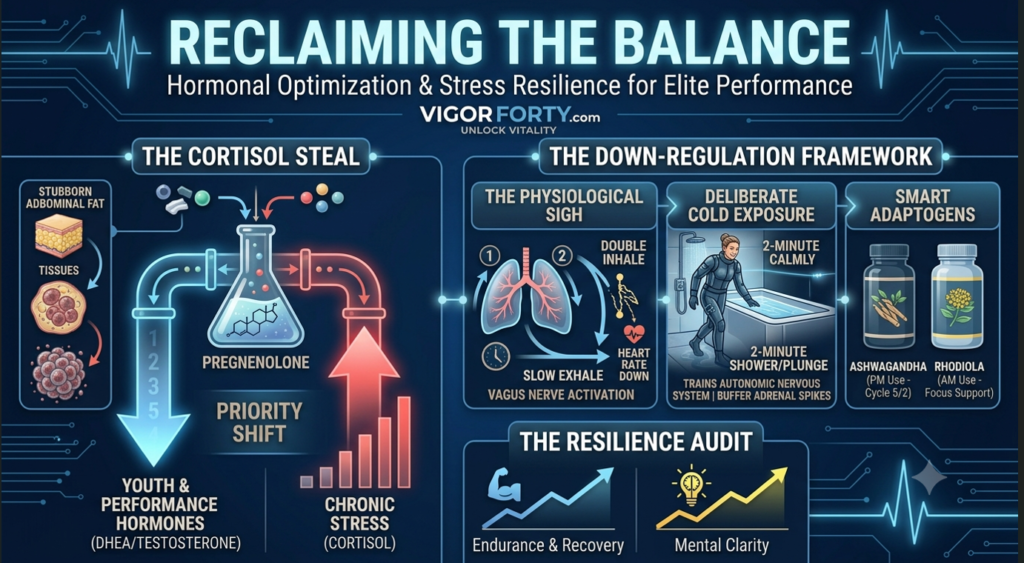
- The Physical Cost: Sustained high cortisol forces the liver to release excess glucose, leading to systemic inflammation, muscle breakdown, and abdominal fat storage.
- The Light Lever: Viewing natural sunlight within the first hour of waking is the fastest, non-pharmacological way to anchor your daily cortisol rhythm.
- Clinical Alignment: The Endocrine Society and Mayo Clinic emphasize that lifestyle changes—not just medication—are foundational to reversing chronic HPA-axis (hypothalamic-pituitary-adrenal) dysfunction.
Read Related Articles:
- The Cortisol Reset Protocol
- The Anatomy of Breathwork
- Meditation for the Stressed Brain
- The Vagal Tone: Your Nervous System’s Volume Knob
- The Circadian Stress Connection
- The Gut-Brain Axis: Neurochemistry of Stress
- Hormesis: Building Stress Resilience Through Physical Adversity
- Neuro-Architecture: Designing Spaces to De-Excite the Amygdala
- Social Jetlag and Chrono-Stress
- Digital Dopamine Detox: Rewiring the Attention-Stressed Brain
- Psychoneuroimmunology: How Stress Paralyzes Your Immune System
- Autophagy: The Cellular Housekeeping of Stress Recovery
- Decision Fatigue and Executive Stress
- Epigenetics: Rewriting Your Inherited Stress Response
- The Endocannabinoid System: The Body’s Equilibrium Engine
Introduction: The Modern Adrenal Crisis
We live in an era of perpetual neurological urgency. While our ancestors faced acute, short-term stressors like escaping a predator, modern humans face chronic, low-grade stressors—non-stop work notifications, financial pressures, and sleep deprivation.
According to epidemiological data, this constant state of alert has triggered an unmitigated stress crisis. The human body responds to every single stressor by activating the HPA axis, resulting in the continuous release of cortisol, our primary stress hormone. When cortisol remains elevated over months or years, it ceases to protect the body and instead begins to degrade it, leading to modern burnout, brain fog, and metabolic dysfunction. To heal, we have to look past superficial relaxation and understand the mechanics of cortisol regulation.
Section 1: The Biological Impact of High Cortisol
Cortisol is not inherently evil. In healthy amounts, it regulates blood pressure, controls your sleep-wake cycle, and tames inflammation. However, chronic stress converts this vital survival mechanism into a systemic health hazard.
When your brain perceives a threat, the adrenal glands flood the system with cortisol. This shifts the body into survival mode, altering several critical systems:
- Metabolic Shift: Cortisol inhibits insulin, causing glucose to flood your bloodstream to provide quick energy for a physical fight. Because modern stress is sedentary, that glucose isn’t burned off; instead, it gets redeposited as visceral fat around your internal organs.
- Immune Suppression: In the short term, cortisol suppresses inflammation. But over time, your immune cells become desensitized to it, causing systemic, low-grade inflammation to flare up throughout the body.
- The Satiety Disruptor: High cortisol suppresses your brain’s sensitivity to leptin (the fullness hormone) while driving up ghrelin (the hunger hormone). This specifically triggers cravings for calorie-dense fats and carbohydrates.
Section 2: The Daily Cortisol Reset (Visual Habit Swap)
Fixing a broken stress response doesn’t mean moving to a remote island. It requires restructuring your immediate daily environment to signal safety to your nervous system.
The table below outlines simple behavioral shifts to protect your adrenal health throughout the day:
| Instead of Doing (Cortisol Spiking) | Swap With (Cortisol Regulating) | Why It Matters |
| Scrolling your phone in bed immediately after waking | Stepping outside for 5–10 minutes of direct morning sunlight | Sunlight triggers a healthy morning cortisol peak, which sets an automatic timer for your brain to produce melatonin 14 hours later. |
| Drinking black coffee on an empty stomach at 7:00 AM | Delaying caffeine until 9:30 AM and pairing it with protein | Caffeine on an empty stomach spikes cortisol when it is already naturally high. Delaying it prevents mid-day crashes and jitters. |
| Powering through the mid-afternoon slump with sugar | Taking a 10-minute Non-Sleep Deep Rest (NSDR) or mindfulness break | Gives the prefrontal cortex a rest, lowering active nervous system stress and clearing metabolic waste without a glucose crash. |
| Answering intense work emails or watching news before bed | Dimming overhead lights and reading fiction or journaling | Eliminates blue-light induced cortisol spikes that block deep, restorative REM sleep cycles. |
Section 3: The Medical Block (Endocrine Society & Mayo Clinic Guidelines)
Clinical consensus heavily supports aggressive lifestyle intervention as the primary treatment for chronic stress and adrenal dysregulation.
The Endocrine Society
The Endocrine Society highlights that prolonged exposure to high glucocorticoids (stress hormones) directly accelerates the onset of metabolic syndrome, muscle atrophy, and mood disorders. Their clinical briefs emphasize that protecting the body’s natural circadian rhythm—specifically through light exposure patterns and fixed sleep schedules—is mandatory for maintaining optimal hormonal balance and preventing long-term adrenal fatigue symptoms.
The Mayo Clinic
The Mayo Clinic provides clear parameters on the physical consequences of unmanaged stress. Their diagnostic frameworks explicitly connect unmanaged chronic stress to high blood pressure, cognitive decline, and increased risk of heart attacks. The Mayo Clinic strongly advocates for a multi-disciplinary approach to stress, prioritizing regular physical activity, structured relaxation protocols, and strong social connections as medical necessities rather than optional luxuries.