
Author: Vigor Forty Editorial Team
Medically Reviewed By: Editorial Review Board
Disclaimer: This article is for informational purposes only and is not a substitute for professional medical advice. Read our full Medical Disclaimer.
Key Takeaways
- The Nervous System Hack: Breathwork is the only autonomic (automatic) bodily function that you can consciously control to directly alter your heart rate and brain chemistry.
- The Vagus Nerve Connection: Lengthening your exhalations relative to your inhalations instantly stimulates the vagus nerve, triggering the parasympathetic “rest and digest” response.
- The CO2 Paradox: Shallow chest breathing causes you to over-breathe and drop your carbon dioxide levels, which counterintuitively restricts oxygen delivery to your brain and tissues.
- Clinical Alignment: Harvard Health and the American Psychological Association formally recommend structured breathing techniques as a first-line treatment for acute anxiety and panic disorders.
Read Related Articles:
- The Cortisol Reset Protocol
- The Anatomy of Breathwork
- Meditation for the Stressed Brain
- The Vagal Tone: Your Nervous System’s Volume Knob
- The Circadian Stress Connection
- The Gut-Brain Axis: Neurochemistry of Stress
- Hormesis: Building Stress Resilience Through Physical Adversity
- Neuro-Architecture: Designing Spaces to De-Excite the Amygdala
- Social Jetlag and Chrono-Stress
- Digital Dopamine Detox: Rewiring the Attention-Stressed Brain
- Psychoneuroimmunology: How Stress Paralyzes Your Immune System
- Autophagy: The Cellular Housekeeping of Stress Recovery
- Decision Fatigue and Executive Stress
- Epigenetics: Rewriting Your Inherited Stress Response
- The Endocannabinoid System: The Body’s Equilibrium Engine
Introduction: The Over-Breathing Epidemic
Though we breathe roughly 25,000 times every single day, the vast majority of modern adults are doing it incorrectly. Under the weight of chronic daily stress, our breathing patterns have adapted in an unhealthy way: we have become shallow, rapid, upper-chest mouth-breathers.
Epidemiological and physiological studies reveal that this sub-clinical over-breathing keeps the sympathetic nervous system constantly active. By taking rapid, shallow breaths, we signal to our brain that we are in danger, keeping our bodies trapped in a loop of anxiety, elevated heart rates, and tense muscles. To break this state, we must learn the precise biometrics of breathwork—shifting from an unconscious vulnerability to an intentional tool for neural regulation.
Section 1: The Physiology of the Autonomous Toggle
Your autonomic nervous system is divided into two branches: the sympathetic (“fight or flight”) and the parasympathetic (“rest and digest”). While you cannot consciously command your gallbladder to secrete bile or your heart to slow down, you can control your breath. Because respiration is tied directly to your heart rate, changing how you breathe alters your entire physiology.
This mechanism relies on a process called Respiratory Sinus Arrhythmia (RSA):
- The Inhale (Sympathetic Acceleration): When you inhale, your diaphragm moves down, temporarily shrinking the space inside your chest cavity. This causes your heart to compress slightly and blood flow to speed up. To maintain equilibrium, your brain tells your heart to beat faster.
- The Exhale (Parasympathetic Deceleration): When you exhale, the diaphragm moves back up, expanding the chest cavity. The heart expands, blood flow slows down, and the vagus nerve releases a neurotransmitter called acetylcholine. This acts as a biological brake, telling your heart to beat slower.
By simply making your exhalations longer than your inhalations, you actively slow down your heart rate and turn down your brain’s stress response.
Section 2: The Emergency Breathwork Toolkit (Visual Routine Guide)
Different stress states require different breathing mechanics. You don’t need hours of meditation; you just need a few minutes of targeted breath patterns.
The table below outlines three evidence-based breathing structures to deploy based on your immediate mental state:
| Breath Pattern | Structural Execution | When to Use & Why it Works |
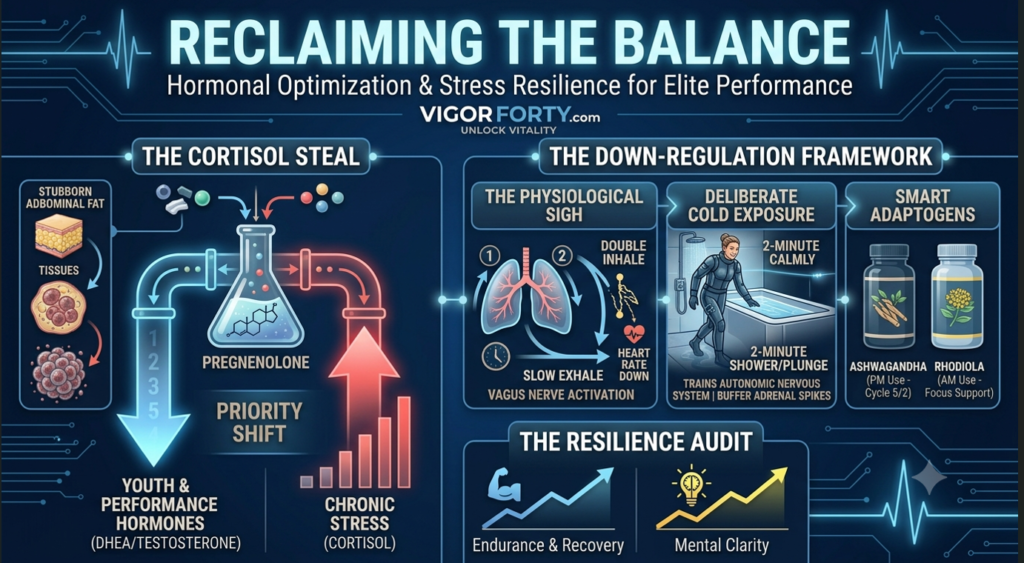
| The Physiological Sigh | Two quick, deep inhales through the nose, followed by a long, slow sigh out through the mouth. Repeat 3 times. | Acute Anxiety / Instant Reset: The double inhale re-inflates tiny air sacs in the lungs (alveoli), maximizing carbon dioxide elimination and dropping heart rate in under 30 seconds. |
| Box Breathing (4-4-4-4) | Inhale for 4 seconds, hold for 4 seconds, exhale for 4 seconds, hold empty for 4 seconds. Repeat for 3 minutes. | High Pressure Focus / Brain Fog: Used by Navy SEALs to maintain calm and mental clarity during high-stress operations. It balances oxygen and CO2 ratios perfectly. |
| The 4-7-8 Technique | Inhale through the nose for 4 seconds, hold your breath for 7 seconds, exhale slowly through the mouth for 8 seconds. | Insomnia / Racing Thoughts: The long 8-second exhale forces the body into a deep parasympathetic state, making it highly effective for falling asleep. |
Section 3: The Medical Block (Harvard Health & APA Guidelines)
The application of clinical breathwork is deeply rooted in modern neuroscience and psychiatry, serving as a pillar of preventative mental healthcare.
Harvard Health Publishing
Harvard Medical School’s clinical publications explicitly state that eliciting the “relaxation response” through deep abdominal breathing alters gene expression associated with inflammation and energy metabolism. Harvard health directives note that deep diaphragmatic breathing increases oxygen exchange, stabilizes blood pressure, and provides a powerful, immediate counter-balance to the physical damage caused by unmanaged stress hormones.
The American Psychological Association (APA)
The APA advocates for the regular integration of somatic (body-based) therapies, including breathwork, within traditional cognitive behavioral treatment frameworks. Their clinical insights reveal that changing your breathing pattern disrupts the catastrophic thinking loops associated with anxiety. By regulating your physiology first, you give the cognitive parts of your brain the stability required to process stress rationally.