
Walk down the health aisle of any American supermarket or scroll through health social media, and you’ll see an endless war between dietary extremes. Low-carb advocates clash with low-fat proponents, while others insist that weight management is strictly a math problem of “calories in vs. calories out.”
But focusing solely on calories or eliminating entire food groups misses the grander metabolic picture.
If you suffer from brain fog two hours after lunch, experience intense sugar cravings at 4:00 PM, or find it increasingly difficult to drop visceral fat despite “eating clean,” you don’t have a calorie problem. You have a metabolic flexibility problem.
To achieve lifelong energy and a vibrant body, the goal shouldn’t be constant restriction. It should be teaching your body how to seamlessly burn whatever fuel is available.
Read Related Articles
- The 3-2-1 Rule: How to Optimize Your Circadian Rhythm for Deep, Restorative Sleep
- Beyond Sleep Hygiene: Why Your Bedroom Is Keeping You Tired (And How to Fix It)
- Calm the System, Sleep Follows: Breaking the Cycle of High-Stress Biohacking
- Recharging the Cellular Battery: The Deep Science of Mitochondrial Health and Mid-Life Energy
- Beyond Calorie Counting: Mastering Metabolic Flexibility to Erase Mid-Day Crashes and Stubborn Fat
- Protecting the Master Processor: Reversing Brain Fog and Building Lifelong Cognitive Reserve
- Reclaiming the Balance: Healing the “Cortisol Steal” and Building Elite Stress Resilience
1. What is Metabolic Flexibility?
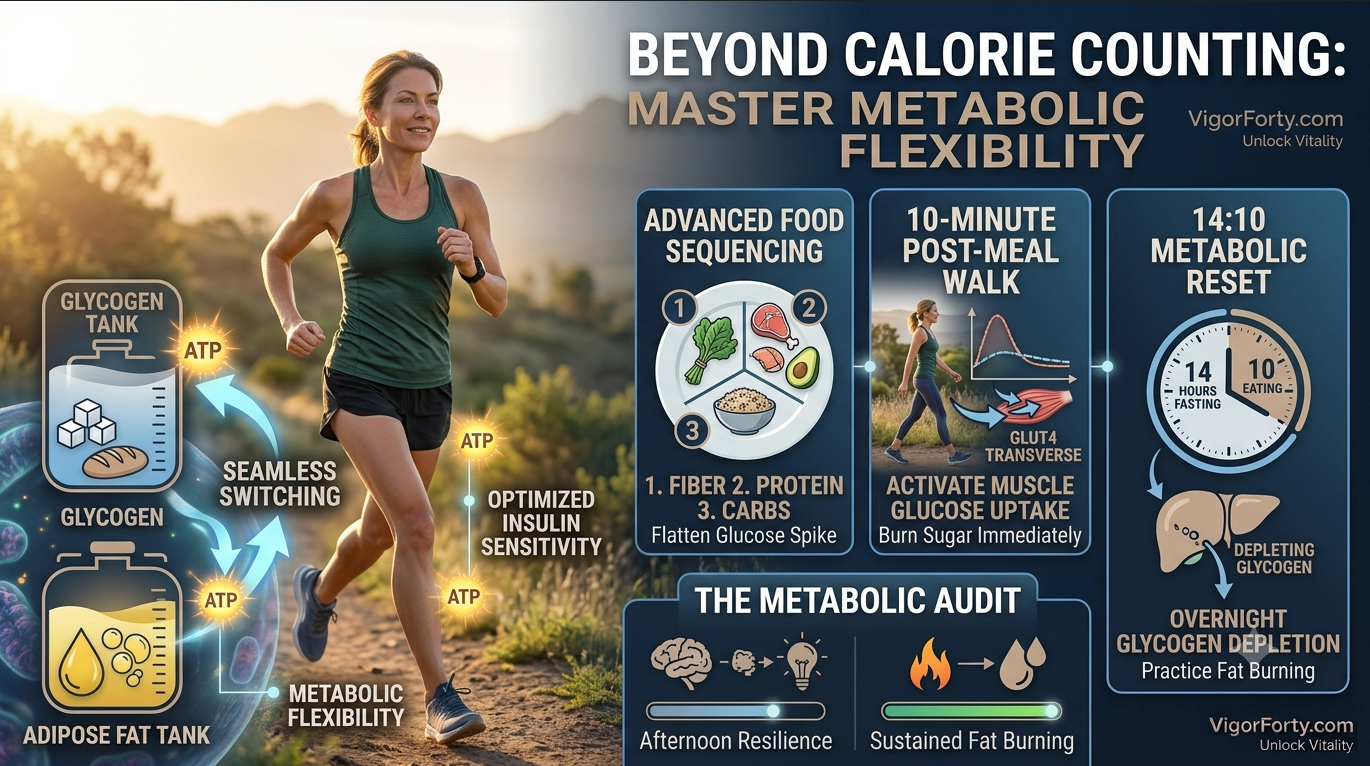
Think of your body as a hybrid vehicle. It has two distinct fuel tanks:
- The Glycogen Tank (Carbohydrates): A fast-burning, easily accessible fuel source with limited storage capacity.
- The Adipose Tank (Fat): A massive, highly efficient, long-burning fuel source that can provide tens of thousands of calories of sustainable energy.
A metabolically flexible individual can switch between these tanks without friction. When they eat carbs, their body burns carbs. When they go a few hours without food or go for a long walk, their insulin drops, and their body effortlessly flips the switch to burn stored body fat.
Unfortunately, the modern lifestyle has broken this switch. Due to constant snacking, ultra-processed foods, and high stress, millions of people are trapped in perpetual carbohydrate dependency. Because their insulin levels never drop, they can never access their fat tank. When their blood sugar inevitably dips, instead of burning fat, they experience a sudden energy crash, mood swings, and a primal urge for more sugar.
2. Reversing Age-Related Insulin Resistance
As we cross into our 40s, our cells naturally become less responsive to insulin—the hormone responsible for escorting glucose out of the bloodstream and into muscles. When cells ignore insulin, the pancreas has to pump out even more of it to get the job done.
High circulating insulin acts like a biological padlock on your fat cells; as long as insulin is elevated, fat burning ($lipolysis$) is completely blocked. Reversing this resistance is the first step to unlocking metabolic flexibility.
The Power of Food Sequencing
You don’t necessarily have to completely abandon your favorite carbohydrates to stabilize your blood sugar; you just need to change the order in which you eat them. Clinical data shows that eating foods in a specific sequence drastically blunts the post-meal glucose spike:
- The Order: Eat your fiber (vegetables/salad) first, followed by your proteins and fats, and finish with your complex carbohydrates or starches.
- Why it works: Fiber creates a viscous mesh lining in your small intestine, slowing down the absorption of glucose into the bloodstream. Protein and fat further delay gastric emptying. By the time the carbohydrates hit your system, the glucose curve is flattened, saving your pancreas from an insulin surge.
3. Demystifying the Continuous Glucose Monitor (CGM) Trap
Continuous Glucose Monitors (CGMs) have exploded in popularity across the US wellness community. While they are phenomenal tools for understanding individual biology, many users fall into the trap of trying to achieve a completely flat glucose line, avoiding all carbohydrates out of fear.
A healthy metabolism isn’t a flat line; it is a resilient curve. It is perfectly normal for your blood sugar to rise after a meal, provided it safely returns to baseline within two hours.
Instead of fearing spikes, use your data (or your internal awareness) to optimize how your body handles them:
- The 10-Minute Post-Meal Walk: Muscle contraction is incredibly elegant; it can pull glucose directly out of your bloodstream without requiring insulin at all (via a mechanism called GLUT4 translocation). A simple 10-minute walk immediately after dinner can erase up to $30\%$ of a glucose spike, channeling those calories directly into muscle energy instead of storing them as fat.
- Identify Stress Spikes: You might notice your blood sugar spiking during a high-stress work meeting even if you haven’t eaten a single carbohydrate. That is cortisol signaling your liver to dump stored glucose into your blood for a fight-or-flight response. Managing psychological stress is just as critical to blood sugar balance as your diet.
4. Time-Restricted Eating: The 14:10 Metabolic Reset
The easiest way to force your hybrid engine to practice burning fat is to lengthen the period your body spends in a low-insulin state. You don’t need to engage in multi-day water fasts to achieve this.
- The Action: Commit to a consistent 14:10 Time-Restricted Eating window. This means fasting for 14 hours (mostly while sleeping) and consuming all your daily nutrition within a 10-hour block (e.g., 9:00 AM to 7:00 PM).
- The Metabolic Benefit: By hour 12 of a fast, your liver’s glycogen stores begin to deplete, and insulin drops to baseline. This signals your enzymatic pathways to start mobilizing fatty acids. It is essentially an overnight workout for your metabolic switch.
The VigorForty Metabolic Audit
Metabolic flexibility is true biological freedom. It means you are no longer a slave to the 3:00 PM energy crash or dependent on a steady stream of caffeine and snacks to maintain your mood.
This week, pick one meal and try the food sequencing method—fiber first, carbs last. Pair it with a brief walk around the block after you finish eating. Give your hybrid engine the inputs it needs to unlock its true, dual-fuel potential.
Have you noticed your energy crashing after specific meals? Have you ever experimented with a CGM or time-restricted eating? Let us know your experiences in the comments below!