
We tend to look at aging through a physical lens: fine lines on our skin, slowing metabolic rates, or joints that ache after a workout. But the most critical component of longevity is entirely unseen. It is the health, volume, and processing speed of our brain.
Many high-performing adults accept a slow slide into “senior moments,” fading memory, and chronic brain fog as an inevitable tax of growing older. We find ourselves misplacing our keys, struggling to recall a colleague’s name on a Zoom call, or relying on an extra shot of espresso just to manage complex tasks in the afternoon.
But modern neuroscience has completely shattered the myth that your brain must deteriorate with age.
Through the mechanisms of neurogenesis (the creation of new neurons) and the development of a dense cognitive reserve, you have the power to structurally upgrade your brain. To protect your sharp edge for decades to come, you simply need to understand how the brain maintains, cleanses, and rewires itself.
Read Related Articles
- The 3-2-1 Rule: How to Optimize Your Circadian Rhythm for Deep, Restorative Sleep
- Beyond Sleep Hygiene: Why Your Bedroom Is Keeping You Tired (And How to Fix It)
- Calm the System, Sleep Follows: Breaking the Cycle of High-Stress Biohacking
- Recharging the Cellular Battery: The Deep Science of Mitochondrial Health and Mid-Life Energy
- Beyond Calorie Counting: Mastering Metabolic Flexibility to Erase Mid-Day Crashes and Stubborn Fat
- Protecting the Master Processor: Reversing Brain Fog and Building Lifelong Cognitive Reserve
- Reclaiming the Balance: Healing the “Cortisol Steal” and Building Elite Stress Resilience
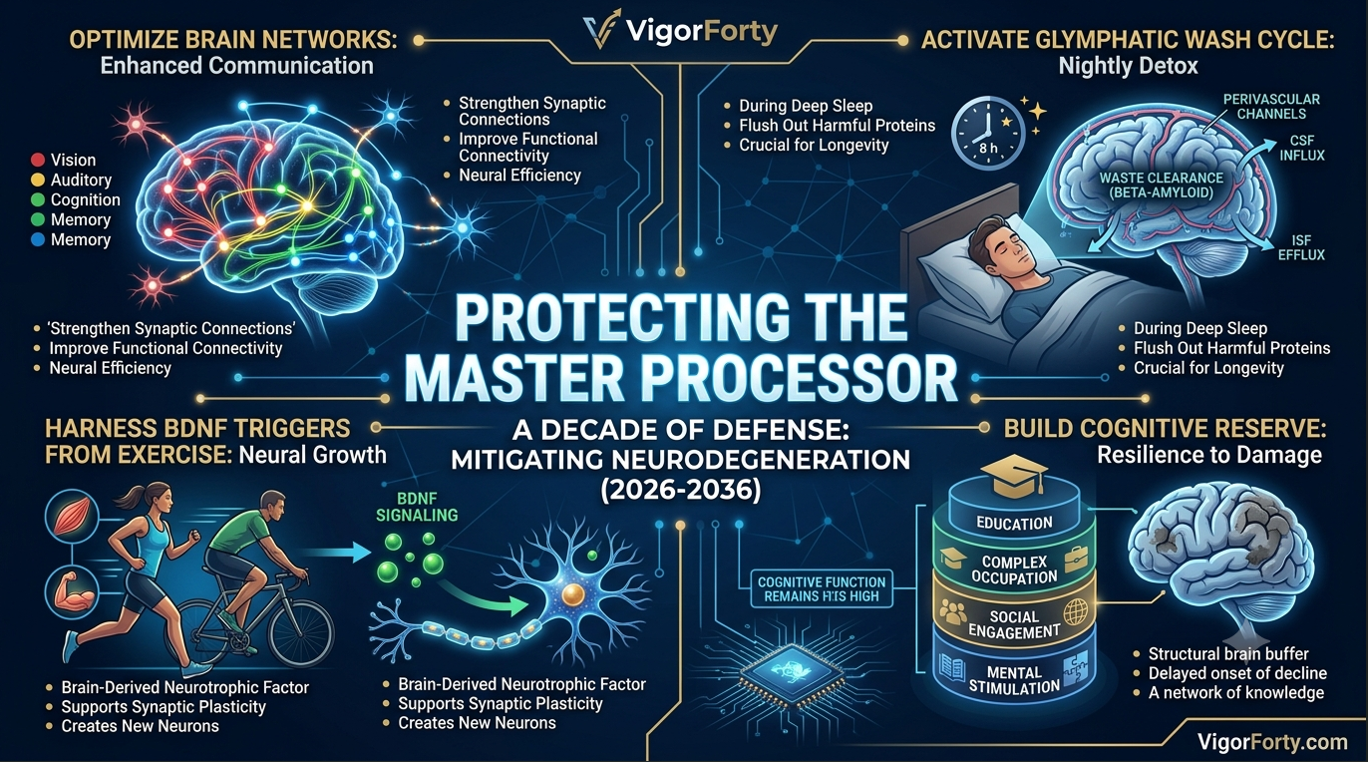
1. The Glymphatic System: The Brain’s Midnight Trash Collection
To understand how to protect your cognitive processing speed, you first need to understand how your brain cleans itself.
Unlike the rest of your body, which utilizes the lymphatic system to clear out metabolic waste, the brain is sealed behind a strict blood-brain barrier. For decades, scientists wondered how the brain disposed of cellular debris. In 2012, researchers discovered a specialized waste clearance pathway named the glymphatic system.
Think of the glymphatic system as a dishwasher for your mind. When you enter deep, slow-wave sleep, your brain cells physically shrink by roughly 60%. This contraction allows cerebrospinal fluid (CSF) to rush through the tissue, literally washing away toxic waste products—including amyloid-beta and tau proteins, the exact plaques associated with Alzheimer’s disease and cognitive decline.
- The Breakdown: If you consistently cut your sleep short or fail to reach deep sleep stages, this nightly rinse cycle is aborted. The cellular “trash” accumulates, leading directly to next-day brain fog and long-term neurodegeneration. Protecting your sleep architecture isn’t just about energy; it is a non-negotiable act of neurological detoxification.
2. Triggering BDNF: Fertilizer for Your Neurons
For generations, the scientific consensus was that humans were born with a fixed number of brain cells, and aging was a slow process of losing them. We now know this is false. A process called neurogenesis occurs throughout adulthood, primarily in the hippocampus—the brain’s center for memory and learning.
The primary driver of this growth is a protein called Brain-Derived Neurotrophic Factor (BDNF). Neuroscientists refer to BDNF as “Miracle-Gro for the brain” because it supports the survival of existing neurons, encourages the growth of new ones, and strengthens the connections (synapses) between them.
You can actively flood your brain with BDNF using two powerful lifestyle inputs:
High-Intensity Interval Training (HIIT)
While Zone 2 cardio is the king of mitochondrial health, brief bursts of high-intensity exercise are unmatched for boosting BDNF. Studies show that bringing your heart rate above 80% of its maximum for short intervals triggers an immediate release of BDNF in the brain.
- The Action: Integrate one or two brief HIIT sessions into your weekly routine. This can be as simple as a 20-minute workout alternating between 30 seconds of maximum effort (sprinting, rowing, or air-biking) and 90 seconds of recovery.
Tactical Thermal Stress (Sauna Use)
Exposing your body to heat stress triggers the release of heat shock proteins and significantly elevates BDNF levels. Data out of Finland tracks a direct, dose-dependent relationship between regular sauna use and a profoundly lower risk of developing cognitive decline.
- The Action: Utilize a traditional or infrared sauna at roughly 160°F to 175°F for 20 minutes, 2 to 3 times per week.
3. Building a Cognitive Reserve through Micro-Challenges
Building biological longevity isn’t just about physical cells; it’s about network density. This is known as your cognitive reserve—the brain’s ability to improvise, find alternate neural pathways, and function efficiently even if some individual cells suffer damage over time.
Think of it like a highway system. If your city only has one main road, a single accident paralyzes traffic. If your city has a dense network of side streets and back avenues, traffic flows seamlessly around any obstacle.
To build side streets in your brain, you must actively force it out of its comfort zone. Doing the same crossword puzzle, reading the same genres, or performing the same daily professional routine will not suffice. The brain requires novelty combined with high cognitive effort.
- The Action Step: Regularly introduce small, structural micro-challenges to your routine. Learn a new language, pick up an instrument, or practice dual-task training (such as practicing mental math or memory games while walking or balancing). If a mental task feels easy, you aren’t building a cognitive reserve; it must feel slightly frustrating to trigger neuroplasticity.
4. The Structural Nutrition Framework for Brain Volume
Your brain is incredibly nutrient-dense, composed of roughly 60% fat. The structural integrity of your brain’s cellular membranes relies entirely on the specific fatty acids and phospholipids you consume. To support brain volume and protect the blood-brain barrier, focus on these essential nutritional pillars:
- Omega-3 Fatty Acids (High DHA/EPA): Docosahexaenoic acid (DHA) is a primary structural component of the cerebral cortex and retina. High levels of EPA and DHA fight neurological inflammation and support synaptic flexibility. Prioritize wild-caught cold-water fish (salmon, sardines, mackerel) or high-quality, third-party tested fish oil supplements.
- Choline & Phospholipids: Choline is the foundational precursor to acetylcholine, the neurotransmitter responsible for focus, learning, and memory. Ensure your diet contains high-quality sources like pasture-raised egg yolks, grass-fed beef liver, or sunflower lecithin.
The VigorForty Neurological Audit
Your brain is the master processor controlling every single experience, movement, and emotion of your life. Protecting its health is the single greatest investment you can make for your future independence and vitality.
This week, evaluate your mental environment. Are you protecting your brain’s nightly glymphatic rinse cycle? Can you introduce a brief 20-minute burst of intensive exercise to flood your brain with BDNF? Give your mind the structural nutrients, deep cleansing, and novel challenges it needs to stay sharp, resilient, and limitlessly vibrant.
Do you ever notice brain fog creeping in after a poor night’s sleep? What steps do you take to keep your mind sharp? Share your thoughts in the comments below, and don’t forget to subscribe to VigorForty for weekly, evidence-based longevity strategies!