
In our high-pressure modern society, stress is often viewed as a badge of honor. We manage demanding executive roles, family responsibilities, and financial obligations, telling ourselves that we are handling it all perfectly. We convince ourselves that as long as we can push through the day, our bodies are coping.
But behind the scenes, your endocrine system is keeping a meticulous scorecard.
If you are experiencing stubborn abdominal fat that refuses to budge, experiencing unprovoked irritability, or finding yourself “tired but wired” at 11:00 PM, you aren’t just getting older. You are likely experiencing the systemic wear-and-tear of a chronic, low-grade cortisol elevation.
To restore your vitality and protect your longevity, you have to look past basic relaxation clichés and understand how to biologically master your body’s stress response.
Read Related Articles
- The 3-2-1 Rule: How to Optimize Your Circadian Rhythm for Deep, Restorative Sleep
- Beyond Sleep Hygiene: Why Your Bedroom Is Keeping You Tired (And How to Fix It)
- Calm the System, Sleep Follows: Breaking the Cycle of High-Stress Biohacking
- Recharging the Cellular Battery: The Deep Science of Mitochondrial Health and Mid-Life Energy
- Beyond Calorie Counting: Mastering Metabolic Flexibility to Erase Mid-Day Crashes and Stubborn Fat
- Protecting the Master Processor: Reversing Brain Fog and Building Lifelong Cognitive Reserve
- Reclaiming the Balance: Healing the “Cortisol Steal” and Building Elite Stress Resilience
1. The Cortisol-DHEA Steal: How Stress Robs Your Vitality
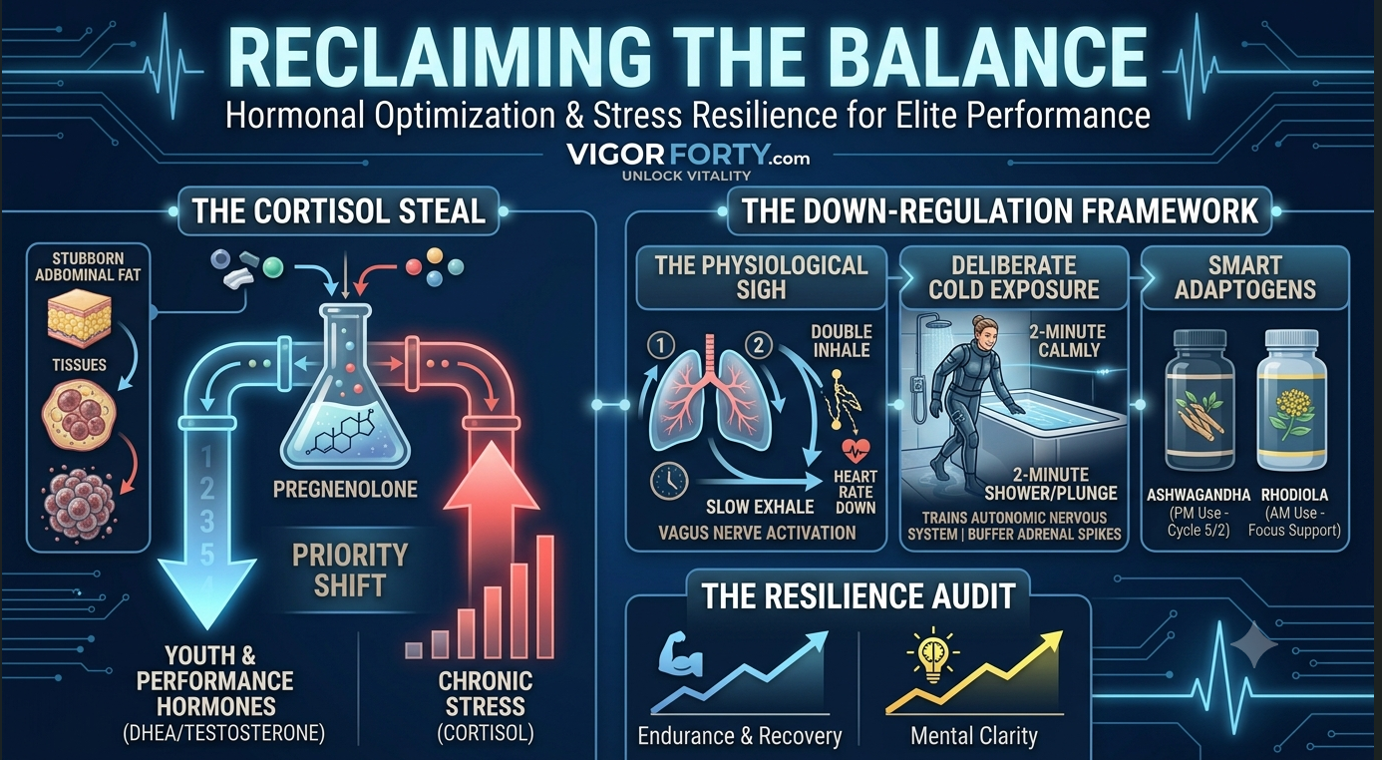
To understand why chronic stress leaves you feeling depleted, we have to look at the cellular assembly line in your adrenal glands. Your body utilizes a foundational master hormone called pregnenolone to manufacture several critical substances.
When your brain perceives a threat—whether it’s a real physical danger or a passive-aggressive email from your boss—it shifts all production priorities toward survival. Pregnenolone is heavily funneled into creating cortisol (the primary stress hormone) at the direct expense of DHEA (Dehydroepiandrosterone). DHEA is a crucial precursor required to synthesize your youth and performance hormones, including testosterone and estrogen.
In clinical biology, this is often referred to as the Cortisol Steal.
When your body is locked in an endless survival loop, your hormone production shifts. Instead of supporting tissue repair, muscle mass, and mental drive, your biology focuses entirely on managing stress. This hormonal shift accelerates aging from the inside out, leading directly to a loss of lean muscle, lower libido, and a compromised immune system.
2. Measuring Your Allostatic Load
Stress isn’t just an emotional feeling; it is a cumulative physical weight known as your allostatic load. Think of your body as having an internal stress bucket. Every demanding meeting, missed hour of sleep, poor meal, and intense workout pours water into that bucket.
If your bucket is constantly overflowing, your autonomic nervous system remains trapped in a sympathetic (fight-or-flight) state. This chronic elevation increases your blood pressure, disrupts your gut microbiome, and promotes systemic inflammation.
Building elite stress resilience isn’t about trying to live an impossible, stress-free life. It is about expanding the size of your bucket and knowing how to drain the water efficiently using precise physiological interventions.
3. The Physiological Tools to Down-Regulate Your Nervous System
When your stress levels spike, telling yourself to “calm down” rarely works because cognitive loops are driven by your physical state. To change your mind, you must leverage your body.
The Physiological Sigh
Discovered by neurobiologists, the physiological sigh is the fastest behavioral method to reduce autonomic arousal in real-time. It takes less than five seconds and can be done right at your desk.
- The Action: Take two quick, consecutive inhales through your nose (one deep inhale, followed immediately by a sharp “sharp” sniff to fully inflate the lungs), then execute a long, slow exhale through your mouth.
- The Science: The second sniff pops open the tiny air sacs (alveoli) in your lungs that collapse under stress. This dramatically increases the surface area for carbon dioxide clearance, immediately triggering your vagus nerve to slow down your heart rate.
Strategic Deliberate Cold Exposure
While it sounds counterintuitive to introduce a major stressor like cold water to lower your overall stress, deliberate cold exposure acts like weight training for your nervous system.
- The Action: End your morning shower with 2 minutes of cold water (below 60°F), or utilize a dedicated cold plunge.
- The Science: Stepping into freezing water triggers a massive, immediate spike in norepinephrine and cortisol. By consciously forcing yourself to take slow, controlled belly breaths during the shock, you train your prefrontal cortex to maintain calm amidst a chaotic physical storm. This creates a psychological buffer, making you less reactive to everyday stressors.
4. The Smart Approach to Adaptogens
The American supplement market is currently flooded with “stress-busting” adaptogenic herbs. While these can be highly effective tools, they must be used strategically rather than treated as a daily crutch to mask burnout.
- Ashwagandha (KSM-66): Phenomenal for blunting excessive cortisol production. However, because it actively lowers cortisol, it is best taken in the evening to prevent blunting the healthy morning cortisol spike you need to wake up. It should be cycled (e.g., 5 days on, 2 days off) to prevent desensitization.
- Rhodiola Rosea: An excellent adaptogen for morning or afternoon use. It helps mitigate mental fatigue and supports cognitive performance during acute periods of high work stress without causing drowsiness.
The VigorForty Resilience Audit
Your performance, energy, and long-term health are directly tied to your hormonal balance. Pushing through chronic exhaustion isn’t a strategy for success; it’s a recipe for biological bankruptcy.
This week, audit your stress responses. When you feel a wave of anxiety or pressure building during the day, pause and perform three consecutive physiological sighs. Give your nervous system the direct, physical signals it needs to step out of survival mode and step back into vibrant health.
Do you find yourself feeling “tired but wired” late at night? Have you ever tried cold showers or adaptogens to manage your stress? Share your experiences in the comments below, and subscribe to the VigorForty newsletter for advanced, science-backed strategies to optimize your biology.