
Have you ever looked at a verification code on your phone, switched to your browser tab, and immediately forgotten the numbers? Yet, at the exact same time, you can flawlessly recall the lyrics to a song you haven’t heard in fifteen years, or vivid details of a childhood vacation.
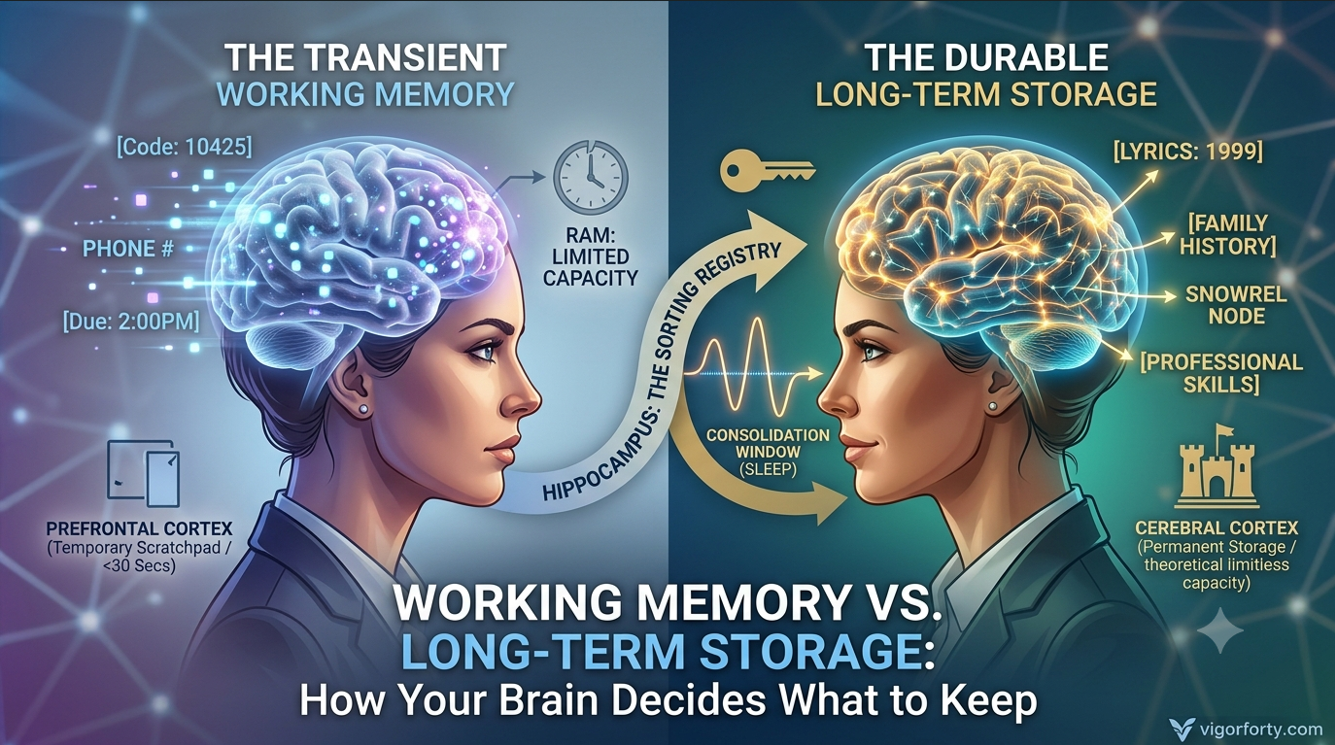
This happens because your brain does not have a single, unified “hard drive” for memories. Instead, it utilizes two entirely distinct systems: Working Memory and Long-Term Storage.
In our information-saturated world, the bridge between these two systems is constantly overwhelmed. If you find yourself forgetting names, losing your train of thought, or struggling to retain what you read, it isn’t a sign of cognitive decline—it is an optimization issue.
Here is the neurological blueprint of how your brain sorts data, and how to structurally upgrade your long-term memory retention.
1. The Synaptic Sorting Room: Working Memory vs. Long-Term Storage
To improve your memory, you must understand the anatomical path information takes as it enters your nervous system.
Working Memory (The RAM)
Managed primarily by the Prefrontal Cortex (PFC), working memory is your brain’s temporary scratchpad. It has an incredibly strict capacity limit. Classic psychological and neurological data shows that the average human can only hold roughly $7 \pm 2$ pieces of information in their conscious mind at any given moment. This data is highly volatile; if it isn’t intentionally moved, it disappears within 15 to 30 seconds to make room for the next incoming stimulus.
Long-Term Storage (The Hard Drive)
Long-term memory is a physically vast, theoretically limitless network of structural synaptic connections spread across the Cerebral Cortex. These memories are not stored as single files; they are stored as complex, distributed patterns of neural pathways.
[Incoming Info] ──> Working Memory (PFC / Max 30 Secs)
                           │
                           ▼  <── Consolidates during Sleep
                     Hippocampus (The Sorting Registry)
                           │
                           ▼  <── Long-Term Potentiation (LTP)
                   Cerebral Cortex (Permanent Storage)
The Hippocampus (The Sorting Registry)
Sitting deep within your temporal lobe is the Hippocampus. Think of the hippocampus as the brain’s ultimate routing manager. It takes temporary information from your working memory, evaluates its importance, and decides whether to write that data into the permanent architecture of your cerebral cortex or discard it entirely.
2. Long-Term Potentiation (LTP): How Memories Become Permanent
When your hippocampus decides a piece of information is important, it triggers a cellular process called Long-Term Potentiation (LTP).
LTP is the literal biological mechanism behind the phrase “neurons that fire together, wire together.” When you learn something new, a specific pathway of neurons fires. If that pathway fires repeatedly or with intense emotional salience, the connections (synapses) between those neurons structurally strengthen.
- The sending neuron learns to release more neurotransmitters (like glutamate).
- The receiving neuron builds more physical receptors to catch those signals faster.
Over time, this pathway becomes so highly greased that it requires very little energy to activate. A temporary thought has successfully transformed into a permanent physical structure in your brain.
3. The VigorForty Memory Consolidation Protocol
If you want to stop losing information and ensure important insights move seamlessly from your volatile working memory into long-term storage, implement these three science-backed techniques.
Technique 1: The Spaced Retrieval Method
Reviewing a piece of information ten times in one single hour is highly inefficient; your brain recognizes the repetition as redundant and stops dedicating resources to it.
- The Action: To trigger robust LTP, space out your retrieval windows. Review the core concept 1 hour after learning it, 1 day later, 3 days later, and then 7 days later. Forceptfully pulling information from your memory right as it is about to fade signals the hippocampus that this data is critical for survival, forcing permanent storage.
Technique 2: The “Feynman” Associative Anchor
New memories cannot float freely in space; they must be physically anchored to existing neural pathways.
- The Action: Whenever you learn a complex new concept, explain it aloud in the simplest possible terms as if you were teaching it to a 10-year-old, and consciously connect it to an experience you already understand intimately. This process constructs thick, multi-lane neural bridges from your new memory to your pre-existing mental models.
Technique 3: Protect the Sleep Consolidation Window
The physical transfer of data from the fragile hippocampus into the durable cerebral cortex happens almost entirely during Deep Non-REM Sleep.
- The Action: If you stay up late cramming information or checking your phone, you spike cortisol, which actively interrupts the dialogue between your hippocampus and cortex. Prioritize a high-quality sleep block immediately following any day of heavy cognitive learning to lock those memories in place.
4. References & Scientific Frameworks
To maintain absolute authoritative integrity for vigorforty.com, this article compiles data from the following key frameworks:
- Working Memory Capacity Limits: Miller, G. A. (1956). The Magical Number Seven, Plus or Minus Two: Some Limits on Our Capacity for Processing Information. Psychological Review.
- Long-Term Potentiation (LTP) Mechanics: Bliss, T. V., & Collingridge, G. L. (1993). A synaptic model of memory: long-term potentiation in the hippocampus. Nature Neuroscience Reviews.
- Sleep and Memory Consolidation: Stickgold, R. (2005). How Sleep Architecture Consolidates and Rewires Long-Term Memory Storage. Nature Medicine and Sleep Science Repositories.
Read Related Articles
- The Anatomy of Brain Fog: Why You Feel Sluggish and How to Reset in 24 Hours
- The Glucose Rollercoaster: How Blood Sugar Spikes Are Sabotaging Your Afternoon Focus
- Sleep Architecture and Clarity: The Exact Nighttime Routine to Prevent Morning Brain Fog
- Dopamine Detoxing for Deep Work: Rewiring Your Brain to Love Hard Tasks
- The Science of Flow State: Neurochemicals Needed to Trigger Peak Concentration
- The VigorForty Focus Protocol: A Step-by-Step Daily Routine for Uninterrupted Work
- Working Memory vs. Long-Term Storage: How Your Brain Decides What to Keep