Author: Vigor Forty Editorial Team
Medically Reviewed By: Editorial Review Board
Disclaimer: This article is for informational purposes only and is not a substitute for professional medical advice. Read our full Medical Disclaimer.
Key Takeaways
- The Vagus Highway: The vagus nerve is the longest cranial nerve in the body, acting as a bidirectional superhighway that allows the brain and gut to constantly communicate stress levels.
- Vagal Tone Defined: Higher vagal tone means your body can transition out of a stressful “fight or flight” state and return to a calm, recovered baseline much faster.
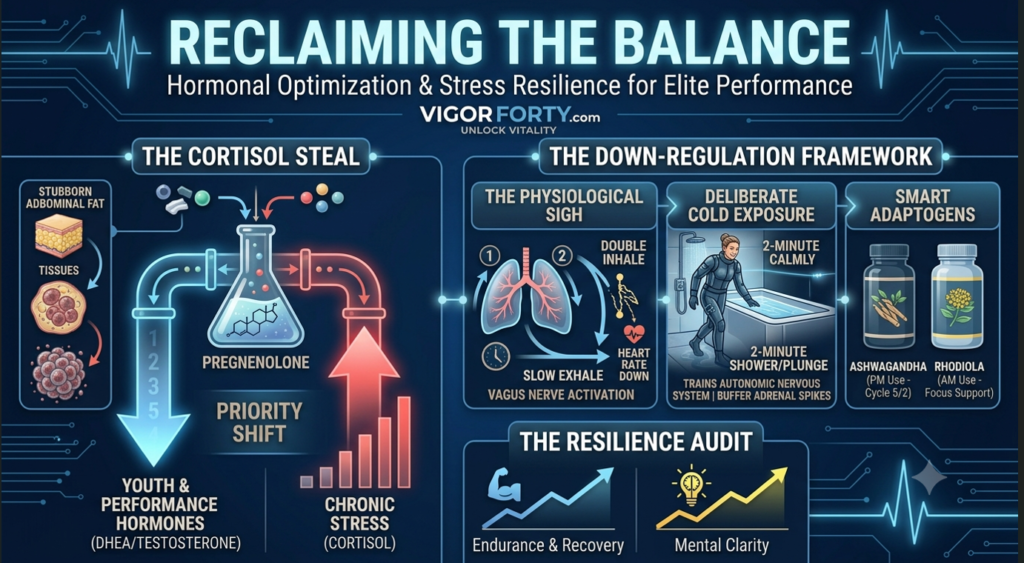
- Somatic Stimulation: Simple physical actions like cold exposure, humming, and specific throat stimulation directly trigger the vagus nerve to slow down an racing heart.
- Clinical Alignment: The Cleveland Clinic and the American Journal of Psychiatry recognize vagal nerve stimulation as a scientifically validated path to treating treatment-resistant depression and chronic inflammatory issues.
Read Related Articles:
- The Cortisol Reset Protocol
- The Anatomy of Breathwork
- Meditation for the Stressed Brain
- The Vagal Tone: Your Nervous System’s Volume Knob
- The Circadian Stress Connection
- The Gut-Brain Axis: Neurochemistry of Stress
- Hormesis: Building Stress Resilience Through Physical Adversity
- Neuro-Architecture: Designing Spaces to De-Excite the Amygdala
- Social Jetlag and Chrono-Stress
- Digital Dopamine Detox: Rewiring the Attention-Stressed Brain
- Psychoneuroimmunology: How Stress Paralyzes Your Immune System
- Autophagy: The Cellular Housekeeping of Stress Recovery
- Decision Fatigue and Executive Stress
- Epigenetics: Rewriting Your Inherited Stress Response
- The Endocannabinoid System: The Body’s Equilibrium Engine
Introduction: The Biological Brake Pedal
When stress hits, your heart rate climbs, your blood pressure rises, and your digestion grinds to a halt. This is your sympathetic nervous system firing on all cylinders. But how does the body switch this system off? The answer lies in a single, massive neural highway: the vagus nerve.
Clinical research reveals that chronic psychological stress acts like a constant weight on our biological accelerator. Over time, our body loses its natural ability to slow down, leading to low “vagal tone.” When vagal tone is compromised, you remain trapped in a state of hyper-vigilance—exhausted but wired, plagued by poor digestion, and prone to systemic inflammation. To reclaim our calm, we have to treat the vagus nerve not as an abstract concept, but as a muscle that requires intentional daily conditioning.
Section 1: The Science of High vs. Low Vagal Tone
The word vagus means “wanderer” in Latin, an apt name for a nerve that originates in the brainstem and wanders down through the neck, heart, lungs, and entire digestive tract. It is the primary powerhouse behind your parasympathetic nervous system.
The health of this nerve is measured by your Vagal Tone, which is directly tied to Heart Rate Variability (HRV):
- Low Vagal Tone: Characterized by an inability to bounce back after a stressful event. Your heart rate stays elevated, your breathing remains shallow, and your body struggles to rest. This is closely linked to chronic fatigue, irritable bowel syndrome (IBS), and systemic inflammation.
- High Vagal Tone: Represents an adaptable, resilient nervous system. When you face a stressor, your body clears the stress response quickly. Your heart rate drops efficiently, blood pressure normalizes, and your organs receive the signals required to digest food and repair tissue.
Because the vagus nerve physically passes through your vocal cords and diaphragm, you can use targeted physical habits to manually send a signal to your brain to turn down the stress dial.
Section 2: Somatic Vagus Nerve Exercises (The Visual Protocol)
You can directly stimulate the vagus nerve using non-invasive, physical interventions throughout the day to snap your body out of an active anxiety cycle.
The table below outlines simple somatic shifts to naturally optimize your vagal tone:
| Active Stress State | Somatic Vagal Swap | Why It Matters |
| Experiencing sudden, acute panic or a racing heart | Splashing ice-cold water on your face or holding an ice pack to your chest for 30 seconds | Triggers the “mammalian dive reflex,” which instantaneously signals the vagus nerve to drop your heart rate and redirect oxygenated blood to core organs. |
| Feeling chronic, low-grade physical tension in the jaw and neck | Deep, rhythmic humming, chanting, or gargling water loudly | The vagus nerve passes directly through the larynx and pharynx. The physical vibrations of humming stimulate these nerve endings, releasing calming acetylcholine. |
| Dealing with post-meal bloating or stress-induced indigestion | Practicing a 3-minute elongated belly-breathing session before your first bite | Relaxes the abdominal walls and signals the vagus nerve to increase stomach acid and digestive enzymes, preventing stress-induced gut issues. |
| Waking up feeling anxious, stiff, and mentally fatigued | Performing gentle side-to-side neck stretches while looking all the way to the left and right with just your eyes | Relieves tension in the suboccipital muscles, a primary physical bottleneck for cranial nerve circulation and blood flow to the brain. |
Section 3: The Medical Block (Cleveland Clinic & Psychiatry Consensus)
The clinical application of vagal conditioning has expanded from neurosurgery into standard preventative psychiatric and metabolic care.
The Cleveland Clinic
The Cleveland Clinic’s neurological guidelines state that vagus nerve function is an essential metric of cardiovascular health and autonomic balance. Their clinical publications highlight that regular, daily stimulation of the vagal highway prevents the chronic overproduction of inflammatory cytokines. The clinic explicitly recommends integrating breath control and somatic therapies to mitigate the long-term systemic damage caused by elevated stress states.
The American Journal of Psychiatry
Research published by the American Journal of Psychiatry confirms that regulating autonomic tone through physical and behavioral interventions directly balances neurotransmitter pathways in the brain. Their clinical findings show that improving vagal tone helps restore standard signaling of serotonin and norepinephrine, offering a critical, non-pharmacological layer of defense against anxiety, burnout, and mood disorders.