
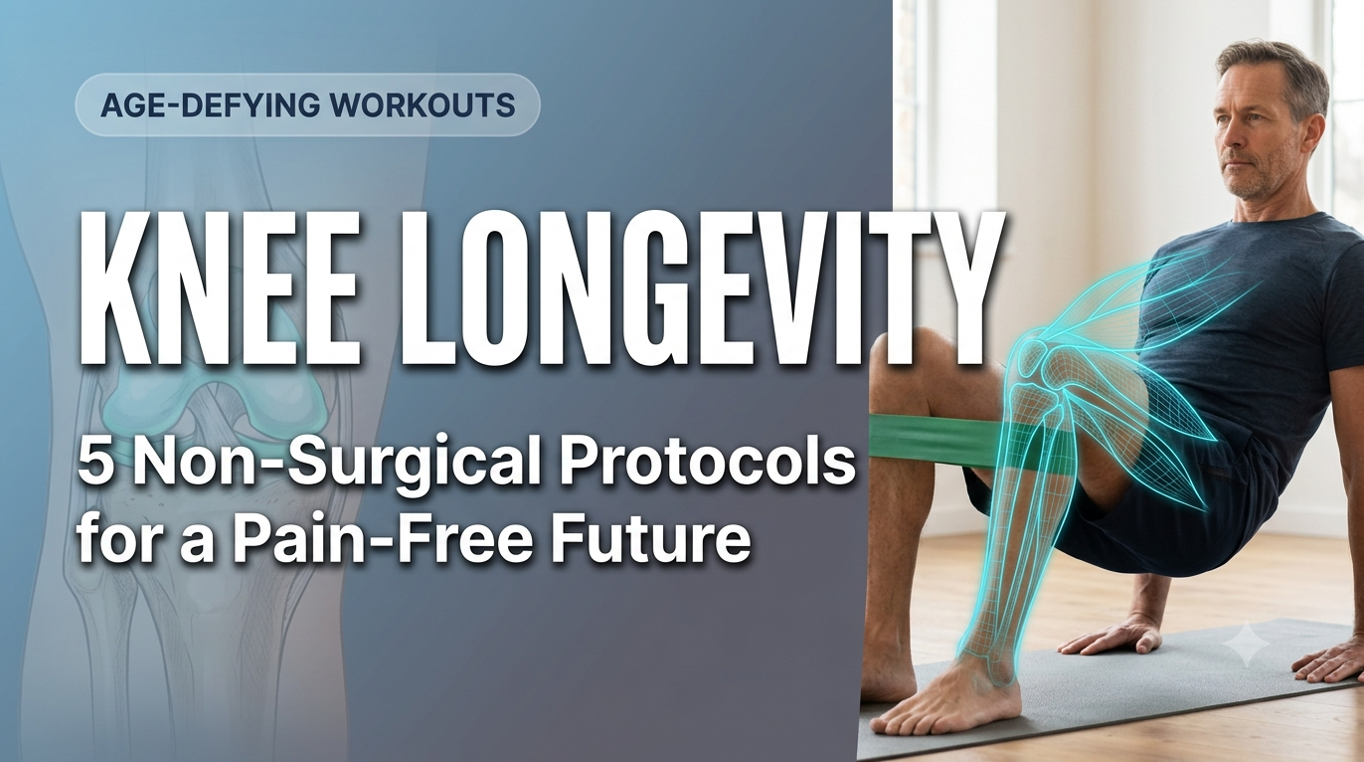
Author: Vigor Forty Editorial Team
Medically Reviewed By: Editorial Review Board
Disclaimer: This article is for informational purposes only and is not a substitute for professional medical advice. Read our full Medical Disclaimer.
📌 Key Takeaways
- VMO Activation Precision: A simple straight leg raise, done correctly, is often more crucial for knee tracking than a heavy leg press.
- The Posterior Chain Imbalance: Weak glutes and hamstrings—not bad knees—are the primary driver of chronic anterior knee pain.
- GLP-1 & Joint Load Synergy: Rapid weight loss from medication unloads the joint, but targeted strength work is non-negotiable to prevent leaving the knee fragile and unsupported.
- Micro-Dosing Movement: Daily, low-dose exercises rebuild cartilage tolerance and synovial fluid viscosity far better than weekly, high-impact punishment.
Read Related Articles
- The Non-Negotiable Blueprint: How to Build an Age-Defying Body After 4
- Knee Longevity: 5 Non-Surgical Strengthening Protocols Your Orthopedic Surgeon Agrees With
- The Deep Core Canister: Building a Natural Back Brace from the Inside Out
- Hip Integrity: Unlocking Mobility to Extend Your Movement Age
- Fast-Twitch After 50: Why Power (Not Just Strength) Prevents Falls
- The Essential Recovery Toolkit: Anti-Inflammatory Nutrition for Joint Preservation
Introduction: Why Your “Bad Knee” Might Be an Innocent Victim
If you’re over 40 and feel a persistent, dull ache behind your kneecap when climbing stairs or a sharp pinch when squatting down to pick up a grandchild, you’ve likely been told your knee is simply “wearing out.” The common narrative is that the cartilage is gone, and a creaky joint is an inevitable symptom of chronological age.
This is a dangerously passive myth.
In the vast majority of non-traumatic cases, chronic knee pain is not a structural inevitability; it’s a mechanical control error. The knee is a relatively simple hinge joint caught in the middle of a complex system. It rarely initiates its own problems. Instead, it’s the victim of a mutiny happening in the joints above and below it—specifically, a lazy hip and a stiff ankle.
Modern functional fitness shifts the therapeutic focus away from isolated knee flexion and toward integrated stability. This is especially urgent for the millions of Americans currently using GLP-1 weight-loss medications. While slimming down is the single most effective way to reduce absolute mechanical load on the knee joint, rapid weight loss without targeted strength work can lead to a phenomenon known as sarcopenic fragility—a weaker leg holding up a lighter body, leaving you prone to instability and falls.
To protect your knees for a 50-year healthspan, you must transform them from passive hinges into shock-absorbing springs.
Section 1: The Diagnostic Check — Ankle Mobility and the “Knee-Over-Toe” Debate
Before you load a muscle, you must unlock the joint. The modern sedentary lifestyle has created an epidemic of dorsiflexion stiffness. When your ankle cannot bend adequately to allow your shin to move forward, your knee cannot track properly over your toe. The body compensates by collapsing the arch of the foot and rotating the knee internally—grinding precious cartilage against the thigh bone with every single step.
Old-school fitness dogma often warned, “Never let your knees go past your toes!” We now know this advice inadvertently creates weak, pain-sensitive joints. The knee is designed to travel past the toes to act as a spring. Avoiding this position is like never bending your elbow; the joint stiffens and becomes fragile.
Protocol 1: The Full Range Tibialis Raise & Wall Mobilization
Before strengthening, you need to check if your joint has the physical room to move.
- The Wall Test: Stand barefoot facing a wall, with your big toe 4 inches from the baseboard. Try to touch your knee to the wall without letting your heel lift off the ground. If you feel a deep block in the back of your calf or your heel pops up, your ankle is stealing your knee’s range of motion.
- The Fix: Perform slow, controlled tibialis raises (leaning against the wall and pulling your toes toward your shins) to strengthen the muscle that decelerates the foot. Spend 2 minutes daily driving your knee over your toe against the wall, gently freeing the joint capsule. This sets a safe foundation for all squatting patterns.
Section 2: The Quadriceps Contradiction — Why Internal Pressure Matters More than External Weight
When a physical therapist evaluates an aging knee, they often see severe atrophy of the vastus medialis oblique (VMO), the teardrop-shaped muscle on the inside of the knee cap. This muscle is the patella’s steering wheel. When it’s weak, the kneecap drifts laterally and grinds against the outer groove of the femur, creating inflammation and pain.
Rehabilitating the VMO requires patience, not ego. Heavy leg extensions on a machine place high torque on the joint line and can actually aggravate this condition. The gold standard for isolated VMO activation is a mechanically perfect Straight Leg Raise (SLR).
Protocol 2: The Corrective Straight Leg Raise (The “Terminal Lock”)
This is not a generic leg lift. It’s a surgical strike on motor control.
- Set-Up: Lie on your back, one leg bent, the straight leg flat on the floor.
- The Firing Sequence: This is the critical step. Squeeze a rolled-up towel under your straight knee by pushing the back of the knee downward. You must see the kneecap slide toward your hip and the quadriceps fully flatten out. Hold this 10% max contraction for 5 seconds. This is your internal brace.
- The Lift: Maintaining that quadriceps lock, lift the heel just 6 inches off the ground. Do not lift higher; doing so shifts the workload to the hip flexors. Lower it slowly, maintaining the contraction.
- Target: Perform 3 sets of 15 slow repetitions daily. This reinforces the neural path to the VMO without a single pound of external load. You aren’t building muscle here; you’re turning on a switch that your nervous system has forgotten exists.
Section 3: The Posterior Chain Solution — Protecting the Cushion from Behind
Orthopedic surgeons emphasize that the meniscus—the knee’s natural shock-absorbing cushion—is most vulnerable to shear force. Shear occurs when the thigh bone slides forward over the shin bone, a movement often caused by a gluteal amnesia epidemic. When the large muscles of your backside refuse to fire, your hamstrings and quadriceps must fight a civil war for pelvic stability, and the anterior cruciate ligament pays the tax.
To save the knee, you must give it a powerful back wall.
Protocol 3: The Rigid Hip Bridge with Posterior Pelvic Tilt
- Set-Up: Lying on your back, heels close to your glutes.
- The Anti-Shear Lock: Before lifting your hips, flatten your lower back into the floor by tucking your tailbone. You will feel your deep core engage. Hold this posterior tilt for the entire set. If your lower back arches, your hamstrings are cheating and your hip flexors are pulling your knee joint into a vulnerable position.
- The Extension: Drive through the heels to lift the hips. At the top, your body should form a straight, rigid line from your shoulders to your knees. Clench your glutes intensely, as if holding a coin between them. The motion should be powered by the squeeze, not the height.
- Target: 3 sets of 15 reps, pausing at the top for a 3-second maximal glute contraction. This strengthens the hip extension mechanism that spares the knee during walking and stair climbing.
Protocol 4: The Bodyweight Sliding Hamstring Curl (Nordic Regression)
- Set-Up: Kneel on a soft mat with a partner holding your ankles, or secure your heels under a heavy couch.
- The Lifeline: This is an eccentric (lengthening) exercise. Keep a straight, rigid line from your knees to your head. Lower your body toward the ground as slowly as possible, fighting gravity every inch of the way. The moment you can no longer control the descent, place your hands on the ground and push yourself back to the starting position.
- Target: 3 sets of 5 ultra-slow negatives. The hamstrings act as the ACL’s critical dynamic stabilizer. Lengthening them under load teaches your brain to fire this muscle to decelerate the shin bone, protecting the joint capsule.
Section 4: The Medical Necessity — Muscle as a Metabolic Shield
The connection between functional leg strength and systemic health cannot be overstated, specifically regarding the GLP-1 weight-loss therapy context.
Clinical literature highlights a concerning trend: rapid, non-selective weight loss can result in a 30-40% reduction in lower limb skeletal muscle mass if strength training is ignored. The quadriceps and hamstrings are massive metabolic organs. Maintaining or growing this tissue during a caloric deficit—whether through diet or medication—keeps your resting metabolic rate from crashing.
When you combine a high-protein diet (as outlined in our previous guide) with the low-impact protocols above, you create a biological partition. Your body, demanding energy due to the deficit, is forced to look at fat stores for fuel because the structural tension of the eccentric curls and glute bridges signals, “This muscle is critical for survival; do not catabolize it.”
This is how you ensure that the knee that was once burdened by 30 extra pounds of body weight is actually strong enough to carry the new, healthier you without buckling.
Section 5: The 5-Minute Daily “Knee Fluid” Flow
Finally, cartilage is avascular; it has no blood supply. It relies on the ebb and flow of synovial fluid to receive nutrients and remove metabolic waste, acting like a sponge. You don’t need a brutal workout to achieve this; you need high-frequency, pain-free motion.
Protocol 5: The Passive Unloaded Pendulum
- Sit on a high counter or table so your legs dangle freely.
- Gently swing the lower leg back and forth, like a pendulum, for 60 seconds. Let the motion come from the shin, not the hip.
- Follow this with 10 slow, passive circles in each direction.
- Perform this routine first thing in the morning to lubricate the joint, and again after long periods of sitting. This bathes the cartilage in fluid, reducing the “start-up pain” common with morning stiffness.
Conclusion: Longevity is in the Little Things
Preserving your knees past 40, 60, and 80 isn’t about finding the perfect heavy lift. It’s about restoring the intention behind the movement. It requires shifting your mindset from “working out hard” to “sending a biological signal.” A perfectly executed, 6-inch straight leg raise sends a stronger signal to your knee’s longevity pathways than a sloppy, heavy barbell squat that grinds your meniscus. Integrate these five non-negotiable protocols, and you rebuild your structural foundation from the inside out, one pain-free step at a time.