Author: Vigor Forty Editorial Team
Medically Reviewed By: Editorial Review Board
Disclaimer: This article is for informational purposes only and is not a substitute for professional medical advice. Read our full Medical Disclaimer.
📌 Key Takeaways
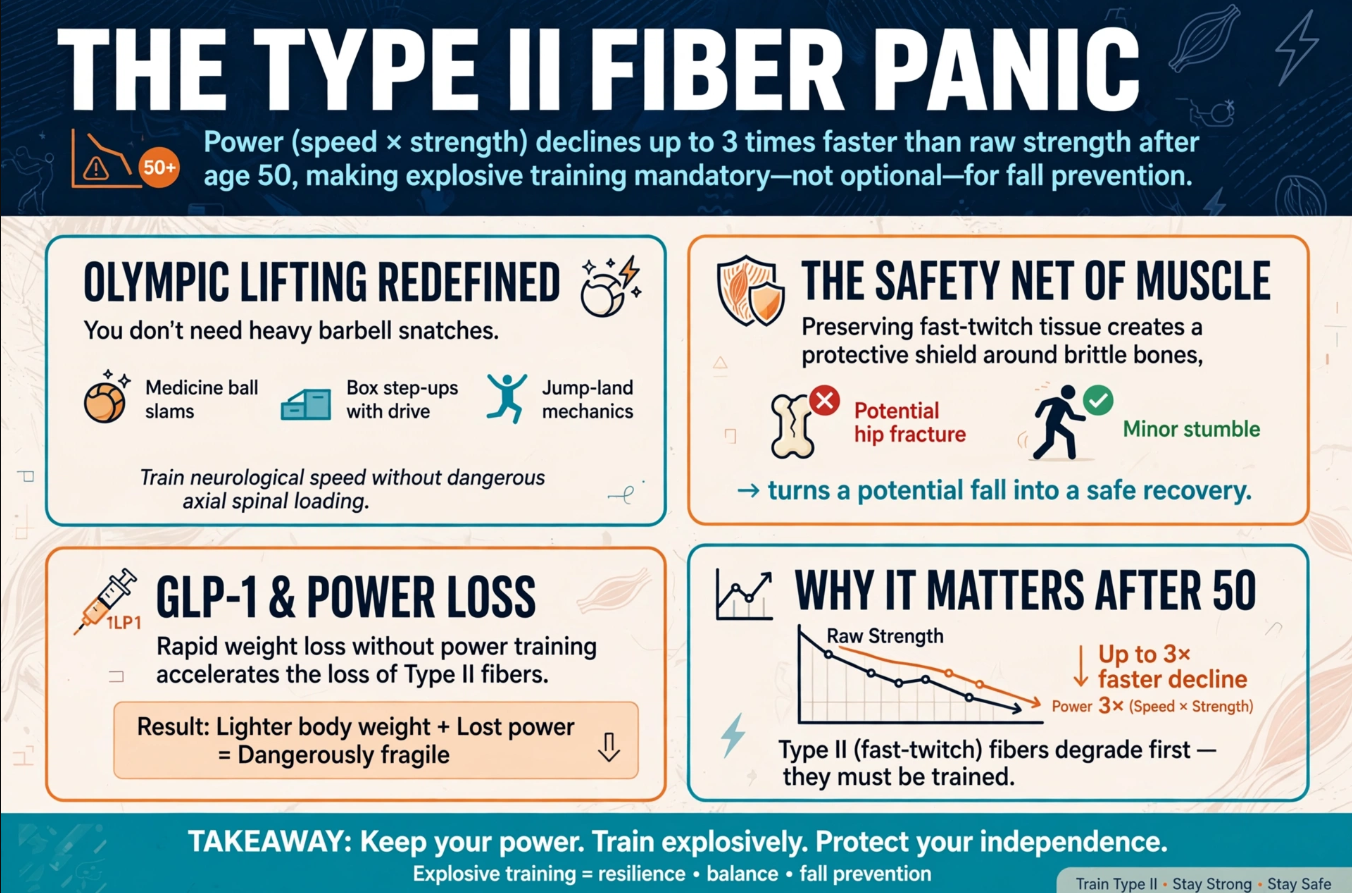
- The Type II Fiber Panic: Power (speed × strength) declines up to 3 times faster than raw strength after age 50, making explosive training mandatory—not optional—for fall prevention.
- Olympic Lifting Redefined: You don’t need heavy barbell snatches. Medicine ball slams, box step-ups with drive, and jump-land mechanics train neurological speed without dangerous axial spinal loading.
- The Safety Net of Muscle: Preserving fast-twitch tissue creates a protective shield around brittle bones, turning a potential hip fracture into a minor stumble.
- GLP-1 & Power Loss: Rapid weight loss without power training accelerates the loss of Type II fibers, leaving individuals lighter but dangerously fragile.
Read Related Articles
- The Non-Negotiable Blueprint: How to Build an Age-Defying Body After 4
- Knee Longevity: 5 Non-Surgical Strengthening Protocols Your Orthopedic Surgeon Agrees With
- The Deep Core Canister: Building a Natural Back Brace from the Inside Out
- Hip Integrity: Unlocking Mobility to Extend Your Movement Age
- Fast-Twitch After 50: Why Power (Not Just Strength) Prevents Falls
- The Essential Recovery Toolkit: Anti-Inflammatory Nutrition for Joint Preservation
Introduction: The Silent Thief of Independence
Imagine this scenario: You are walking on an uneven sidewalk and your toe catches a lifted edge of concrete. In the fraction of a second before your brain consciously registers the trip, your body must execute a lightning-fast sequence—detect the perturbation, fire the hip flexors and quadriceps to rapidly lift the foot, extend the opposite ankle to push off, and stiffen the core to maintain an upright posture. This is not a feat of raw strength; it is a feat of power.
Power is defined as the ability to produce force quickly. It is the difference between a slow, grinding squat and the explosive motion that catches you mid-stumble. Here is the alarming reality that few men over 50 understand: your ability to produce power declines significantly faster than your ability to produce raw strength as you age. Research on aging muscle fibers shows that Type II (fast-twitch) muscle fibers atrophy at a rate nearly three times that of Type I (slow-twitch) endurance fibers after the fifth decade of life.
This condition, known as dynapenia, is the specific loss of muscle power that exists independently from sarcopenia (the loss of muscle mass). You can maintain a respectable amount of muscle size and still be dangerously power-deficient. This explains why a seemingly fit older adult can still suffer a devastating fall. Their muscles are present, but the neurological wiring to call them into action instantaneously has rusted away from disuse.
The good news is that fast-twitch fibers retain their trainability deep into aging. A 90-year-old can still recruit and strengthen these explosive motor units with appropriate stimulation. The key is understanding that the stimulation must be fast, safe, and neurologically demanding—not just heavy.
Section 1: The Physiology of Power Loss — Why Slow Lifting Isn’t Enough
When you perform a traditional, slow-tempo bodybuilding set—say, a 3-second lowering and 2-second lifting pace on a leg press—you are selectively recruiting Type I endurance fibers. These fibers are efficient, oxygen-dependent, and built for marathon efforts, not emergency responses. Type II fibers, by contrast, are anaerobic, glycogen-fueled, and designed for maximal contraction velocity. They only come online when the demand for force production is both high and rapid.
The nervous system’s ability to rapidly recruit these motor units is termed “rate coding.” With age and sedentary living, the myelin sheath surrounding the nerves that communicate with Type II fibers degrades. The signal weakens and slows, much like an old internet cable with corroded wiring. The muscle fiber itself remains viable, but the command center has lost the high-speed connection.
Rebuilding this connection requires ballistic intent. Every repetition in power training, even if the external load is light or zero, must be performed with the conscious intention to move as fast and explosively as humanly possible. The external speed may appear modest due to the load or the movement pattern, but the internal neural command must be at full voltage. This is what re-myelinates the pathway and awakens the dormant fast-twitch reserves.
Section 2: The “Olympic Lifting” Bait and Switch — Explosive Training Without the Risk
When you hear “explosive training,” images of elite athletes performing heavy barbell snatches and clean-and-jerks might come to mind. These are beautiful, effective movements for young, highly-trained competitors with years of technical practice. For the over-50 functional fitness seeker, however, heavy Olympic lifts present an unfavorable risk-to-reward ratio. The high-velocity spinal loading under a heavy barbell can exceed the safe capacity of aging intervertebral discs.
The intelligent alternative is to borrow the velocity demands of Olympic lifting while removing the compressive spinal component. This is achieved through movements where the force is projected away from the body (medicine ball throws) or where bodyweight is accelerated vertically with a controlled landing (box step-up jumps). The legs generate the triple extension of ankles, knees, and hips—the exact same athletic movement pattern as a snatch—but the spine is either unloaded or protected.
Protocol 1: The Medicine Ball Slam (Overhead to Ground)
This is the king of safe, high-velocity power expression. It channels aggression and speed through the entire kinetic chain while gravity and the floor absorb the impact.
- Set-Up: Stand with feet shoulder-width apart, holding a soft, non-bouncing medicine ball (8-12 lbs) overhead with straight arms.
- The Execution: Throw the ball directly down into the ground about 12 inches in front of your feet with maximum violence. Flex your trunk, hinge at the hips, and drive the ball through the earth. Imagine you are trying to crack the concrete slab. Catch the ball on the bounce (or pick it up and reset). The movement must be a full-body whip, not just an arm swing.
- Target: 4 sets of 6 reps, with full rest (60-90 seconds) between sets. Power training requires full neurological recovery. You are not training for metabolic burn; you are training for signal clarity.
Protocol 2: The Low Box Step-Up with High-Velocity Drive
This exercise eliminates the eccentric landing stress of a traditional box jump while preserving the concentric explosion.
- Set-Up: Stand facing a low, sturdy box or the first step of a staircase (6-8 inches high).
- The Execution: Place one foot entirely on the box. Shift your weight onto that foot and, in one violent motion, drive through that leg to propel yourself vertically. The objective is not just to stand up on the box; it is to generate enough upward momentum that the grounded foot leaves the floor entirely and lands softly on the box beside the lead foot, or you catch a brief moment of airtime. Land quietly. A quiet landing is a controlled landing.
- Target: 3 sets of 5 explosive reps per leg. Focus on the speed of the drive, not the height of the box.
Section 3: The Eccentric Anchor — Building Tendon Stiffness to Catch Yourself
Power is not only about generating force; it is also about absorbing it. When you stumble, your quadriceps must eccentrically contract—lengthening under tension—to decelerate your body mass as your knee bends rapidly. An Achilles tendon and patellar tendon that are stiff and springy can store and release elastic energy efficiently, acting like a biological bungee cord. Tendons that are weak and compliant absorb force poorly and transfer it to the bones and joints.
This is where controlled, submaximal plyometrics become essential. The goal is not to exhaust yourself but to condition the springs.
Protocol 3: The Altitude Drop to Stable Landing
- Set-Up: Stand on a low box or the bottom step of a staircase (4-6 inches high).
- The Execution: Step off the box—do not jump off. You are a dead weight dropping. Land on both feet, and the moment your toes touch the ground, sink into a quiet squat position and freeze. Hold the landing for 3 seconds. Your body must absorb the kinetic energy silently. If there is a loud thud, your heels bang together, or your torso collapses forward, your eccentric brakes are not engaging properly.
- Progression: Once you can perform 5 perfect, silent landings in a row, gradually increase the height. Never exceed a height where you lose the ability to land silently and freeze without wobbling.
- Target: 2 sessions per week, 5 drops per session. This trains the rapid neuromuscular response required to catch yourself mid-fall and the tendon stiffness to transmit that force without tearing.
Section 4: Rotation and Reaction — The 3D Power Neglected by Traditional Gyms
Most catastrophic falls in older adults occur not during forward walking, but during transitional movements—turning, pivoting, reaching sideways, or stepping backward. Traditional gym exercises are overwhelmingly performed in the sagittal plane (forward and backward). The transverse plane (rotation) and frontal plane (side-to-side) are severely neglected. Fast-twitch fibers in the obliques, glute medius, and hip rotators are left completely untrained, creating a three-dimensional vulnerability.
Protocol 4: The Lateral Bound and Stick
- Set-Up: Stand on your right leg, left foot off the ground.
- The Execution: Leap laterally to your left as far as you can, landing on your left leg. Absorb the landing by sinking deep into the hip and knee, and freeze. Your torso must remain upright; do not let the opposite hip drop. Hold the single-leg landing for 3 full seconds before resetting.
- Target: 3 sets of 4 bounds per direction. This trains frontal plane power and single-leg stability simultaneously—directly mimicking the motion required to step sideways off a curb to avoid an obstacle or to catch yourself when you lose balance reaching for a high shelf.
Section 5: The GLP-1 and Sarcopenic Power Crash
The clinical discussion around GLP-1 weight-loss medications has largely centered on muscle mass loss. However, the quality of the remaining muscle matters as much as the quantity. Early data and clinical observations suggest that Type II fibers, being the body’s “emergency use only” muscle tissue, may be particularly vulnerable to catabolism during rapid, pharmaceutically-driven caloric deficits. When the body is in a steep negative energy balance and needs amino acids for vital organ function, it will prioritize breaking down the energetically expensive, glycogen-hungry fast-twitch fibers and spare the metabolically thrifty slow-twitch fibers.
The result is an individual who steps on the scale and celebrates a lower number, but whose neuromuscular system has been silently hollowed out. They are lighter, but their ability to react to a slip on a wet floor has been severely diminished. The combination of GLP-1 therapy with deliberate power training, as detailed in the protocols above, is not merely a nice addition to a weight loss plan—it is a critical countermeasure against an invisible, dangerous deficit.
Section 6: The 7-Minute Power Prescription (Twice Weekly)
You do not need a dedicated hour-long plyometrics class. Two brief, intense sessions per week are sufficient to maintain and restore fast-twitch function. Here is a time-efficient blueprint.
Day 1 (Focus: Vertical & Linear Power):
- Medicine Ball Slam: 4 sets x 6 reps (90 seconds rest between sets).
- Low Box Step-Up Drive: 3 sets x 5 reps per leg (60 seconds rest between sides).
- Altitude Drop Landing: 5 perfect, silent reps.
Day 2 (Focus: Rotational & Lateral Power):
- Rotational Medicine Ball Throw (side-on to a sturdy wall): 3 sets x 6 reps per side.
- Lateral Bound and Stick: 3 sets x 4 reps per direction (90 seconds rest between sets).
- Single-Leg Quick Hop in Place (rapid ankle rebounds): 3 sets x 10 seconds per leg. Focus on minimal ground contact time and a stiff ankle.
Conclusion: Don’t Just Be Strong, Be Quick
Strength allows you to lift a heavy box. Power allows you to catch yourself when you trip over the doorstep carrying it. As you journey past 50 and beyond, your training must evolve from a singular focus on muscle mass and heavy resistance to an integrated approach that includes velocity, reaction, and stiffness. The protocols in this article are your insurance policy against the silent thief of independence. Train your fast-twitch fibers, and they will be there in your moment of need, firing before you even know you are falling.