
Author: Vigor Forty Editorial Team
Medically Reviewed By: Editorial Review Board
Disclaimer: This article is for informational purposes only and is not a substitute for professional medical advice. Read our full Medical Disclaimer.
📌 Key Takeaways
- The Anti-Rotation Revolution: Why resisting movement (Pallof presses and woodchops) preserves spinal health far better than thousands of traditional crunches or sit-ups.
- Breath as a Strength Tool: 360-degree diaphragmatic breathing isn’t meditation fluff—it’s the hydraulic stabilizer that locks your lumbar spine before any limb moves.
- The “Loaded Carry” Biomarker: Your ability to carry a heavy suitcase, a bag of potting soil, or a toddler for distance without leaning sideways is the single best predictor of functional core age.
- GLP-1 Protection: During rapid weight loss, a strong internal canister protects the newly exposed spine from instability injuries as the external body mass cushion disappears.
Read Related Articles
- The Non-Negotiable Blueprint: How to Build an Age-Defying Body After 4
- Knee Longevity: 5 Non-Surgical Strengthening Protocols Your Orthopedic Surgeon Agrees With
- The Deep Core Canister: Building a Natural Back Brace from the Inside Out
- Hip Integrity: Unlocking Mobility to Extend Your Movement Age
- Fast-Twitch After 50: Why Power (Not Just Strength) Prevents Falls
- The Essential Recovery Toolkit: Anti-Inflammatory Nutrition for Joint Preservation
Introduction: The Six-Pack Illusion vs. The Hidden Canister
Walk through any commercial gym and you will witness an endless parade of crunches, sit-ups, and twisting Russian leans. The cultural obsession with the rectus abdominis—the “six-pack muscle”—has convinced generations of men that a strong core is defined by what you see in the mirror.
This is not just incorrect; it is biomechanically dangerous, especially after 40.
The superficial six-pack is a vanity muscle with very limited functional responsibility. Its primary job is to flex the spine forward, a motion we perform thousands of times daily already by sitting at desks, driving cars, and scrolling phones. Loading this chronically shortened muscle with more flexion creates compressive shear on the lumbar discs, potentially accelerating degenerative disc disease and nerve impingement.
The true functional core is not a washboard. It is a pressurized canister.
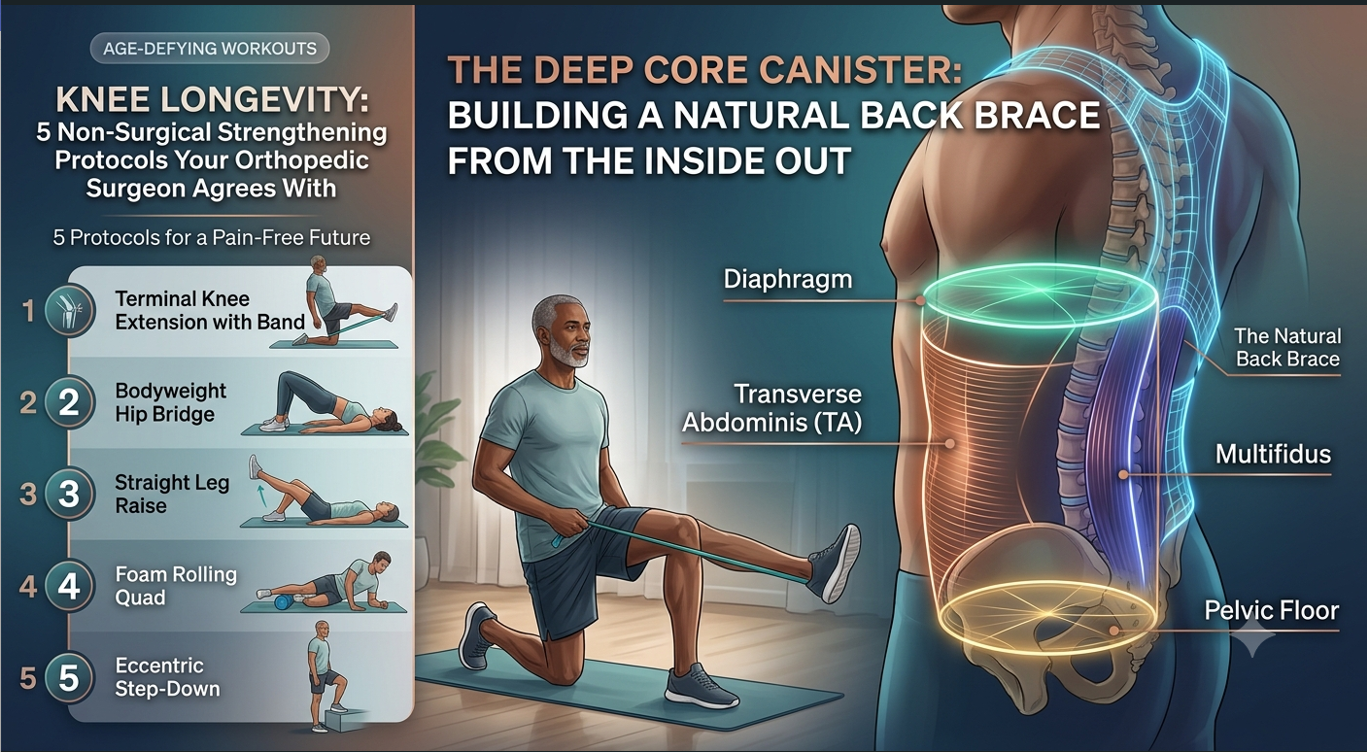
Imagine a sealed cylinder surrounding your midsection. The diaphragm is the roof, the pelvic floor is the base, the deep transverse abdominis wraps around the front and sides like a corset, and the multifidus muscles lock the individual vertebrae together in the back. When these four components co-contract in perfect sequence, they create intra-abdominal pressure—a rigid, protective cylinder that stabilizes the spine from the inside out, allowing your arms and legs to generate force without shearing your delicate lumbar discs.
This is how a 90-year-old farmer can still lift a hay bale without injury while a 40-year-old desk worker throws out his back picking up a dropped pen. One operates from a pressurized canister; the other operates from a deflated balloon.
Section 1: The Neurological Sequence — Why Breathing is Your First “Ab Exercise”
Modern stress, poor posture, and sedentary living have created an epidemic of “chest breathing.” When you breathe shallowly into your upper ribs and neck, your diaphragm remains dormant, your sympathetic nervous system stays locked in fight-or-flight mode, and your deep core never receives the signal to fire.
Clinical rehabilitation research emphasizes that the transverse abdominis (TVA)—your internal weight belt—activates milliseconds before any limb movement. In a healthy, pain-free individual, the brain fires the TVA to stiffen the spine in anticipation of the load, then the arm or leg moves. In individuals with chronic low back pain, this sequence is reversed. The limb moves first, the spine is left unprotected, and micro-damage accumulates.
Retraining this sequence begins not on a machine, but on your back, breathing.
Protocol 1: 360-Degree Diaphragmatic Breathing with Dead Bug Regression
This is a motor control reset, not a strength exercise. Do not progress until this is perfect.
- Set-Up: Lie on your back, knees bent at 90 degrees directly over hips, arms extended straight toward the ceiling. Place one hand on your lower ribs, the other on your belly button.
- The Breath: Inhale deeply and slowly through your nose for 4 seconds. You must feel your lower ribs expand laterally into your hand and your belly rise, while your upper chest and neck remain completely soft and still. This is a 360-degree expansion of the abdominal wall.
- The Exhale Brace: Exhale forcefully through pursed lips for 6 seconds, as if blowing through a coffee straw. As you exhale, feel your ribcage drop down and knit together. The hand on your belly should feel the deep wall tighten, not hollow inward. This is the sensation of intra-abdominal pressure.
- The Limb Challenge: Maintaining this pressure, lower your right arm overhead and your left leg to the floor simultaneously. Only go as far as you can without your lower back arching off the ground or your ribcage flaring open. Return to center on an inhale. Repeat alternating sides.
- Target: 3 sets of 8 slow, perfect repetitions per side. If your back arches, you have exceeded your core’s capacity to stabilize. Reduce the range of motion. Mastery of this drill re-codes the brain-to-muscle connection that protects the spine.
Section 2: The Anti-Rotation Revolution — Preserving the Discs Under Load
Once the canister can pressurize in a static position, it must be challenged to resist unwanted movement. The spine is designed for stability, not excessive twisting. While the thoracic spine (upper back) needs mobility and rotation, the lumbar spine (low back) is engineered for stiffness.
Traditional oblique exercises often involve loaded rotation—holding a weight and twisting side to side—which grinds the lumbar facet joints. A far safer and more functional approach is anti-rotation training, where the force tries to pull you out of alignment, and your core works to lock you in place. This trains the obliques and TVA to fire together as a unified girdle.
Protocol 2: The Standing Pallof Press — The Ultimate Anti-Shear Hold
- Set-Up: Anchor a resistance band at chest height to a pole or door hinge. Stand perpendicular to the anchor point, holding the band with both hands clasped against your sternum. Step sideways until the band is taut and wants to pull you into the anchor.
- The Brace: Squeeze your glutes, set your ribs down, and create your exhale pressure from Protocol 1. Your body must be a rigid pillar from ankles to shoulders.
- The Press: Press your hands straight out in front of your chest. The band will try to rotate your torso. Resist. Hold the extended position for 3 seconds. The core’s job is to keep your hips and shoulders perfectly square to the wall in front of you—zero rotation allowed.
- Target: 3 sets of 10 reps per side. This exercise trains the functional capacity to prevent your spine from twisting when you carry an unbalanced load, plant a shovel in the ground, or open a heavy door.
Protocol 3: The Suitcase Carry — Unilateral Loaded Stability
This is the biomarker test mentioned in the key takeaways. No gym exercise translates more directly to real life.
- Set-Up: Hold a heavy dumbbell or kettlebell in one hand, arm hanging straight down at your side. Stand tall.
- The Execution: Walk slowly in a straight line for 30 seconds. The weight wants to pull you sideways, compressing one side of your spine and stretching the other. Your deep core must fire aggressively to keep your shoulders level and your spine perfectly vertical. If your opposite hand is flailing for balance or your hip drops, the weight is too heavy.
- Target: 3 walks of 30-45 seconds per side. This builds asymmetrical resilience. Life is never perfectly balanced; your core must be prepared for the uneven load of carrying groceries, luggage, or a child on one hip.
Section 3: The Posterior Wall — Fortifying the Multifidus
The canister is only as strong as its back wall. The multifidus muscles are short, deep, segmental stabilizers that connect one vertebra to the next. Research shows that in individuals with even a single episode of low back pain, the multifidus atrophies and can lose its ability to fire independently. It’s as if the brain pulls the circuit breaker and forgets to turn the switch back on, leaving a hole in the back of the canister.
Traditional “Superman” back extensions, where you lift your chest and legs off the floor simultaneously, generate massive compressive loads on the spine (often exceeding 6,000 Newtons of force). A smarter, spine-sparing alternative is the Bird Dog, which challenges the multifidus in its true role: anti-extension stability during limb movement.
Protocol 4: The Bird Dog with Minimal Spinal Movement
- Set-Up: On all fours, hands directly under shoulders, knees under hips. Place a foam roller or a wooden dowel along the length of your spine, touching your sacrum, between your shoulder blades, and the back of your head.
- The Challenge: Extend your right arm forward and your left leg straight back. The dowel must not tilt, roll off, or lose contact with any of the three points. The movement comes from the hip and shoulder joints only; the spine remains frozen in neutral.
- The Focus: Think about reaching through the heel, not lifting the leg high. A high leg lifts the pelvis and rotates the lumbar spine. A long leg keeps the canister sealed.
- Target: 3 sets of 8 reps per side, with a 5-second hold at full extension. This re-educates the multifidus to co-contract with the opposite arm and leg, rebuilding the neurological pathways that stabilize individual spinal segments.
Section 4: The GLP-1 and Body Composition Connection
For the rapidly growing demographic of men using GLP-1 weight-loss medications, the deep core canister takes on an urgent protective role. Significant, rapid fat loss dramatically alters your body’s center of gravity and the passive stability provided by a thicker abdominal wall.
Imagine a man who has carried 40 extra pounds of visceral and subcutaneous fat around his midsection for a decade. That mass, while metabolically dangerous, provides a degree of external intra-abdominal pressure and a “cushioned” force distribution. As that mass melts away rapidly with medication-assisted weight loss, the lumbar spine is suddenly exposed. The internal musculature must rapidly adapt to provide the stability that the external mass once passively offered.
If the transverse abdominis and multifidus remain dormant during this transition, the individual becomes highly susceptible to disc bulges, facet joint irritation, and chronic lower back pain—a cruel irony for someone who just achieved a healthier weight. Integrating these deep core protocols during the weight loss phase is not optional; it is an essential structural bridge from the old body to the new one.
Section 5: Building the Daily Canister Habit
You don’t need a gym to train your deep core. You can integrate the canister brace into your existing daily life to create a 24/7 protective environment for your spine.
- The “Stoplight” Brace: Every time you stop at a red light while driving, perform one full exhale brace. Squeeze your glutes slightly into the seat, feel your ribs drop, and create that 360-degree pressure for 5 seconds. This breaks the pattern of passive, slumped sitting.
- The Standing Brace: While waiting for your morning coffee to brew, stand on one leg and maintain a perfectly level pelvis for 30 seconds. This fires the deep hip stabilizers that feed into the pelvic floor base of the canister.
- The Lift Sequence: Before you lift anything—a laundry basket, a dumbbell, a bag of mulch—audibly exhale and set your brace. Make it a physical habit. Brace, then move. Brace, then lift. This one ritual can spare your discs a lifetime of cumulative micro-trauma.
Conclusion: A Silent, Stable Spine
A strong core doesn’t announce itself with a rippling six-pack. It announces itself with silence—the absence of chronic ache, the ability to wake up without stiffness, and the confidence to lift a heavy object without a flash of anticipatory fear. The deep core canister is a natural, biological back brace that you build from the inside out. By prioritizing diaphragmatic breath, anti-rotation stiffness, and segmental spinal stability, you give your lumbar spine the armor it needs to carry you through decades of vigorous, pain-free living.